
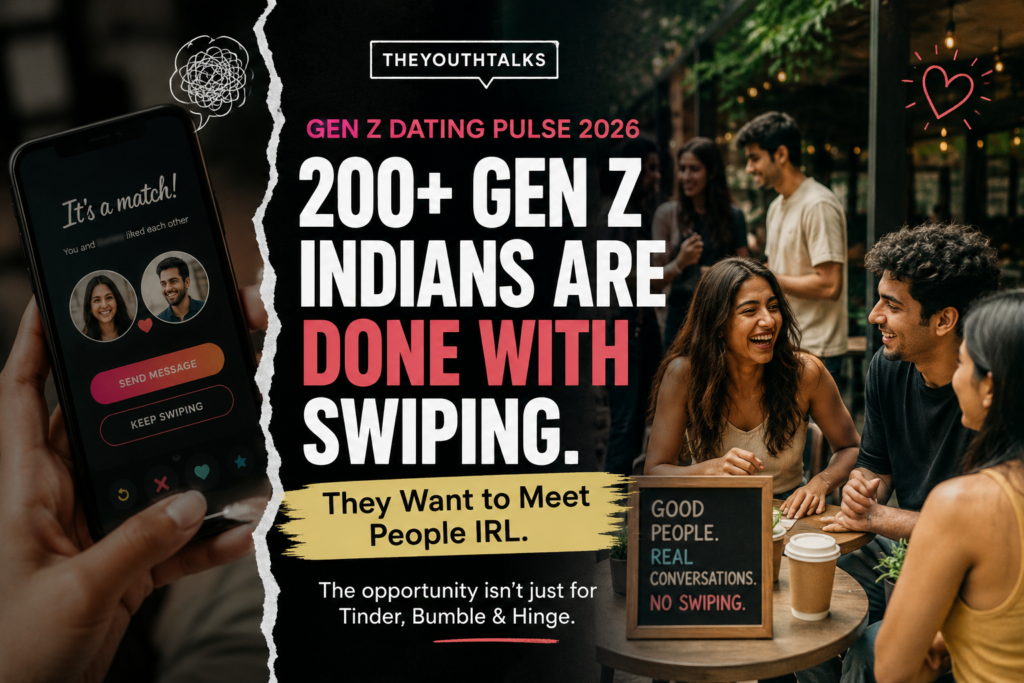
TheYouthTalks Gen Z Dating Pulse 2026 suggests that India’s young daters may be ready to trade endless scrolling for something much more human: meeting people in real life.
For years, dating apps promised to solve one of the oldest problems in human relationships: how do you meet someone new?
The answer was increasingly digital.
Create a profile. Upload a photograph. Write a clever bio. Swipe right. Swipe left. Match. Chat. Repeat.
For an entire generation of young Indians, this became the new architecture of dating.
It was convenient. It was fast. It expanded the pool of people you could potentially meet far beyond your college, workplace, neighbourhood or existing social circle.
But convenience has a strange habit of becoming routine.
And in 2026, something appears to be shifting.
Our TheYouthTalks Gen Z Dating Pulse 2026, based on conversations with 200+ Gen Z Indians, points to an emerging sentiment: young people aren’t necessarily rejecting dating apps, but they are increasingly questioning whether dating should begin and end with an algorithm.
They want something more spontaneous.
More authentic.
More human.
They want to meet people in real places, in real situations, with real conversations happening around them.
And that could have significant implications for the future of dating in India.
Because the next disruption in dating may not be another swipe feature.
It may be the return of IRL connection.
The Swipe Was Supposed to Make Dating Easier
There is no denying that dating apps changed the game.
Before them, meeting someone new often depended on circumstance. You met people at university, at work, through friends, at parties, through family networks or simply by chance.
Dating apps dismantled many of those limitations.
Suddenly, a person sitting alone in a café could potentially discover hundreds of other people looking for connection.
That was revolutionary.
It gave people choice.
It gave people access.
And for many, it made dating less intimidating.
But the same abundance that made dating apps attractive may also be contributing to their biggest challenge.
When there are seemingly endless profiles to browse, dating can begin to feel less like meeting people and more like shopping.
Photo.
Bio.
Swipe.
Next.
Another photograph.
Another profile.
Another decision.
The process becomes familiar very quickly.
And familiarity can turn into fatigue.
The issue isn’t necessarily that Gen Z has run out of people to meet. It is that the process of meeting them can feel repetitive.
A carefully selected photograph cannot tell you how someone laughs.
A dating prompt cannot show you how someone behaves when a waiter gets their order wrong.
A witty bio cannot recreate the feeling of sitting across from someone and discovering that you have unexpectedly spent two hours talking.
Those details matter.
Sometimes, chemistry is not something you can predict.
You have to experience it.
Gen Z Is Asking a Different Question
Perhaps the most revealing change isn’t what young Indians are saying about dating apps.
It is the question they are beginning to ask instead.
For years, the question was:
“Which app should I use?”
Now, the more interesting question may be:
“Where can I actually meet interesting people?”
That is a subtle change, but it opens up an entirely different ecosystem.
Cafés.
Concerts.
Book clubs.
Fitness communities.
Comedy shows.
Music gigs.
Workshops.
Travel groups.
Sports communities.
College events.
Networking gatherings.
House parties.
Friend-of-friend circles.
The common factor isn’t dating.
It is context.
There is something else happening besides the possibility of romance.
And that may be precisely what makes these environments attractive.
Imagine walking into a photography workshop on a Saturday afternoon.
You haven’t arrived with the pressure of finding a partner. You are there because you enjoy photography.
You start talking to someone about the camera they’re carrying.
The conversation moves to travel.
Then food.
Then music.
Maybe you discover you have nothing in common.
Maybe you discover you have a lot.
Either way, the interaction begins naturally.
The activity creates the context.
The conversation creates the chemistry.
The relationship, if there is one, comes later.
That is very different from opening a dating app with the explicit objective of finding a romantic connection.
Gen Z May Want Better Connections, Not More Matches
This could be the most important insight for the dating industry.
For much of its evolution, the dating-app proposition has revolved around discovery.
More people.
More profiles.
More matches.
More conversations.
More possibilities.
But more isn’t necessarily better.
A person with 100 matches may still feel lonely.
Someone with dozens of conversations may still struggle to find one genuinely meaningful connection.
The problem is not mathematical.
It is emotional.
Dating is ultimately about connection, and connection is difficult to quantify.
One interesting conversation can be more memorable than a month of swiping.
One unexpected encounter can stay with you longer than dozens of online exchanges.
This suggests a potential movement from quantity to quality.
The question for dating companies may therefore become less about how many people they can put in front of users and more about how effectively they can help users create meaningful experiences with them.
The app becomes the starting point.
The real-world experience becomes the destination.
What If the Dating App Became a Ticket to Real Life?
This is where the opportunity becomes particularly intriguing.
Imagine opening a dating platform in 2026 and seeing something different from a stack of profiles.
Instead, you see:
Friday: Live Music & New People
Saturday: Morning Run Club
Sunday: Coffee & Conversations
Wednesday: Board Games
Thursday: Comedy Night
The platform isn’t necessarily telling you who your perfect match is.
It is telling you where people with similar interests are going to be.
That changes the proposition entirely.
Instead of:
“Here is someone you might like.”
the platform could say:
“Here is something you might enjoy. There will be other people there who enjoy it too.”
That is less transactional.
It is also potentially more human.
The dating experience becomes connected to social discovery.
And that could be a much larger market.
The Rise of Interest-First Dating
There is another important cultural shift underneath this.
Young people don’t necessarily want to define every social experience around romance.
In fact, a “Singles Night” may sound more intimidating than exciting.
But change the label.
Indie Music Night.
Photography Walk.
Weekend Trek.
Gaming Night.
Book Club.
Stand-Up Open Mic.
Startup Founders Social.
Suddenly, the event has a purpose beyond dating.
People can arrive because they are curious.
Because they want to meet people.
Because they have an interest.
Because they are bored on a Saturday evening.
Or simply because they want to get out of the house.
The romantic possibility remains.
But it doesn’t dominate the experience.
And that could be the secret.
When people aren’t under pressure to find “the one”, they may be more open to simply having a good conversation.
Dating becomes a by-product of social connection, rather than the only reason to show up.
That distinction could become increasingly important for Gen Z.
The Opportunity Isn’t Just for Tinder, Bumble and Hinge
The implications extend far beyond dating platforms.
If young Indians are looking for more opportunities to connect offline, a whole ecosystem of businesses could participate.
Cafés can become social hubs.
Fitness studios can organise community runs.
Bookstores can host discussion nights.
Comedy clubs can create themed gatherings.
Music venues can build communities around particular genres.
Travel companies can create group experiences for young professionals.
Universities can facilitate interest-based events.
Even consumer brands can become part of this ecosystem.
For years, marketers have asked:
“How do we advertise to Gen Z?”
The more interesting question in 2026 might be:
“What can we create that gives Gen Z a reason to show up?”
That is a fundamentally different approach to engagement.
Instead of interrupting someone’s digital experience with an advertisement, a brand can become part of a memorable physical experience.
Instead of buying attention, it can create belonging.
And for a generation that spends enormous amounts of time online, that distinction could matter.
Are Dating Apps Actually Going Away?
Probably not.
And it would be a mistake to interpret the shift toward IRL experiences as the death of dating apps.
Dating platforms still offer enormous value.
They provide convenience, accessibility and choice. They can also help people meet others they might never encounter through their everyday social circles.
The issue is not necessarily online versus offline.
It may be about what each does best.
Technology is excellent at discovery.
Communities are excellent at creating context.
Physical experiences are excellent at creating human connection.
Put those three together, and the future of dating begins to look less like a choice between an app and real life.
It looks like a funnel.
Digital discovery.
Shared interests.
Community.
Real-world interaction.
Offline chemistry.
The dating platform doesn’t disappear.
Its role evolves.
The Question Tinder, Bumble and Hinge Should Be Asking
For Tinder, Bumble and Hinge, the biggest question may not be whether young people are becoming bored with swiping.
There is a much more important question:
What happens after the swipe?
Because a match is not a relationship.
A conversation is not a relationship.
Even a great profile is not a relationship.
At some point, two people have to leave the interface and enter the real world.
That transition is where the next opportunity may exist.
What if dating platforms recommended restaurants as well as people?
What if they surfaced local events based on shared interests?
What if they helped users discover communities?
What if they facilitated group experiences where people could meet without the awkwardness of a formal date?
The dating platform could become less of a dating marketplace and more of a social discovery platform.
That distinction could be enormous.
Gen Z Isn’t Rejecting Technology. They’re Rebalancing It.
There is a broader lesson here that goes well beyond dating.
Gen Z is often described as the most digitally native generation.
They communicate through messaging platforms.
They consume entertainment through screens.
They discover products through social media.
They build communities online.
Yet being digitally native does not mean being digitally satisfied.
Young people can simultaneously embrace technology and crave experiences technology cannot replicate.
They can stream music and still want concerts.
They can play games online and still value communities.
They can maintain friendships through messages and still want to sit across from someone over coffee.
And dating may be another expression of the same phenomenon.
The problem isn’t technology.
The problem is when technology becomes a substitute for the human experience it was supposed to enable.
A dating app can introduce two people.
It cannot decide whether they will laugh together.
An algorithm can identify common interests.
It cannot manufacture chemistry.
A profile can start a conversation.
It cannot replace being in the same room.
That is why the next evolution of dating may not be about making the algorithm infinitely smarter.
It may be about making real life easier to access.
The New Dating Funnel Could Start With Community
This is perhaps the biggest strategic opportunity emerging from the conversation.
The old model looked something like this:
Profile → Swipe → Match → Chat → Date
The emerging model could look very different:
Interest → Community → Experience → Connection → Relationship
That is a profound shift.
It means the future of dating could intersect with the future of community.
The places where young people gather may become just as important as the apps they use to find each other.
A café could become a dating venue without calling itself one.
A running club could become a social network.
A book club could create unexpected relationships.
A music festival could become a meeting point for strangers.
A brand event could produce connections that have nothing to do with the product being advertised.
The most successful experiences may be those where romance is possible but never forced.
Because people don’t necessarily want to be told when to fall in love.
They want opportunities to meet people worth knowing.
The Future of Dating May Be Offline
The dating industry spent the last decade making it easier to find people.
The next decade could be about making it easier to meet them.
That doesn’t mean the smartphone disappears.
It means the smartphone may finally return to being what it was supposed to be: a tool that helps us navigate the world, rather than a place where the entire experience happens.
For dating companies, the opportunity is enormous.
For cafés, restaurants, venues, communities and event organisers, it may be even bigger.
And for brands trying to understand Gen Z, there is a lesson worth paying attention to.
Don’t just ask where young people are scrolling.
Ask where they want to go.
Don’t just ask what content they consume.
Ask what experiences they crave.
Don’t just create another digital touchpoint.
Create a reason to step away from the screen.
Because if our conversations with 200+ young Indians tell us anything, it is this:
They don’t necessarily need another match.
They need a reason to meet.
And in 2026, the next big dating trend in India may not be another feature, another filter or another algorithm.
It may simply be people meeting people.
IRL.