The same young Indian women who put Apple ahead of Samsung in smartphones reverse the order when it comes to consumer electronics. The reason may be hiding in the difference between identity and everyday life.
There is a curious contradiction sitting inside the brand preferences of young Indian women.
Ask them which smartphone brand they love most, and Apple comes out ahead of Samsung.
Expand the question beyond smartphones to consumer electronics, and the order reverses.
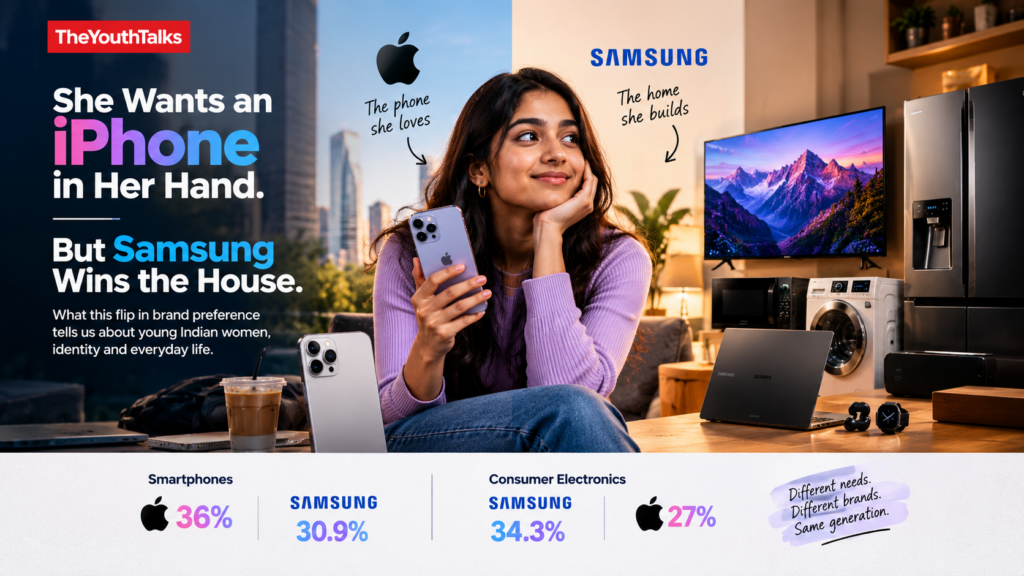
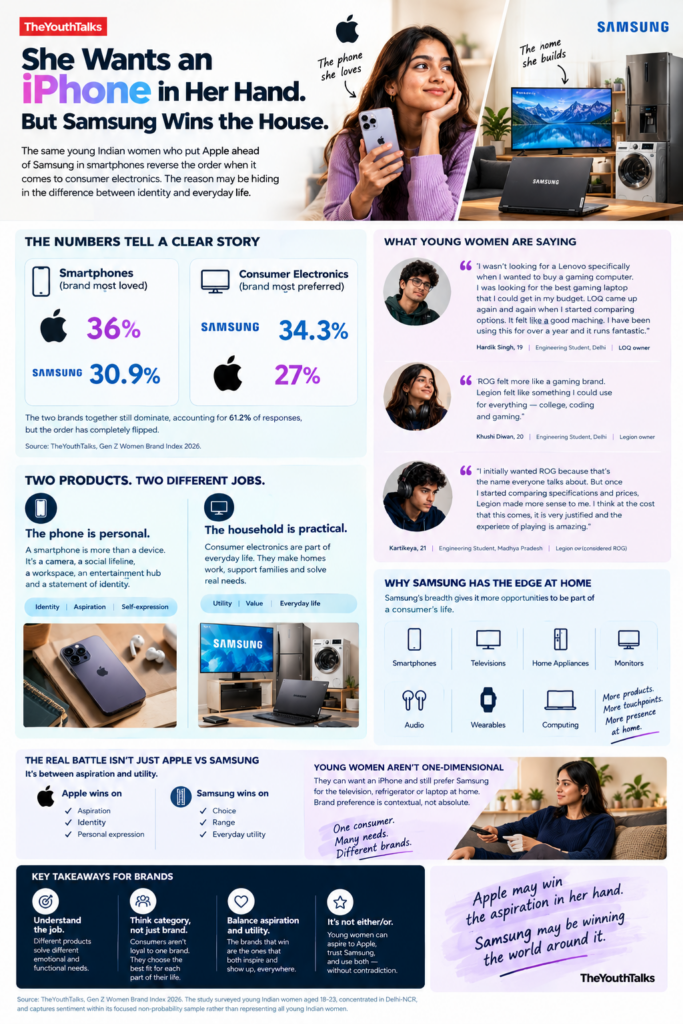
According to TheYouthTalks’ research, Apple leads Samsung 36% to 30.9% in smartphones. But across consumer electronics, Samsung leads Apple 34.3% to 27%.
The two brands remain remarkably dominant in both conversations. But the interesting part isn’t the size of the gap.
It is the reversal.
The same young consumer can put an iPhone at the top of her smartphone wish list and still prefer Samsung when thinking about the wider universe of electronics.
At first glance, that might look contradictory.
It probably isn’t.
It may instead tell us something fundamental about how young Indian women assign meaning to different products.
The smartphone is personal. The household is practical.
And the brand that wins one does not necessarily have to win the other.
The phone is the product she carries into the world
Think about what a smartphone actually represents.
It is not simply a piece of electronics.
It is in her hand when she leaves home. It captures photographs with friends. It carries conversations, social media, music, entertainment and payments. It increasingly becomes a camera, calendar, navigation system, workplace, creative studio and communication hub all at once.
But there is another layer.
A smartphone is visible.
Other people see it.
It can become part of how someone presents herself to the world.
That makes the smartphone unusually powerful as an identity product.
Apple has spent years building precisely this kind of cultural and aspirational equity. The iPhone is not merely sold as a collection of specifications. For many consumers, the brand itself carries meaning.
And that meaning can matter even before someone has the purchasing power to own the product they want.
TheYouthTalks’ earlier research on young Indian women found a similar tension in the smartphone category: Apple emerged as the most preferred brand at 36%, ahead of Samsung at 30.9%, even though a large majority of respondents reported monthly spending capacity below ₹10,000.
That gap between what a consumer wants and what she can immediately afford is important.
Preference does not always mean ownership.
Sometimes it means aspiration.
But a television doesn’t say the same thing about you
Now move from the smartphone to the rest of the home.
A television sits in the living room.
A refrigerator occupies the kitchen.
A washing machine becomes part of a household routine.
A monitor may sit on a desk for years.
An air conditioner is judged largely by whether it cools the room efficiently.
Even a laptop, despite being personal, can serve multiple roles — college, work, entertainment, coding and communication.
These products matter enormously.
But they don’t necessarily operate as the same kind of identity statement.
Nobody walks into a café thinking about whether the refrigerator at home says something about them.
The television may be important, but it is usually part of a shared environment.
The appliance is expected to work.
And this is where Samsung’s breadth becomes strategically interesting.
Samsung has a life beyond the smartphone
Samsung’s biggest advantage in consumer electronics may not be that it can beat Apple at any single product.
It is that Samsung can be present across many products at once.
Smartphones.
Televisions.
Monitors.
Home appliances.
Wearables.
Audio.
Computing.
That breadth creates a fundamentally different relationship with the consumer.
Apple’s ecosystem is tightly integrated around a relatively concentrated portfolio of premium personal technology.
Samsung can participate in the bedroom, the kitchen, the living room and the study.
A young woman might prefer an iPhone and still choose a Samsung television.
She might use a Samsung monitor with a Windows laptop.
Her family may own Samsung appliances.
She may wear a Samsung device.
There is no contradiction.
In fact, the consumer doesn’t necessarily see these decisions as part of one grand brand choice.
They are separate jobs.
And that is perhaps the biggest lesson hiding inside the data.
Consumers don’t have to be loyal to a brand everywhere. They can be loyal to a brand for a particular job.
Apple may own the object. Samsung may own the environment.
This is where the Apple-Samsung comparison becomes more nuanced.
It is tempting to ask: Who is winning?
But the better question may be:
Winning what?
Apple can occupy a powerful space around aspiration, identity and personal technology.
Samsung can occupy a broader space around choice, functionality, familiarity and everyday technology.
These aren’t mutually exclusive positions.
A young woman doesn’t have to decide whether she is an “Apple person” or a “Samsung person.”
She can be both.
She can aspire to an iPhone because of what the product represents to her, while preferring Samsung for the television, monitor or appliance she expects to live with every day.
This is becoming increasingly important as consumer journeys become less linear.
The traditional idea of brand loyalty assumes that consumers choose a brand and then stay with it.
Modern consumers often do something else.
They choose a brand for a context.
The brand they trust for banking may not be the brand they love for fashion.
The brand they aspire to wear may not be the brand they buy most often.
The brand they use every day may not be the brand they would name if asked which one they love.
The Youth Talks’ broader Gen Z research makes precisely this distinction important: brand usage and brand love are not necessarily the same thing. Its 2026 Gen Z Adored Brand Index, based on more than 5,000 Gen Z respondents, explicitly examines the gap between what young consumers use and what they genuinely love.
The Apple-Samsung finding appears to be another expression of that phenomenon.
The household changes the decision
There is another layer that makes consumer electronics particularly interesting: the buyer is not always the only person making the decision.
A smartphone may be chosen almost entirely by the individual.
A television might involve parents, siblings or a partner.
A refrigerator could be a family purchase.
A laptop might be influenced by a student’s course, a parent’s budget or a professional requirement.
An appliance may stay in the household for a decade.
So when a young woman says she prefers Samsung in consumer electronics, her answer may be shaped by something broader than personal aspiration.
It can reflect familiarity.
Availability.
Trust.
Perceived reliability.
The products already present at home.
What her family uses.
What she has grown up seeing.
That creates a different kind of brand equity.
Samsung doesn’t necessarily need to be the most exciting object in the room.
It can simply become the brand that feels familiar enough to trust.
And familiarity is an extraordinarily powerful asset when the product being purchased is expensive, long-lasting or shared with other people.
The numbers reveal a fascinating reversal
Put the two findings next to each other and the story becomes almost impossible to ignore:
| Category | Apple | Samsung |
|---|---|---|
| Smartphones | 36% | 30.9% |
| Consumer electronics | 27% | 34.3% |
The order flips.
Apple leads smartphones by 5.1 percentage points.
Samsung leads the broader consumer-electronics preference by 7.3 percentage points.
The finding does not mean that every young Indian woman thinks about Apple as an aspirational brand and Samsung as a practical one.
Nor does it prove that identity explains the entire difference.
Brand familiarity, product availability, pricing, household ownership, category breadth and individual experience can all influence preference.
But the contrast gives marketers an unusually useful hypothesis:
Different products can carry different psychological jobs.
And the smartphone may have one of the strongest identity functions of them all.
Young women aren’t one-dimensional consumers
There is a tendency in youth marketing to put consumers into neat boxes.
Apple user.
Samsung user.
Premium consumer.
Value consumer.
Gen Z.
But real people are considerably messier.
A young woman can want an iPhone and still be highly price-conscious.
She can love premium fashion and shop at Zudio.
She can discover products on Instagram and still trust a decades-old brand.
She can be experimental in one category and deeply loyal in another.
The Youth Talks’ research across young Indian women repeatedly points towards this contextual nature of preference. Its Gen Z Women Brand Index covers 20 categories and more than 200 brands, finding that quality and trust are among the strongest themes across the study — while the brands that lead can change dramatically from one category to another.
That is why a single “Gen Z brand loyalty” narrative can be misleading.
There may not be one Gen Z.
There may be dozens of category-specific versions of the same consumer.
For Apple, the question is different. For Samsung, it is too.
The finding creates an interesting strategic question for both companies.
For Apple, the challenge is not simply maintaining smartphone preference. It is whether that preference can extend beyond the highly personal products around which the brand has historically built its ecosystem.
For Samsung, the opportunity may be almost the reverse.
It already has an extraordinary breadth of products.
The question is whether that breadth can translate into deeper emotional preference rather than simply functional familiarity.
Because breadth can get a brand into the home.
But love is what makes people ask for the brand by name.
That distinction matters.
A consumer may buy Samsung because it makes sense.
Another may actively want Samsung.
Those are not the same relationship.
And Samsung’s long-term opportunity may lie in turning its enormous everyday footprint into something more emotionally resonant with younger consumers.
The bigger lesson: stop asking whether consumers are loyal
For marketers, perhaps the most valuable lesson from this finding is also the simplest.
Stop asking whether a consumer is loyal to a brand.
Ask what job the brand is doing.
Is it helping her express herself?
Is it signalling aspiration?
Is it giving her confidence in a purchase?
Is it familiar because her family has used it for years?
Is it convenient?
Is it affordable?
Does it work across multiple needs?
The answers can change from category to category.
And that is not disloyalty.
It is how modern consumption works.
A young Indian woman can aspire to Apple, trust Samsung, use Google Pay, bank with SBI, discover beauty products on Instagram and order dinner through Zomato.
There is no contradiction.
She is simply solving different problems with different brands.
The smartphone in her hand. The world around her.
That brings us back to the original reversal.
Smartphones: Apple 36%. Samsung 30.9%.
Consumer electronics: Samsung 34.3%. Apple 27%.
Same generation.
Same broad consumer universe.
Two very different category outcomes.
Perhaps Apple wins more of the products that help young women express who they are.
Perhaps Samsung wins more of the products that help shape how they live.
That distinction should make every marketer pause.
Because the future of brand building may not belong to the company that creates the strongest universal loyalty.
It may belong to the company that understands, category by category, what consumers are really asking a brand to do for them.
The phone she carries can be a statement.
The television she watches, the refrigerator in her kitchen and the monitor on her desk can simply be part of life.
And sometimes, the brand that becomes part of life can be just as powerful as the one she dreams of carrying.
Apple may win the aspiration in her hand. Samsung may be winning the world around it.
*Source: TheYouthTalks, Gen Z Women Brand Index 2026. The study surveyed young Indian women aged 18–23, concentrated in Delhi-NCR, and captures sentiment within its focused non-probability sample rather than representing all young Indian women. *