
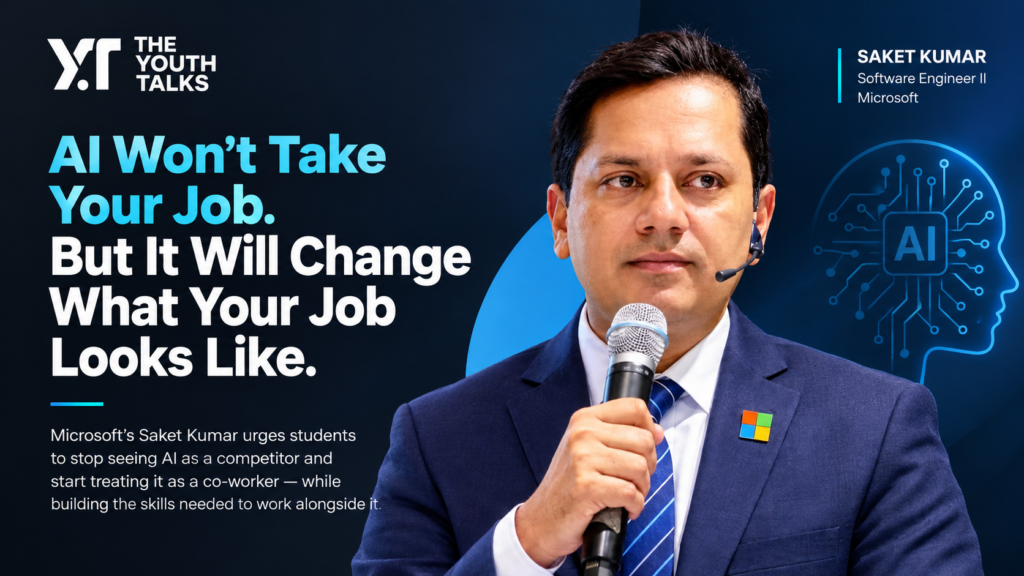
At a recent AI Jobs Project session, Microsoft Software Engineer II Saket Kumar urged students to stop thinking of AI as a competitor and start treating it as a co-worker — while building the skills needed to work alongside it.
For students preparing to enter the workforce, artificial intelligence can sometimes look less like an opportunity and more like a competitor.
The anxiety is understandable. AI can already generate content, write code, analyse information and automate a growing number of repetitive tasks. For a generation about to enter the job market, the obvious question is: if AI can do some of the work, where does that leave me?
At a recent AI Jobs Project session in Noida, Microsoft Software Engineer II Saket Kumar offered students a different way of looking at the problem.
His message was simple: stop thinking “me versus AI” and start thinking “me plus AI.”
According to Kumar, the bigger change taking place in the workplace may not be the disappearance of every job, but the transformation of what people are expected to do within those jobs.
From “humans versus AI” to “humans plus AI”
Kumar began by confronting the fear directly.
When he asked students whether they believed AI would impact jobs, several hands went up. But rather than dismissing that anxiety, he challenged the way students were framing it.
AI, he argued, should not automatically be viewed as the employee competing with you. It can instead become the co-worker or assistant that helps you do your job faster and better.
The distinction sounds subtle, but it has major implications.
Kumar offered an example from his own experience as an engineer. Work that once took him an entire day to code could, with the help of AI tools, now be completed in 10 or 20 minutes.
The technology, in his view, had not made his engineering experience irrelevant. It had multiplied his productivity.
That distinction could become increasingly important as AI enters everyday workflows.
The question for students, therefore, may not simply be “Will AI take my job?” but rather:
“Will I know how to use AI when I enter that job?”
The job may remain. The skills required for it may change.
One of the most interesting moments in the conversation came when a student questioned the continued importance of conventional skills.
If AI can automate repetitive tasks, the student asked, why should young people continue developing skills around work that AI can perform?
Kumar’s answer was that AI still requires humans in the loop.
He used software engineering as an example. AI can generate code, but that code cannot simply be pushed into production without someone reviewing, testing and challenging it. The engineer therefore remains important — but the engineer’s role begins to evolve.
The implication is significant.
The engineer of the AI era may spend less time simply writing code and more time reviewing, validating, solving problems and making decisions around the code.
The same principle could extend well beyond software.
As AI takes over portions of execution, human skills such as judgement, domain knowledge, problem-solving and the ability to evaluate AI-generated output become increasingly important.
In other words, AI may not eliminate the need for skills. It may change which skills matter most.
New AI roles are emerging — but students need to prepare for them
Kumar also pointed students towards roles and areas that have grown alongside the development of AI, including AI engineering, machine learning engineering, data engineering and data science.
But his advice wasn’t to abandon everything students are already learning and suddenly become “AI experts.”
Instead, he encouraged them to build an understanding of AI and then connect it with their existing interests.
A student interested in data analytics, for instance, asked how she could differentiate herself. Kumar suggested exploring machine learning and data science alongside analytics. Other students asked about DSA, programming languages and DevOps.
His response across these conversations was consistent: fundamentals still matter.
Programming knowledge, DSA and an understanding of technology don’t suddenly become irrelevant because AI can write code. Rather, these foundations can help a young professional understand, evaluate and work effectively with AI-generated output.
So, where should students actually begin?
This is perhaps the biggest question facing young people today.
AI has developed so quickly that a student starting from scratch can easily feel that they are already too late.
Kumar’s answer was almost deliberately uncomplicated:
Start with the basics.
He suggested that beginners first build foundational understanding and explore areas including prompt engineering, large language models, computer vision, natural language processing and machine learning. He also pointed students towards Microsoft’s AI-900 learning path as one possible starting point.
But his most practical recommendation wasn’t about a particular certification or technology.
It was about consistency.
Kumar asked students to dedicate 20–30 minutes every day to learning AI. Even if they have only 10 minutes on a particular day, he suggested, they should spend those 10 minutes rather than skip the day altogether.
The objective isn’t to master AI in a month.
It is to make learning AI a habit.
What does “AI at work” actually look like?
The conversation became particularly tangible when Kumar described how he uses AI in his own DevOps work.
He spoke about working with Kubernetes and AKS, where engineers often have to use complex kubectl commands to retrieve logs and investigate infrastructure issues.
Kumar described creating an agent that allows him to give instructions in natural language, with the system handling the underlying command and returning the required information. A task that could previously take around 30 minutes can be accelerated through this approach.
A student then asked the obvious question: couldn’t an agent like this eventually replace a DevOps engineer?
Kumar’s answer returned to the central idea of the session.
No.
The AI isn’t the DevOps engineer.
The DevOps engineer is now working with AI.
The repetitive part of the task can be automated, while the engineer continues to bring the context, judgement and expertise required to understand the larger problem.
The real competitive advantage may be the willingness to keep learning
There was another recurring theme throughout the session: students cannot afford to stop learning once they get their first job.
Technology changes quickly. Kumar pointed out that new technologies appear constantly and students don’t necessarily need to master every new development, but they should at least remain aware of what is happening in their field.
That may ultimately be the more useful way to think about AI and careers.
The AI era isn’t necessarily creating a simple choice between human jobs and machine jobs.
It is creating a workforce where the ability to work with machines, question their output, integrate them into existing workflows and continuously acquire new skills could become increasingly important.
For students, that means the starting point doesn’t have to be fear.
It can be curiosity.
Learn the basics. Build something. Experiment with AI. Apply it to an existing skill. Keep learning.
Because the future workplace may not belong to people who know everything about AI today.
It may belong to people who are willing to learn what AI can do tomorrow.