





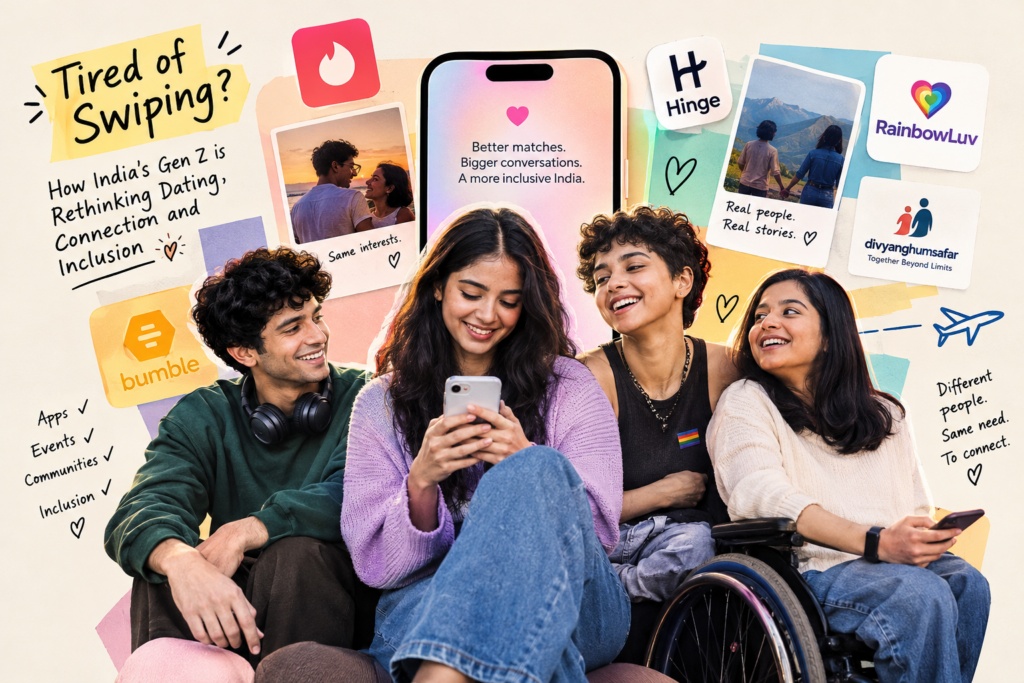
From dating-app fatigue and offline meet-ups to LGBTQ+ relationships and accessibility, young Indians are prompting a bigger question: what does a genuinely meaningful and inclusive dating experience look like?
For years, dating apps promised to make one of life’s oldest pursuits considerably easier: meeting someone new.
A profile, a few photographs, a short biography and a swipe were all it took to open the possibility of a conversation with someone outside one’s immediate social circle. For young Indians, particularly those living in large cities or moving away from home for education and work, these platforms created opportunities to meet people they might otherwise never have encountered.

But a growing conversation around dating-app fatigue suggests that access to more people does not automatically translate into meaningful connection.
The cycle can be familiar: browse profiles, match with someone, exchange messages, wait for a reply and sometimes start all over again. Conversations can lose momentum, intentions may not align, and the distance between matching with someone and actually meeting them can feel surprisingly large.

This dissatisfaction is not entirely new. Indian media have reported on young daters questioning the repetitive nature of online dating, while a November 2025 BBC News India report documented young Indians exploring alternatives such as hobby-based gatherings, singles events and other offline meet-ups.
TheYouthTalks has also explored this shift through its Gen Z Dating Pulse 2026, based on conversations with more than 200 Gen Z Indians. The emerging question is not simply whether young people are abandoning dating apps, but whether they want more human ways to meet and build connections.

Yet there is another dimension to this conversation that deserves equal attention.
As India’s Gen Z rethinks dating, whose experiences are being considered — and who might still be left out?
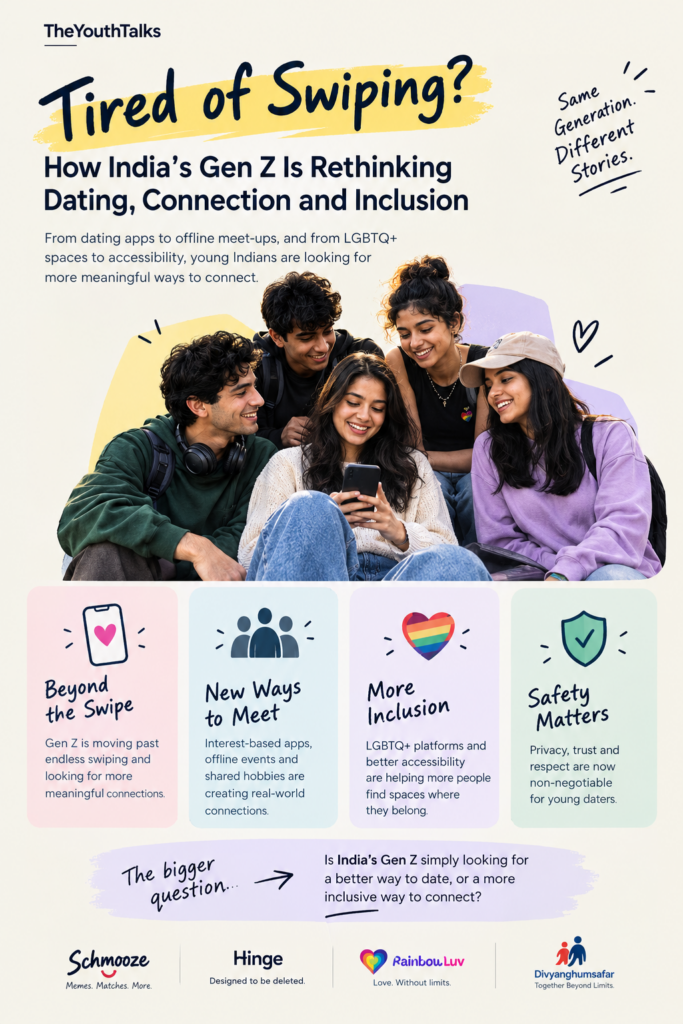
The problem may not be dating itself
It is tempting to interpret dating-app fatigue as evidence that young people are losing interest in relationships. That would be an oversimplification.
Being tired of an experience is not the same as abandoning the underlying desire. Someone may want companionship but dislike endless messaging. Another person may enjoy meeting new people but feel uncomfortable being judged primarily through photographs. Someone else may prefer to establish trust through shared activities rather than an unfamiliar person’s online profile.
For Gen Z, dating also exists within a broader digital environment in which friendships, entertainment, communication and self-expression frequently begin online. The convenience of digital discovery is undeniable, but the experience can become frustrating when the interaction never moves beyond the screen.
There is also a practical dimension. Dating can involve transport, meals, entertainment and the expectation of a carefully planned outing. In October 2026, The Indian Express reported on how rising costs and lifestyle expectations are influencing how young people approach dating, including conversations about who pays and what a date should cost.
For young adults managing college expenses, their first salaries or financial responsibilities at home, the idea of dating can come with pressures beyond emotional compatibility.
This does not mean every Gen Z dater shares the same frustrations. Some enjoy dating apps and meet compatible partners through them. Others prefer introductions through friends, campus communities, workplaces or shared interests.
The important point is that there is no single Gen Z dating experience. And that is precisely why the conversation needs to become broader.
From matching profiles to finding common ground
One possible response to dating fatigue is to change the basis on which people connect.
A profile built around photographs and a few carefully selected prompts offers limited insight into how two people might actually interact. Shared interests, humour, hobbies and values can offer different starting points for conversation.
Consider the difference between matching with someone because both people find each other attractive and discovering that they enjoy the same music, books, sport or creative pursuits. Neither approach guarantees compatibility, but a shared interest can provide a more natural opening for conversation.
This is part of the appeal of dating formats that place greater emphasis on intentionality and common ground. Hinge, for example, has positioned itself around relationships and introduced changes to its Indian experience in September 2026, including a phased waitlist for new members and screenshot protection for profiles. The company says these features are intended to build trust and give users greater confidence. These are the platform’s stated objectives, rather than independent evidence that the changes will solve dating fatigue.
The larger opportunity is to make the journey from discovery to conversation feel less mechanical.
Could a platform encourage people to communicate more meaningfully? Could events organised around interests give people a reason to meet without the immediate pressure of a romantic outcome? Could users have more control over what they share and how quickly they move towards an offline meeting?
These are not questions that technology can answer on its own. But they are questions dating platforms, event organisers and young users are already giving reason to consider.
Why meeting offline is attracting attention
Offline dating is not a new invention. People have always met through friends, college societies, workplaces, social gatherings and shared activities.
What is interesting is the renewed attention being given to these formats as alternatives or complements to app-based discovery.
The BBC’s 2025 reporting from India explored hobby-based gatherings and singles events, including creative ways of introducing people to one another.
Such formats can change the context in which two people meet. Rather than deciding whether to engage with a profile, participants can encounter one another through a shared activity. A conversation might begin around a game, a workshop or a common interest instead of the pressure to produce an impressive opening message.
For some, this can feel more natural. For others, dating apps remain a more comfortable way to initiate contact.
Neither route is inherently superior. Offline spaces can bring their own challenges, including social anxiety, safety concerns, accessibility barriers and the pressure of meeting strangers in person. A well-designed event also requires clear ground rules, appropriate moderation and respect for personal boundaries.
The goal should not be to declare digital dating over. It should be to give young people more ways to build connections, with greater control over the experience.
Inclusion: Is there room for every kind of dater?
This is where the conversation becomes more important.
When people talk about improving dating apps, the discussion often centres on better matches, fewer ghosting experiences, stronger verification and clearer intentions. These are legitimate concerns. But a platform can improve its matching experience without necessarily meeting the needs of every person who uses it.
For LGBTQ+ young adults, for instance, dating may involve questions of identity, privacy, acceptance and personal safety that are not experienced in exactly the same way by every heterosexual dater.
Some may be comfortable being open about their identity. Others may need greater control over who can see their profile, what information is disclosed and how they interact with potential matches. Their experiences will also vary by location, family circumstances and social environment.
A June 2026 report by Hinge on LGBTQIA+ dating, based on more than 31,000 LGBTQIA+ and heterosexual Hinge daters globally, highlighted the importance of clarity, emotional safety and consistency in relationships. Its findings are international, not specific to India, so they should be treated as a useful perspective rather than a representative picture of Indian queer youth.
India’s queer dating landscape also cannot be reduced to a single platform or experience. Some people use mainstream dating apps, while others seek LGBTQ+-focused platforms, community spaces or offline gatherings. The important questions include whether those spaces are active, whether users trust them, how privacy is protected and whether people can participate without feeling pressured to disclose more than they wish.
For a generation that increasingly speaks about authenticity and self-expression, the ability to decide how and when to share one’s identity should be part of the conversation.
Inclusion, however, must extend beyond sexual orientation and gender identity.
People with disabilities can face different barriers when looking for companionship. Physical accessibility may determine whether someone can attend a social event. Digital accessibility can affect whether a person can navigate an app, communicate comfortably or use its features independently. Assumptions about disability and relationships can also shape how people are treated by potential partners and society.
A dating experience designed around a narrow idea of what a user looks like, how they communicate or where they can meet may unintentionally exclude people.
The answer is not to assume that all disabled people want the same kind of relationship, or that everyone wants a separate dating platform. Some may prefer mainstream apps with better accessibility; others may value specialist matchmaking or communities where they feel understood.
The question is whether users have meaningful choices.
Are event venues physically accessible? Can people use dating platforms with assistive technologies? Are communication preferences accommodated? Are users treated as individuals with romantic lives and relationship goals, rather than being defined by a disability?
These are practical design questions, not merely statements of good intentions.
Safety and privacy must be part of the experience
A more inclusive dating culture also needs to take safety seriously.
Online, users may worry about fake profiles, unwanted messages, screenshots, harassment or the misuse of personal information. Offline, meeting a stranger can introduce different concerns around location, consent and personal boundaries.
These risks can be especially consequential for people who have good reasons to be cautious about revealing their identity or personal circumstances.
Platform features can help, but no feature can guarantee a safe experience. Verification, reporting mechanisms, privacy controls, moderation and clear community standards all matter. So does the way platforms respond when users raise concerns.
Offline organisers have responsibilities too. Events should communicate expectations clearly, provide ways to report inappropriate behaviour and avoid treating attendance as consent to romantic attention.
For young people, trust is not just a feature on a settings page. It is the confidence that they can participate, change their minds, say no and leave an interaction without being punished for doing so.
And inclusion means little if a person can technically join a platform but cannot use it with reasonable confidence or dignity.
What does the dating industry need to understand about Gen Z?
The opportunity for dating platforms may lie less in promising an endless supply of potential matches and more in understanding the quality of the experience they create.
First, more choice does not automatically mean better connection. A large pool of profiles may be useful, but the process of finding someone compatible still depends on context, communication and mutual interest.
Second, intentions matter, but they are not identical for everyone. Some users want a long-term relationship, others want to date casually, and some are still figuring out what they want. Platforms and events can help people communicate honestly without suggesting that one relationship goal is universally correct.
Third, trust must be built into the experience. Privacy, consent, accessibility and respectful behaviour cannot be treated as secondary concerns.
Fourth, there should be more than one route to meeting someone. Apps, introductions through friends, interest-led gatherings and organised social events can serve different needs. The future does not have to be a contest between digital and offline dating.
Finally, inclusion should influence design from the beginning. LGBTQ+ users and people with disabilities should not be brought into the conversation only after a product has been built. Their experiences can help identify barriers that other users and product teams might overlook.
For businesses, these are not only social considerations. They are also questions about whether a service understands the full range of people it hopes to serve. But the commercial opportunity should not become the sole reason to address people’s needs. Respect, autonomy and dignity matter in their own right.
The future of dating may be less about swiping — and more about choice
It would be premature to declare that India’s Gen Z is abandoning dating apps. Many continue to use them, and digital platforms remain a practical way to meet people outside existing social circles.
What appears more useful to examine is whether young people want a wider range of experiences: better conversations, clearer intentions, safer interactions and opportunities to meet people in contexts that feel comfortable to them.
For some, that may mean changing how they use an existing app. For others, it may mean attending a social event, meeting through friends or taking a break from dating altogether.
For LGBTQ+ young adults and people with disabilities, the question also includes whether those options are accessible, respectful and appropriate to their circumstances.
There is no single solution, because Gen Z is not a single, uniform audience. Its members have different identities, expectations, financial realities and ideas of companionship.
That diversity should be a starting point for understanding the generation, not an inconvenient complication to be ignored.
The next phase of dating may not be defined by the app that offers the most profiles or the cleverest algorithm. It may be shaped by the experiences that help people feel comfortable enough to show up as themselves, communicate honestly and decide what kind of connection they want.
For India’s Gen Z, the question may no longer be simply, “Who can I match with?”
It may be something more fundamental: “Where can I meet someone, feel respected and build a connection that works for me?”
And that is a question the dating industry — online and offline — still has to answer.