






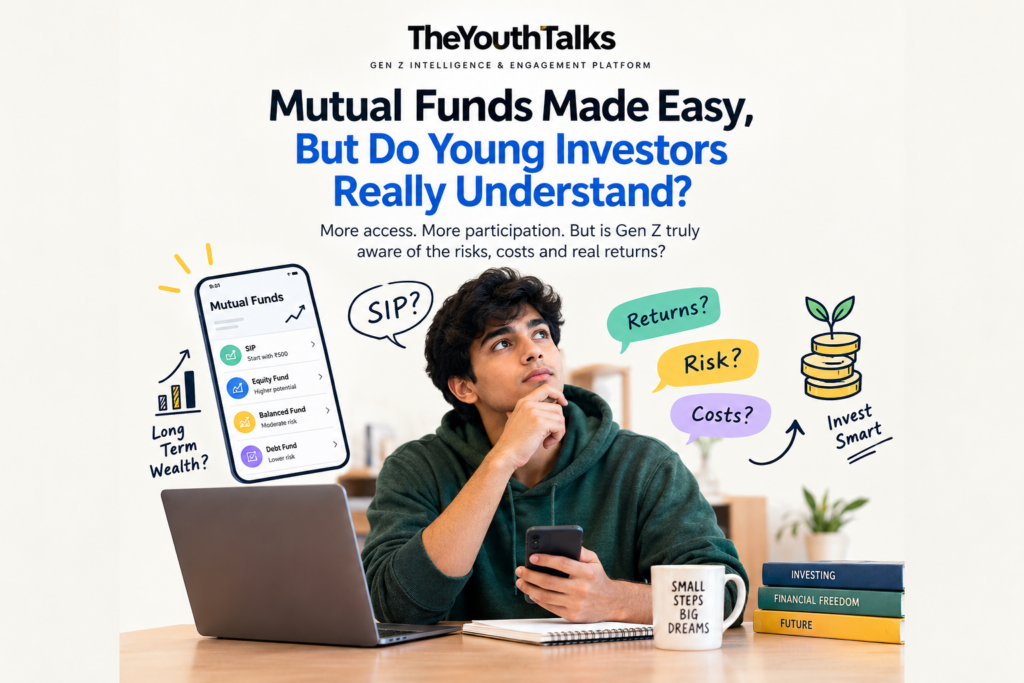
Young Indians are discovering investing through apps, social media and small monthly contributions. But as mutual funds become easier to access, a more important question emerges: do first-time investors understand where their money goes, what risks they take and what they should realistically expect?
A few years ago, investing might have sounded like something that began after getting a stable job, buying a home or sitting down with a financial adviser. Today, a young Indian can open an investment app, set up a monthly contribution and begin investing without leaving their room.
The language of investing has also become more familiar. SIPs, compounding, index funds and long-term wealth creation appear in online conversations, financial content and social-media feeds. For students approaching their first job and young professionals receiving their first salary, investing increasingly feels like something they should understand early.

There is a good reason for this interest. Starting to save and invest early can give money more time to grow, depending on the investment and market performance. Digital platforms have also made access more convenient.
But convenience creates a new challenge. Knowing how to start investing is not the same as understanding what you are investing in.

As Gen Z enters India’s investment landscape, the real test is not whether young people recognise the term mutual fund. It is whether they can look beyond a fund’s recent returns, understand its risks and decide whether it fits their financial goals.
A generation entering the investment conversation
The growth of India’s mutual fund industry provides useful context. According to the AMFI–Crisil Factbook 2025, industry assets under management reached ₹65.74 lakh crore in March 2025, up from ₹22.26 lakh crore in March 2020. The report attributes the broader expansion to factors including digital access, formalisation of savings and wider investor participation. Source: AMFI–Crisil Factbook 2025

Young investors are part of this changing landscape. In August 2025, India Today reported platform data from Share.Market, PhonePe’s wealth platform, showing that 48% of its mutual fund investor base during the preceding 12 months was aged 18–30. Of those under-30 investors, 92% used systematic investment plans, with an average monthly transaction value of ₹1,000. These are figures from one platform, not a representative estimate of all Indian Gen Z investors, but they illustrate the growing role of smaller, regular investments among younger participants. Source: India Today
The trend presents an opportunity. A young person does not need a large salary to begin learning about financial planning, and regular investing can encourage consistency.
However, participation numbers tell us how people invest, not necessarily how well they understand their decisions. A monthly SIP may be a sign of discipline, but it does not automatically demonstrate knowledge of market risk, fund categories, costs or investment suitability.
That is where the conversation needs to move next.
The SIP is a starting point, not the whole lesson
A Systematic Investment Plan, or SIP, allows an investor to put a fixed amount into a mutual fund at regular intervals. Instead of investing a large sum at once, someone might contribute ₹500, ₹1,000 or another affordable amount each month.
The appeal is easy to understand. It creates a routine and can help investors avoid trying to predict the perfect moment to enter the market.
But an SIP is a method of investing, not a guarantee of returns. The outcome depends on the fund, the underlying investments, market conditions, costs and the period for which the money remains invested.
Consider a young professional who starts an SIP because a creator says it is the easiest way to build wealth. If that person understands the monthly commitment but believes the investment will deliver a fixed return, the basic concept has not been fully understood.
The same problem arises when compounding is presented as a near-magical process. Compounding can help investment gains generate further gains over time, but the outcome is not predetermined in market-linked investments. Returns vary, losses are possible and projections are not promises.
The financial lesson is therefore more nuanced than “start early”. It is to understand what the investment is designed to do, what could go wrong and whether the money can remain invested for the intended period.
When the search for higher returns becomes the risk
Young investors often have a long investment horizon, which can allow them to take some risks that would be less suitable for someone who needs their money soon. But a longer horizon does not make every risky investment appropriate.
India Today reported in August 2025 that young investors on Share.Market showed strong participation in equity mutual funds, including diversified categories and mid-cap and small-cap funds. The same report highlighted concerns about investors chasing past performance and the greater volatility associated with some of these market segments. Source: India Today
This is where financial awareness can become confused with financial confidence.
A young investor may know which fund delivered a high return over the previous three years. But that number alone does not reveal how much risk the fund took, how it performed during difficult periods, whether its strategy is suitable or whether the same results will continue.
Equity funds can lose value. Mid-cap and small-cap funds may experience particularly sharp fluctuations. A fund that performed exceptionally well during one period can underperform during another.
The challenge is not that young investors should avoid risk altogether. It is that they need to distinguish between taking risk for a reason and taking risk because a recent performance chart looks exciting.
Learning finance from social media
Social media has made financial concepts easier to encounter. Short videos, explainers and creator-led conversations can introduce a first-time investor to ideas that once seemed intimidating.
That is a genuine benefit. Clear explanations can encourage people to ask questions, compare products and take greater responsibility for their financial decisions.
But the format has limitations. A complicated financial decision may be compressed into a short video or a headline promising a particular outcome. A creator’s personal experience may be presented as though it applies equally to everyone. The distinction between education, opinion, promotion and personalised financial advice may not always be obvious to a viewer.
The answer is not to dismiss financial content online. It is to develop the habit of checking it.
Who is making the recommendation? Is the person appropriately qualified or registered for the activity they are undertaking? Are the risks explained alongside the potential benefits? Does the claim refer to past performance, a projection or a guaranteed return? Is the content sponsored or promoting a particular product?
Young investors need to learn that a confident explanation is not necessarily a complete one.
Five questions every first-time investor should be able to answer
Understanding mutual funds does not require becoming a financial expert. It does require being comfortable with a few fundamental questions.
1. What does this fund invest in? An equity fund, a debt fund and a hybrid fund can have very different underlying investments and risk profiles.
2. What can make its value fall? Market movements, interest-rate changes, credit problems and other factors can affect different types of funds in different ways.
3. When might I need this money? Money required soon may not be suitable for a volatile investment. Time horizon matters.
4. What am I paying? Expenses affect investment outcomes. Investors should understand the scheme’s costs and the difference between direct and regular plans.
5. Am I choosing this fund for a clear reason, or because it recently performed well? Recent returns are only one part of understanding an investment. They do not predict future performance.
These questions are not a recommendation to buy any particular product. They are a basic framework for evaluating whether an investment is understood before money is committed.
The Association of Mutual Funds in India provides educational resources on mutual fund types, expenses, risks and other fundamentals through its Investor Corner. SEBI also publishes investor education resources and research intended to support informed participation in securities markets.
What financial literacy should look like for Gen Z
Financial literacy is often reduced to knowing definitions: what an SIP is, what an index fund does or what compounding means. Those concepts matter, but genuine understanding appears when an investor can apply them to a real decision.
Can a young person explain why they selected a particular fund category? Can they recognise that market-linked investments do not offer assured returns? Can they resist changing their strategy every time markets fall or a new fund becomes popular? Can they distinguish money intended for near-term needs from money available for long-term investment?
These abilities matter more than memorising financial terminology.
Schools and colleges have a role to play, as do employers, financial institutions, regulators and credible educators. Financial education should move beyond encouraging people to start investing and help them understand the decisions that follow.
For Gen Z, this is particularly important because many are learning about money while simultaneously navigating their first salaries, education expenses, family responsibilities and the pressure to become financially independent.
They do not need to know everything before beginning their financial education. But they should be able to recognise what they do not yet understand.
The real measure of an informed investor
Gen Z’s growing interest in mutual funds is an encouraging development in India’s financial journey. Digital access and smaller investment amounts have lowered barriers to participation, while regular investing can help establish useful habits.
Yet the next stage cannot be measured simply by counting new accounts or SIP registrations.
A more meaningful measure is whether investors understand the products they hold, the risks they accept, the costs they pay and the goals they are trying to achieve.
The objective is not to make every young Indian an expert in markets. It is to make sure that investing is a considered financial decision rather than an act of imitation.
Because knowing how to start a SIP may be the beginning of an investment journey. Knowing why you chose it, what could go wrong and whether it suits your goals is what makes that journey informed.