

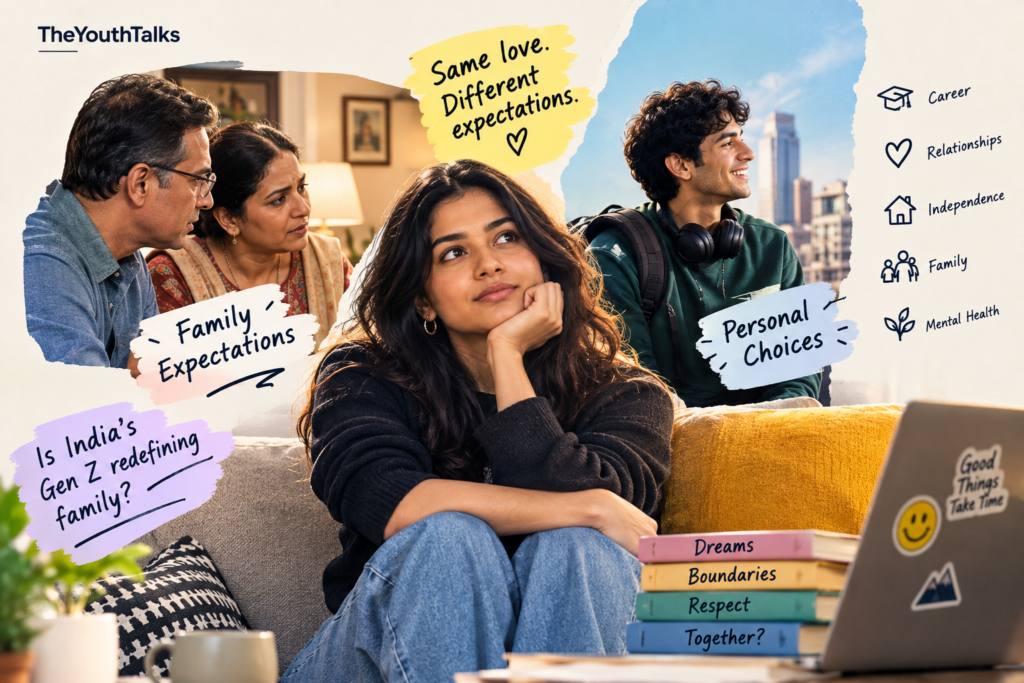
For young Indians, family remains a source of belonging, security and identity. But as personal choices evolve, a difficult question is emerging: can you love your family while wanting to live differently from what it expects?
A young Indian tells their parents they do not want to pursue the career the family has spent years preparing them for. Another wants to marry someone their parents would not have chosen. Someone else wants to move to another city, live independently, delay marriage or simply stop having to explain every personal decision.
None of these situations necessarily means a family is breaking apart. They may involve ordinary disagreements between generations. Yet each raises a question that sits at the heart of family life in contemporary India: when does parental guidance become control, and when does a young adult’s desire for independence begin to feel like rejection to their family?
For many young Indians, the answer is complicated.
Family is not merely a relationship one chooses to maintain. It can be a source of financial support, emotional security, cultural identity and practical assistance. Parents may have made considerable sacrifices to provide educational opportunities that they never had themselves. Their hopes for their children may be rooted in love, hard work and a desire to protect them from uncertainty.
But the children who benefit from those sacrifices are also growing into adults with their own ambitions, relationships and ideas about how they want to live.
Sometimes these expectations align. Sometimes they do not.
The emerging conversation about Gen Z and family is not simply about young people rejecting tradition. It is about how they negotiate the distance between being a good son or daughter and becoming an independent adult.
The family conversation is changing
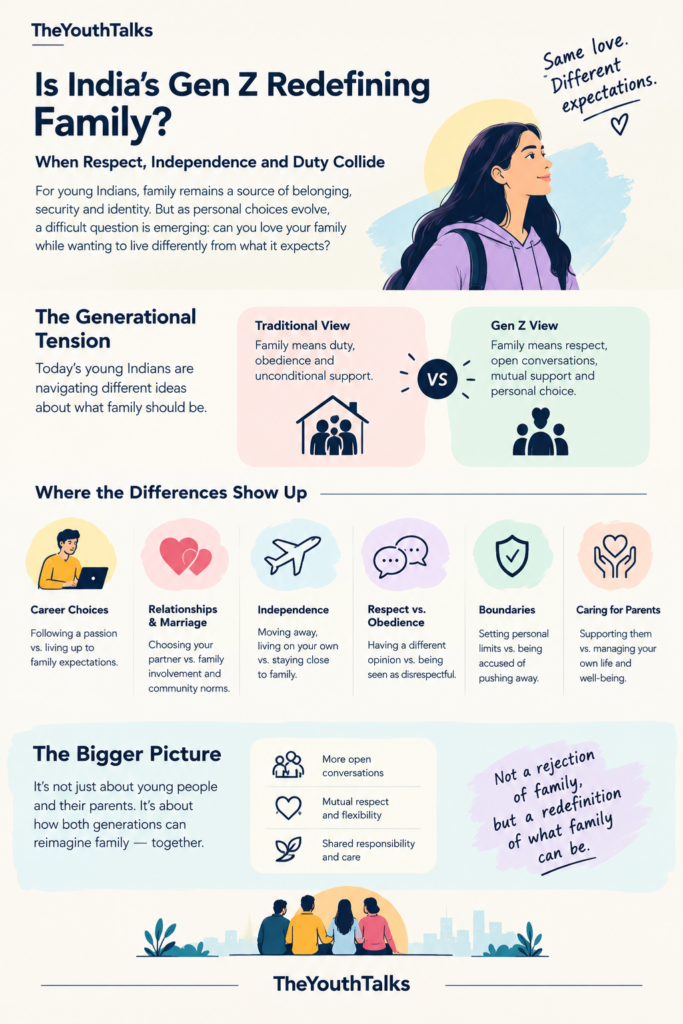
For generations, many Indian families have understood family relationships through a framework of shared responsibility. Parents provide for their children, make sacrifices for their future and guide important decisions. In return, children are expected to respect their elders, remain connected to their families and take responsibility for their parents as they grow older.
This arrangement can offer enormous benefits. Family networks can help young adults navigate education, employment, financial setbacks and personal crises. Grandparents and other relatives may provide childcare, emotional support and a sense of continuity. Adult children may, in turn, support their parents financially or through caregiving.
The challenge arises when family members have different ideas about what those responsibilities should involve.
A parent might consider regular updates about a child’s whereabouts an ordinary expression of concern. The child might experience the same questions as a lack of trust. A parent may regard advice about a career or marriage as a responsibility that comes with raising a child. The young adult may feel that the decision should ultimately be theirs.
Neither interpretation automatically makes someone unreasonable. The disagreement often lies in what each person believes a family relationship entitles them to expect.
This tension is not unique to Gen Z, nor is it evidence that every Indian household is becoming more individualistic. But it offers a useful way to examine why seemingly small disagreements can become emotionally significant.
The question is not whether parents should care about their children’s decisions. It is how that care changes when children become adults.
When career choices become family decisions
Consider a familiar situation: a student wants to pursue design, filmmaking, entrepreneurship or a career in the creator economy, while their parents favour engineering, medicine, government service or another profession they consider more secure.
For the parents, the preferred option may represent years of sacrifice and a desire to ensure their child has a stable future. They may have seen economic uncertainty first-hand and may reasonably worry about careers whose income prospects appear unpredictable.
For the young person, however, the alternative may represent a genuine interest, a different understanding of success or a desire to avoid spending decades in work they do not enjoy.
The disagreement is rarely just about the course or profession. It can become a disagreement about who has the right to define a successful life.
This is particularly difficult when the family is financing the education. Financial dependence can give parents a legitimate stake in the practical consequences of a decision, while also making it harder for a young adult to disagree openly.
The question becomes more complicated still when a student is asked to follow a particular path because the family has invested heavily in it. Does that investment give parents a continuing say in the child’s future? How much independence can a young adult reasonably exercise before becoming financially independent?
There are no universal answers. Parents are entitled to express concerns about affordability, employability and risk. Young adults, meanwhile, need room to develop their own judgment and take responsibility for the choices they make.
A healthier conversation would allow both sides to discuss the risks without treating disagreement as disloyalty.
Instead of asking, “Why won’t you listen to us?”, parents might ask, “How have you evaluated this option?” Instead of dismissing parental concerns as outdated, young adults might explain their plans, financial assumptions and alternatives.
The aim is not to eliminate generational differences. It is to prevent those differences from becoming a test of love or obedience.
Respect does not always mean agreement
In many Indian households, respect for elders is a deeply embedded value. It can mean listening carefully, acknowledging experience, helping parents and recognising the sacrifices they have made.
But respect can become difficult to negotiate when it is interpreted as the expectation that younger family members should not disagree.
A young adult who challenges a parent’s decision may be accused of becoming arrogant. A daughter who refuses an unwanted marriage proposal may be described as ungrateful. A son who chooses to live separately may be told that he has forgotten his family.
Such responses can transform a disagreement about a decision into a judgment about someone’s character.
This matters because adults can disagree with their parents and still love them. They can recognise a parent’s contribution without accepting every opinion. They can value family traditions while deciding which ones they want to continue.
The distinction is between rejecting a person’s dignity and questioning a person’s expectations.
A parent may disagree with a child’s choice of career or partner. A young adult may disagree with a parent’s views about lifestyle or marriage. Both can express those differences without humiliation, threats or attempts to control the other’s decisions.
This is not an argument for treating every parental expectation as unreasonable. Nor does independence mean that young adults should disregard the consequences of their choices for others.
It is an argument for understanding respect as something that can coexist with disagreement.
What Indian research tells us about the other side of the story
The pressures of family life do not fall exclusively on younger generations. Parents and older relatives also have expectations, responsibilities and vulnerabilities that can be overlooked when the discussion focuses only on individual freedom.
A qualitative study published in Ageing & Society in 2023 explored intergenerational relationships through 26 in-depth interviews with adult children in South India, including people living in different family arrangements. Participants described the pressures created by modern work, caregiving demands, older relatives’ expectations and the costs of providing support. Yet the study also found that many adult children remained motivated by traditional commitments to care for older family members and preserve emotional bonds.
The finding is important because it complicates the idea that independence and family duty are necessarily opposites.
An adult child may feel overwhelmed by caregiving responsibilities and still want their parents to be comfortable. Someone may struggle with a parent’s inflexibility while appreciating the support that parent has provided. A young professional may want to live independently without wanting less contact or affection.
The challenge is often how responsibility is distributed and negotiated.
If one family member is expected to provide most of the care, how can other relatives contribute? If work requires a young adult to move to another city, can support be shared through regular visits, financial assistance and coordinated care? If parents and children disagree about living arrangements, can they discuss practical alternatives rather than interpreting every option as a personal rejection?
These questions become increasingly important as education and employment take young adults away from their hometowns.
A family may no longer share the same household, but it can still share responsibilities. Equally, living under one roof does not guarantee emotional closeness.
The form of family life may change without the underlying commitment disappearing.
When moving away feels like moving on
For many young Indians, moving to another city for college, a first job or a career opportunity is a significant step towards independence. It introduces new routines, friendships and responsibilities. It also changes the rhythm of family relationships.
Parents who were accustomed to daily interaction may now rely on phone calls and messages. Young adults may enjoy having greater control over their schedules but feel guilty when they cannot respond immediately. A missed call can become a minor inconvenience for one person and a sign of neglect for another.
Research published in BMC Research Notes in September 2026 examined 64 parents aged 45–65 whose adult children had emigrated abroad. The exploratory study found an association between loneliness and psychological distress among these parents. Because the sample was small and specifically recruited from parents whose children had moved abroad, the findings cannot be generalised to all Indian parents or families. They nevertheless illustrate that geographical separation can bring emotional challenges for those left behind.
This is an important counterpoint to the idea that independence is always experienced as liberation.
For a young adult, moving away may be a necessary step towards building a career and discovering who they are. For a parent, the same move may bring loneliness, worry or a sense that a familiar family routine has disappeared.
Both experiences can be real.
The solution cannot always be that the child must return home or that the parent must simply accept the change without emotion. Families may need to develop new ways of staying connected: agreeing on regular calls, planning visits, sharing important updates and being honest about what kind of contact feels sustainable.
The objective is not constant availability. It is a relationship in which connection is maintained through mutual understanding rather than guilt.
Marriage, relationships and the right to choose
Few areas reveal the tension between individual choice and family expectations as clearly as marriage.
In many Indian families, marriage is understood as a decision that affects more than two people. Parents may consider religion, caste, community, financial stability, family background and long-term compatibility. Their involvement may come from a sincere belief that they are helping their children make a consequential decision.
Young adults may approach the same decision differently. They may place greater emphasis on emotional compatibility, shared values, personal attraction and the ability to build a life with someone they have chosen themselves.
For some, family introductions and individual choice work together. For others, conflict emerges when parental approval becomes a condition for proceeding.
A young adult may want their parents’ blessing without wanting them to make the final decision. A parent may want to protect their child from a difficult relationship but struggle to distinguish genuine concerns from their own preferences.
These situations cannot be reduced to a simple contest between modernity and tradition. Arranged introductions can involve meaningful choice, just as relationships formed independently can involve poor judgment. What matters is whether the people entering the relationship can make a decision freely and with a clear understanding of its consequences.
A family’s experience can offer valuable perspective. But the fact that a decision affects the family does not mean every member should have an equal veto over it.
The difficult work is finding a way for advice, care and family participation to coexist with an adult’s right to make decisions about their own life.
Boundaries are not necessarily a rejection of family
The language of personal boundaries has become more visible in conversations about relationships and well-being. But the concept can be misunderstood.
A boundary is not automatically an ultimatum. It can be a way of communicating what someone is comfortable with, what they are able to do and how they wish to be treated.
A young adult might ask their parents not to comment on their appearance every time they meet. Someone else might want career decisions to be discussed without insults. Another person might explain that they cannot answer repeated calls during working hours but will call back in the evening.
These requests do not necessarily indicate a damaged relationship. They can be attempts to make a relationship more manageable and respectful.
Of course, boundaries also involve responsibility. A person cannot reasonably expect others to accommodate every preference without discussion. Nor should the language of self-care be used to avoid all difficult conversations or disregard commitments.
The difference lies in whether the boundary is intended to protect a person’s well-being while allowing a relationship to continue, or whether it is being used to punish, manipulate or control someone else.
Family disagreements can sometimes be repaired through clearer communication, acknowledgement of past hurt and changes in behaviour. In other circumstances, persistent intimidation, abuse or serious violations of safety may require distance and outside support.
It is important not to confuse ordinary disagreement with abuse, or to assume that every conflict can be resolved simply by communicating better.
The goal is not to encourage young Indians to cut ties with their families. It is to recognise that maintaining a relationship and accepting every behaviour within it are not the same thing.
Are young Indians rejecting family, or trying to renegotiate it?
The most useful way to understand this change may be to move beyond the binary of tradition versus modernity.
A young person can want financial independence and still seek their parents’ advice. They can reject an arranged marriage and still value family participation in their wedding. They can move abroad and remain closely involved in caring for ageing parents. They can challenge a family tradition without rejecting the culture from which it comes.
Equally, parents can adapt to their children’s independence without abandoning their own values. They can offer advice without insisting that it must be followed. They can acknowledge that the world their children are entering is different from the one they experienced, while still sharing the lessons they believe matter.
These adjustments are not always easy. They require both generations to accept that love does not guarantee agreement and that good intentions do not automatically prevent hurt.
They also require an understanding that independence is not a single moment. It develops gradually through education, employment, relationships, financial decisions and the everyday experience of taking responsibility.
For young adults who remain financially dependent on their families, negotiating independence may be especially difficult. The ability to make choices is shaped not only by personal confidence but also by income, housing costs, employment opportunities and access to support.
That is why the conversation cannot be reduced to whether Gen Z is becoming more individualistic. It must also ask what conditions allow young adults to make responsible choices without being forced to choose between autonomy and belonging.
The family Gen Z wants may still include its parents
It would be easy to turn this discussion into a generational argument: young Indians want freedom, while their parents want control.
Reality is more complicated.
Many parents want their children to be happy, secure and independent, even when they disagree about what those things look like. Many young adults want to make their own decisions without losing the emotional connection and practical support their families provide.
The conflict emerges when each side believes that its own understanding of love is the only legitimate one.
For one generation, love may be expressed through guidance, sacrifice and involvement. For another, it may also require listening, privacy and the freedom to make mistakes. Both can value family while disagreeing about how that value should be expressed.
Perhaps the more meaningful question for India’s Gen Z is not whether family should come before individual choice. It is whether family relationships can make space for both.
Can parents remain important without having the final say in every decision? Can adult children pursue different lives without treating every disagreement as a reason to withdraw? Can families distribute care and responsibility in ways that recognise the needs of both younger and older members?
There will be no universal answer. Families differ by region, class, culture, finances, household structure and personal experience. Some disagreements can be resolved through conversation; others may require time, support or distance.
But one idea deserves greater attention: independence does not have to mean indifference, and family duty does not have to mean unquestioning obedience.
India’s Gen Z may not be asking for a life without family. Many may be trying to understand how to build a life of their own while remaining part of one.
The family that emerges from that negotiation may look different from the family their parents grew up with. It may involve different living arrangements, more explicit boundaries, shared caregiving responsibilities and a greater willingness to discuss decisions that were once considered settled.
That does not necessarily make it a weaker family.
It may simply be a family learning that relationships can remain meaningful even when the people within them are allowed to become different from one another.
And perhaps that is the conversation worth having: not whether young Indians are abandoning family, but whether Indian families can evolve without losing the care, commitment and sense of belonging that make them matter in the first place.