We live in perhaps the most connected generation in history. We can instantly message people thousands of kilometres away, follow hundreds of people and belong to dozens of online communities.
And yet, there is a surprisingly simple problem technology hasn’t completely solved:
What if I want to do something today, but don’t have anyone to do it with?
That question sits at the heart of SeeYaa, an activity-based social discovery platform built around a simple idea: perhaps social technology should not only help us find people we already know, but also help us discover the right people to do something with.
The idea emerged from a series of everyday experiences — cycling, gaming and nightlife — that appeared unrelated but revealed the same underlying problem: the people were there, the interests were there, but there was no easy mechanism to bring the two together at the right time.
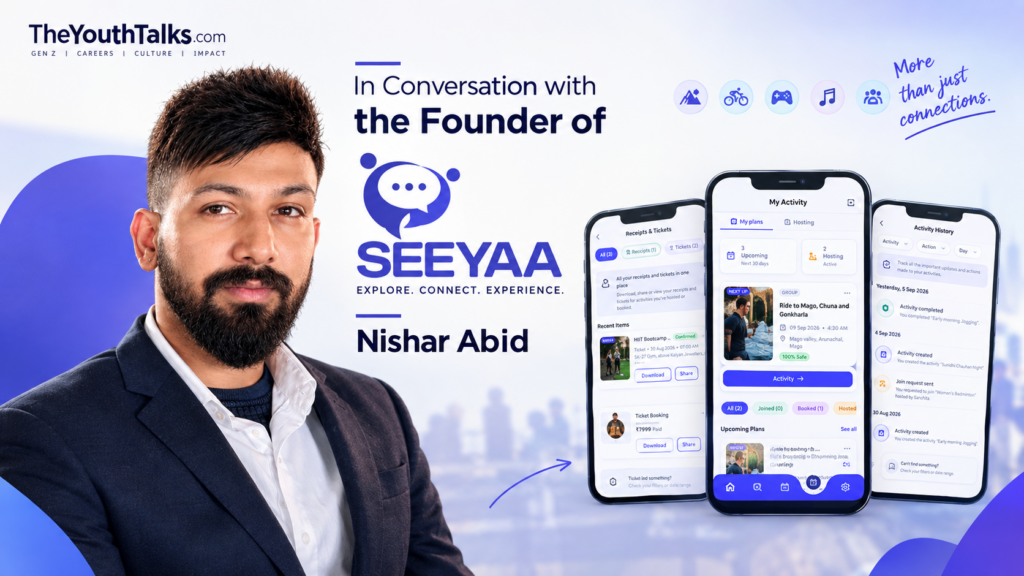
TheYouthTalks spoke with the founder of SeeYaa about social discovery, young Indians moving cities, the changing nature of friendship and why the next generation of social technology may be less about spending time online and more about helping people get offline.
The problem wasn’t a lack of people. It was discovering the right people at the right moment.
TheYouthTalks: Your idea appears to have emerged from three very different experiences — cycling, gaming and nightlife. What did those experiences collectively make you realise?
Nishar:
The three experiences were very different, but they all pointed towards exactly the same problem.
When I was living in Delhi, I bought a cycle assuming that I would eventually find people around me to ride with. There were cyclists around me, but I didn’t know them. Even when I found people who cycled, our timings, locations or plans didn’t necessarily match.
Then in Mumbai, I bought a PlayStation and FIFA. I had the equipment but nobody to play with. One evening I happened to meet someone who loved gaming too, but he didn’t have a PlayStation. We exchanged numbers and started playing together.
Later, I wanted to go to a premium club but couldn’t find anyone who wanted to join me that particular evening.
Three completely different situations — cycling, gaming and nightlife — but the underlying problem was the same.
It wasn’t necessarily a lack of people.
The right people probably existed nearby.
I simply couldn’t discover them at the right moment.
That became the starting point for SeeYaa.
From social networking to social discovery
TheYouthTalks: We have Instagram, WhatsApp, dating apps, gaming communities and hundreds of contacts. Why do you think finding someone who wants to do the same thing as us, at the same time, is still difficult?
Nishar:
Most social platforms are built around an existing social graph.
You follow people you already know, or people whose content you want to consume.
There are platforms for dating, ticketing, travel, gaming and events, but real life isn’t divided into such neat categories.
Sometimes you simply wake up on a Sunday and think, “What can I do today?”
Maybe you want to play badminton. Maybe there’s a concert nearby. Maybe you want to go cycling, try a new café, play football or simply explore the city.
You may have friends who enjoy those things, but they may not be free that particular day. So increasingly, the constraint isn’t necessarily “I don’t have friends.”
It is:
“Nobody I know wants to do what I want to do, when I want to do it.”
SeeYaa is built around expanding that pool beyond the people already saved in your phone.
“What do you want to do?” instead of “Who do you know?”
TheYouthTalks: SeeYaa flips the traditional social-network model from “Who do you know?” to “What do you want to do?” Why was that distinction important?
Nishar:
That’s the larger idea behind SeeYaa.
Instead of asking only “Who do you know?”, we want to ask:
“What do you want to do?”
And then help you discover the people, activities and experiences around you that match that intent.
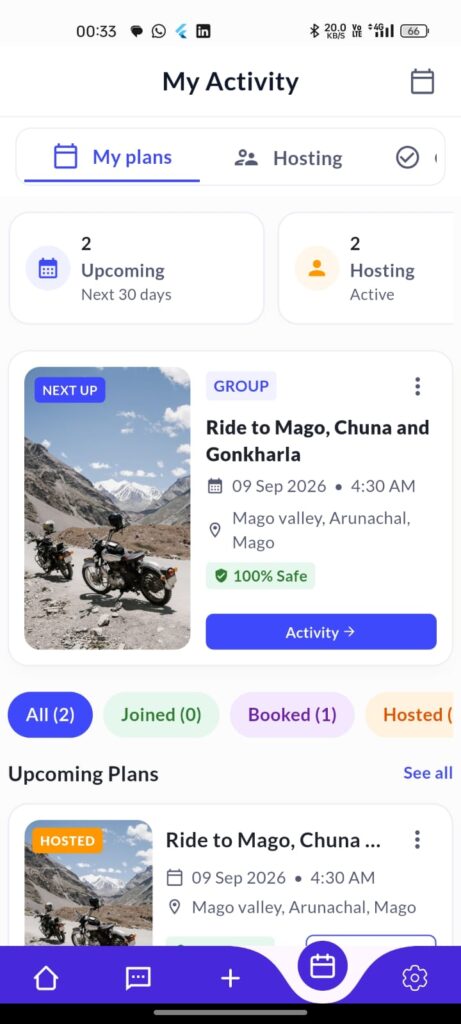
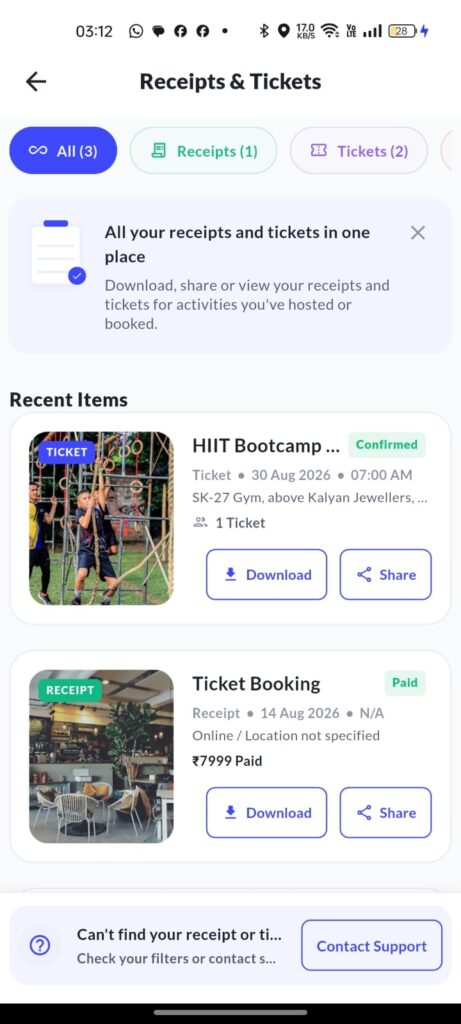
Imagine opening an app and discovering that someone a few kilometres away is looking for two more people for badminton tonight. Someone else is organising a Sunday cycling ride. A group is planning a trek. There’s a football game looking for another player. Someone wants a FIFA opponent.
You don’t necessarily need to become friends first and make plans later.
The plan itself can introduce you.
That’s what changes the conventional social-media equation.
Today, it is usually:
People → Connection → Conversation → Activity
SeeYaa wants to enable:
Activity → Connection → Conversation → Relationship
Sometimes friendship may follow. Sometimes it won’t.
And that’s perfectly fine.
The objective isn’t to manufacture friendships. It is to make shared experiences easier to discover.
Young Indians are constantly moving
TheYouthTalks: Young Indians are increasingly moving to cities for college, work and opportunities. Is SeeYaa primarily solving a problem for people entering a new city, or is the problem equally relevant to people who already have established friend circles?
Nishar:
Young Indians are increasingly mobile.
Someone from Guwahati might move to Bengaluru. Someone from Jaipur might move to Mumbai. Someone from Indore might move to Delhi.
You can arrive in a city containing millions of people and still know almost nobody.
But even people with established friend circles encounter another problem: adult schedules rarely align.
Your friends may love travelling but aren’t free this weekend. They may enjoy football but not at 7 AM. They may want to attend the same concert but can’t afford it that month. They may love nightlife but have work the next morning.
So the problem isn’t restricted to people who have no friends.
It’s also about expanding the pool of people you can do things with beyond your existing social circle.
What changes beyond India’s metros?
TheYouthTalks: You see an opportunity in Tier-II and Tier-III cities. What is different about social discovery in these markets?
Nishar:
The exposure to music, gaming, travel, fashion, nightlife, fitness, creators and global culture increasingly exists outside India’s largest metros.
Young people in Tier-II and Tier-III cities can have the same interests as someone in Mumbai or Bengaluru.
But the infrastructure for discovering local experiences and communities can be much more fragmented.
That’s where we see an opportunity.
The long-term ambition is to build city by city, creating enough density that wherever SeeYaa operates, opening the app gives you a meaningful answer to:
“What’s happening around me?”
The challenge of getting strangers to meet strangers
TheYouthTalks: You’re ultimately asking people who don’t know each other to meet offline. What has building SeeYaa taught you about trust and safety?
Nishar:
[FOUNDER TO RESPOND — this is not addressed in the supplied article.]
Solving the chicken-and-egg problem
TheYouthTalks: Every community platform faces the challenge of creating enough density for the product to become useful. What do you think about the city-by-city chicken-and-egg problem?
Nishar:
The ambition is to build city by city, creating enough density that the platform becomes useful wherever it operates.
From users to an “intent-based audience”
TheYouthTalks: You also see SeeYaa connecting users, communities, organisers and businesses. What does an “intent-based audience” mean in practice?
Nishar:
On one side, you have people asking:
“What should I do?”
On another, you have people saying:
“Who wants to join?”
And then you have organisers and businesses saying:
“We’re doing something. How do we reach the right people?”
SeeYaa can eventually connect all three.
For users, that means discovering people and experiences.
For communities, it means finding participants.
For organisers, it means discovering audiences.
And for venues and experience businesses, it creates an audience based not merely on demographics, but on intent.
A person actively searching for something to do on Saturday evening is fundamentally different from someone simply scrolling past an advertisement.
What happens to events when discovery becomes social?
TheYouthTalks: Could events eventually become more than transactions — with people discovering others who are attending, coordinating plans and continuing those connections afterwards?
Nishar:
Events are an important part of the opportunity.
Concerts, college events, workshops, parties, sports events, meet-ups and experiences already bring strangers together around a shared interest.
The opportunity is to make those experiences more social before, during and after they happen.
Discovering an event shouldn’t necessarily end with purchasing a ticket.
You could potentially see communities forming around it, discover others interested in attending, coordinate plans and continue interacting around shared interests.
That turns an event from a transaction into a potential social experience.
For organisers, SeeYaa could consequently evolve beyond discovery into ticketing, promotion, audience-building and community tools.
Is the future of social technology actually more offline?
TheYouthTalks: Your larger proposition seems almost counterintuitive: that perhaps the future of social technology isn’t about spending more time looking at other people’s lives, but about using technology to experience more of our own. Why do you believe that?
Nishar:
Social media solved one enormous problem:
How do we stay connected?
But perhaps the next generation of social products has to solve a different one:
What do we actually do with that connectivity?
Having 1,000 followers doesn’t necessarily give you someone to cycle with tomorrow morning.
Being in twenty WhatsApp groups doesn’t necessarily find you a FIFA opponent tonight.
Knowing hundreds of people doesn’t guarantee that one of them wants to attend the same event this weekend.
SeeYaa is therefore being built around a simple belief:
Shared interests become far more powerful when they become shared experiences.
The ambition isn’t to replace Instagram, WhatsApp, dating apps or traditional social networks.
It’s to solve a different part of our social lives.
To turn:
“I want to do this”
into
“Let’s do this.”
Looking ahead
TheYouthTalks: If SeeYaa succeeds, what do you think will fundamentally change about the way young Indians discover people, communities and experiences in their cities?
Nishar:
The larger ambition is to become the discovery layer for real-world social life.
A place you open not because you already know exactly what you’re looking for, but because you want to know:
Who’s around?
What’s happening?
What can I do?
And who can I do it with?
Perhaps the future of social technology isn’t about spending more time looking at other people’s lives through a screen.
Perhaps it’s about using that screen to go out and live more of our own.
That’s the future SeeYaa wants to build.
More Than Discovery: A Complete Platform for Organisers
SeeYaa isn’t designed only for the person looking for something to do. It is also being built for the people and businesses creating those experiences.
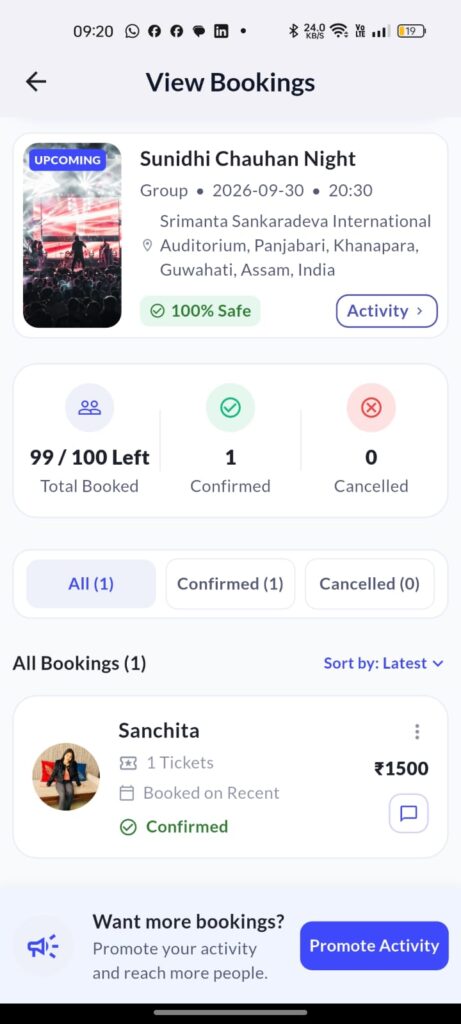
An organiser can create and publish an activity or event directly on SeeYaa, including ticketed events. Users can discover the event, choose their ticket, complete the booking and receive their digital ticket directly within the platform.
The experience continues at the venue. Organisers can use QR-based ticket verification through SeeYaa to scan and validate attendees’ tickets at the entrance, making the journey from discovery to attendance seamless.
But ticketing is only one part of what SeeYaa offers organisers.
The platform provides organisers with an integrated set of tools to manage their events, attendees, communication, promotion and business operations from a single place.
Through SeeYaa, organisers can:
- Create and publish activities and ticketed events
- Set ticket categories, pricing and availability
- Receive and manage bookings directly through the platform
- Generate digital tickets for attendees
- Scan and verify ticket QR codes at the venue
- Communicate with attendees through in-app messaging
- Send messages to multiple attendees at once
- Call attendees through in-app calling
- Export booking and attendee data
- Track bookings and attendance
- View their earnings and transaction information
- Withdraw eligible earnings through the platform
- Promote their activities and events
- Use AI-powered audience targeting to reach users who are more relevant to their event
- Access an integrated CRM for managing their audience and interactions
- Appoint team members or staff to help manage bookings and event operations through SeeYaa
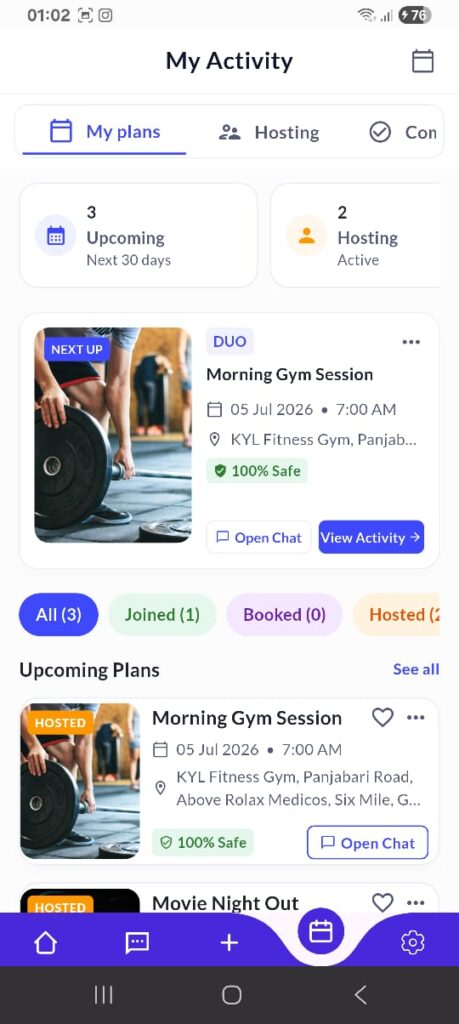 The platform also keeps the post-booking experience within the same ecosystem. If an event is eligible for a refund under the organiser’s and SeeYaa’s applicable terms and conditions, users can request and receive the refund through the platform itself.
This creates a journey that goes far beyond simply listing an event.
For an organiser, the journey can be:
Create → Promote → Target → Sell → Communicate → Manage → Verify → Track → Earn
For a user, it can be:
Discover → Connect → Book → Get Your Ticket → Attend → Experience → Review
The vision is to reduce the fragmentation that organisers often face when running an event. Instead of creating an event in one place, selling tickets somewhere else, communicating with attendees through messaging apps, maintaining booking information in spreadsheets and using separate tools for promotion and customer management, SeeYaa brings these functions together within one ecosystem.
This is an important part of SeeYaa’s larger vision: we don’t want to be just the place where people discover experiences. We want to build the infrastructure that helps those experiences happen.
For users, SeeYaa can help answer:
“What can I do, and who can I do it with?”
For organisers and businesses, it can answer:
“How do I create the experience, reach the right people, manage them and grow?”
That two-sided approach is what SeeYaa is ultimately trying to build—a platform connecting people, experiences, organisers and businesses in the real world.