Gen Z Says They Don’t Watch TV. The Data Tells a Different Story.
Ask most 18–24-year-olds in India a simple question: Do you watch TV?
The answer is usually immediate—Not really.
No hesitation. No nuance. Just a quick dismissal.
But ask the same person whether they watched a viral MTV Roadies audition clip on Instagram, debated contestants from Bigg Boss in a WhatsApp group, laughed at a Taarak Mehta Ka Ooltah Chashmah meme, or saved a startup pitch from Shark Tank India to rewatch later—and suddenly the answer changes.
That contradiction perfectly captures the state of youth media consumption in India today.
Gen Z is not rejecting television.
They are redefining it.
According to BARC India, India has nearly 210 million TV households, with weekly viewing crossing 800 billion viewing minutes. These numbers confirm one thing: television is still a dominant force in Indian media. Yet, for Gen Z, television no longer means sitting in a living room at 9 p.m. waiting for a show to begin.
Television today exists everywhere:
– On Instagram Reels
– On YouTube clips
– On meme pages
– In Discord conversations
– Through fan edits and reaction videos
In short, TV has become platform-agnostic.
That raises a fascinating question: What are Gen Z in India actually watching?
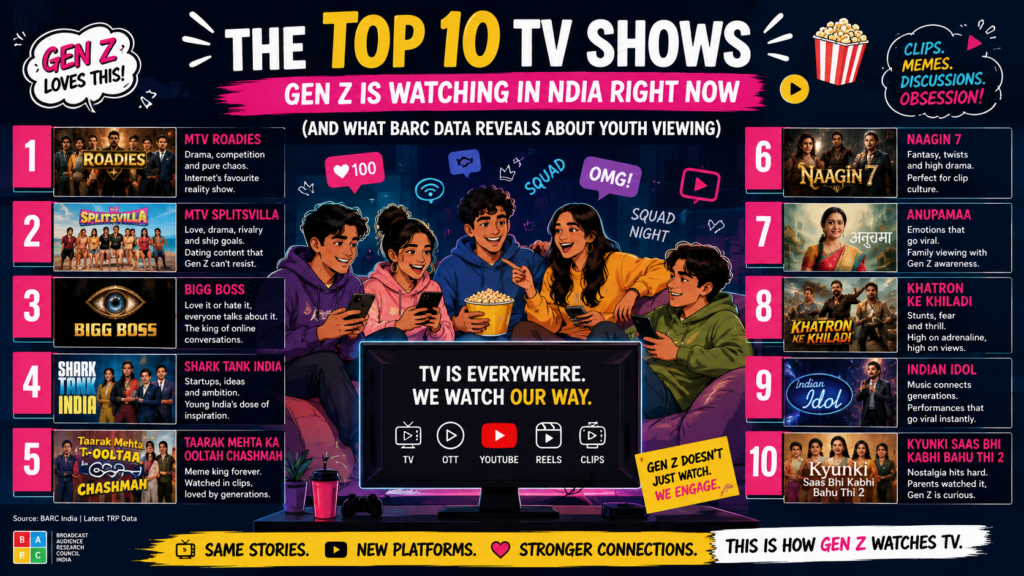
Using recent BARC performance, digital engagement trends, and youth cultural relevance, here are the top 10 TV shows shaping Gen Z attention right now.
1. MTV Roadies: Still the Ultimate Youth Reality Franchise
Few shows understand youth psychology as well as MTV Roadies.
Conflict. Competition. Ambition. Aggression. Redemption.
The formula hasn’t changed much over the years, and yet it continues to work.
What keeps Roadies relevant is not just television viewership—it is virality. One heated argument, one iconic one-liner, or one emotional backstory can spread across social media within hours.
I recently saw a college group discussing a Roadies audition clip with the same intensity people once reserved for cricket matches. That says a lot.
Roadies is no longer merely a TV show.
It is internet culture.
2. MTV Splitsvilla: Romance, Drama, and the Power of Ship Culture
Dating content has become one of Gen Z’s favorite entertainment categories.
That explains the enduring popularity of MTV Splitsvilla.
The show blends romance, betrayal, influencer aesthetics, and competitive tension into a format designed for binge-worthy consumption. Gen Z particularly loves “ship culture”—emotionally investing in contestant pairings and rooting for their favorite couples.
Drama travels fast.
Splitsvilla knows exactly how to engineer it.
3. Bigg Boss: Love It or Hate It, You’ll Talk About It
Very few Indian shows generate as much sustained conversation as Bigg Boss.
It thrives on emotional intensity.
Contestants fight. Alliances form. Friendships collapse. Social media explodes.
Even people who claim they “don’t watch Bigg Boss” somehow know exactly what happened last night.
That’s the power of cultural relevance.
For Gen Z, Bigg Boss is rarely consumed in a traditional linear way. Instead, it lives through:
– Fan wars
– Voting campaigns
– Meme pages
– Commentary channels
– Reaction content
Watching has become participative.
4. Shark Tank India: Where Business Became Cool
Perhaps the most surprising Gen Z favorite is Shark Tank India.
Its rise reflects a deeper cultural shift.
Young Indians increasingly admire founders, creators, and builders—not just celebrities. Entrepreneurship has become aspirational.
Students today are asking different questions:
– How do I build a startup?
– How do I raise capital?
– Can I become financially independent early?
That mindset aligns perfectly with Shark Tank.
The show transformed business conversations into mainstream entertainment.
For Gen Z, ambition itself has become content.
5. Taarak Mehta Ka Ooltah Chashmah: The Meme King of Indian TV
If there is one show that proves longevity matters, it is Taarak Mehta Ka Ooltah Chashmah.
This show has transcended generations.
Parents watch it on television. Gen Z watches it through memes, clips, and viral edits.
Characters like Jethalal have become cultural icons. Entire reaction formats online borrow from the show’s expressions and dialogues.
Ironically, many Gen Z viewers have never watched a full episode from start to finish.
And yet, they know every iconic scene.
That is modern media consumption.
6. Naagin 7: Fantasy Still Wins
Spectacle matters.
And Naagin understands spectacle extremely well.
Fantasy dramas continue to attract attention because they offer escapism, heightened emotions, and dramatic twists. BARC rankings consistently show strong performance during major plot developments.
Gen Z, especially online, embraces this with a degree of irony and affection.
Camp entertainment is cool again.
Shows that lean into theatrical absurdity often perform exceptionally well in clip culture.
7. Anupamaa: Emotional Storytelling Has No Age Limit
At first glance, Anupamaa feels like a classic family drama aimed at older audiences.
But Gen Z engagement tells a different story.
Why?
Because many younger viewers encounter it through co-viewing with parents or through viral clips online. Emotional scenes spark discussions about relationships, marriage, self-respect, gender expectations, and emotional labor.
These conversations resonate deeply with young audiences.
Even those who don’t watch daily remain highly aware of the show’s narrative arcs.
That awareness itself is powerful.
8. Khatron Ke Khiladi: High Adrenaline, Low Friction
Khatron Ke Khiladi offers exactly what short-attention-span audiences love: intensity.
Action. Stunts. Fear. Competition.
The visual nature of the show makes it extremely shareable in bite-sized formats. Whether it’s a dangerous stunt or a celebrity reaction, clips travel well across platforms.
Gen Z responds strongly to fast-paced, visually stimulating content.
This show delivers that consistently.
9. Indian Idol: Talent Still Creates Virality
Music remains universal.
That’s why Indian Idol continues to stay relevant among younger viewers.
A powerful performance can instantly go viral. A contestant’s emotional backstory can spark massive engagement. Musical moments are endlessly replayable.
In an era dominated by short-form content, music clips perform exceptionally well because they deliver emotional payoff quickly.
Talent still cuts through the noise.
10. Kyunki Saas Bhi Kabhi Bahu Thi 2: Nostalgia Gets Repackaged
Perhaps the most unexpected entrant is Kyunki Saas Bhi Kabhi Bahu Thi.
Its reboot reveals something fascinating: nostalgia is transferable.
Many Gen Z viewers are engaging with the show because their parents watched the original. The emotional attachment of one generation is being inherited by another.
This is cultural legacy in motion.
Sometimes, youth engagement is not built from novelty alone.
Sometimes, it comes from familiarity.
What BARC Data Doesn’t Fully Capture
Here lies the central insight.
Traditional TRP metrics measure television viewership. But Gen Z attention behaves differently.
They consume fragmented media.
They don’t always watch full episodes.
They don’t always watch on TV.
They don’t always watch live.
But they still engage deeply.
A show with moderate TRP can become culturally dominant if it wins social media.
This means brands and media companies need to rethink how they define “viewership.”
Because today, attention is distributed across platforms.
A 30-second viral clip can create more cultural impact than a 30-minute episode.
That is the new reality.
The Future of Youth Viewing in India
The biggest takeaway from current BARC trends is not simply which show ranks first.
It is something far bigger.
Gen Z does watch television—but not in the way previous generations did.
For millennials, television meant scheduled programming.
For Gen Z, television means discoverable content.
If it’s funny, dramatic, emotional, insightful, or meme-worthy, they will watch it.
They don’t care whether it originated on:
– TV
– OTT
– YouTube
– Instagram
Content is content.
Platforms are secondary.
That shift has permanently changed the media landscape.
And perhaps that is the most important lesson for brands, creators, and broadcasters alike:
Stop asking whether Gen Z watches TV.
Start asking where and how they experience culture.
Because they are absolutely watching.
Just not where you expect.