





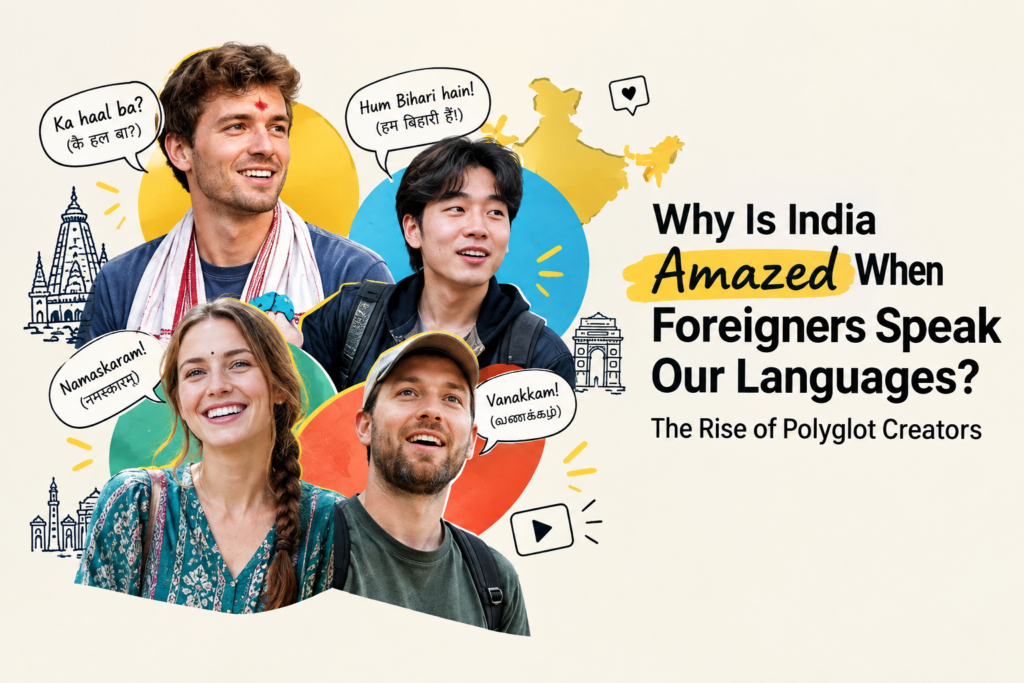
From an American speaking Bhojpuri to a Korean creator embracing his Bihari identity, multilingual creators are winning Indian social media. Their popularity reveals something about cultural pride, the power of recognition and the internet’s appetite for the unexpected.
Imagine scrolling through Instagram and coming across a foreigner speaking fluent Bhojpuri. Not just a greeting or a rehearsed sentence, but the language’s everyday expressions, familiar rhythms and local humour.
You might pause. You might replay the video. You might send it to a friend with a message that says, “Listen to this!”
But why?
Millions of Indians speak Bhojpuri, Hindi, Bengali, Malayalam, Marathi, Tamil and dozens of other languages every day. Yet when someone from another country speaks one of these languages fluently, social media often reacts as if it has witnessed something extraordinary.
The phenomenon is no longer limited to a few viral clips. International creators are building audiences by speaking Indian languages, performing regional humour and engaging with cultural references that many viewers recognise from their own lives.
Consider American creator Andrew Hicks, popularly known as Drew Hicks, whose fluency in Hindi and Bhojpuri helped him build a social-media following. In March 2024, he received the Best International Creator award at India’s National Creators Awards. His connection to India began in childhood, when his father’s work brought the family to Varanasi and Patna. Source: Hindustan Times
Then there is Yechan Lee, the South Korean creator known online as Charlie or @40kahani. Having spent around 20 years growing up in Bihar, he developed a natural command of Hindi and the regional accent. His online identity as a “Korean Bihari” reflects a connection that goes beyond learning a few phrases for a camera. Source: The Economic Times
These examples raise a bigger question for India’s creator economy: when a foreigner speaks our language, are we celebrating linguistic ability, cultural connection or simply the novelty of seeing ourselves through someone else’s eyes?
The answer may be a little of all three.
The novelty of the unexpected
Social media runs on surprise. A familiar situation becomes interesting when something about it defies expectations.
A person speaking their mother tongue is ordinary. A foreigner speaking it with remarkable fluency is unexpected. That contrast creates an immediate reason to watch.
The viewer may arrive out of curiosity, stay for the language and share the video because the experience feels delightful or unusual.
In that sense, multilingual creators have a natural advantage. They combine a recognisable cultural reference with an unexpected performer.
But the surprise is not always about language alone. An American speaking Bhojpuri may remind viewers of a region that rarely receives the same international attention as India’s major cities. A Korean creator using Bihari expressions can bring regional humour into a wider digital conversation. A foreigner speaking Malayalam may surprise people who are accustomed to seeing the language represented primarily by native speakers.
The internet turns these encounters into shareable moments.
The risk is that the novelty can overshadow the achievement itself. A creator may have spent years learning a language, yet the audience’s response can centre almost entirely on how surprising it is that someone with their appearance or nationality speaks it.
The question then becomes whether the audience is appreciating the skill — or simply reacting to an expectation being overturned.
Drew Hicks and the appeal of Bhojpuri
Drew Hicks is a particularly interesting example because his connection to Hindi and Bhojpuri is rooted in his early experiences in India.
His story complicates the assumption that Indian languages are merely an exotic interest for foreign travellers. For him, the languages are connected to childhood, memories, food and relationships.
His online popularity has also helped bring Bhojpuri into conversations beyond its usual audience. That matters because regional languages can be culturally significant to millions of speakers while receiving comparatively limited attention in national and international media.
There is something powerful about a language being recognised beyond its immediate community. It can signal that the language is worthy of curiosity, humour and serious engagement.
But we should be careful not to imply that Bhojpuri needs an international creator to validate it. Its cultural importance exists independently of social-media views.
The creator’s popularity can make a language more visible. It does not confer value on the language in the first place.
When the outsider becomes an insider
Yechan Lee’s story takes this idea further.
As reported by The Economic Times in April 2026, Lee’s years in Bihar shaped his command of Hindi and his sense of connection with the region. He has described the language not simply as a performance tool but as part of a personal identity built through lived experience. Source: The Economic Times
This is an important distinction.
Learning a language can begin with curiosity, travel, education, family or work. Over time, it can create relationships that make a person feel connected to a place. The resulting content can resonate because it reflects genuine familiarity rather than a superficial imitation of local speech.
It also challenges the idea that cultural identity must fit neatly into nationality. A person’s passport may tell us where they are from, but it cannot fully describe the languages they speak, the communities they belong to or the places that have shaped them.
For Indian audiences, a creator who speaks a regional language naturally can feel both surprising and familiar. The person is an outsider in one sense, but the language creates a point of connection.
That tension is part of the appeal.
Not every multilingual creator is doing the same thing
The category is broader than viral performances by foreigners speaking Indian languages.
Australian creator Joseph “Joe” Freeman has studied Hindi for decades and creates Hindi-language content. His journey, documented by SBS Hindi in July 2026, includes time spent in India and a deep engagement with the language beyond short-form entertainment. Source: SBS Hindi
American educator Eliza Keyton, known as Eli Kutty, takes a different approach by teaching Malayalam through short videos. Her content connects language learning with everyday relationships and cultural understanding. The Economic Times has also highlighted how her lessons help people navigate the experience of connecting with Malayali family members. Source: The Economic Times
German traveller Rainer Krack offers another example. In August 2026, The Indian Express reported that he had attracted attention for speaking Hindi, Bhojpuri and Marathi, developed through years of travelling in India. Source: The Indian Express
These creators illustrate different motivations: education, immersion, relationships, travel and entertainment.
Treating them all as people chasing the same viral trend would miss the point. Some have developed meaningful relationships with the languages they speak; others may use multilingualism as one element of a broader entertainment format.
The important question is not whether a creator is foreign. It is whether the content demonstrates genuine engagement with the language and the people who use it.
When cultural appreciation becomes a performance
There is a less comfortable side to this trend.
Social media rewards content that can be understood quickly and shared widely. That creates an incentive to exaggerate accents, simplify cultural differences or turn regional identities into punchlines.
A creator who speaks a few phrases in an unfamiliar language may attract attention without having much understanding of the culture behind it. Another might perform a stereotyped version of a community because the exaggeration generates laughs.
This does not mean every humorous impression is disrespectful. Comedy, mimicry and playful cultural exchange are not inherently harmful. The context, intent and execution matter.
But there is a difference between laughing with a community and making the community itself the joke.
It is also worth asking whether creators receive different reactions depending on who they are. A foreigner speaking an Indian language may be praised for being exceptionally talented, while an Indian who speaks several regional languages may be regarded as doing something ordinary.
That contrast is worth investigating, although it should not be assumed in every case. The attention a creator receives can depend on the quality of the content, the audience, the platform and the particular cultural moment.
For brands and marketers, the lesson is straightforward: multilingual content can build genuine affinity, but simply inserting a regional phrase or accent into a campaign does not automatically make it culturally relevant.
What does this tell us about India?
India’s linguistic diversity is often discussed as a challenge for communication, education and commerce. The popularity of multilingual creators offers another perspective: language can also be a source of identity, humour, belonging and digital discovery.
Regional-language content can make audiences feel seen. It can introduce viewers to unfamiliar communities and encourage people to learn languages beyond their own. It can also help creators connect with audiences who are not well served by English-first media.
At the same time, the surprise surrounding foreign speakers invites reflection. Why does fluency sometimes appear more remarkable when it comes from someone we did not expect to possess it? What assumptions do we make about who speaks a particular language? And how might those assumptions shape the way we value languages and the people who speak them?
These questions matter beyond social media. They touch on the status of regional languages, the prestige sometimes attached to English and the way cultural recognition is distributed.
The most productive response is not to dismiss the excitement. It is to use it as an opportunity to appreciate the languages themselves and the communities that keep them alive.
The language is the bridge, not the gimmick
Multilingual creators are succeeding because they bring together skill, surprise and cultural connection. Their content can entertain, educate and make regional languages more visible to wider audiences.
But the strongest examples are not necessarily those in which a foreigner delivers the most unexpected line. They are the ones in which language becomes a route to understanding another place, its people and their everyday lives.
For Indian audiences, that may be the most valuable part of the phenomenon. A creator speaking Bhojpuri, Malayalam or Marathi can remind viewers that their language travels beyond the places where it is commonly heard — and that someone else may find its expressions, humour and rhythms worth learning.
There is no need to turn every multilingual video into a debate about cultural appropriation, just as there is no need to assume every viral clip represents meaningful cultural exchange.
The better question is what remains after the surprise fades. Has the video encouraged someone to learn a new language? Has it introduced an audience to a community it knew little about? Has it helped people connect across cultural boundaries? Or has it reduced a language to a brief performance designed to collect views?
When a foreigner speaks our language, the surprise may earn the first view. What the creator does with that language determines whether the attention becomes something more meaningful.