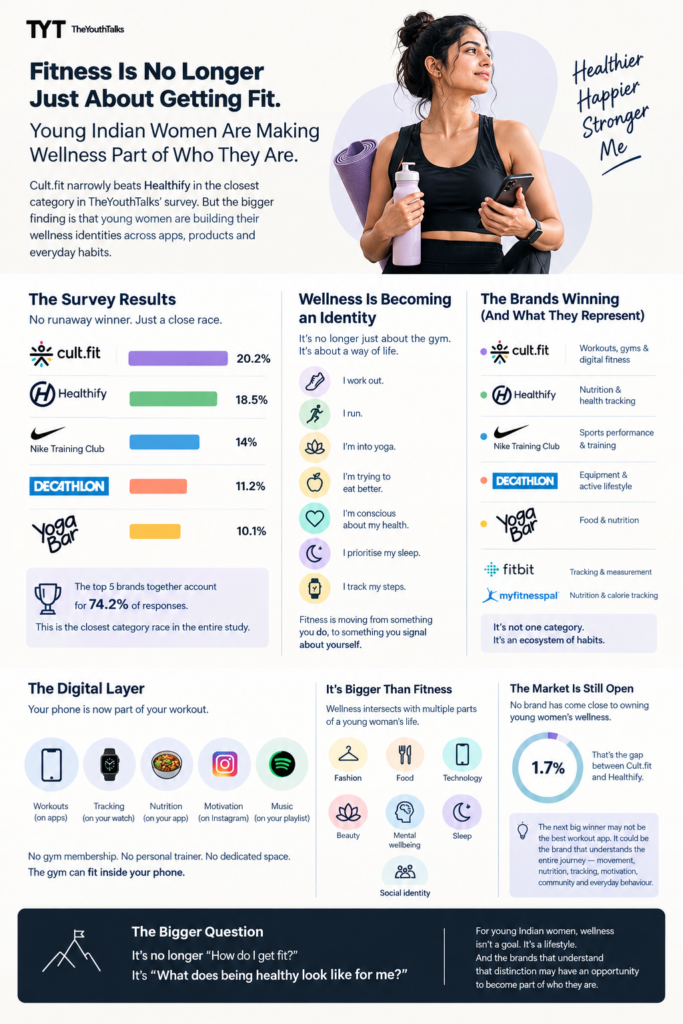
Cult.fit narrowly beats Healthify in the closest category in TheYouthTalks’ survey. But the bigger story is not who came first. It is why no brand has managed to pull away.
For years, fitness was fairly easy to define.
You went to the gym. You ran in the park. You played a sport. Perhaps you joined a yoga class or followed a workout routine. Fitness was something you did.
That definition is becoming increasingly inadequate.
For young Indian women, wellness is beginning to look less like a scheduled activity and more like a collection of everyday choices — what they eat, how they sleep, how many steps they take, what they wear, which app they open in the morning and even the kind of content they consume on Instagram.
The latest TheYouthTalks survey offers an interesting window into this shift.
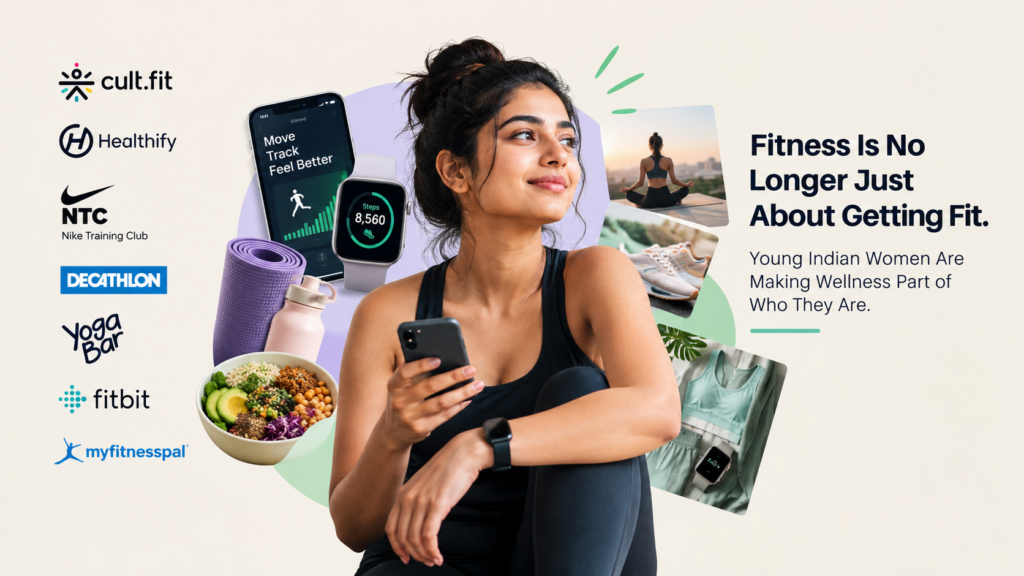
There is no runaway winner in the fitness and wellness category. Cult.fit leads with 20.2% of responses, only 1.7 percentage points ahead of Healthify at 18.5%. Nike Training Club follows at 14%, Decathlon at 11.2%, and Yoga Bar at 10.1%.
Together, the top five account for 74.2% of responses.
More strikingly, this is the closest category race in the entire study.
That narrow gap may actually tell us more about the consumer than about the brands.
It suggests that young women are not necessarily looking for one company to own their wellness journey. They are assembling that journey themselves.
Wellness Is Becoming Part of Identity
There was a time when saying “I am into fitness” probably meant one thing: I work out regularly.
Today, it could mean almost anything.
It could mean running three times a week. It could mean doing a 20-minute yoga session before college. It could mean tracking calories, increasing protein intake or trying to sleep eight hours every night.
It could even mean taking the stairs instead of the lift.
The individual actions are small. But together, they create something larger: an identity.
“I run.”
“I do yoga.”
“I am trying to eat healthier.”
“I track my steps.”
“I am conscious about my sleep.”
These statements are not merely descriptions of behaviour. They are increasingly ways in which young people describe themselves.
And that distinction matters.
A gym membership is transactional. An identity is emotional.
Once fitness becomes part of how someone sees herself, the products and services around that identity can become considerably more valuable. A smartwatch is no longer just a device. Activewear is no longer simply clothing. A nutrition app is no longer merely a calorie calculator.
They become signals of the person someone wants to be.
The Brands Winning the Category Tell the Same Story
Look at the brands appearing at the top of the survey.
Cult.fit — 20.2%
Healthify — 18.5%
Nike Training Club — 14%
Decathlon — 11.2%
Yoga Bar — 10.1%
These aren’t five versions of the same business.
They represent five different entry points into wellness.
Cult.fit brings workouts, gyms and digital fitness together. Healthify approaches the space through nutrition and health tracking. Nike Training Club brings a global sports and training proposition. Decathlon occupies the equipment and active-lifestyle space. Yoga Bar enters through food and nutrition.
And that is precisely the point.
Young consumers don’t necessarily experience these as separate categories.
A woman might use Cult.fit to exercise, Healthify to monitor what she eats, Decathlon to buy running gear and Yoga Bar when she wants a convenient snack.
Her wellness routine can span four brands without any sense of contradiction.
The consumer journey is fragmented because wellness itself has become fragmented.
Your Phone Has Become Part of Your Workout
Perhaps the biggest structural change is the role of technology.
For a young woman today, the gym does not necessarily begin when she walks into a physical fitness centre.
It can begin when she opens an app.
Her phone can provide the workout.
Her smartwatch can measure her heart rate.
Her app can track calories.
YouTube can provide a yoga session.
Instagram can provide motivation.
Spotify can provide the soundtrack.
A food-delivery app can help her choose a healthier meal.
The technology layer has effectively collapsed the distance between wanting to become healthier and doing something about it.
This has dramatically lowered the entry barrier to fitness.
You do not necessarily need a gym membership. You may not need a personal trainer. You do not even need a large space at home.
You can exercise in your bedroom, track the workout on your phone and measure the result on your wrist.
The gym, in a very real sense, can now fit inside your phone.
But There Is No Single Definition of “Healthy”
The survey’s unusually close competition also reveals something else.
There is no universally accepted version of wellness among young women.
For one person, fitness might mean strength training.
For another, it might mean running.
For someone else, it could be yoga, mindful eating or simply becoming more active during the day.
And increasingly, mental wellbeing and physical wellbeing are difficult to separate.
Someone trying to sleep better may start exercising.
Someone exercising regularly may become more conscious about nutrition.
Someone tracking nutrition may become interested in strength training.
Someone discovering yoga may eventually explore meditation.
One habit leads to another.
This is why the category cannot easily be reduced to “fitness.”
It is becoming an ecosystem of habits.
The Wellness Consumer Is Mixing and Matching
This creates an interesting challenge for brands.
Historically, companies competed within relatively defined categories. Gyms competed with gyms. Sportswear brands competed with sportswear brands. Food companies competed with food companies.
Wellness is making those boundaries increasingly porous.
A fitness app can compete for attention with a running community.
A sportswear brand can become a lifestyle brand.
A nutrition company can become part of someone’s fitness routine.
A smartwatch can influence behaviour rather than simply record it.
And social media creators can sit in the middle of all of these categories, connecting products, habits and aspiration.
The consumer doesn’t necessarily care where the category boundaries exist.
She is simply building a routine that works for her.
This Is Bigger Than Fitness
That makes the opportunity considerably larger than the gym or workout market.
Wellness increasingly touches fashion, food, technology, beauty, sleep, mental wellbeing, entertainment and social identity.
Consider a hypothetical young professional in Bengaluru.
She may start running because she wants to become fitter. She buys running shoes. She downloads a tracking app. She begins watching videos about nutrition. She increases her protein intake. She starts paying attention to sleep. Six months later, fitness is no longer one activity on her weekly calendar.
It has become a lifestyle.
That transition is where the real brand opportunity lies.
Companies that think narrowly about a product may capture a transaction.
Companies that understand the broader behaviour can potentially become part of a consumer’s everyday life.
The Digital-First Consumer Is Changing the Fitness Funnel
The rise of digital fitness also changes how brands acquire and retain consumers.
The old funnel might have looked something like this:
Awareness → Gym visit → Membership → Workout
The new journey can be far less linear.
Instagram → Creator → App → Workout → Tracker → Nutrition → Community → Product
A consumer may discover a workout through a creator, download an app, buy equipment from a marketplace, track her progress on a smartwatch and share the experience with friends.
There is no single starting point.
That matters because brands can no longer assume that owning one part of the journey means owning the consumer.
The consumer can enter the wellness ecosystem almost anywhere.
Why the 1.7-Point Gap Matters
The most interesting number in the TheYouthTalks survey may not actually be Cult.fit’s 20.2%.
It may be 1.7%.
That is the gap separating Cult.fit from Healthify.
If one brand had scored 40% while everyone else remained far behind, the story would have been about market leadership.
Instead, the category is remarkably distributed.
Cult.fit has a lead, but it does not have ownership.
Healthify is close behind. Nike Training Club has a meaningful share. Decathlon and Yoga Bar also command significant consideration.
The market, therefore, appears open.
More importantly, it suggests that young Indian women have not settled on one definitive answer to the question of what wellness should look like.
That could change.
But for now, the consumer is doing something far more interesting: she is creating her own answer.
The Next Wellness Brand May Not Look Like a Fitness Brand
This is perhaps the biggest implication for marketers.
The next major wellness brand does not necessarily have to be another gym, workout app or sportswear company.
It could come from nutrition.
It could come from technology.
It could come from beauty.
It could come from fashion.
It could even come from a company that today has very little to do with fitness.
The opportunity is to understand the behavioural system rather than simply the individual product.
Movement. Nutrition. Sleep. Tracking. Motivation. Community. Recovery. Mental wellbeing.
These are no longer isolated consumer needs.
They increasingly intersect.
And the brand that can connect them without making wellness feel like another chore could occupy a powerful position in the lives of young consumers.
The Question Is No Longer “How Do I Get Fit?”
The fitness industry has spent decades trying to answer a relatively straightforward question:
How do I help people get fit?
Young Indian women may be asking a different question now.
What does being healthy look like for me?
That is a much more personal question.
And perhaps that is why there is no runaway winner in this category.
The consumer isn’t waiting for one brand to tell her what wellness means. She is experimenting, combining, adapting and making it her own.
For brands, the lesson is equally clear.
Don’t just sell the workout.
Don’t just sell the protein bar.
Don’t just sell the smartwatch.
Understand the life around the product.
Because fitness may have started as something people do.
For a growing generation of young Indian women, wellness is becoming something they identify with.
And the brand that understands that distinction may have an opportunity to become much more than a fitness brand.
It could become part of who the consumer believes she is.