





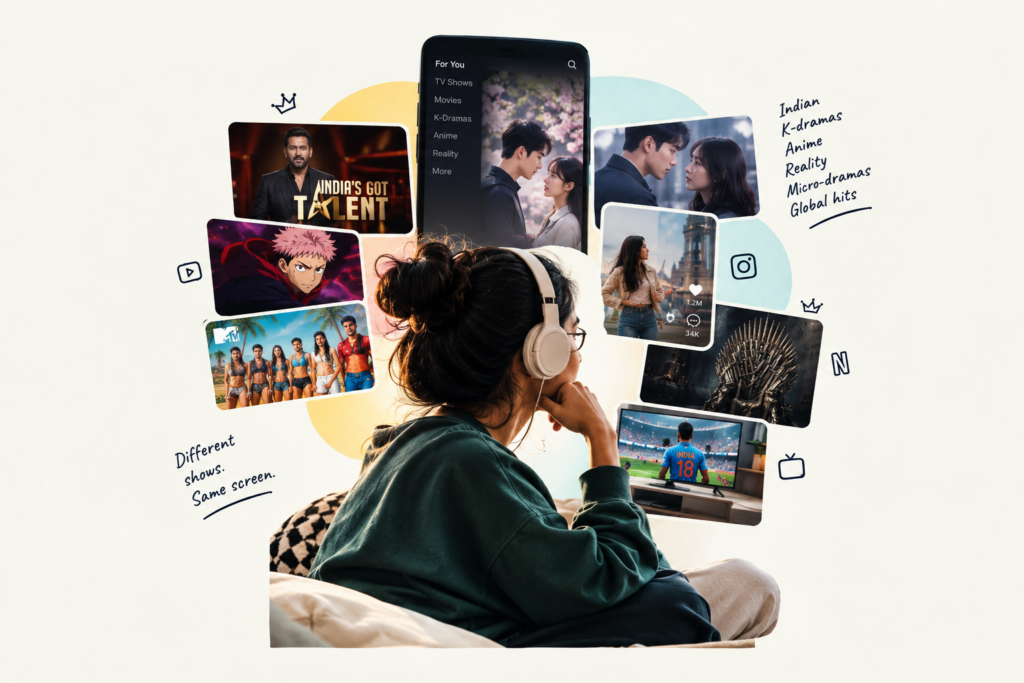
From K-dramas and anime to micro-dramas, reality shows and Indian originals, the country’s young viewers are building a far more fragmented — and global — entertainment culture.
There was a time when asking an Indian youngster what they were watching would probably have produced a fairly predictable answer.
A television serial. A cricket match. A Bollywood film. Perhaps a popular reality show.
Today, the question is considerably harder to answer.
A 20-year-old in India could be watching a Hindi reality show on one screen, a Korean drama on another, discovering an anime recommendation through social media and spending the next half-hour watching short-form videos or a micro-drama on a phone.
The old idea of “television viewing” doesn’t quite capture this behaviour anymore.
India’s latest digital video numbers make the scale of that change clear.
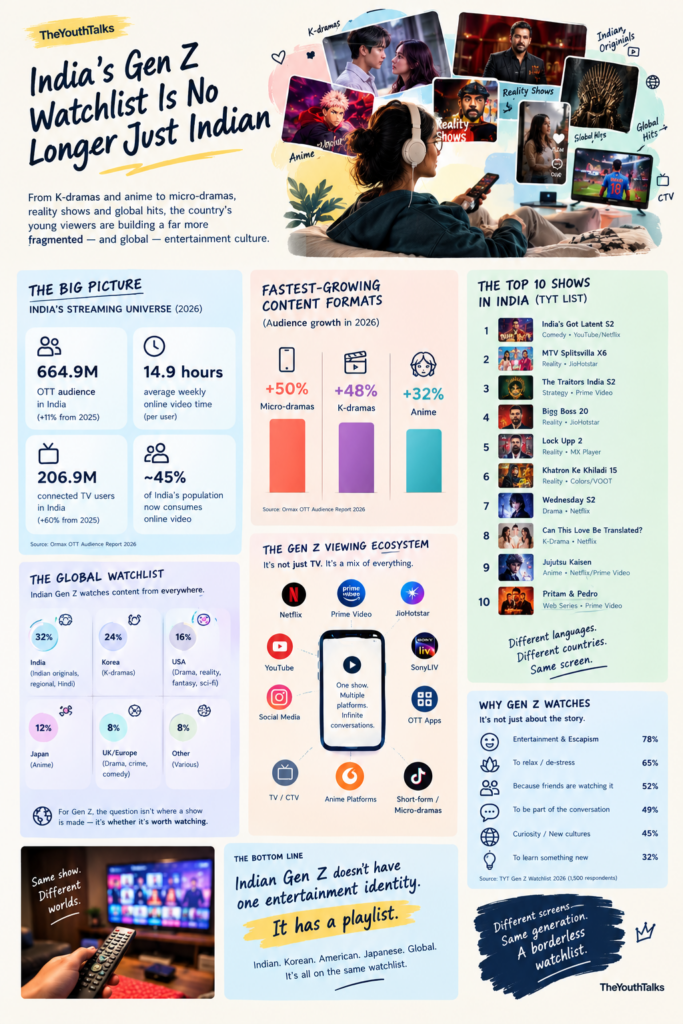
According to the Ormax OTT Audience Report 2026, India’s OTT audience has reached an estimated 664.9 million people, an 11% increase from 2025. Around 45% of India’s population is now consuming online video. Even more strikingly, the country’s Connected TV audience has grown 60% in a year to reach 206.9 million.
But perhaps the most interesting part of the report isn’t simply how many Indians are watching.
It is what they are watching.
Micro-dramas, K-dramas and anime have emerged as the fastest-growing content formats, with their audiences growing by 50%, 48% and 32% respectively.
For India’s Gen Z, that matters.
Because this generation isn’t simply inheriting the entertainment habits of previous generations.
It is helping create a new one.
The Indian watchlist is getting bigger
Ormax estimates that the average Indian OTT audience now spends 14.9 hours every week watching online video. That figure includes content consumed across social media, micro-drama platforms and FAST channels, translating into an estimated 517 billion hours of annual video consumption.
That is an extraordinary amount of time.
But the more interesting question is where those hours are going.
The answer increasingly seems to be: everywhere.
The modern Indian viewer does not necessarily think in terms of television, OTT or social media as completely separate entertainment worlds.
A show can begin with an Instagram Reel.
A recommendation can come from YouTube.
A trailer can appear while scrolling through a social feed.
A friend can send a WhatsApp message saying, “You have to watch this.”
The viewer then moves to Netflix, JioHotstar, Prime Video or another platform.
The conversation returns to social media.
The content comes full circle.
For Gen Z, the entertainment ecosystem is not a collection of separate platforms. It is one continuous feed of discovery, viewing and conversation.
K-drama is no longer a niche interest
One of the clearest signals of this changing watchlist is the rise of Korean dramas.
Ormax estimates that 107.8 million Indians watch K-dramas at least once a month, up from 72.9 million in 2025 — a remarkable 48% increase in one year.
The audience is also notably female-skewed. Ormax says 60% of India’s K-drama viewers are women, while 23% of female OTT audiences watch K-dramas compared with 11% of male OTT audiences.
This is important because K-dramas are no longer simply imported entertainment consumed by a small fandom.
They are increasingly part of India’s mainstream digital culture.
And the phenomenon extends beyond individual shows.
K-drama audiences are discovering Korean fashion, beauty, food, music, language and cultural references alongside the stories they watch.
The content travels further than the screen.
Ormax’s StreamView tracking found that eight K-dramas featured on its weekly Top 50 most-watched OTT properties in India during 2026 so far.
That tells us something significant about the Indian entertainment market.
Young Indians may still love Indian storytelling.
But the definition of what feels culturally relevant is expanding.
Anime is moving into the mainstream
The same story is playing out with anime.
For years, anime in India was often treated as a specialised fandom — something associated with a relatively small group of passionate viewers.
That distinction is becoming harder to sustain.
Ormax reports that India’s anime audience grew 32% in 2026, placing anime among the fastest-growing content formats in the country.
The important shift isn’t simply that more people are watching anime.
It is that anime increasingly functions as a social identity and fandom ecosystem.
Characters become profile pictures.
Scenes become memes.
Fan edits circulate through social media.
Recommendations move through friend groups.
Merchandise, gaming, cosplay and online communities extend the experience beyond watching an episode.
This is particularly relevant to Gen Z because entertainment increasingly isn’t just about consumption.
It is about participation.
A show becomes more valuable when there is something to do with it after the episode ends.
The rise of the micro-drama viewer
Perhaps the most disruptive finding is the growth of micro-dramas.
According to Ormax, the audience for micro-dramas grew 50% in 2026, making them the fastest-growing of the three highlighted formats.
Research by Meta and Ormax offers an even more revealing picture.
89% of micro-drama viewers discover the format through social feeds and recommendations, while viewers typically consume it in short, repeat sessions throughout the day. Around 90% of viewing happens alone.
That changes the traditional idea of what a “show” is.
The viewer may not sit down at 9 p.m. to watch an episode.
They may watch three minutes while travelling.
Another five minutes between classes.
Another episode while eating.
Another while waiting for someone.
The phone isn’t simply becoming a smaller television.
The behaviour itself is changing.
This is particularly relevant to Gen Z, whose entertainment habits were formed in an environment of feeds, notifications and on-demand content.
The question is no longer only:
“What do you want to watch?”
It is increasingly:
“What can capture your attention right now?”
But television isn’t dead
There is another finding in the Ormax report that complicates the usual narrative.
Connected TV is growing rapidly.
India’s CTV audience has reached 206.9 million, up 60% from 129.2 million in 2025.
That means the future of Indian entertainment isn’t necessarily a simple journey:
TV → smartphone → streaming.
Instead, it may be:
TV + smartphone + laptop + social feed + streaming + short-form video.
The screen is changing depending on the situation.
A person might watch a short clip on their phone, a full episode on a laptop and a movie with their family on a connected television.
The same viewer can behave like three different audiences during the same day.
And Gen Z is likely to be particularly comfortable moving between those contexts.
The show no longer ends when the episode ends
There is another reason this matters.
A successful show today increasingly exists in several places simultaneously.
There is the actual programme.
Then there are clips.
Memes.
Reaction videos.
Fan theories.
Instagram edits.
YouTube discussions.
Reddit threads.
WhatsApp conversations.
Influencer commentary.
A viewer may spend an hour watching a series and another hour consuming content about that series.
This is where India’s Gen Z viewing culture becomes particularly interesting.
The value of a show is no longer determined only by its ratings.
It can also be measured by how much conversation it generates.
Ormax’s StreamView data provides a useful benchmark here because it attempts to answer a basic question that has become surprisingly difficult in India’s fragmented streaming market:
What is India actually watching?
Its January–June 2026 watchlist tracks the 50 most-watched properties on streaming in India across formats, genres, languages and platforms. Ormax notes that its framework was created partly because India’s streaming ecosystem lacks a single central measurement system and because platforms often report different types of metrics.
That fragmentation is itself part of the story.
India’s Gen Z doesn’t have one entertainment culture
Consider what an Indian 20-year-old’s watchlist can now contain.
A Hindi reality show.
A Korean romance.
A Japanese anime.
An American teen drama.
A Hindi comedy special.
A micro-drama discovered on a social feed.
An Indian regional-language series.
A YouTube creator.
There is no contradiction in this combination.
For earlier generations, international entertainment often arrived through a relatively limited number of television channels, movie releases or physical media.
Gen Z has grown up with an almost unlimited catalogue.
The result is not necessarily the disappearance of Indian culture.
It is the removal of the borders around it.
Young Indians can be deeply invested in Indian creators while simultaneously consuming Korean, Japanese, American and European entertainment.
They don’t necessarily classify these choices as “foreign content.”
They simply classify them as good content.
And that may be the biggest change of all
The Indian entertainment industry has traditionally been organised around categories:
Hindi.
Regional.
Television.
Cinema.
OTT.
Youth.
Family.
International.
But the viewer doesn’t necessarily care about those categories anymore.
A Gen Z viewer’s watchlist is likely to be organised around something much simpler:
“Is this worth my time?”
That is a profound shift.
Because attention has become the scarce resource.
There are now more platforms, more shows, more creators and more formats competing for it than ever before.
Ormax’s 2026 numbers show just how large that competition has become: 664.9 million Indians consuming online video, 14.9 hours of weekly consumption per OTT audience member, 206.9 million connected-TV viewers and rapidly expanding categories such as K-dramas, anime and micro-dramas.
The next battle may therefore not be about getting people to watch television.
They already are watching.
The battle is about earning a place on an increasingly crowded watchlist.
The future Indian watchlist will be borderless
Perhaps the easiest way to understand India’s new entertainment generation is to stop asking:
“What kind of shows does Gen Z like?”
And start asking:
“What makes a show travel?”
A Korean drama can travel because its characters feel relatable.
An anime can travel because its fandom is participatory.
A reality show can travel because every episode becomes a conversation.
A micro-drama can travel because it fits naturally into the rhythm of a mobile-first life.
An Indian original can travel because it speaks to an experience young Indians recognise.
Different formats.
Different languages.
Different platforms.
But the same underlying competition:
attention, relevance and conversation.
The next generation of Indian viewers isn’t choosing between television and streaming.
It isn’t choosing between Indian and international entertainment.
It isn’t even choosing between long-form and short-form in the way the industry once imagined.
It is choosing whatever fits the moment.
And that may be the defining characteristic of India’s new entertainment culture.
The Indian Gen Z watchlist is no longer a channel schedule.
It is a global playlist.