

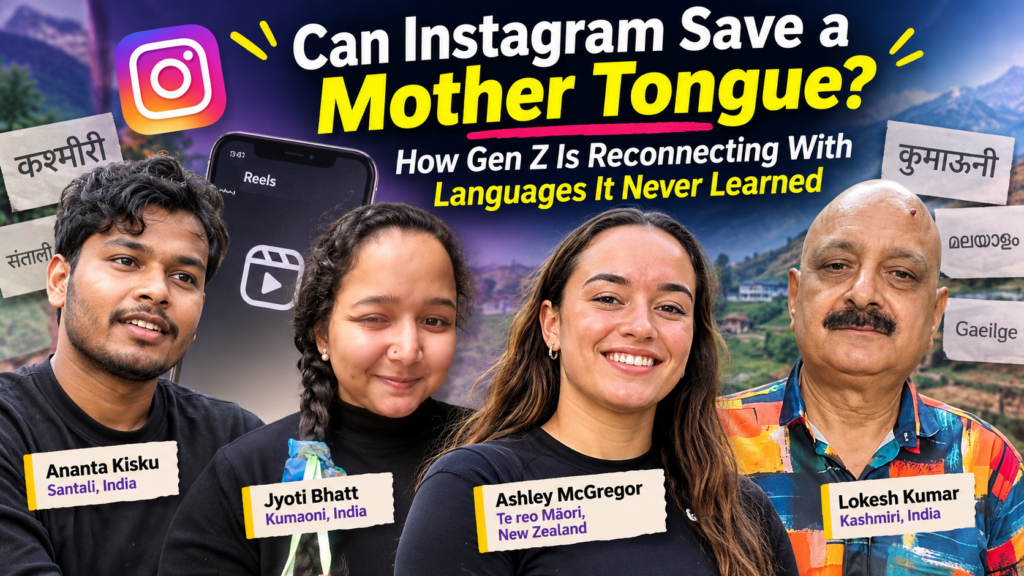
From Kashmiri and Santali in India to Scots in Scotland and te reo Māori in New Zealand, a new generation of creators is using social media to make inherited languages visible, relatable and relevant again. But can a viral reel do what families, schools and communities have struggled to achieve?
For many young Indians, the first encounter with their mother tongue may not happen in a classroom or through a conversation with their grandparents. It might happen while scrolling through Instagram.
A young person comes across a reel explaining an unfamiliar word in Kashmiri. Another discovers a creator translating romantic expressions into Santali. Someone else begins watching comedy sketches in Kumaoni because the jokes remind them of conversations at home.
These encounters may seem small. But they point towards a larger cultural shift: social media is becoming an unexpected entry point for young people trying to reconnect with languages they understand only partially, rarely speak or never had the opportunity to learn.
For generations, languages were passed down through everyday interactions. Children learnt expressions by listening to parents, grandparents and neighbours. They picked up vocabulary through conversations, songs, stories and local traditions.
But migration, urbanisation, changing family structures and the growing dominance of a few widely spoken languages have altered that process. Many young people have grown up in households where a regional language is understood by older family members but is not necessarily spoken by the younger generation.
Now, creators are experimenting with a different approach. They are turning vocabulary into short videos, proverbs into explainers, poetry into reels and everyday conversations into comedy. Instead of asking young people to attend a language class, they are bringing language lessons into the platforms they already use.
The question is whether this digital discovery can become something more lasting.
The language that gets lost between generations
The experience of young Kashmiri Pandits offers one window into this challenge.
Following the exodus of Kashmiri Pandits from the Valley, many families rebuilt their lives elsewhere. For younger generations raised outside Kashmir, opportunities to use Kashmiri in everyday life became more limited. The language remained present in family memories, songs and expressions, but speaking it confidently was not always a natural outcome.
The story of Teena Wali, featured in a recent report on Kashmiri language creators, captures this distance. When she used the expression ‘Batt Khoyata?’ in front of her family, they were surprised. She had learnt it from an Instagram reel.
The creator behind the account, Learn Kashmiri With Papa, is Lokesh Kumar, who began making content after retirement. According to the report, his page has attracted a learner community of more than 3,000 people, many of them young. Followers have even approached him about Zoom classes and individual lessons.
This is an important distinction. The audience is not necessarily looking for entertainment alone. Some viewers want to move beyond learning a handful of expressions and understand the language more deeply.
The challenge of language transmission among displaced Kashmiri Pandit families is not unique. Research published in the Interdisciplinary Journal of Linguistics in 2023 examined language preferences among 400 migrant Kashmiri Pandit respondents aged 10–30 in Jammu and Udhampur. It identified a shift towards Hindi among younger respondents, while highlighting the continuing importance of grandparents in preserving Kashmiri through speaking and listening.
The research helps explain why a social media encounter can become meaningful. It offers an additional point of access to a language that may no longer be part of a young person’s everyday environment.
From Santali vocabulary to Kumaoni comedy
Kashmiri is only one example of this emerging activity in India.
In 2021, graphic designer Ananta Kisku started Olitun, a digital initiative focused on Santali language and culture. Through Facebook, Instagram and YouTube, he began creating vocabulary content, picture dictionaries and explanations of everyday words.
One of his videos, featuring romantic expressions in Santali, prompted a young follower to contact him. The viewer wanted to know how to say ‘I love you’ in his mother tongue. He knew how to express it in English and Bengali but did not know the Santali equivalent.
The incident revealed something important: language loss does not always mean that people have rejected their mother tongue. Sometimes, they simply lack the vocabulary to use it in situations that matter to them.
Kisku’s work makes language learning accessible through familiar formats. A word can be introduced through a picture, a translation or an everyday situation rather than a formal lesson. The Indian Express reported that Santali-speaking followers were using the platform to learn words they had heard from grandparents but had not necessarily learnt from their parents.
A similar approach is visible in Uttarakhand.
Jyoti Bhatt began uploading Kumaoni skits in 2021. Her first video reportedly received more than 5,000 views within 30 minutes. Her mother helps her identify phrases and checks the language used in her videos.
Bhatt’s audience includes Uttarakhandis who have moved to other parts of India or abroad. For them, the videos offer more than entertainment. They create a familiar cultural space in a digital environment where much of the content they encounter may be in Hindi or English.
Then there is Zoha Sanofer, who uses comedy and everyday family situations to introduce Dakhini to social media audiences. Rather than presenting the language as an academic subject, her videos draw on familiar interactions and humour.
These examples reveal different ways of making a language accessible. Santali vocabulary lessons provide a learning resource. Kumaoni skits preserve everyday speech and cultural references. Dakhini comedy makes the language entertaining and shareable.
The common factor is that the language is being used, not merely discussed.
The global movement: from Scots to Māori
This is not an exclusively Indian phenomenon.
In Scotland, poet and social media creator Len Pennie has become one of the most visible contemporary advocates for the Scots language. With more than a million followers across social platforms, she uses poetry, explanations and word-of-the-day videos to introduce Scots to audiences around the world.
A word such as ‘hurkle-durkle’, describing the act of staying in bed when one should be getting up, gained attention online. For many viewers, the appeal began with the unusual expression. But it also opened a window into a language that has historically existed in the shadow of English.
National Geographic reported in February 2026 that around 70% of Pennie’s social media audience was based in the United States. Her work demonstrates how a language can find new audiences far beyond the place where it originated.
The experience of te reo Māori creators in New Zealand offers another perspective.
Ashley McGregor began posting running videos in te reo Māori, accompanied by captions. Her intention was to incorporate the language into an activity she already enjoyed. Her content inspired other creators, including Rongopai Tickell, to make similar videos.
Tickell has described content creation as a way of keeping herself accountable to speaking the language. This is an interesting reversal of the traditional teacher-student relationship. The creator is also a learner, using the platform to practise, receive feedback and become more confident.
In Chile, the Kimeltuwe initiative has taken a more structured educational approach to Mapuzugun, the Mapuche language. Its creators use illustrations, digital teaching materials and social media posts to make the language accessible. UNESCO’s 2023 digital-language toolkit documented more than 216,000 followers for the initiative on Facebook.
One of its notable approaches was interpreting commonly used emoticons in Mapuzugun. It took a familiar feature of online communication and used it to introduce the language in a contemporary context.
In Hawaii, creators have also been using Instagram, Facebook and TikTok to increase the visibility of ʻōlelo Hawaiʻi. Maluhia States, behind the account Ka Alalā, has worked to bring the sound and expressions of native speakers into his digital content. His experience raises an important issue: learning a language is not just about memorising translations. Pronunciation, context and the way people naturally speak are equally important.
Across these examples, social media is being used in different ways. Some creators are building vocabulary, some are normalising everyday speech, while others are documenting expressions and cultural knowledge that might otherwise remain inaccessible to younger audiences.
Why the format matters to Gen Z
The significance of these initiatives is not simply that they use Instagram or TikTok. It is that they understand how younger audiences consume and interact with content.
A traditional language lesson generally follows a structured progression: vocabulary, grammar, pronunciation and practice. Social media works differently. A person may encounter a word without intending to learn a language at all.
A funny expression, a family joke or a translated lyric can generate curiosity. The viewer may save the video, share it with a friend, ask a question in the comments or follow the creator.
The next interaction could be more meaningful. Someone might ask a grandparent what a particular expression means. Another might begin using a word in a family WhatsApp group. A third might look for a structured course.
The content is not necessarily replacing formal learning. It may be creating the motivation to begin.
There is also an important social dimension. For some young people, speaking a regional or indigenous language can feel uncomfortable, particularly if their education and professional lives have largely taken place in another language.
Short-form content can make the first step less intimidating. A young person does not have to demonstrate fluency to participate. They can learn a word, ask a question or share a phrase.
The experience of Tenyidie, spoken by the Angami community in Nagaland, illustrates this challenge. A 2026 report by the People’s Archive of Rural India described young people trying to make the language more visible through reels, memes and social media posts. One young speaker explained that speaking Tenyidie could feel formal and uncomfortable.
The issue, therefore, is not always a lack of access to the language. It can also be a lack of everyday spaces in which young people feel comfortable using it.
Can a viral reel become a language classroom?
There are limits to what social media can achieve.
A 30-second video can introduce a word, but it cannot necessarily teach the grammar, pronunciation, context and variations required to use that word correctly. A proverb can be translated, but its cultural meaning may depend on a story that cannot fit into a short clip.
There are also questions about accuracy. Who checks the words and translations? How are regional variations handled? What happens when different speakers disagree about pronunciation or usage?
The involvement of older speakers can be valuable here. In Bhatt’s case, her mother helps verify the language used in her videos. That relationship illustrates how digital creators can work with people who carry deeper linguistic knowledge.
The next step for many of these initiatives could be to move beyond individual videos towards structured learning resources: searchable dictionaries, pronunciation libraries, online classes, recorded conversations, children’s stories and digital archives.
UNESCO’s Digital Initiatives for Indigenous Languages toolkit makes a similar broader argument. Digital language preservation is not simply about putting more words online. It involves normalising language use, educating new audiences, supporting communities and giving indigenous voices greater control over their digital representation.
The organisation has highlighted social media campaigns, videos and meme-based initiatives as useful approaches, but digital activity is only one part of a larger preservation effort.
A language needs people who speak it at home, opportunities to use it in education and public life, and communities willing to pass it on. Social media can support those conditions, but it cannot create all of them on its own.
A new opportunity for creators and cultural communities
There may also be an emerging creator ecosystem around language and cultural preservation.
Most of the examples discussed here began as small, independent efforts. They did not necessarily start with professional studios, large teams or commercial ambitions. They began with a creator who wanted to teach a few words, document everyday conversations or make a language more visible.
But the possibilities extend further.
Creators could develop structured language courses, collaborate with educators, publish digital learning material, create podcasts and build communities for learners living outside their home regions. Cultural organisations, universities and publishers could support these efforts through research, archives and educational partnerships.
There is also an opportunity for brands, provided they approach the subject with sensitivity. A campaign that simply inserts a few regional words into an advertisement is unlikely to create meaningful cultural value. Supporting local-language storytelling, independent creators, community archives and learning initiatives could be more constructive.
For marketers, the larger insight is that young audiences do not necessarily have to choose between global digital culture and local identity. The same person can follow international creators, consume English-language entertainment and still feel a strong desire to reconnect with a language associated with family and belonging.
That combination deserves greater attention.
The real test is what happens after the reel
There is a temptation to measure these initiatives through followers, likes and video views. Those numbers tell us whether content is attracting attention, but not whether a language is being revived.
A more meaningful measure would be what happens afterwards.
Does a viewer begin using the language in everyday conversations? Does someone who previously understood only a few words become comfortable speaking it? Are young people learning to read and write it? Are families using it more often at home? Are new creators emerging from the audience?
These are harder outcomes to measure, but they matter far more.
For a young Kashmiri, discovering an expression through Instagram might prompt a conversation with a grandparent. For a Santali-speaking young person, learning a romantic phrase might make the language feel relevant to a relationship. For a young Māori creator, making running videos in te reo Māori might turn language practice into part of everyday life.
None of these moments, individually, can guarantee a language’s survival.
But they suggest that the relationship between young people and their mother tongues is not necessarily disappearing. In some cases, it is being rebuilt through new channels.
The most interesting possibility is that technology may be giving a generation another opportunity to inherit something that previous generations assumed would pass down naturally.
A language does not survive simply because people remember it fondly. It survives when people continue to use it, adapt it, create in it and pass it on.
Instagram may not save a mother tongue by itself. But it might just give someone a reason to speak it again.