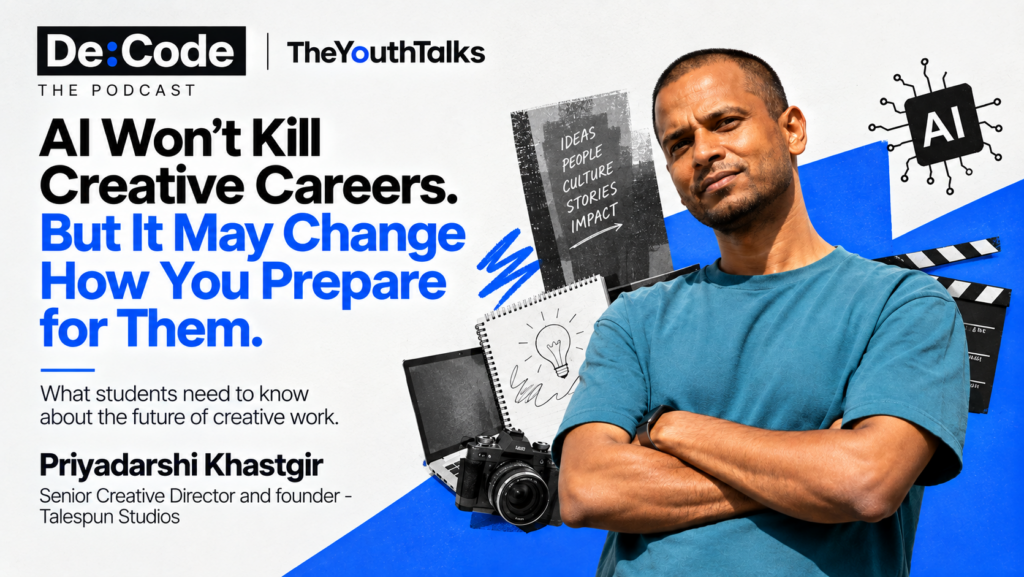
For students dreaming of careers in advertising, filmmaking, design, writing or content, the advice from creative director Priyadarshi Khastgir is simple: learn AI, but don’t let AI become your creativity.
For a student entering the creative industry today, the landscape can look intimidating.
A few years ago, becoming a copywriter meant learning to write. Becoming a designer meant learning design. A filmmaker had to understand cameras, sets, production and editing. Young professionals generally entered the industry at the bottom, executed work, made mistakes, learnt from seniors and gradually moved towards bigger conceptual and strategic responsibilities.
AI is disrupting that ladder.
Today, a single person can generate a script, create visuals, produce a video and research a subject using tools that were once available only to specialised teams.
So what should a student preparing for a creative career actually learn?
According to Priyadarshi Khastgir, Senior Creative Director and founder of Talespun Studios, the answer isn’t simply “AI”.
It is the ability to think.
In a recent De:Code conversation with TheYouthTalks, Khastgir argues that while job descriptions in the creative industry are changing, the fundamental definition of a creative person hasn’t.
A creative person, he says, is someone who thinks differently and has an interesting point of view about life. Tools may change, but that doesn’t.
And that distinction could become increasingly important for today’s students.
Your AI is only as smart as you are
AI can produce impressive-looking work very quickly. But Khastgir believes the person using the tool still matters enormously.
His argument is straightforward: someone who understands the craft of photography, writing, design or filmmaking will generally be able to use AI more effectively than someone who only knows how to write prompts.
Why?
Because experience gives you a reference point.
You know what looks good. You know what doesn’t work. You understand the limitations of the craft. You can recognise when the machine has produced something technically impressive but creatively ordinary.
That creates an important lesson for students: don’t confuse knowing the tool with knowing the profession.
Learning prompts is useful. Learning the craft is what gives those prompts meaning.
The biggest threat may be mediocrity
Khastgir is fairly blunt about the future.
He believes mediocre creative talent will have very little room to survive as AI becomes more capable. AI can already write, design and generate video. The question increasingly becomes whether a human can produce something better than what the machine can generate.
That sounds threatening, but there is another way to look at it.
For a student, AI can actually be an extraordinary advantage.
You can experiment faster. You can prototype ideas without a large budget. You can create things that previously required an entire production team.
But the opportunity comes with a responsibility: use the speed to create more, not to think less.
Don’t skip the mistakes
Perhaps the most important point in the conversation concerns something students rarely hear in the AI era: making mistakes is part of learning.
Traditionally, young creatives learnt through execution. They would make something, get it wrong, go back to the drawing board and try again.
AI can compress that process dramatically.
A task that once took days can potentially be completed in hours or minutes.
But Khastgir worries that young professionals may therefore get fewer opportunities to struggle with the craft and understand why something works or doesn’t work.
That matters because experience creates judgement.
Someone who has made hundreds of mistakes can often identify the right answer faster than someone who has never made any.
Your portfolio doesn’t have to look perfect
There is another particularly useful lesson for students.
Khastgir says he doesn’t primarily judge young creatives by their degrees or academic credentials. He wants to see what they have actually created.
That could be a professionally produced portfolio. But it could also be a poem, a haiku, a joke, a video, a film or simply an interesting piece of work that demonstrates how someone thinks.
His approach is essentially:
Don’t tell me you’re creative. Show me.
For students, that is liberating.
You don’t necessarily need expensive equipment or a perfect portfolio website to begin.
Start creating.
Shoot something on your phone. Write something. Make a short film. Design something. Build a campaign for a fictional brand. Experiment with AI. Then ask yourself whether the work actually says something about you.
Go outside the prompt box
Perhaps Khastgir’s strongest advice to young people is to gain real-world experience.
He recommends internships and actual exposure to the industry—not simply because they look good on a CV, but because they expose students to how the work really happens.
A prospective filmmaker should spend time on a set. Someone who wants to write should actually write. Someone interested in advertising should understand how campaigns are developed and executed.
The reason is simple.
Experience creates perspective.
And perspective creates originality.
As Khastgir puts it, if everyone is living inside a world of prompts, what separates one person from another is their lived experience and the unique point of view that comes from it.
The future creative may be different
Khastgir expects creative teams to become smaller as AI takes over more execution and research. But he doesn’t see collaboration disappearing. In fact, he believes talented people working together can still produce better work than one person working alone with a machine.
For students, therefore, the message isn’t to run away from AI.
It is almost the opposite.
Learn it. Use it. Experiment with it.
But simultaneously learn the craft, develop taste, build a portfolio, seek internships, find mentors, make mistakes and experience the world beyond the screen.
Because when everyone has access to the same creative superpowers, the real advantage may belong to the person who has something different to say.
AI can help you make the work. Your job is to make sure the work is worth making.
This story is based on TheYouthTalks’ De:Code conversation with Priyadarshi Khastgir, Senior Creative Director and founder of Talespun Studios. Watch the full podcast:-