For more than a century, Royal Enfield has changed motorcycles, products, markets and consumers. What it has rarely changed is the feeling that the brand represents something people want to become.
There are brands that survive for generations.
There are brands that reinvent themselves every few years to remain relevant.
And then there are a rare few that manage to do something considerably harder: they allow every new generation to find its own reason to want them.
Royal Enfield belongs to that category.
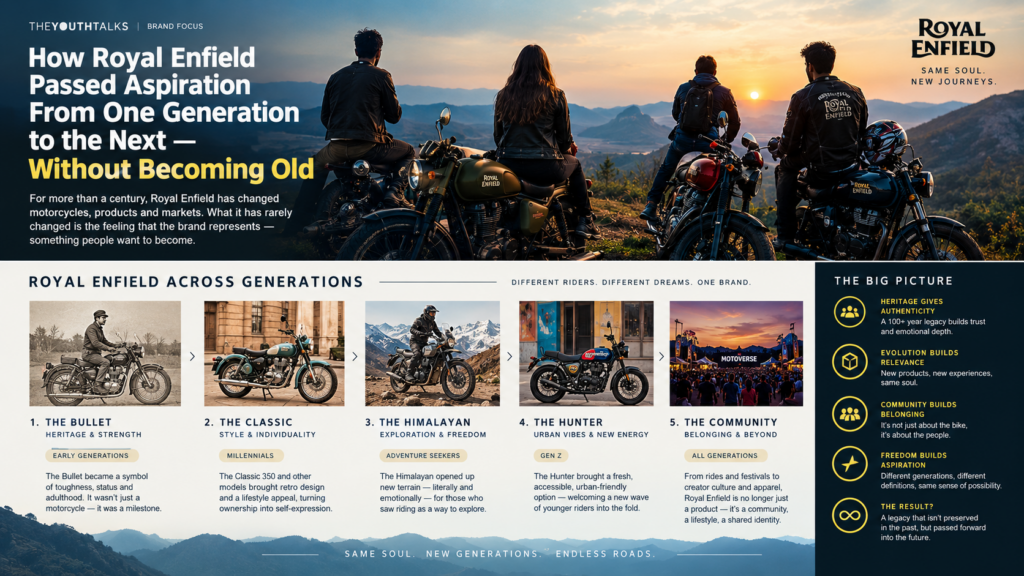
For one generation, the Bullet represented toughness, status and adulthood. For another, the Classic 350 became a statement of individuality. Today, for many younger riders, a Royal Enfield can represent freedom, exploration, self-expression, community and a lifestyle that exists well beyond the motorcycle itself.
The interesting part is not that Royal Enfield has attracted younger consumers.
It is how it has done so without abandoning the heritage that made the brand desirable in the first place.
That may be one of the most important lessons in modern brand building.
A legacy that could easily have become a liability
Royal Enfield’s story goes back to 1901, when the first Royal Enfield motorcycle was produced in Britain. The company eventually established a deep association with India, with Royal Enfield motorcycles being manufactured in the country since the 1950s. Eicher acquired Enfield India in 1994, and the company subsequently chose to focus on the mid-size motorcycle segment.
That history is extraordinary.
But history alone does not guarantee relevance.
In fact, heritage can become a problem.
A brand that constantly talks about its past can start feeling like it belongs to its past.
That was one of the fundamental challenges Royal Enfield had to overcome.
The motorcycle market around it was becoming increasingly modern, competitive and performance-oriented. Younger consumers had more choices, more international influences and increasingly different ideas about what a motorcycle could represent.
Royal Enfield could have responded by trying to become another modern motorcycle company.
Instead, it largely did something more interesting.
It made its heritage an asset while changing the context in which that heritage was experienced.
The transformation from motorcycle to aspiration
The Bullet was once strongly associated with a particular image of the Indian motorcycle owner.
But Royal Enfield gradually expanded the universe around the brand.
The Classic brought retro design into a more contemporary product proposition. The Thunderbird, Continental GT, Himalayan, Interceptor, 650 Twins, Hunter and subsequent models allowed different types of riders to see themselves within the Royal Enfield world.
The company’s own history reflects this evolution: the Hunter 350, introduced in 2022, was explicitly designed as a lighter, shorter-wheelbase motorcycle suited to urban environments, while the Himalayan opened another dimension around adventure riding.
The significance of this evolution is easy to miss.
Royal Enfield did not necessarily tell consumers:
“Forget the old Royal Enfield.”
Instead, it effectively said:
“There is a new way for you to experience Royal Enfield.”
That distinction matters.
Because the brand remained recognisable.
The silhouette, sound, mechanical character, design cues and sense of authenticity continued to provide continuity.
But the person riding the motorcycle could change.
And so could the reason for riding it.
Millennials didn’t kill the heritage. They modernised its meaning.
For many Millennials, the Royal Enfield aspiration was connected to a particular stage of life.
The motorcycle could represent independence.
A first serious job.
The ability to afford something beyond basic transportation.
Weekend rides.
Long-distance journeys.
A certain kind of masculinity and individuality.
But there was another important shift happening.
The motorcycle increasingly became part of a lifestyle.
Royal Enfield’s marketing and community-building strategy leaned heavily into riding rather than conventional product advertising. Years ago, the company was already talking about using rides and experiences as a way to connect with consumers rather than relying purely on conventional advertising.
That philosophy helped change the relationship between consumer and brand.
A Royal Enfield was no longer simply something you bought.
It could become something you did.
You rode it.
You travelled with it.
You customised it.
You photographed it.
You joined communities around it.
You met other riders.
You told stories about where it took you.
That is an important transition for any legacy brand.
Products have lifecycles. Identities can last much longer.
And then came Gen Z
Gen Z is not necessarily looking for the same thing previous generations looked for.
The meaning of aspiration has changed.
For younger consumers, aspiration can be less about displaying conventional status and more about expressing individuality.
Experiences matter.
Community matters.
Discovery matters.
Aesthetic identity matters.
The ability to tell a story about oneself matters.
And increasingly, consumers don’t simply want brands to tell them who they should be.
They want brands that give them material to construct their own identity.
Royal Enfield’s proposition fits surprisingly well into that world.
Its motorcycles can be photographed.
They can be customised.
They can be ridden across cities or mountains.
They can become part of fashion, music, travel, art and creator culture.
And perhaps most importantly, the brand has built a community around the machine.
That is why the company’s recent focus on community is particularly significant.
Its 2024-25 annual report described Motoverse as a convergence of riders, creators, musicians, artists and explorers, positioning the festival as an expression of a broader motorcycling culture rather than simply a product event.
At the 2025 edition, Royal Enfield said close to 40,000 people came together in Goa for three days of riding, art, workshops and performances.
That is a very different proposition from:
“Here is our new motorcycle. Please buy it.”
It is closer to:
“Here is a world you can belong to.”
The community became part of the product
This may be Royal Enfield’s most important brand-building lesson.
The motorcycle is the physical product.
But the community increasingly becomes part of the emotional product.
Royal Enfield itself has described its community as helping define the DNA of its motorcycles.
That creates an interesting feedback loop.
People buy the motorcycle because they like what it represents.
They then participate in the culture around it.
That culture attracts more people.
Those people bring their own interpretations into the brand.
And the brand becomes bigger than the original product.
This is also why Royal Enfield’s long-running rides and adventure programmes matter.
The Himalayan Odyssey, for example, isn’t positioned merely as a motorcycle ride. Royal Enfield describes it as a multi-day experience built around terrain, exploration and bonds between riders.
The brand is effectively selling stories waiting to happen.
And that is particularly powerful in an age where consumers document their lives digitally.
The Hunter may be one of the clearest examples of the transition
If the Bullet represents the heritage of Royal Enfield, the Hunter represents an interesting part of its future.
Launched in 2022, the Hunter was designed around urban riding and a more accessible form factor.
In 2026, ETAuto reported that consumers under 25 accounted for around one-third of Royal Enfield’s sales, with the Hunter playing an important role in bringing younger riders into the brand.
Royal Enfield itself has also described the newer Hunter as bringing a wave of new and young riders into its global community.
That is strategically important.
Because the brand doesn’t have to choose between:
heritage OR youth.
It can potentially have both.
The older consumer can see continuity.
The younger consumer can see possibility.
And both can still recognise the same brand.
The real trick: don’t make the brand younger
This is perhaps the most counterintuitive lesson from Royal Enfield.
When legacy brands become worried about Gen Z, the instinct is often to make everything younger.
Change the colours.
Use younger influencers.
Speak in internet language.
Create short-form content.
Put the brand on every social platform.
But youthfulness is not the same thing as relevance.
A 100-year-old brand pretending to be 22 can quickly become uncomfortable.
Royal Enfield’s approach offers another possibility.
Don’t make the brand younger. Make the brand available to younger interpretations.
That is a subtle but important difference.
Royal Enfield can retain its visual codes, its mechanical heritage and its philosophy of motorcycling while allowing a 22-year-old rider to interpret those things differently from a 42-year-old rider.
The brand remains relatively constant.
The meaning evolves.
From “owning a Royal Enfield” to “being a Royal Enfield person”
This is where the story ultimately becomes bigger than motorcycles.
Some of the world’s strongest brands achieve a similar transformation.
People don’t merely consume them.
They identify with them.
Royal Enfield has spent years building towards that territory.
The motorcycle becomes a symbol.
The ride becomes an experience.
The community becomes a social layer.
The brand becomes a cultural identity.
And aspiration becomes less about the object itself and more about the life associated with it.
That is why the brand can continue to mean different things to different generations without necessarily losing its core.
For one rider, it may mean the freedom of a first long-distance ride.
For another, it might mean a weekend escape from city life.
For someone else, it might simply be the design, the sound or the feeling of riding something distinctive.
The aspiration is no longer one-dimensional.
And perhaps that is exactly why it travels so well across generations.
A legacy isn’t something you preserve. It’s something you transfer.
Royal Enfield’s story offers an interesting lesson for every legacy brand trying to understand younger consumers.
The objective shouldn’t necessarily be to make the old brand look young.
It should be to identify what made the brand desirable in the first place — and find new ways for younger consumers to experience that feeling.
Royal Enfield’s heritage provides the foundation.
Its products create new entry points.
Its rides create experiences.
Its communities create belonging.
And its newer motorcycles give younger consumers permission to interpret the brand in their own way.
The result is a rather unusual form of continuity.
The brand doesn’t remain relevant because every generation wants the same Royal Enfield.
It remains relevant because every generation can want a Royal Enfield for its own reasons.
That may be the real meaning of being timeless.
Not refusing to change.
Not pretending to be young.
But carrying something recognisable into the future — and allowing every new generation to make it their own.
Royal Enfield hasn’t simply preserved an aspiration.
It has learned how to pass that aspiration forward.