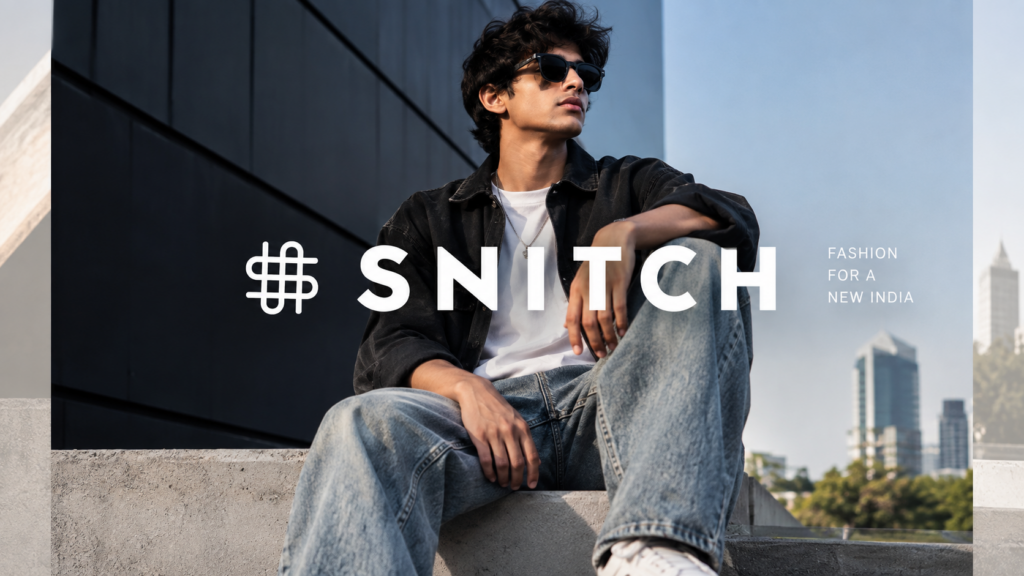
In a market where a trend can emerge on Instagram in the morning and feel old by the weekend, Snitch has built its fashion business around a new consumer expectation: don’t just understand what’s next. Get there quickly.
Fashion has always been about change.
But the speed of change has changed.
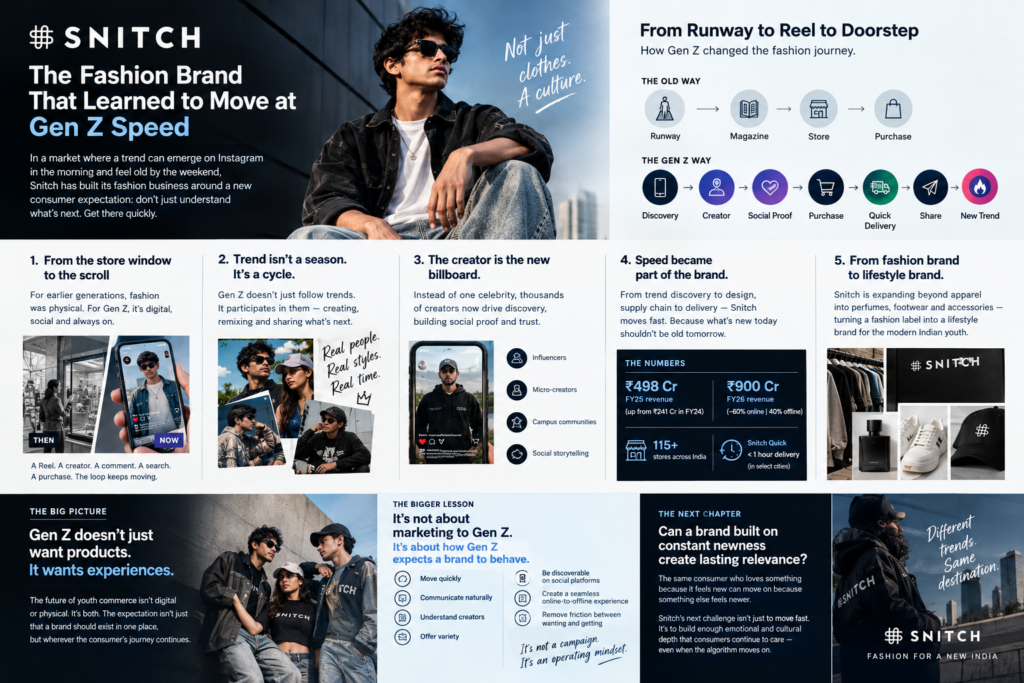
For earlier generations, a fashion trend could take months to travel from a runway to a magazine, from a magazine to a store and eventually into someone’s wardrobe. Today, a young consumer can discover a silhouette, colour, styling idea or aesthetic on Instagram, see a creator wearing it, compare alternatives, read comments, check reviews and potentially buy it within minutes.
The fashion journey has compressed.
And few Indian brands illustrate this shift as clearly as Snitch.
Founded by Siddharth Dungarwal, Snitch began as a B2B apparel business before the pandemic forced a dramatic rethink. The company moved towards a direct-to-consumer model and built its proposition around men’s fashion that was contemporary, accessible and faster to respond to changing tastes.
What makes the Snitch story particularly interesting for anyone studying Gen Z is that its success isn’t simply about putting trendy clothes in front of young consumers.
It is about understanding the speed at which culture now becomes commerce.
From the store window to the scroll
The traditional fashion journey was physical.
A consumer walked past a store, noticed a display, entered, tried something on and made a decision.
The new journey can begin anywhere.
A Reel.
A meme.
A creator.
A friend’s outfit.
A comment section.
A search.
That has fundamentally changed what a fashion brand needs to do.
Snitch describes itself as a D2C brand focused on creating a direct relationship with consumers, supported by its website, app, social platforms and increasingly its physical stores.
That direct relationship matters because the digital storefront is no longer just a place where a consumer completes a transaction.
It is where discovery happens.
For a generation accustomed to discovering products through feeds rather than catalogues, the difference between content and commerce is becoming increasingly difficult to see.
A piece of content can be an advertisement.
An advertisement can be a product recommendation.
A product recommendation can become a purchase.
And a purchase can become another piece of content.
The loop keeps moving.
Snitch’s marketing has consequently leaned into social storytelling, influencer-led communication, performance marketing and a tone designed to feel native to the platforms where younger consumers spend their attention. Industry analyses of the brand have similarly identified its social-first approach and trend-led product cycle as central elements of its strategy.
The real product may be speed
It is tempting to look at Snitch and conclude that its product is shirts, trousers, denims, jackets or accessories.
But there is another way to look at the business.
The product is speed.
Speed in identifying what consumers are beginning to want.
Speed in translating that insight into a product.
Speed in putting it in front of the customer.
And increasingly, speed in getting that product into the customer’s hands.
That is a fundamentally different way of thinking about fashion.
Traditional fashion has historically been organised around seasons and collections.
The digital consumer increasingly thinks in terms of what’s happening now.
Snitch has built around that tension.
The company reported operating revenue of about ₹498 crore in FY25, up sharply from ₹241 crore in FY24. For FY26, founder and CEO Siddharth Dungarwal reported revenue of about ₹900 crore, with approximately 60% coming from online channels and 40% from offline retail.
The numbers alone aren’t the story.
What they demonstrate is the scale that can emerge when a brand aligns its product engine, digital distribution and physical retail with a consumer culture that increasingly values freshness.
Gen Z doesn’t just consume trends. It participates in them.
This is where the Snitch story becomes bigger than menswear.
Gen Z is often described as a generation that follows trends.
That description is incomplete.
Young consumers increasingly participate in creating, remixing and distributing those trends.
A creator wears something.
Someone comments on it.
Another person recreates the look.
A brand notices the pattern.
A new product appears.
Consumers respond.
The cycle begins again.
This creates a very different relationship between the brand and the audience.
The audience isn’t simply waiting for the brand to tell it what is fashionable.
The brand is watching the audience too.
That makes social media more than a communications channel.
It becomes a source of cultural signals.
For a brand such as Snitch, this can make relevance less about predicting the next six months and more about recognising what is beginning to happen right now.
That is particularly important when the consumer is young, digitally native and exposed to an extraordinary number of global fashion references every day.
The creator is becoming part of the storefront
There is another important shift happening here.
The traditional fashion model was built around a relatively small number of powerful voices: celebrities, models, magazines and large media properties.
The creator economy has multiplied those voices.
Instead of one celebrity telling millions of people what to wear, thousands of creators can demonstrate how a product fits into different lifestyles, aesthetics and identities.
For brands targeting younger consumers, this creates something traditional advertising struggles to manufacture:
social proof.
A consumer doesn’t just see the product.
They see someone who looks like them wearing it.
That distinction matters.
Snitch’s marketing strategy has been associated with influencer marketing and social-first storytelling, helping the brand participate in the digital environments where its audience already discovers fashion.
And the bigger lesson for brands is clear.
Gen Z does not necessarily need a brand to look bigger.
It needs the brand to feel closer to culture.
But Snitch isn’t only a digital story anymore
There is an interesting irony in Snitch’s evolution.
A brand that grew through digital discovery is increasingly investing in physical retail.
By FY26, Snitch reported having more than 115 stores across India, with offline revenue accounting for about 40% of its business. Its offline business was reported to have grown strongly year-on-year.
That matters because the future of youth commerce isn’t necessarily digital versus physical.
It is likely to be digital and physical.
The consumer may discover a shirt on Instagram, visit a store to experience it, buy it through an app, receive it at home and post the outfit later.
The channels have blurred.
The consumer simply sees one brand.
That is why the idea of omnichannel retail is particularly relevant for Gen Z. The expectation isn’t that a brand should exist in one place.
The expectation is that the brand should be available wherever the consumer’s journey happens to continue.
And now, even fashion is entering the quick-commerce era
Snitch has pushed this idea further with its move into quick commerce.
The company launched Snitch Quick in October 2025, offering apparel delivery in under an hour in selected markets. By 2026, the service was reported to be operational in cities including Bengaluru, Delhi, Gurugram and Ahmedabad.
At first glance, delivering a shirt in under an hour can sound like a novelty.
But it represents something much more interesting.
Indian consumers have already become accustomed to a world in which groceries, food, electronics accessories and everyday essentials can arrive extraordinarily quickly.
Fashion is now being pulled into the same expectation of immediacy.
The question is no longer only:
“Do I want this?”
It increasingly becomes:
“Why can’t I have this now?”
That is a very different consumer mindset.
And for a generation that lives inside an always-on digital environment, the distinction between discovering something and owning it can become remarkably small.
From fashion brand to lifestyle brand
Snitch is also expanding beyond its core apparel offering into categories including perfumes, footwear and accessories.
That expansion is significant.
The long-term opportunity for a successful youth brand is rarely limited to one product.
If a brand becomes associated with a particular aesthetic, attitude or cultural identity, consumers may be willing to let it enter more parts of their lives.
This is how a fashion company can gradually become a lifestyle company.
But there is an important challenge here.
The more a brand expands, the harder it becomes to maintain the sharpness that created its original appeal.
For Snitch, the question will therefore not simply be how quickly it can launch more categories or stores.
It will be whether it can retain the cultural responsiveness that made the brand relevant in the first place.
The bigger lesson for brands chasing Gen Z
There is a lesson here that goes well beyond fashion.
For years, brands have asked:
“How do we market to Gen Z?”
Perhaps that is the wrong question.
A better question might be:
“How does Gen Z expect a brand to behave?”
The difference is important.
A younger consumer may expect brands to move quickly.
To communicate naturally.
To understand creators.
To offer variety.
To be discoverable on social platforms.
To provide a seamless online-to-offline experience.
And increasingly, to remove friction between wanting something and getting it.
Snitch’s journey suggests that meeting these expectations cannot be solved by a social-media campaign alone.
It requires the entire organisation to move faster — from trend discovery and design to supply chain, content, distribution, retail and fulfilment.
That is perhaps the most interesting thing about Snitch.
Its Gen Z strategy isn’t only in its advertising. It is embedded in the way the business operates.
The question that comes next
There is, however, one question that will ultimately determine how far the Snitch story travels.
Can a brand built around constant newness create lasting relevance?
That is a difficult challenge for every trend-led brand.
The same consumer who loves something because it feels new can move on because something else feels newer.
The very speed that creates attention can also make attention temporary.
Snitch’s next chapter will therefore be less about proving that it can move fast.
It has already demonstrated that.
The larger challenge is building enough emotional and cultural depth that consumers continue to care when the algorithm moves on to something else.
Because ultimately, fashion isn’t only about keeping up with what people want to wear.
It is about understanding why they want to wear it in the first place.
And that may be the most important lesson from Snitch’s rise.
The next generation of successful youth brands may not be the ones that simply predict trends.
They may be the ones that can listen to culture, respond to it and turn that response into something consumers can experience almost immediately.
In a world where the distance between trend and transaction is shrinking every day, Snitch has built a business around closing that gap.
And for Gen Z, that may be exactly where fashion is headed next.