
From shorter getaways and shared accommodation to AI-powered planning and experience-led holidays, India’s Gen Z is changing not just where it travels, but how it thinks about spending money on travel.
For an earlier generation of Indian travellers, a holiday often meant saving for months, planning one major annual trip and making the most of every day away from home. For today’s young travellers, that idea is gradually changing. A long weekend in the mountains, a short international getaway with friends or an unplanned trip to a relatively unexplored destination can be just as appealing as an elaborate annual holiday.
But there is an interesting contradiction emerging in how India’s Gen Z approaches travel. Young Indians want to explore more places, experience different cultures and travel internationally. Yet, they are also becoming increasingly conscious of how much they spend to make those experiences possible.
The shift is not necessarily towards travelling less. It is towards travelling differently.
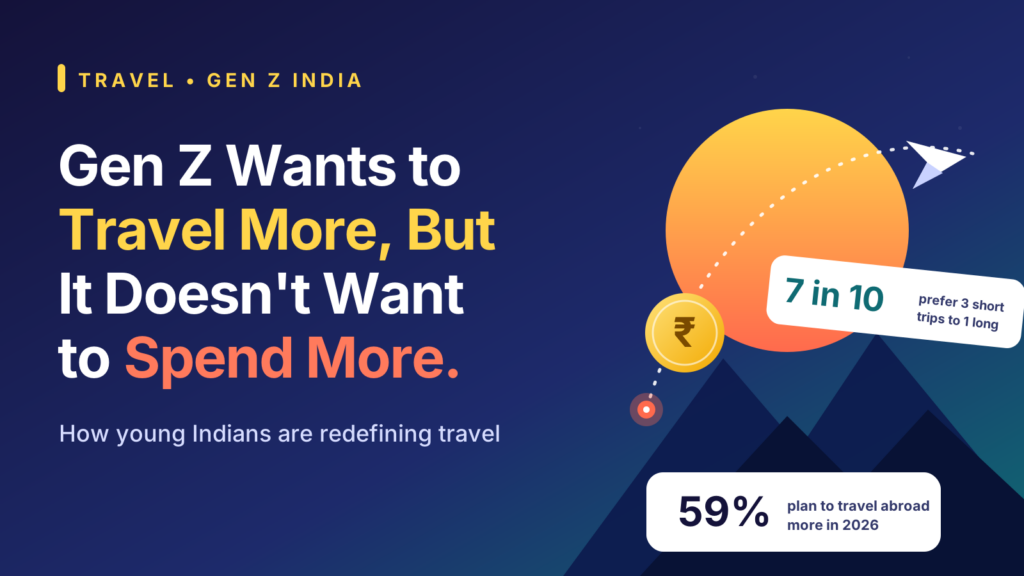
According to Skyscanner’s Gen Z Travel Statistics and Trends 2026, 59% of Gen Z Indians say they intend to travel abroad more in 2026. However, only 44% expect to spend more on accommodation. Nearly a third (32%) say they will consider lesser-touristed destinations to save money. The findings suggest that international travel remains an aspiration, but expensive hotels and conventional tourist destinations are not necessarily part of the plan.
The same research highlights how far young travellers are willing to go to make holidays affordable. More than half (56%) of Gen Z respondents in India made financial sacrifices for their last holiday. Almost half (48%) said they were willing to buy fewer new clothes, while 31% considered using fewer taxis to save towards their next trip.
For travel companies, this presents an important shift in consumer behaviour. Gen Z is not simply looking for cheaper holidays. It is trying to extract greater value from every rupee spent.
The annual holiday is giving way to smaller escapes
One of the more interesting developments is the changing frequency and duration of travel.
Rather than waiting for one major holiday every year, younger Indians appear increasingly attracted to multiple shorter trips. This allows them to explore different destinations without committing a significant portion of their annual savings to a single vacation.
Airbnb’s June 2026 report, Never the Same: The New Rules of Gen Z Travel in India, offers some evidence of this shift. Seven in ten respondents aged 18–29 said they would prefer three short trips over one long annual holiday. Meanwhile, 87% expressed a preference for trips lasting less than a week.
The report also found that 66% book their trips within days or weeks of travelling, suggesting that flexibility and spontaneity are becoming important parts of the experience.
Airbnb’s internal search data further indicated that searches by Indian Gen Z travellers for summer travel increased by more than 30% year-on-year, with domestic trips lasting two to six nights emerging as a particularly fast-growing format.
This is significant for an industry that has traditionally designed many of its products around longer holidays and advance bookings.
Shorter trips could create opportunities for regional tourism destinations, boutique accommodation providers, weekend travel operators and experience-based businesses. They could also encourage destinations outside India’s established tourist circuits to attract younger visitors.
For Gen Z, the appeal is relatively straightforward: more opportunities to travel, without necessarily having to finance one expensive holiday.
Budget-conscious does not mean experience-poor
It would be easy to interpret this generation’s preference for affordable travel as an indication that it is willing to compromise on the quality of its holidays. The research suggests something more nuanced.
Young travellers appear willing to compromise on certain aspects of travel while protecting the experiences they consider important.
Skyscanner’s research found that 37% of young Indians would consider budget accommodation over more comfortable stays, while 36% would accept shorter holidays if that helped stretch their budgets.
However, the same research reveals that experiences remain important.
Globally, 61% of Gen Z respondents in a Skyscanner survey identified food as the most important factor when choosing a holiday destination, ahead of weather (57%) and shopping (39%). Among young Indians, 45% said they visit local supermarkets while travelling to discover foods unavailable at home. Another 54% considered this one of the best ways to understand local culture and food habits.
The distinction matters.
A young traveller might be perfectly comfortable staying in a modest hostel or budget hotel but still spend on a memorable food experience, a local concert or an activity that offers a different perspective on the destination.
The spending priorities are changing rather than disappearing.
This could also explain the growing appeal of group travel. Airbnb found that three in four Gen Z respondents considered their travel companions more important than the destination itself. More than half preferred staying together in a shared home rather than booking separate hotel rooms.
Shared accommodation can reduce individual costs while creating opportunities for social experiences. For travel platforms and hospitality brands, this makes group-friendly accommodation and flexible pricing particularly relevant.
Social media creates the aspiration. Technology helps make it happen.
Travel discovery has changed considerably with the growth of digital platforms.
A destination that might once have been discovered through a travel magazine, a family recommendation or a traditional travel agent can now enter a young person’s consideration set through a short video on Instagram or YouTube.
Skyscanner’s research identifies Instagram and YouTube as the leading sources of travel inspiration among Gen Z Indians, with both platforms cited by 70% of respondents.
Google and Kantar’s Travel Rewired: Decoding the Indian Traveler report offers another useful perspective. Its research found that 68% of Indian travellers use YouTube for travel inspiration, making it the leading source in its study. The report also found that 41% of travellers relied heavily on creators for travel inspiration.
Among first-time or novice travellers, YouTube was particularly influential, with 67% identifying it as a source of travel inspiration.
For young Indians, travel content does more than showcase destinations. It provides a glimpse of what an experience might actually cost, where to stay, what to eat and which activities are worth considering.
But digital discovery is only one part of the transformation. Artificial intelligence is beginning to influence the planning process itself.
Skyscanner found that 87% of Indian Gen Z respondents felt confident using AI to help plan and book trips, up from 80% in 2025. More than half (51%) intended to use AI for destination research, while 47% planned to use it to compare flight and hotel options.
This creates an interesting possibility for the travel industry.
Instead of visiting multiple websites, comparing dozens of destinations and manually building itineraries, a young traveller can increasingly use an AI assistant to explore options within a defined budget.
A simple request such as planning a five-day international holiday within a particular budget could become the starting point for destination discovery, accommodation comparisons and itinerary planning.
However, greater confidence in AI does not automatically translate into complete trust in its recommendations. Price accuracy, availability, visa requirements and booking reliability will remain important considerations.
For travel platforms, the challenge will be to become part of this evolving discovery process without losing consumer trust.
Travelling for identity, not just sightseeing
Another important change is the growing relationship between travel and personal identity.
For many young Indians, a holiday is not simply about visiting famous monuments or ticking off popular tourist attractions. It is an opportunity to explore personal interests, connect with people and experience lifestyles different from their own.
Airbnb’s 2026 research found that 87% of Indian Gen Z respondents believed the way they travelled reflected who they were as individuals. As many as 95% said they wanted their trips to feel personal and unique rather than typical or pre-planned.
Interestingly, 90% said they were likely to seek places that had not been widely recommended online or gone viral.
The findings challenge the assumption that a generation heavily influenced by social media will always gravitate towards the same popular destinations.
In fact, there may be a growing appetite for discovering places that feel relatively personal and less commercialised.
Skyscanner’s research offers additional evidence of the importance of cultural experiences. Around 27% of young Indians planned to attend a gig or concert while travelling in 2026, while 24% intended to visit a library or bookshop.
More than half (52%) said they had travelled overseas specifically to meet new people.
For travel brands, this suggests that the destination alone may no longer be sufficient to attract younger consumers. The experiences available at that destination, the people they might meet and the interests they can pursue could become equally important.
It also creates opportunities for music festivals, sporting events, cultural programmes, local food experiences and community-led tourism.
Wellness is becoming part of the holiday equation
Travel is also increasingly being associated with mental wellbeing and personal restoration.
Skyscanner’s research found that 93% of Gen Z respondents globally believed travel improved their mental wellbeing, while 90% said they returned from holidays feeling less anxious and more positive.
Around 73% said they planned trips specifically for wellness benefits, including relaxation and self-care.
Among young Indians, nearly one in three planned to visit a spa or salon on their next holiday, while 24% intended to practise yoga or meditation.
This is particularly interesting because it challenges the traditional association between youth travel and nightlife, adventure or party destinations.
A holiday might now involve spending time in the mountains, reading, visiting a wellness retreat or simply disconnecting from everyday routines.
For hospitality businesses, this opens up a wider consumer proposition. Accommodation providers may need to think beyond rooms, amenities and location to offer experiences that support relaxation, fitness and personal wellbeing.
However, these preferences should not be interpreted as evidence that all young travellers are abandoning conventional holidays. Rather, wellness is becoming another consideration in how they evaluate a travel experience.
The sustainability question: values versus spending
Gen Z is frequently described as a generation that cares about sustainability. Travel research, however, suggests that there is a gap between environmental intentions and actual consumer behaviour.
Skyscanner found that 56% of Gen Z travellers globally preferred supporting environmentally responsible companies, even if doing so cost more.
But Booking.com’s 2026 sustainability research presents a more complicated picture. Based on responses from 32,500 travellers across 35 markets, the study found that 75% of Gen Z respondents wanted to travel more sustainably over the coming year.
Yet, when it came to specific actions, Gen Z was less likely than older generations to commit to behaviours such as reducing waste, lowering energy consumption and shopping at local independent businesses.
For example, among those intending to travel more sustainably, fewer than half of Gen Z respondents planned to reduce general waste, compared with 67% of Boomers.
This is an important distinction for travel businesses.
Young consumers may express a preference for sustainable accommodation and responsible tourism, but affordability continues to influence actual purchasing decisions.
A sustainably operated hotel that is significantly more expensive may struggle to attract a price-conscious young traveller, even if the traveller supports its environmental positioning.
The opportunity lies in making responsible travel more accessible rather than treating sustainability exclusively as a premium offering.
What this means for the travel industry
India’s Gen Z is entering the travel market with a different set of expectations. It wants flexibility, affordability, digital convenience and experiences that feel personally meaningful.
For airlines, this could mean greater attention to transparent pricing, flexible booking options and affordable routes to emerging destinations.
For hotels and accommodation providers, group-friendly stays, shorter booking durations and experience-led offerings could become increasingly relevant.
For online travel agencies, AI-enabled discovery and personalised recommendations may become important differentiators.
Tourism boards and destination marketers, meanwhile, have an opportunity to look beyond established tourist hotspots and introduce younger travellers to lesser-known destinations, local culture and regional experiences.
There is also an opportunity for brands to rethink how they communicate with this audience. Selling a luxury holiday may not always be as effective as demonstrating how a traveller can create a memorable experience within a realistic budget.
Ultimately, the next generation of travel consumers may not measure a holiday by the amount of money spent or the number of landmarks visited.
They may measure it by the experiences they bring home, the people they meet and the memories they create.
Gen Z wants to see more of the world. It simply wants to do it on its own terms.
For the travel industry, understanding that distinction could become one of the most important competitive advantages of the coming decade.