
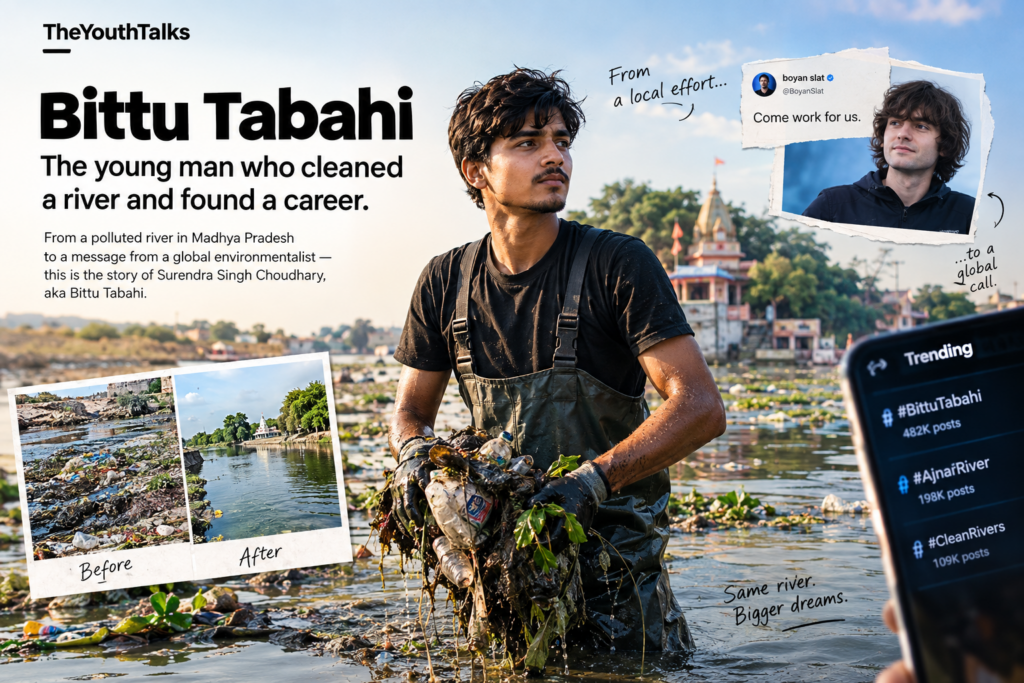
Surendra Singh Choudhary began by stepping into a polluted river in Madhya Pradesh with little more than his own hands, some basic tools and a stubborn belief that somebody had to do something. Months later, his work has earned national attention — and an invitation from The Ocean Cleanup’s Boyan Slat to come work with him.
There is something almost absurd about the image.
A young man standing in the middle of a polluted river, knee-deep in dirty water, pulling out plastic bottles, algae and accumulated garbage with his hands.
No corporate team around him. No elaborate campaign. No large NGO logo behind him. No government machinery doing the work.
Just one person, looking at a river that had effectively become a dumping ground and deciding that he could no longer simply walk past it.
His name is Surendra Singh Choudhary.
On social media, however, millions are beginning to know him by a very different name: Bittu Tabahi.
And his story has suddenly become much bigger than a river in Madhya Pradesh.
It started with a river he couldn’t ignore
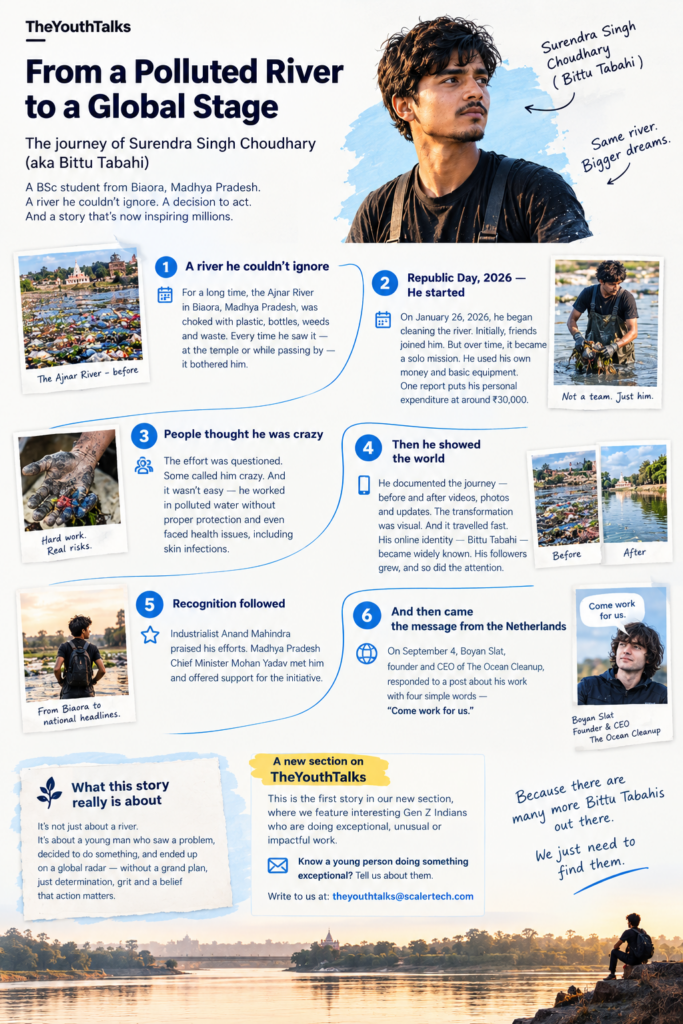
Choudhary is a BSc student from Biaora in Madhya Pradesh’s Rajgarh district. Reports describe him as being around 20–21 years old, with the exact age varying across recent coverage.
For some time, the condition of the Ajnar River had bothered him.
The river was clogged with plastic, bottles, weeds, algae and other waste. What should have been a natural water body had, in places, begun to resemble a dumping ground.
Choudhary had seen it repeatedly — including when visiting a temple or passing by the river.
Like most people, he could have simply complained about it.
Instead, on January 26, 2026 — Republic Day — he started cleaning it.
Initially, he had friends helping him.
But as the days turned into weeks, the group became smaller. Eventually, much of the work was being done by Choudhary himself.
And he kept going.
He used his own money and basic equipment. One recent report puts his personal expenditure at around ₹30,000. He continued getting into the polluted water, removing waste and documenting the transformation.
There was no obvious career opportunity waiting at the other end of this.
There wasn’t even much recognition in the beginning.
There was simply a dirty river.
And a young man who had decided to do something about it.
People thought he was crazy
Perhaps the most revealing part of Bittu’s story is what happened before people started calling him a hero.
People reportedly questioned what he was doing.
Some called him crazy.
And from a distance, perhaps it did look a little crazy.
Why would a college student spend months cleaning a polluted river? Why would he spend his own money doing it? Why would he continue when there was no guarantee that the river would remain clean?
There is also a less romantic side to the story.
Working in polluted water without adequate protection carries obvious health risks. Reports say Choudhary experienced health problems while carrying out the cleanup, including skin-related issues.
That matters.
Because it is easy, after the photographs go viral, to turn an act of difficult physical labour into an inspirational Instagram story.
But the reality is much less polished.
For months, this meant stepping into filthy water and physically removing what other people had thrown into it.
Again and again.
Then he started showing people what he was doing
This is where the story takes a distinctly Gen Z turn.
Bittu didn’t just clean the river.
He documented it.
Before-and-after photographs and videos began appearing on social media, showing the difference between the river before the cleanup and the stretches that had been cleared.
The transformation was visual.
And visual stories travel.
What may have been almost invisible work in a small Madhya Pradesh town suddenly became something people across the country could see on their phones.
His online identity — Bittu Tabahi — became increasingly recognisable.
The nickname is almost ironic.
“Tabahi” means destruction.
But Bittu’s version of destruction was directed at the garbage choking a river, not the river itself.
And the internet began paying attention.
Reports now say his efforts have attracted hundreds of thousands of followers and widespread social-media engagement.
The people who had once seen a young man doing something unusual were now watching a young man transform a piece of their environment in real time.
Then Anand Mahindra noticed
At some point, the story moved beyond Biaora.
Industrialist Anand Mahindra publicly praised Bittu’s efforts, helping take the story to a much larger audience.
The attention continued to grow.
Madhya Pradesh Chief Minister Mohan Yadav also met Choudhary and praised his initiative, with reports saying the government offered support for the effort.
But perhaps the most interesting part of the story was still to come.
Because somewhere on the other side of the internet, someone else was watching.
Someone who knew a thing or two about cleaning rivers and oceans.
And then came the message from the Netherlands
On September 4, a post about Choudhary’s work reached Boyan Slat, the Dutch environmental entrepreneur and founder and CEO of The Ocean Cleanup, the organisation known for developing technologies to tackle plastic pollution in oceans and rivers.
Slat’s response was remarkably short.
“Come work for us.”
Four words.
But for a 20-year-old BSc student who had started cleaning a polluted river in his hometown, they represented an extraordinary turn in the story.
There is something wonderfully unexpected about the sequence.
He didn’t start by applying for an international environmental job.
He didn’t build a polished résumé around sustainability.
He didn’t spend months preparing for an interview.
He started cleaning a river.
And eventually, the work itself became the résumé.
The career lesson hiding inside Bittu’s story
This may be the most interesting part of the Bittu Tabahi story for young Indians.
For years, young people have been told that careers follow a familiar sequence.
Get a degree.
Build a résumé.
Apply for jobs.
Give interviews.
Get hired.
Bittu’s story doesn’t quite follow that template.
His career opportunity, at least at this stage, appears to have emerged from doing something first and getting noticed later.
That doesn’t mean every student should quit college tomorrow and start cleaning rivers.
It does mean that the definition of a career is changing.
The internet has made it possible for a young person’s work to travel far beyond their geography.
A student in Biaora can be seen by an entrepreneur in the Netherlands.
A local environmental initiative can become an international conversation.
And a skill, passion or obsession that initially looks unconventional can sometimes become an opportunity precisely because it is unconventional.
For India’s young population, that is an important lesson.
But Bittu’s story is not really about going viral
There is a danger in telling stories like this.
We can become so fascinated by the viral moment that we forget the months before it.
The internet sees the transformation.
It doesn’t always see the repetition.
It sees the clean river.
It doesn’t see the mornings spent in dirty water.
It sees Anand Mahindra’s praise.
It doesn’t see the people who initially thought the exercise was pointless.
It sees Boyan Slat’s job invitation.
It doesn’t see the young student who started all of this without knowing where it would lead.
And perhaps that is what makes Bittu’s story worth telling.
Not because one young man has “saved” a river.
That would be too easy — and probably too early to say.
In fact, reports indicate that littering and waste management remain problems around the area, reminding us that cleaning a river once is very different from keeping it clean permanently.
The bigger question is whether Bittu’s individual effort can become something sustainable — with local residents, authorities and institutions taking responsibility alongside him.
Because one person can remove a lot of garbage.
But one person cannot be the waste-management system.
What happens after the applause?
That may be the next chapter of the Bittu Tabahi story.
The cameras are here now.
The social-media posts are everywhere.
Politicians have met him. Industrialists have praised him. An international environmental organisation has noticed him.
But eventually, the attention will move somewhere else.
The real test will be whether the river remains cleaner.
Whether people stop throwing garbage into it.
Whether the administration builds systems to manage waste.
Whether the community begins to see the river differently.
And whether Bittu himself decides what comes next.
Perhaps he takes up Boyan Slat’s invitation.
Perhaps he continues his work in India.
Perhaps he studies further.
Perhaps he becomes something nobody has yet imagined.
For now, the only thing we know for certain is that Surendra Singh Choudhary — Bittu Tabahi on the internet — didn’t begin with a grand plan to become famous.
He saw something broken.
And he started fixing it.
The world noticed later.
That, perhaps, is the most powerful part of his story.
In a time when young people are constantly being told to build personal brands, chase followers, optimise their résumés and find the “right” career, Bittu offers a rather different formula:
Do something that matters. Document it honestly. Keep going when nobody is watching.
Sometimes, the opportunity comes after.
Sometimes, the work becomes the résumé.
And sometimes, a young man cleaning a forgotten river in Madhya Pradesh ends up being noticed by the other side of the world.
We want to hear about more young Indians like Bittu
Bittu Tabahi’s story is also the reason we are starting something new at TheYouthTalks.
There are thousands of young Indians doing remarkable things that rarely make it into the news. Students building businesses from their bedrooms. Young people solving problems in their communities. Creators experimenting with ideas nobody has tried before. Athletes, artists, researchers, entrepreneurs, volunteers and ordinary young Indians doing extraordinary work.
We want to find them.
As part of a new section on TheYouthTalks, we will be featuring interesting Gen Z Indians whose work, ideas or journeys deserve to be seen and heard.
And we want your help.
Know a young person doing something exceptional? Know someone whose story deserves a larger audience? Tell us about them.
Write to us at [your email address] with their name, what they’re doing and why you think we should know their story.
Because there are many more Bittu Tabahis out there.
We just need to find them.