
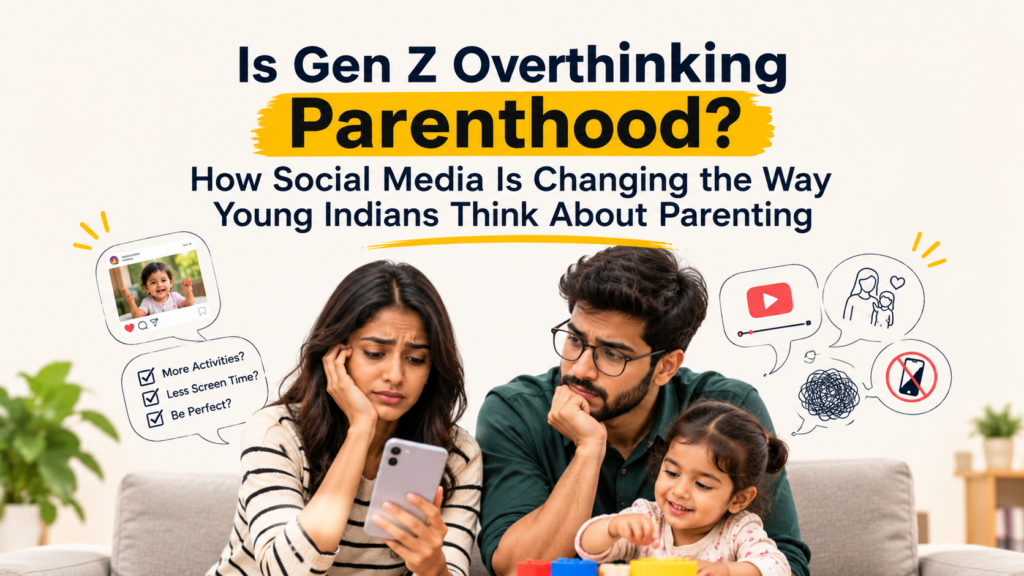
From picture-perfect family moments and expert parenting advice to screen-time anxiety and the pressure to raise emotionally well-adjusted children, social media is changing what being a “good parent” looks like. For a generation that has grown up online, the expectations of parenthood may be more visible — and more difficult to escape.
Parenthood has always come with questions. Am I doing enough for my child? Am I making the right decisions? Will my child have better opportunities than I did? These concerns are hardly new. Every generation of parents has had its own anxieties, shaped by the economic, cultural and social environment in which it raises children.
But for Gen Z, the experience of becoming a parent is unfolding in a very different information environment.
A young parent today does not have to wait for advice from relatives, friends or a paediatrician. Parenting recommendations, developmental milestones, meal plans, screen-time rules, educational activities and opinions on everything from sleep routines to discipline are available on Instagram, YouTube and online parenting communities. A single search can produce hundreds of answers — often contradictory, sometimes useful and occasionally alarming.
The result is a new kind of parenting environment: one in which parents are not only raising children but are also constantly exposed to images and opinions about how they should be doing it.
This raises an interesting question: is Gen Z becoming more conscious and informed about parenthood, or is it also becoming more anxious about getting it right?
The pressure to be a perfect parent
A recent survey by parenting platform What to Expect offers an indication of how strongly the idea of perfect parenting resonates with younger mothers.
According to findings reported by the publication, 83% of Gen Z mothers said they aspired to a perfect motherhood score, compared with 77% of Millennial mothers. The survey also identified differences in the concerns reported by the two groups. Gen Z mothers were more likely to worry about keeping children occupied with activities, ensuring screen-free time, managing family schedules and allowing children to explore their identities.
The numbers should be read with some caution. They represent self-reported responses from a particular survey, not a representative picture of mothers in India or proof that every Gen Z parent experiences greater anxiety. But they point towards a broader cultural question: what does perfection in parenting mean to a generation that has grown up watching other people’s lives unfold online?
For many parents, the ideal is no longer limited to providing food, education, safety and stability. There is growing attention to emotional development, mental health, creativity, physical activity, digital boundaries and the child’s individual identity. These are valuable priorities. The difficulty begins when every priority starts to feel like a responsibility that must be fulfilled perfectly.
A child must be engaged, but not overscheduled. They must have access to technology, but not become dependent on it. They must perform well academically, but not experience excessive pressure. They should be confident, but not entitled; independent, but not unsupported.
The modern parent is expected to balance all of these competing demands. Social media makes those expectations more visible, often presenting them as achievable routines rather than difficult trade-offs.
When parenting becomes a comparison exercise
One of social media’s most powerful influences is its ability to turn private experiences into public reference points.
A parent scrolling through Instagram may encounter a family preparing elaborate school lunches, a toddler following a carefully designed learning routine, a mother documenting a balanced work-and-family schedule or a father demonstrating an apparently effortless approach to gentle parenting.
There is nothing inherently wrong with sharing these experiences. Parenting creators can provide useful information, help people feel less isolated and make expert advice more accessible. But the content that travels furthest is often the content that is visually appealing, emotionally engaging or easy to replicate.
The ordinary parts of parenting — exhaustion, uncertainty, arguments, financial compromises, missed routines and days when nothing goes according to plan — are less likely to appear in a polished post.
This creates an uneven comparison. Parents are measuring their everyday lives against selected moments from someone else’s.
A 2023 scoping review published in Issues in Mental Health Nursing examined research on social-media comparison and maternal mental health. It found that exposure to highly idealised portrayals of motherhood could encourage social comparisons and negatively affect maternal well-being. The review included nine studies, most of which originated in the United States, so its findings should not be treated as a direct measure of Indian parents’ experiences. Nevertheless, it offers a useful explanation of how idealised parenting content can influence the way mothers evaluate themselves.
A separate study published in Computers in Human Behavior in 2022 examined how idealised Instagram portrayals of motherhood affected new mothers. Its findings suggested that such portrayals could increase envy and state anxiety, particularly when mothers compared themselves with people they perceived as similar to them.
The implication is not that parents should avoid social media altogether. It is that the distinction between inspiration and comparison can become difficult to maintain when the feed repeatedly presents one version of what successful parenting looks like.
The screen-time paradox
Perhaps one of the most interesting contradictions facing digitally native parents is their relationship with technology.
Gen Z has grown up alongside smartphones, social platforms, streaming services and increasingly accessible digital tools. Technology is part of how this generation learns, works, socialises and entertains itself. Yet when it comes to raising children, many young parents are also concerned about screen exposure, online safety and the influence of digital platforms.
This concern is not difficult to understand. Parents are raising children in an environment where screens are used for education, entertainment, communication and, increasingly, access to artificial intelligence. The challenge is no longer simply whether a child should use technology. It is how much, at what age, for what purpose and under whose supervision.
A 2024 Gallup and Walton Family Foundation report on parenting children from Generation Z found that parents frequently worried about their children’s experiences on social media, their time spent on these platforms and their mental health. The study was focused on parents of Gen Z children rather than Gen Z parents themselves, so it does not establish how younger parents behave. But it illustrates how digital life has become a central concern across the parenting experience.
For Gen Z parents, the contradiction may be particularly personal. They understand the convenience and opportunities technology offers because they have experienced them firsthand. They may also have seen how online environments can affect attention, privacy, self-image and social relationships.
The question is whether they can establish boundaries for their children while navigating the same digital environment themselves.
This is not simply a parenting problem. It is a generational challenge involving technology, habits and the changing definition of a healthy childhood.
The Indian context: tradition meets the parenting feed
In India, these questions take on another dimension.
Parenting decisions are often shaped by more than the preferences of two parents. Grandparents, extended families, domestic arrangements, school environments, neighbourhoods and cultural expectations can all influence how children are raised. In many households, younger parents may be balancing advice from older family members with information they discover online.
That can create a new negotiation inside the family.
A grandparent may prefer familiar approaches to food, discipline or screen use. A younger parent may turn to a paediatrician’s online guidance, a parenting community or a creator who advocates a different method. One generation may place greater emphasis on obedience and academic achievement, while another may want to give children more room to express themselves and discuss their emotions.
These differences should not be reduced to a simple conflict between traditional and modern parenting. Indian families vary enormously by geography, income, education, household structure and access to technology. Nor is every younger parent rejecting the values with which they grew up.
What is changing is the number of voices involved in parenting decisions. Advice that once came largely from family and local communities now competes with a constant stream of digital recommendations.
For urban and digitally connected parents in particular, social media can introduce new ideas about child development, mental health, nutrition and education. It can also create pressure to adopt approaches that may not be practical for their household, budget or circumstances.
A carefully planned activity schedule, for instance, may look attractive online. But it may be difficult to sustain for parents working long hours, managing long commutes or relying on limited childcare support. Similarly, advice about food, toys, learning resources and extracurricular activities can quickly become a source of financial and emotional pressure.
The risk is that parenting begins to look like another area in which families must keep up.
The mental load of getting everything right
The pressure to be a good parent is not created by social media alone. Work demands, rising household expenses, limited time, childcare responsibilities and the availability of support systems all shape the experience.
Research published in JAMA Internal Medicine in May 2025 offers a broader reminder of the pressures parents face. Analysing data from 198,417 mothers in the United States between 2016 and 2023, researchers found that the proportion reporting fair or poor mental health increased from 5.5% to 8.5%. The study also found a decline in the proportion reporting excellent mental health.
Importantly, this research was not a comparison of Gen Z and Millennial mothers. Nearly 90% of the mothers included were aged 30 or older. It therefore cannot be used as evidence that Gen Z mothers have worse mental health. Nor does it establish that social media caused the decline. What it does show is that maternal well-being is a serious issue that deserves attention beyond generational labels.
For younger parents, the mental load can involve trying to meet expectations across several areas simultaneously: being financially responsible, professionally successful, emotionally available and actively involved in a child’s development.
Social media can intensify this pressure by making each of these responsibilities appear measurable. There are routines to follow, milestones to track, products to buy, activities to plan and expert opinions to consider.
Even the language of parenting can create another standard to live up to. Parents are encouraged to practise gentle parenting, mindful parenting, positive discipline and emotionally intelligent communication. These approaches can offer meaningful benefits, but when encountered as rigid rules rather than adaptable principles, they can leave parents worrying about every mistake.
A difficult day does not necessarily mean a parent has failed. A child having a tantrum does not automatically mean a parenting approach is ineffective. Yet the constant availability of advice can make ordinary challenges feel like problems that require immediate correction.
Is Gen Z actually overthinking parenthood?
It would be unfair to conclude that Gen Z is simply more anxious or less confident about raising children. Younger parents may also be more willing to question inherited practices, seek professional advice, discuss mental health and recognise that children have individual emotional needs.
Some of what looks like overthinking may actually be greater awareness.
The difference may lie in the environment in which this awareness operates. Earlier generations also worried about their children’s health, safety, education and future. But they did not have to navigate an endless stream of curated parenting content, public commentary and algorithm-driven recommendations.
Gen Z is entering parenthood in a world where advice is abundant, but certainty is not. More information does not always make decisions easier. Sometimes it creates additional choices, competing opinions and the feeling that a better answer must exist somewhere online.
There is also a difference between using social media to learn and allowing it to define personal standards. A parenting account can introduce a useful idea; it cannot know the realities of every household. A developmental checklist can help parents understand milestones; it cannot capture every child’s individual pace. A video showing a calm response to a child’s difficult behaviour cannot show the full context of the family behind it.
The challenge for younger parents is to recognise that online content is a resource, not a report card.
The opportunity for brands and the parenting industry
This shift has implications beyond families. It also creates an opportunity — and a responsibility — for brands operating in categories such as childcare, education, nutrition, healthcare, toys, family technology and financial services.
Young parents are likely to seek products and services that help them make informed decisions, save time and manage the practical demands of raising children. But brands should be careful about turning parental anxiety into a marketing strategy.
Messages that imply a child will fall behind without a particular learning product, that a good parent must buy a specific range of foods or that every developmental milestone requires another intervention risk adding to the pressure.
There is room for a more useful approach: products that solve genuine problems, information that is transparent about its evidence, and communication that respects the fact that families have different resources and circumstances.
Parenting platforms and creators also have a role to play. Content that includes realistic experiences, acknowledges uncertainty and distinguishes professional guidance from personal opinion can be more valuable than another idealised portrayal of family life.
For brands, trust may come not from promising perfect outcomes but from helping parents make practical, confident choices.
Perhaps the goal should be good parenting, not perfect parenting
Gen Z’s relationship with parenthood is still evolving. Many members of the generation are only beginning to enter this stage of life, and their experiences will differ widely. It is too early to make sweeping claims about how they will raise children or whether they are fundamentally more anxious than the generations before them.
But one shift is worth watching: parenting is increasingly being experienced in public, even when the actual work of raising a child remains deeply personal.
Social media can connect parents with communities, information and support that were once difficult to access. It can also turn the most intimate parts of family life into a constant comparison exercise.
The answer is not to dismiss digital platforms or romanticise earlier generations. It is to recognise the difference between being informed and being overwhelmed.
For Gen Z parents, the real challenge may not be finding more advice. It may be learning when to stop looking for it — and accepting that raising a child will always involve uncertainty, mistakes and decisions that cannot be perfected.
After all, children do not need parents who get everything right. They need parents who are present, responsive and willing to keep learning.