

From Fujifilm Instax to single-use film cameras, the renewed interest in physical photography raises an interesting question for brands: what happens when a generation that can capture everything starts valuing the photographs it can actually hold?
For a generation that has grown up with smartphone cameras, Instagram Stories and cloud storage, taking a photograph has never been easier. One can capture dozens of pictures in seconds, edit them instantly and share them with hundreds of people without ever printing a single image.
And yet, cameras that do something smartphones already appear to do are finding renewed relevance among younger consumers.
Instant cameras, which print photographs shortly after they are taken, are attracting attention for precisely what digital photography cannot replicate in the same way: a physical photograph that exists outside a screen. Single-use film cameras, meanwhile, offer an even more old-fashioned experience. The pictures cannot be reviewed immediately, and the film must be developed before the photographs can be seen.
In India, Fujifilm’s Instax range is one of the clearest examples of this category’s continuing commercial appeal. The company has also been expanding its presence in classic film cameras, suggesting that the opportunity may extend beyond instant prints.
The development raises a larger question for marketers: in a world where almost every moment can be captured digitally, is the appeal of photography shifting from convenience towards experience?
Fujifilm Instax: More than a nostalgia play
Instax is not a new discovery. Fujifilm introduced the product range in 1998 and brought it to India in 2012. What makes the category interesting today is its attempt to remain relevant to a generation that has never known a world without digital cameras.
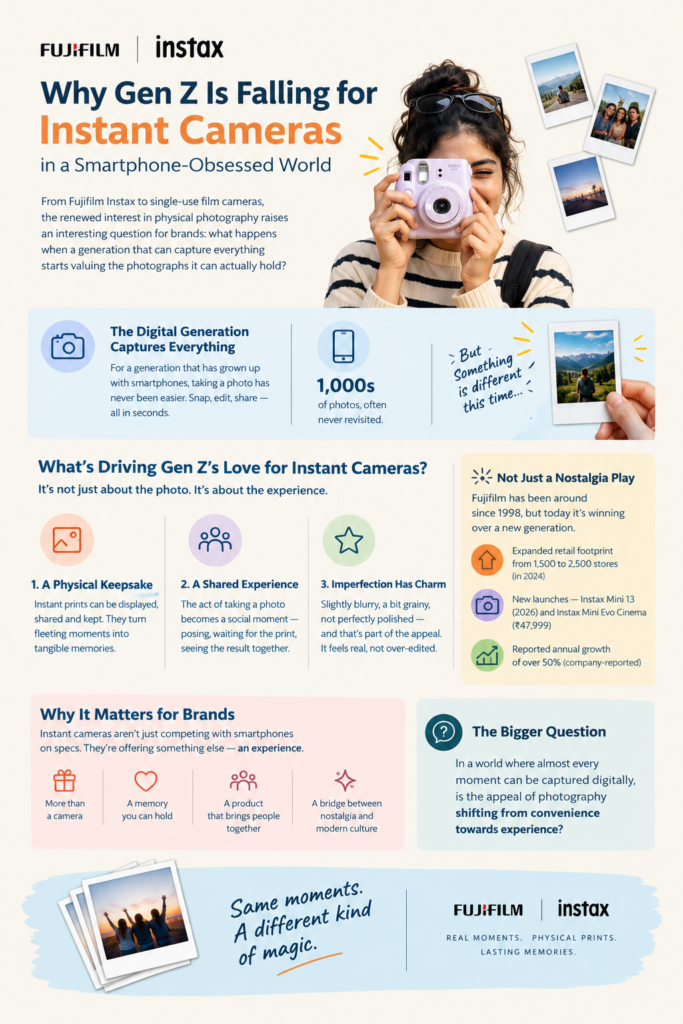
In June 2024, Fujifilm India announced that Instax had expanded its retail footprint from 1,500 to 2,500 stores and reported annual growth exceeding 50%. These are company-reported figures rather than independently audited estimates of the Indian instant-camera market, but they indicate that the business had developed meaningful commercial momentum. Fujifilm India
The brand has also continued to invest in its product portfolio. Its Instax Mini 13, launched in India in 2026, offers a relatively straightforward point-and-shoot experience, while the hybrid Instax Mini Evo Cinema, launched in January 2026 at an announced maximum retail price of ₹47,999, combines video capture with the ability to produce physical prints. Fujifilm India
The price difference between these products is significant. It also illustrates that instant photography is not one uniform market: it ranges from relatively accessible cameras to premium devices that combine physical photography with digital features.
In an August 2026 report, The Indian Express quoted Fujifilm India executive Arun Babu describing Instax as one of the company’s major growth drivers in India. The report also noted interest among younger consumers in Instax and QuickSnap, Fujifilm’s single-use film camera range. The Indian Express
This is a more interesting story than nostalgia alone. Fujifilm is not simply bringing an old product back. It is adapting physical photography to contemporary consumer behaviour.
Why would a smartphone generation want a separate camera?
There are several possible explanations, and they may overlap.
1. A photograph becomes an object, not just a file
Digital photographs are abundant. They sit alongside screenshots, memes, documents and thousands of other images on a phone. Many are never revisited after the day they are taken.
An instant photograph behaves differently. It can be placed on a desk, stuck to a wall, slipped into a wallet or given to a friend. It becomes something that can be displayed and shared without opening an app.
That physical quality creates possibilities beyond the photograph itself. At a birthday party, college farewell, holiday or house party, the printed image can become a keepsake of the occasion.
For brands, this distinction matters. The product is not competing with a smartphone on camera specifications alone. It is offering a different way of preserving and exchanging memories.
2. The act of taking the picture becomes part of the experience
Smartphone photography is often individual and immediate: take a picture, check it, retake it, edit it and post it.
Instant photography introduces a small event into that process. People gather around the camera, pose together, wait for the print and see the result emerge. The photograph becomes part of the social occasion.
This could explain its relevance at weddings, birthdays, college festivals and informal gatherings. An instant camera can be a shared activity rather than merely a device owned by one person.
It also gives brands an opportunity to participate in an experience. A camera at a college event, for example, can generate physical memories that attendees take home, rather than leaving the brand’s presence confined to a digital impression.
3. Imperfection can be part of the appeal
Smartphone cameras increasingly promise sharper images, better low-light performance and computationally enhanced results. Instant cameras make a different proposition. Their prints are small, their image quality varies by model and lighting, and the final result may not look as polished as a photograph taken on a flagship phone.
That difference can be a feature rather than a flaw.
The softer look, limited control and unpredictability can give photographs a distinct aesthetic. They also make the experience feel different from the endless process of editing a digital image until it looks right.
It would be simplistic to claim that every young consumer is tired of perfect pictures. But the popularity of distinctive visual styles across youth culture suggests that technical perfection is not the only quality people value in an image.
For a category such as instant photography, character and experience can be meaningful selling points.
4. The appeal of doing something differently
There is another possibility: a separate camera creates a little distance from the smartphone.
A phone is a multipurpose device. Photography competes with notifications, messaging, social feeds and other demands on the same screen. A dedicated camera can make taking photographs feel like a more deliberate activity.
The appeal may be particularly pronounced with single-use film cameras, where the photographer cannot immediately review every shot. The limitation changes the experience: each photograph involves a choice, and the results remain unknown until the film is developed.
This is not proof that Gen Z is rejecting digital life. Young consumers continue to rely heavily on smartphones. Instead, the interest in analogue photography may reflect a desire to add a different kind of experience alongside digital convenience.
Kodak, Fujifilm and the opportunity for brands
Fujifilm is the strongest Indian example in this story because there is public evidence of its retail expansion, product launches and stated interest in younger consumers.
Kodak also participates in the broader instant-photography category through products such as its Mini Shot camera-and-printer range. However, the available evidence does not establish that Kodak is experiencing the same India-specific, Gen Z-driven growth reported by Fujifilm. The two brands should therefore not be treated as interchangeable success stories.
The broader lesson is about how brands can create value around a product that is not necessarily more convenient than the digital alternative.
First, the experience can be the product. A brand activation that lets people capture and take home a photograph can offer a more tangible memory than a conventional promotional giveaway.
Second, physical objects can extend a brand’s presence beyond the event. A photograph displayed in someone’s room may remain visible long after an event’s social media posts disappear from the feed.
Third, the category can bring together online discovery and offline participation. A physical photograph can still be shared digitally, while a QR code can connect a printed image to additional content. Fujifilm’s higher-end hybrid products already explore this intersection between physical prints and digital media.
These are potential applications, not guarantees of marketing effectiveness. Brands still need to consider whether the experience fits their audience, whether people will value the resulting object and whether the activation creates meaningful brand recall.
The catch: novelty is not the same as a lasting market
Instant cameras also face practical barriers. The upfront cost can be substantial for a student, particularly when compared with a smartphone that already takes photographs. Film or printing consumables add to the ongoing expense. Single-use film cameras require development, which adds another step.
The experience may be attractive for special occasions without becoming a regular habit. A camera can also be bought as a gift, displayed for its design or used a few times before being forgotten.
These considerations matter because social media visibility is not the same as sustained purchasing demand. Product launches and company-reported growth establish that the category has commercial relevance, but they do not tell us what proportion of Indian Gen Z owns an instant camera, how frequently it is used or whether interest is spreading beyond a relatively enthusiastic segment.
Those are questions the industry will need to answer before declaring instant photography a mass youth movement.
What this means for the youth market
The more useful takeaway is not that Gen Z is abandoning smartphones or travelling backwards in time. It is that convenience alone may not satisfy every consumer need.
A smartphone is exceptionally good at capturing and distributing images. An instant camera offers something different: a photograph that can be held, exchanged and kept as an object. The two can coexist because they serve different purposes.
For marketers, this is a reminder to look beyond product specifications and ask what role a product plays in people’s lives. Sometimes the value lies in speed and efficiency. At other times, it lies in the ritual, the memory or the pleasure of having something tangible.
Fujifilm’s continued investment in Instax, alongside its expansion into other camera formats, makes the category worth watching in India. Whether this becomes a broader Gen Z habit or remains a smaller enthusiast market is still an open question.
But the category has already surfaced an intriguing contradiction of the digital age: when almost every photograph can live forever in a phone, a small printed picture can still feel special.
For brands trying to earn a place in young consumers’ lives, that may be the real story—not a return to the past, but a reminder that not every meaningful experience needs to happen on a screen.