For millions of young Indians, paying for something is no longer an event.
It is a reflex.
A QR code appears at a neighbourhood café. A friend asks for her share of dinner. A parent needs money transferred across cities. A mobile recharge is due. A purchase needs to be paid for online.
The response is often the same: open an app, scan or enter a UPI ID, authenticate and move on.
No wallet. No cash. Often, barely a second thought about the payment itself.
That is perhaps the most remarkable part of India’s digital-payment revolution.
The country did not merely replace cash with smartphones. It gradually made the act of paying so frictionless that the payment itself began to disappear into everyday behaviour.
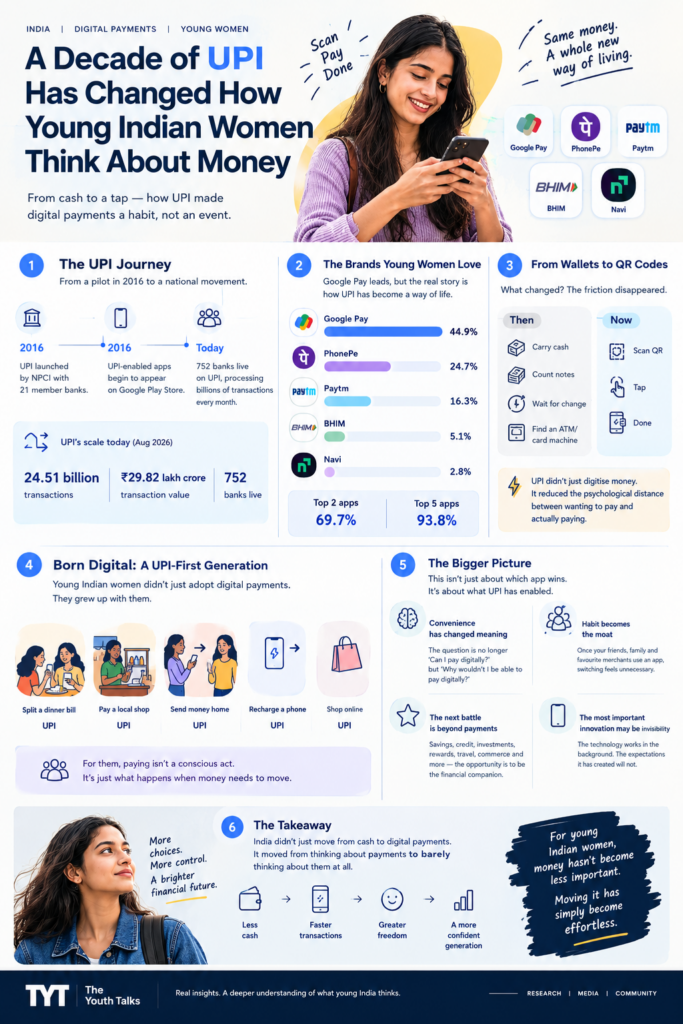
UPI was piloted in April 2016 by the National Payments Corporation of India (NPCI), initially with 21 member banks. By August that year, UPI-enabled applications were beginning to appear on the Google Play Store.
A decade later, UPI is no longer an emerging technology for young Indians. It is part of the infrastructure of everyday life.
TheYouthTalks’ research into brands loved by young Indian women offers an interesting glimpse into that transformation.
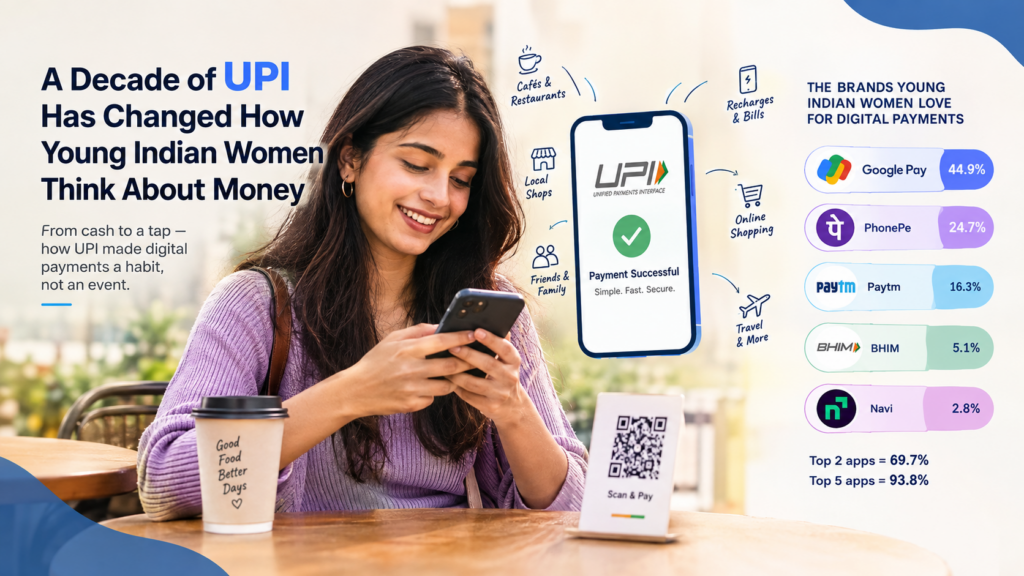
Among the respondents, Google Pay emerged as the most preferred digital-payment brand, with 44.9% of responses, followed by PhonePe at 24.7% and Paytm at 16.3%. BHIM and Navi followed with 5.1% and 2.8%, respectively.
Together, Google Pay and PhonePe accounted for 69.7% of responses, while the five leading platforms captured 93.8%.
The numbers reveal a competitive payments market.
But underneath them is a much larger behavioural story: what happens when an entire generation grows up believing that money should move as easily as a message?
From Carrying Money to Carrying Access to Money
There was a time when the first question before leaving home was fairly basic:
Do I have enough cash?
A wallet mattered. So did the ATM.
You carried notes for the autorickshaw, kept change for the neighbourhood shop and perhaps carried a debit card for larger purchases.
Payments were physical, visible and occasionally inconvenient.
UPI changed the equation.
The underlying system was designed to allow instant bank-to-bank transfers through a common interface, enabling use cases ranging from peer-to-peer transfers and bill splitting to merchant payments.
The result was not simply another way of paying.
It was a reduction in friction.
And friction matters.
If sending ₹50 to a friend requires almost the same effort as sending a message, there is little reason to postpone the transaction. If a roadside vendor accepts a QR code, carrying cash becomes less important. If a parent can transfer money instantly, physical distance becomes less relevant.
The transaction gets smaller, faster and less consequential psychologically.
UPI did not just digitise money. It reduced the distance between deciding to pay and actually paying.
Young Indian Women Are Coming of Age in a UPI-First World
The behavioural shift becomes particularly interesting when viewed through young Indian women.
Many of the consumers represented in TheYouthTalks’ research entered adulthood at a time when QR codes, mobile wallets and UPI were already familiar parts of the environment around them.
They did not necessarily have to abandon a deeply entrenched cash-first financial routine.
They learned to transact digitally as part of everyday life.
That distinction matters.
For a consumer who grew up with UPI, asking a friend to transfer money is not necessarily a “digital payment behaviour”. It is simply what happens when money needs to move.
Split a restaurant bill?
UPI.
Pay the local salon?
UPI.
Send money home?
UPI.
Pay a small merchant?
Scan the QR code.
The technology has become almost invisible.
And that may be UPI’s biggest cultural achievement.
When technology becomes a habit
The most successful technologies eventually stop feeling technological.
Electricity is not a technology most people consciously think about every time they switch on a light. Search is rarely perceived as a sophisticated technological process. Messaging is simply something people do.
UPI is moving in the same direction.
The consumer is increasingly not thinking, “I am using a digital-payment infrastructure.”
She is thinking:
“I’ll send it.”
That distinction is subtle, but important.
The Numbers Behind the Shift Are Hard to Ignore
The scale of UPI’s transformation provides context to the behavioural change.
NPCI’s latest statistics show that UPI processed 24.51 billion transactions in August 2026, with a transaction value of approximately ₹29.82 lakh crore during the month. The network had 752 banks live on UPI at the time.
That is a very different ecosystem from the one that existed when UPI was launched.
In its early days, UPI was an infrastructure project designed to make digital payments more interoperable and accessible. Today, it sits underneath an enormous consumer ecosystem of banks, apps, merchants and everyday transactions.
The evolution can therefore be viewed in two stages.
First came adoption.
People had to be persuaded that digital payments worked.
Then came normalisation.
People stopped thinking about whether digital payments worked at all.
The second stage may ultimately prove more consequential.
Google Pay’s Lead Tells Only Half the Story
TheYouthTalks’ research places Google Pay at the top among the young women surveyed, with 44.9% of responses.
PhonePe follows at 24.7%.
Paytm, at 16.3%, occupies third place.
At first glance, this looks like a straightforward ranking of payment apps.
But consumer behaviour rarely works that neatly.
The more interesting question is not simply which app is being used.
It is why one app becomes the default.
Because once UPI became interoperable, consumers were no longer necessarily choosing between completely different payment technologies.
The underlying payment infrastructure was shared.
The differentiation increasingly moved elsewhere.
Interface.
Trust.
Familiarity.
Ease of use.
Merchant acceptance.
And perhaps most importantly, social behaviour.
If your friends use a particular application, if your family is comfortable with it and if the merchants around you recognise it immediately, the app becomes part of your routine.
The payment application can therefore become less of a product choice and more of a habit.
Paytm’s Journey Shows How Quickly Consumer Habits Can Change
The 16.3% recorded by Paytm in TheYouthTalks’ survey is particularly interesting because of the brand’s place in India’s digital-payment history.
Paytm was one of the brands strongly associated with the early popularisation of mobile-based payments in India.
But category creation and long-term category leadership are not necessarily the same thing.
That is an important lesson from the UPI ecosystem.
Once the payment infrastructure becomes widespread, simply enabling a transaction is no longer enough to differentiate a consumer brand.
The basic expectation becomes table stakes:
It should work.
The competitive question then becomes:
Why should I keep using your app?
That is a much harder question.
When Every App Can Do the Same Thing, Habit Becomes the Moat
Digital payments are an unusual consumer category.
Consider the fundamental task.
Send money.
Receive money.
Scan a QR code.
Pay a merchant.
Split a bill.
Recharge a phone.
At the functional level, the differences between competing platforms may not always be obvious to an everyday consumer.
This makes behavioural familiarity extremely valuable.
Once an application becomes part of someone’s routine, switching can feel unnecessary even when alternatives are readily available.
That creates what could be called a habit moat.
The app does not have to constantly persuade the consumer to use it.
The consumer simply opens it because that is what she has always done.
For brands operating in India’s payments ecosystem, this could become increasingly important.
The battle is no longer only about acquiring users.
It is about becoming the default.
Convenience Has Changed Meaning
Perhaps the biggest shift created by UPI is not technological at all.
It is psychological.
A decade ago, digital payment itself represented convenience.
Today, consumers increasingly expect convenience as the starting point.
The question has moved from:
“Can I pay digitally?”
to:
“Why can’t I pay digitally?”
That change in expectation is profound.
It means a payment failure, an unavailable QR code or a merchant who accepts only cash can feel like an interruption to the normal flow of life.
The technology has reset the baseline.
And young consumers are likely to carry that expectation into every new financial product they encounter.
The Next Battle Is Bigger Than Payments
For payment platforms, the long-term opportunity may therefore lie beyond the transaction itself.
If UPI has already made moving money effortless, the next competition could be around everything that happens before and after the payment.
Savings.
Credit.
Investments.
Rewards.
Financial planning.
Subscriptions.
Commerce.
Travel.
Everyday financial management.
The ambition, in other words, could shift from becoming the app through which a consumer pays to becoming the platform through which she manages more of her financial life.
That is where consumer trust becomes particularly important.
Because the more invisible payments become, the more important the relationship surrounding them can become.
A Decade Later, the Most Important UPI Innovation May Be Invisibility
UPI’s first decade is often described through transaction volumes, adoption numbers and the rise of digital payments.
Those numbers matter.
But there is another metric that is harder to measure.
How often do people think about the technology while using it?
Probably less than they used to.
And that is a sign of success.
TheYouthTalks’ findings among young Indian women illustrate this broader transition. Google Pay’s 44.9% share, PhonePe’s 24.7% and Paytm’s 16.3% tell us something about brand preference.
But the bigger story is what sits beneath those numbers.
A generation has grown accustomed to money moving instantly.
A friend does not have to return cash tomorrow.
A parent does not necessarily need to wait for a bank transfer.
A small merchant does not necessarily need a card machine.
And a consumer does not need to ask herself whether she has cash in her wallet before making a ₹100 purchase.
The wallet has become less important.
Access has become the new wallet.
And perhaps that is the real story of UPI’s first decade.
India did not simply move from cash to digital payments.
It moved from thinking about payments to barely thinking about them at all.
For young Indian women, that behavioural shift is already part of everyday life.
The next decade will reveal what happens when an entire generation expects money to move as effortlessly as information.
The technology may become even less visible. The expectations it has created will not.