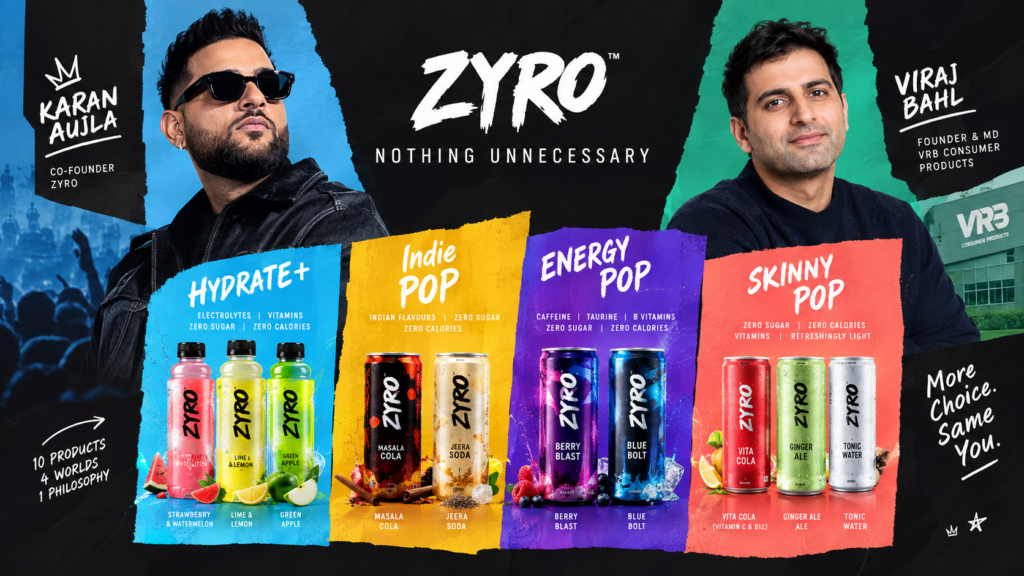
Karan Aujla brings the cultural pull. Viraj Bahl brings the FMCG playbook. Together, Zyro is attempting something more ambitious than a celebrity beverage launch.
When a celebrity launches a beverage, the playbook is usually familiar.
Put the celebrity on the bottle. Build a campaign around their popularity. Get the product into stores. Let fandom drive the first wave of trial.
Karan Aujla’s Zyro is more interesting than that.
Because behind the music star is an established Indian consumer business with more than a decade of experience building food brands.
Zyro is the beverage brand co-founded by Karan Aujla and VRB Consumer Products, the company founded and led by Viraj Bahl, the entrepreneur behind Veeba.
And that combination matters.
Bahl founded Veeba in 2013. Under his leadership, VRB has expanded from a food-solutions business into a broader food and beverage company spanning sauces, condiments, instant foods and beverages. Its portfolio today includes brands such as Veeba, Wok Tok and Zyro.
The scale is significant. In 2024, Bahl told ETRetail that VRB had a presence across 750 towns and cities, with two manufacturing units capable of producing around 10,000 tonnes a month, while the company was planning further capacity expansion.
And according to Tracxn data cited by The Economic Times, VRB reported revenue of about ₹1,030 crore for FY25.
So this isn’t simply Karan Aujla putting his name on a bottle.
It is the meeting point of two very different kinds of brand-building power.
Karan Aujla brings cultural relevance, music, fandom and an existing relationship with young consumers.
Viraj Bahl and VRB bring product development, manufacturing, distribution and FMCG experience.
That makes Zyro a more interesting experiment than the average celebrity endorsement.
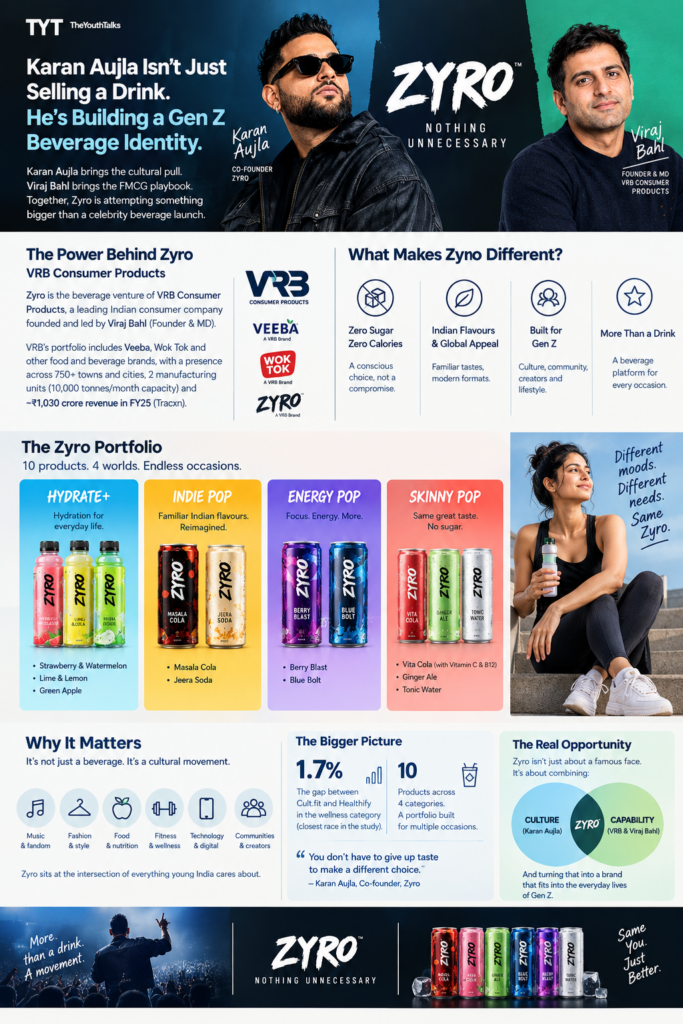
The real story is Culture × Capability
A celebrity endorsement says:
“I like this product.”
A founder-led brand says:
“I helped build this product.”
Zyro is positioning itself firmly in the second category.
On its own website, Aujla says he did not want to simply put his name on a beverage. He describes Zyro as something he helped shape “from the ground up” and identifies himself as its co-founder. The brand’s central philosophy is “Nothing Unnecessary”, built around zero sugar and zero calories.
The launch campaign followed the same approach.
Instead of presenting Aujla in a conventional glossy celebrity endorsement, Zyro’s March 2026 campaign used childhood and teenage images and a personal narrative around simplicity, focus and removing excess. Viraj Bahl positioned the brand around changing consumer preferences for zero-sugar options and what he described as more mindful consumption.
That is an important distinction.
The brand isn’t asking consumers merely to believe that Karan drinks Zyro.
It is asking them to believe that Zyro represents a way of thinking that Karan himself identifies with.
That is a much more ambitious proposition.
But what exactly is Zyro building?
Look at the portfolio and the strategy becomes clearer.
Zyro’s current website lists 10 products across four propositions: Hydrate+, Indie Pop, Energy Pop and Skinny Pop.
That means Zyro isn’t really behaving like a single-product celebrity brand.
It is attempting to build a portfolio of beverage occasions.
Hydrate+: when water isn’t enough — and water isn’t exciting
Hydrate+ currently includes:
- Strawberry & Watermelon
- Lime & Lemon
- Green Apple
These are 400 ml beverages positioned around hydration and everyday refreshment.
The Lime & Lemon variant, for example, is sugar-free and caffeine-free and contains potassium, while the product formulation also includes vitamins.
This gives Zyro an occasion beyond conventional soft drinks.
The consumer doesn’t necessarily have to think:
“I want a cola.”
They can think:
“I want something refreshing after a workout.”
Or after a long day.
Or while travelling.
Or simply because plain water feels boring.
The brand is therefore trying to enter the consumer’s daily routine, not just their soft-drink moment.
Indie Pop: nostalgia without the old formula
Then comes Indie Pop, which currently consists of:
- Masala Cola
- Jeera Soda
This may be one of the more interesting parts of the portfolio.
Instead of asking young consumers to abandon familiar Indian beverage flavours, Zyro is taking those flavours and reinterpreting them through its zero-sugar, zero-calorie proposition.
Jeera Soda is particularly revealing.
It isn’t trying to invent a new flavour for Gen Z.
It is taking something deeply familiar and changing the proposition around it.
The message becomes less:
Forget what you grew up drinking.
And more:
You can have the familiar experience in a format that fits contemporary consumption.
That is an important distinction in a country where modern consumption and nostalgia frequently coexist.
Energy Pop: turning the drink into a utility
Then Zyro moves into Energy Pop.
The current range includes:
- Berry Blast
- Blue Bolt
These products contain caffeine, taurine and B vitamins while maintaining zero sugar and zero calories. Zyro lists 30 mg of caffeine per 100 ml for both; a 250 ml can therefore contains about 75 mg of caffeine.
Here, the drink takes on another role.
It isn’t simply refreshment.
It becomes associated with:
focus → alertness → work → study → gaming → late nights → productivity.
That is particularly relevant to younger consumers whose beverage occasions are increasingly fragmented.
The same person might want hydration in the afternoon, an energy drink during a late-night project and a cola while hanging out with friends.
The opportunity isn’t necessarily to sell one drink to one consumer.
It is to sell different drinks to the same consumer at different moments.
That is how a beverage portfolio begins to become a lifestyle portfolio.
Skinny Pop: the portfolio gets even more interesting
The latest expansion makes the strategy even clearer.
In June 2026, Zyro launched Skinny Pop, with:
- Vita Cola
- Ginger Ale
- Tonic Water
All three are positioned as zero-sugar, zero-calorie beverages.
The most revealing product here may be Vita Cola.
It is a cola with added Vitamin C and B12, while retaining the zero-sugar, zero-calorie proposition.
This is an interesting attempt to take one of the world’s most familiar beverage formats and give it another reason to exist.
Not simply:
“It tastes good.”
But:
“It fits the way I want to consume.”
Ginger Ale and Tonic Water move the brand into yet another set of occasions — including evening consumption and mixer-led usage. Zyro’s current product range lists both at ₹60 MRP for 250 ml.
And suddenly the portfolio starts looking less like a celebrity beverage launch and more like an attempt to build an ecosystem of consumption occasions.
The portfolio tells the real story
Put the four propositions together:
| Zyro proposition | Products | The occasion it is trying to own |
|---|---|---|
| Hydrate+ | Strawberry & Watermelon, Lime & Lemon, Green Apple | Hydration / everyday refreshment |
| Indie Pop | Masala Cola, Jeera Soda | Familiar Indian flavours / social refreshment |
| Energy Pop | Berry Blast, Blue Bolt | Focus / alertness / energy |
| Skinny Pop | Vita Cola, Ginger Ale, Tonic Water | Cola / evening / contemporary refreshment |
The important point isn’t simply that Zyro has ten products.
It is why those products exist alongside one another.
The portfolio appears designed to make the brand relevant across different moments of a young consumer’s day.
That is very different from launching one celebrity-branded beverage and hoping fandom carries it.
Zero sugar is the entry point, not necessarily the moat
There is another important reality.
Zero sugar is no longer an unusual proposition in India’s beverage market.
Consumers already have access to diet colas, zero-sugar variants, energy drinks and a growing range of functional beverages.
So Zyro cannot build a lasting brand simply by saying:
“We don’t have sugar.”
That gets attention.
It may generate trial.
But it doesn’t automatically create loyalty.
The more interesting question is what Zyro does after removing sugar.
It adds:
- flavour,
- caffeine,
- electrolytes,
- vitamins,
- familiar Indian beverage formats,
- different occasions,
- and cultural relevance.
That is where “Nothing Unnecessary” starts functioning as more than a nutritional proposition.
It becomes a brand philosophy.
And importantly, TYT should be careful not to translate “zero sugar” into “healthy.” These are different claims. For example, Zyro’s Berry Blast contains caffeine and taurine, while its products use sweeteners and other formulated ingredients.
The more useful consumer story is therefore about choice and positioning, not a blanket health claim.
So why does Karan Aujla matter?
This is perhaps the most interesting strategic question.
VRB already has manufacturing experience.
It already has distribution.
It already knows FMCG.
It already has consumer brands.
So what does a musician bring to that equation?
Culture.
Karan Aujla has something a conventional FMCG company cannot manufacture overnight: an existing cultural relationship with a young audience.
Music, fashion, social media, concerts and identity increasingly overlap in the way young consumers discover brands.
A beverage can therefore become more than a beverage.
It can become part of the world surrounding an artist.
And that creates a potentially powerful exchange.
Karan gives Zyro cultural relevance.
VRB gives Karan the infrastructure to build a real consumer brand.
That is the Culture × Capability equation.
And it may be the most interesting thing about Zyro.
There is also a fascinating contradiction
Zyro’s philosophy is:
“Nothing Unnecessary.”
But its portfolio is expanding.
Hydration.
Energy.
Cola.
Jeera Soda.
Ginger Ale.
Tonic Water.
Vitamin-infused cola.
Multiple flavours.
Multiple occasions.
That isn’t necessarily a problem.
In fact, portfolio expansion may be exactly what is required to build a serious beverage business.
But it creates a strategic question:
Can a brand built around simplicity remain simple as it becomes bigger?
If consumers see ten unrelated drinks, Zyro risks becoming just another beverage company.
If they see ten expressions of the same idea — familiar, enjoyable beverages without the sugar and calories they don’t want — the portfolio starts to make sense.
The brand architecture therefore becomes critical.
The individual products can change.
The underlying idea has to remain recognisable.
And this is where VRB makes the story more interesting
There is a tendency to treat celebrity consumer brands as if the celebrity is the entire business.
Zyro suggests a different model.
The celebrity isn’t replacing the consumer-company infrastructure.
The celebrity is being placed on top of it.
That distinction matters.
VRB has already demonstrated an appetite for expanding beyond its original sauce business. In 2024, the company launched Wok Tok and said it was targeting seven categories and five brands by 2028, while also investing in additional manufacturing capacity.
Zyro therefore fits into a broader VRB strategy of becoming a more diversified FMCG company.
And that changes how we should read Karan Aujla’s role.
He isn’t necessarily being brought in because VRB needs a famous face.
He may be there because culture itself has become a distribution mechanism for consumer brands.
That is a very different proposition.
From celebrity endorsement to cultural ownership
For years, the conventional formula was:
Celebrity → Advertisement → Product
The emerging model may look more like:
Culture → Community → Identity → Product → Habit
That distinction is important.
A celebrity can create awareness.
A campaign can create trial.
A cultural association can create conversation.
But ultimately, only the product can create habit.
And that may be Zyro’s biggest test.
Because Karan Aujla can get consumers to notice the drink.
VRB can get the drink into distribution.
But neither guarantees that a consumer will reach for the same product again next week.
That has to be earned through taste, price, availability, relevance and repeat behaviour.
The bigger Gen Z opportunity
Perhaps the most interesting thing about Zyro isn’t the drink itself.
It is the attempt to turn culture into consumption.
Young consumers increasingly encounter brands through an interconnected ecosystem of:
music + creators + fashion + food + fitness + technology + communities.
A beverage can sit at the intersection of all of them.
That is exactly the territory Zyro appears to be pursuing.
And Karan Aujla gives the brand something most new beverage companies have to spend years building:
a pre-existing cultural relationship with an audience.
VRB gives that relationship something equally important:
the machinery required to turn a cultural idea into an FMCG business.
That makes Zyro worth watching.
Not because a famous musician launched a drink.
But because it represents a potentially important evolution in how consumer brands are being built in India.
TheYouthTalks Take
Zyro may have started with zero sugar and zero calories. But its bigger proposition is about zero distance between culture and consumption.
Karan Aujla brings the cultural connection.
Viraj Bahl and VRB bring the consumer-business capability.
The portfolio brings the occasions.
And the brand is trying to connect all three through one idea:
Nothing Unnecessary.
Whether that becomes a lasting consumer habit remains to be seen.
But the experiment itself is worth watching.
Because the next generation of Indian consumer brands may not be built by choosing between culture and capability.
They may be built by combining both.