And then there are findings that appear almost inevitable. Instagram dominating social media preferences among young Indian women belongs firmly in the second category.
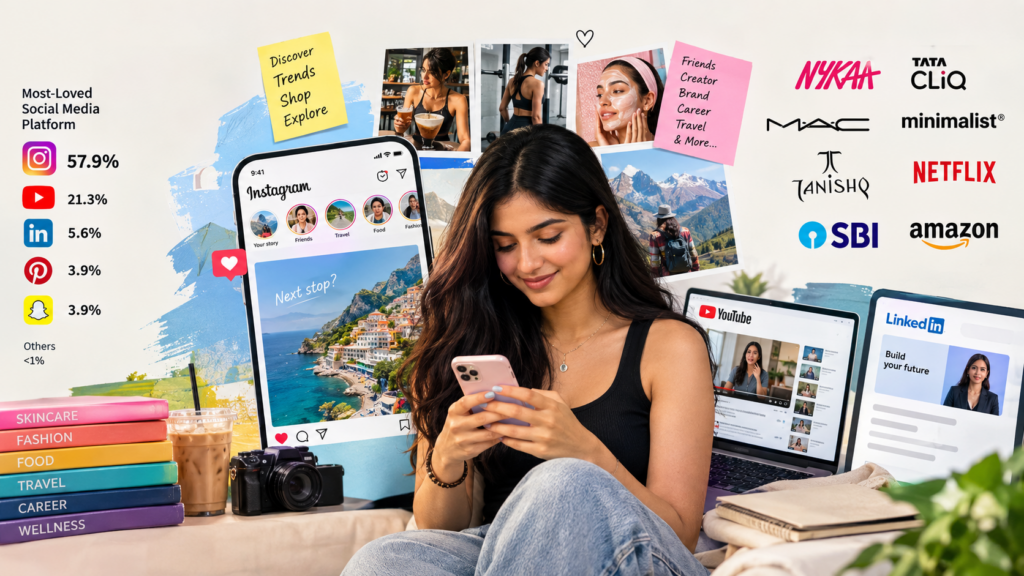
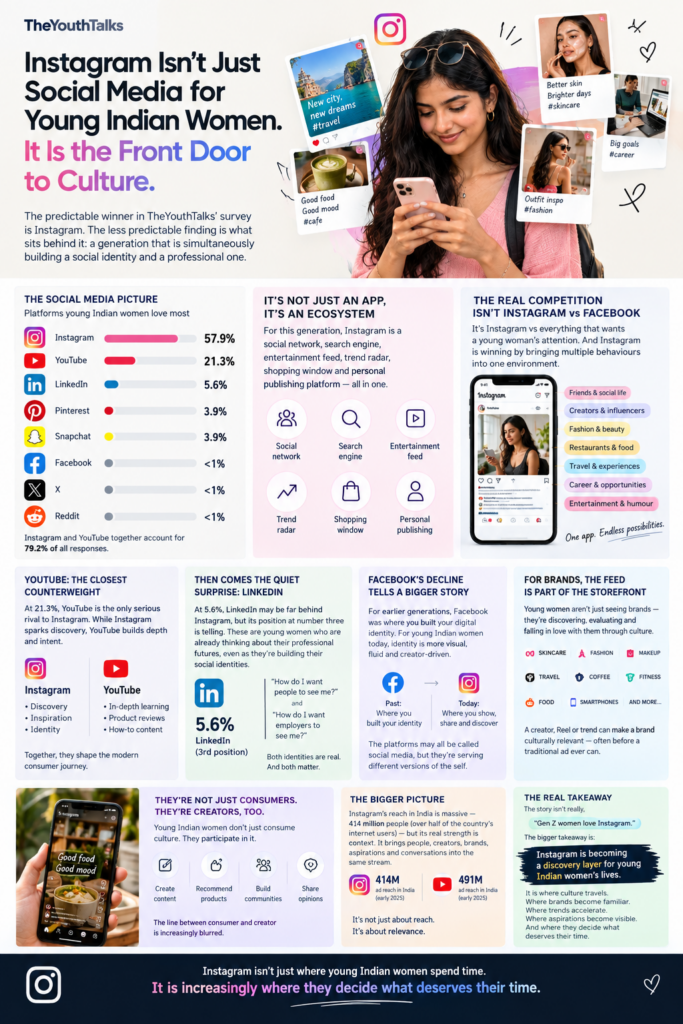
In TheYouthTalks’ survey, 57.9% of young Indian women named Instagram as their most-loved social media platform. YouTube followed at 21.3%, meaning the two platforms together accounted for 79.2% of all responses. LinkedIn came next at 5.6%, while Pinterest and Snapchat each recorded 3.9%.
Facebook, X and Reddit barely featured.
At first glance, the conclusion seems obvious: young women like Instagram.
But that would be an unusually shallow reading of the data.
The more interesting story is what Instagram’s dominance reveals about how a generation is discovering brands, building identity, consuming culture and imagining its future.
Because Instagram is no longer merely a place to post photographs or watch Reels.
For many young Indian women, it is becoming the front door to the wider consumer and cultural world.
Instagram Has Become More Than an App
There was a time when social media platforms were relatively easy to define.
Facebook was where you connected with people you knew. YouTube was where you watched videos. LinkedIn was where professionals networked. Instagram was where you shared photographs.
Those distinctions have largely disappeared.
Today, Instagram can simultaneously function as a social network, entertainment platform, search engine, trend tracker, creator marketplace, shopping window and personal publishing space.
A young woman might open Instagram to check what her friends are doing.
Five minutes later, she could be watching a skincare review.
Then a creator could introduce her to a new fashion label. A Reel might put a café in Bengaluru or a travel destination in Himachal Pradesh on her wishlist. Another creator could explain a financial product. Somewhere in between, she might encounter a career opportunity or a brand she had never actively searched for.
The remarkable part is that none of these behaviours require her to leave the platform.
That is what makes the 57.9% finding important.
It isn’t simply a measure of platform preference.
It is a measure of where attention begins.
And increasingly, attention is where consumer journeys begin too.
Meta reported in 2025 that nearly eight in ten Indian shoppers discovered products through social media, with 96% of those social discoveries taking place on Meta platforms.
A separate 2026 Meta and Retailers Association of India report described India’s retail journey as moving from a traditional search-and-transaction model towards a “scroll-led discovery ecosystem”, with social media influencing 77% of retail purchase decisions.
The exact numbers come from industry-sponsored research and should therefore be read in that context. But the underlying direction is difficult to ignore: discovery is increasingly happening before search.
And Instagram sits right in the middle of that shift.
The Competition Isn’t Really Instagram vs Facebook
It is tempting to compare Instagram with other social platforms as if consumers are choosing between competing apps.
But that misses how people actually use them.
The real competition is for attention, relevance and cultural influence.
Instagram has an unusual advantage because so many different behaviours coexist inside the same environment.
You don’t necessarily open Instagram because you have decided to “use social media”.
You open it because you want to see what is happening.
Then the algorithm takes over.
A friend becomes a creator. A creator becomes a recommendation. A recommendation becomes a brand. A brand becomes an aspiration. An aspiration becomes a search. And sometimes, eventually, a search becomes a purchase.
The entire journey can begin with something as insignificant as a 20-second Reel.
This is particularly powerful for categories that depend on visual appeal or cultural relevance.
Think skincare.
Fashion.
Makeup.
Fitness.
Food.
Travel.
Home décor.
Even technology.
Instagram does not merely tell consumers that these products exist. It places them inside a context in which they can look desirable, useful, relevant or culturally current.
That distinction matters.
YouTube Is the Closest Counterweight
TheYouthTalks survey puts YouTube at 21.3%, considerably behind Instagram but far ahead of every other platform.
That gap tells us something interesting too.
Instagram and YouTube may compete for screen time, but they often perform different jobs.
Instagram is frequently the place where curiosity begins.
YouTube is where that curiosity can become intent.
Instagram might make you interested in a skincare ingredient.
YouTube can give you a 15-minute comparison of products containing it.
Instagram might make a destination look irresistible.
YouTube can show you what the actual trip is like.
Instagram can introduce a new technology or career path.
YouTube can provide the tutorial, interview or explainer that helps someone understand it properly.
In other words:
Instagram creates discovery. YouTube often creates depth.
That distinction becomes particularly relevant for brands trying to understand the modern consumer journey. A Reel may generate awareness, but a longer video, review or tutorial can help convert curiosity into confidence.
The two platforms are therefore less interchangeable than they initially appear.
Then Comes the Quiet Surprise: LinkedIn
Perhaps the most intriguing number in the survey isn’t Instagram’s 57.9%.
It is LinkedIn’s 5.6%.
Five-point-six percent is not a large share compared with Instagram. But its position at number three is revealing.
It places LinkedIn ahead of Snapchat and Facebook among the young women surveyed.
Why does that matter?
Because these are young women who are often still studying or are only beginning their professional journeys.
Professional identity is therefore forming alongside social identity.
For an earlier generation, these identities could have developed sequentially.
College first.
Career later.
Today, the boundary is much less distinct.
A young woman can simultaneously be thinking about:
“How do I want my friends to see me?”
and
“How do I want an employer to see me?”
She may use Instagram to express taste, interests and personality, while using LinkedIn to communicate skills, achievements and ambition.
Neither identity is necessarily more authentic than the other.
They are simply different expressions of the same person.
And that is an important distinction for brands, employers and platforms trying to understand young audiences.
Facebook’s Decline Tells Another Story
The relatively weak showing for Facebook is perhaps more significant when viewed alongside Instagram’s strength.
Facebook once occupied the position that Instagram now occupies: it was where a younger generation built its online identity.
But digital identity has become more visual, fluid and creator-led.
Instagram’s architecture is particularly suited to this shift.
A profile can communicate taste without requiring a long explanation. A Reel can communicate personality in seconds. Stories can make everyday life feel immediate. Creators can turn individual interests into communities.
The result is a platform where identity is not simply declared.
It is continuously performed, edited and discovered.
YouTube then becomes a place for deeper exploration, while LinkedIn increasingly becomes a professional signal.
The platforms may all be called social media, but they are serving different versions of the self.
For Brands, the Feed Is Becoming Part of the Storefront
This is where the survey becomes particularly relevant for marketers.
Consider how a young woman might discover a skincare product today.
She may not begin with a Google search saying, “best serum for my skin type.”
She might first see a creator talking about it.
Then another Reel.
Then a friend sharing a recommendation.
Then a before-and-after video.
Only later does she visit the brand’s website or an e-commerce marketplace.
The brand did not necessarily enter her life through an advertisement.
It entered through culture.
That distinction is becoming increasingly important.
Meta’s 2026 research found that Reels had become a major discovery format among Gen Z, with 89% of respondents in its study engaging with Reels daily. The research also identified beauty, makeup, fashion and trends among the most engaged categories.
Similarly, Meta’s 2025 festive-shopping research found that nearly half of festive shoppers followed influencers or creators, while more than 30% relied on creator reviews and buying guides.
The implications extend beyond beauty and fashion.
A restaurant can become a destination because of Instagram.
A fitness routine can become a trend because of Instagram.
A career aspiration can become visible because someone documents it.
A small brand can acquire cultural relevance without ever having the advertising budget of a multinational.
This is why the feed has increasingly become part of the storefront.
The Young Indian Woman Is Not Just a Consumer
There is another layer to these findings.
It would be easy to look at Instagram’s dominance and conclude that this is simply a story about entertainment or consumption.
It isn’t.
Young women are not only consuming culture on these platforms. They are participating in it.
They create content.
They recommend products.
They build communities.
They share opinions.
They document careers.
They develop personal brands.
They discover businesses.
They influence friends.
And sometimes they become creators themselves.
That is why the distinction between “consumer” and “creator” is becoming increasingly blurred.
The young woman scrolling through a Reel today could be the person influencing another thousand consumers tomorrow.
The cultural journey is no longer one-directional.
The Bigger Story Behind 57.9%
India’s digital ecosystem is enormous. DataReportal estimated that Instagram had an advertising reach of 414 million users in India in early 2025, equivalent to more than half of the country’s internet-user base at the time. YouTube’s reported advertising reach was even larger, at 491 million.
But reach alone doesn’t explain Instagram’s significance among young women.
Its deeper strength is context.
Instagram brings people, creators, brands, aesthetics, aspirations and conversations into the same stream.
That makes it particularly powerful in categories where decisions are influenced by what feels culturally relevant rather than simply what is objectively available.
And this is where TheYouthTalks’ finding becomes more interesting than the headline suggests.
The story isn’t really:
“Gen Z women love Instagram.”
We already know that.
The more consequential observation is:
Instagram is becoming a discovery layer for young Indian women’s lives.
It is where culture travels.
Where brands become familiar.
Where trends accelerate.
Where creators establish credibility.
Where aspirations become visible.
And where different versions of identity — social, aesthetic, professional and aspirational — can coexist.
So yes, Instagram winning 57.9% of the vote may have been predictable.
What is less predictable is how much of the journey that follows may increasingly begin there.
For brands, the question is therefore no longer simply, “Are young women on Instagram?”
The more useful question is:
“What are they discovering about us when they are there?”
Because Instagram isn’t just where young Indian women spend time.
It is increasingly where they decide what deserves their time.