

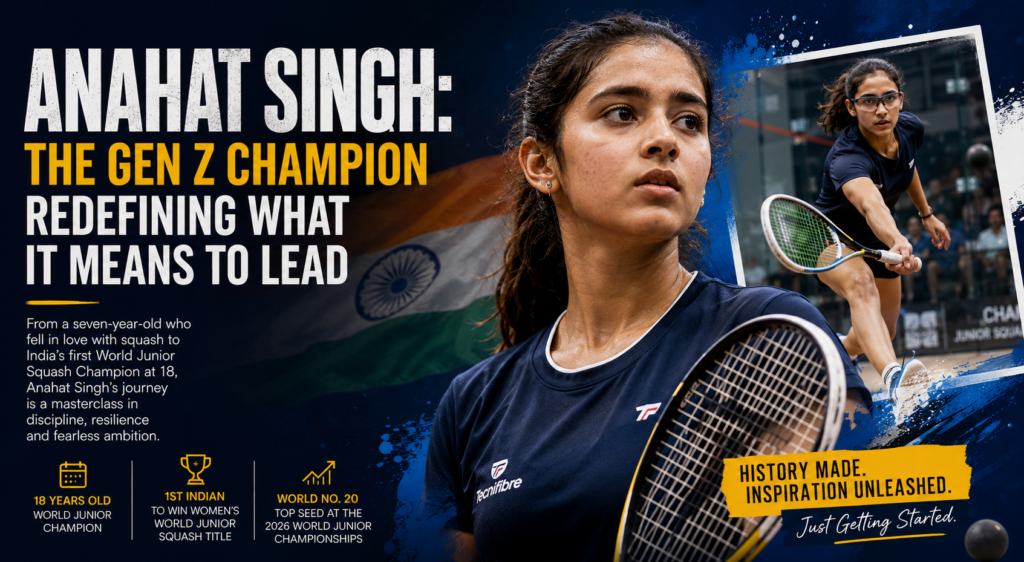
At 18, Anahat Singh has already represented India at a Commonwealth Games, won an Asian junior title and now become India’s first World Junior Squash Champion. But her most interesting story may not be about the titles she has already won. It may be about what her journey tells us about ambition, failure and leadership in the Gen Z era.
There is something almost contradictory about watching an 18-year-old become a world champion.
We tend to associate sporting greatness with experience. With athletes who have spent decades learning how to deal with pressure, disappointment and the enormous psychological burden of representing a country.
Anahat Singh is already learning all of that.
She just happens to be learning it while still being 18.
On July 25, 2026, Singh defeated Egypt’s Ruqayya Salem 11-3, 11-7, 11-9 in the final of the World Junior Squash Championship in Ontario, Canada. The victory made her the first Indian to win the women’s World Junior Squash Championship. She entered the tournament as the top seed and world No. 20, and arrived carrying the expectations that come with being India’s No. 1 squash player.
After the match, Singh described the achievement as something that “means the world” to her. She also said that it felt like she was dreaming.
That reaction is perhaps more revealing than the scoreline.
Because Anahat Singh’s story isn’t really about a teenager suddenly becoming a champion.
It is about a young Indian who has been preparing for this moment for more than a decade.
And it is about something else that makes her particularly interesting to a platform like TheYouthTalks.
Anahat is part of a generation that is frequently described through its contradictions: ambitious but impatient, digitally connected but increasingly concerned about mental wellbeing, determined to succeed but unwilling to blindly follow conventional definitions of success.
Yet here is an 18-year-old whose life has been built around something remarkably old-fashioned.
Practice.
Discipline.
Repetition.
Failure.
And coming back.
The seven-year-old who wasn’t supposed to be the story
Singh’s relationship with squash began almost accidentally.
When she was seven, she accompanied her older sister Amira to a squash training camp in Jaipur conducted by former India international Ritwik Bhattacharya.
Bhattacharya noticed the younger sibling.
According to a 2022 profile in The Indian Express, he jokingly told the family that while Amira was good, Anahat was the one they should really watch. Seven years after that first encounter, Bhattacharya was involved in the decision that eventually saw Anahat accept an invitation to represent India at the 2022 Commonwealth Games in Birmingham.
She was 14.
Fourteen.
At an age when most teenagers are worrying about school, friendships, examinations and the increasingly complicated world of social media, Singh was preparing to walk onto a senior international sporting stage wearing India’s colours.
She became the youngest member of India’s 205-member Commonwealth Games contingent in Birmingham.
And she wasn’t there merely to make up the numbers.
By the time she reached Birmingham, Singh had already accumulated more than 50 junior titles, including victories at major junior events such as the British, German, Dutch and US Junior Opens.
Her Commonwealth Games debut immediately offered a glimpse of the mindset that would later define her.
She defeated St Vincent and the Grenadines’ Jada Ross 11-5, 11-2, 11-0 in the opening round. Afterwards, she spoke about the excitement of playing her first senior tournament and how her confidence grew as the match progressed.
Her attitude was strikingly uncomplicated.
She felt she had nothing to lose.
That sentence tells us something about the athlete.
It also tells us something about the teenager.
She was not approaching the Commonwealth Games as though she had already arrived.
She was approaching it as an opportunity.
That distinction would become important.
Anahat is part of a different generation of Indian athletes
India has produced young sporting prodigies before.
But the environment surrounding today’s athletes is different.
A young athlete doesn’t simply compete anymore.
They exist in public.
Their performances are clipped, posted, analysed and discussed within minutes. Their wins become Instagram Reels. Their defeats become commentary. Their personalities are dissected alongside their statistics.
The athlete has become a media property long before becoming a national celebrity.
And yet Singh’s sporting trajectory has been remarkably traditional.
Train.
Compete.
Lose.
Learn.
Return.
Win.
Repeat.
Perhaps that is one of the reasons her story is so compelling for Gen Z.
Because behind the mythology of instant success is an uncomfortable truth:
There is almost nothing instant about becoming exceptional.
Anahat’s success has been years in the making.
The world champion we see today was already on a squash court when she was seven.
The Commonwealth Games athlete was already competing internationally on the junior circuit.
And the 2026 champion had already experienced the disappointment of not winning the world junior title when she first came close.
That matters.
Because resilience is often spoken about as though it is a personality trait.
In elite sport, it is a practice.
The title didn’t come on the first attempt
The easiest way to tell Anahat’s story would be to describe her as a prodigy who finally fulfilled her destiny.
But that would miss one of the best parts.
She had already come close.
At the 2025 World Junior Squash Championships, Singh reached the semifinals and finished with a bronze medal. That result made her one of the leading Indian players at the tournament, but it wasn’t the title she wanted.
A year later, she returned.
This time she was the top seed.
This was also her final year of junior eligibility, making the tournament particularly consequential.
And she delivered.
Not in a dramatic five-game marathon.
Not through a last-second escape.
She beat Salem in straight games.
11-3.
11-7.
11-9.
A world title, secured with the kind of composure that elite athletes spend years trying to develop.
It is tempting to describe that as confidence.
Perhaps it is.
But confidence in sport is rarely just confidence.
It is memory.
It is the accumulated evidence of thousands of training sessions telling an athlete that when the moment arrives, they know what to do.
The difference between a promising athlete and a champion is often not talent.
It is what happens after the first disappointment.
From Asian champion to world champion
The World Junior title is not an isolated achievement.
In 2025, Singh won the Asian Junior Squash Championship in the Under-19 category, adding another major title to a career that was already moving rapidly beyond the boundaries of junior sport.
The progression is worth pausing over.
2022: India’s youngest athlete at the Commonwealth Games.
2025: Asian Junior Under-19 champion.
2025: World Junior bronze medallist.
2026: World Junior champion.
And then there is another number that changes the context.
By the time of the 2026 World Junior Championship, Singh was ranked No. 20 in the world and was the tournament’s top seed.
Suddenly, the World Junior title doesn’t look like the destination.
It looks like a milestone.
That is an important distinction.
Because the most interesting thing about Anahat’s victory may not be that she has reached the top of junior squash.
It is that she is now leaving junior squash behind.
The real test begins here.
The Olympic dream changes everything
For Indian squash, the timing could hardly be more interesting.
Squash is scheduled to make its Olympic debut at the Los Angeles 2028 Olympic Games.
That gives Singh a completely different horizon.
The junior world championship is one mountain.
The Olympics are another.
And the second is considerably steeper.
The opportunity is historic because India has never had squash as an Olympic medal sport before. For a young athlete already competing at the highest levels, the possibility of becoming part of the first Indian squash generation at the Olympics adds an entirely new dimension to her journey.
But it also creates pressure.
Being identified as a future star can be exciting.
It can also become a burden.
At 14, Anahat was already being discussed as one of India’s brightest young squash prospects.
At 18, she is now a world junior champion.
The question is no longer whether she has potential.
The question is whether she can convert potential into sustained senior excellence.
That is an entirely different challenge.
What does leadership look like when you are 18?
This is where Anahat Singh becomes much more than a sports story.
We often use the word leader rather loosely.
We associate leadership with CEOs, founders, politicians, captains and people with formal authority.
But there is another kind of leadership.
The kind that happens through example.
Anahat doesn’t have to tell India’s young people how to be disciplined.
Her daily life demonstrates it.
She doesn’t have to give a lecture about perseverance.
Her career contains it.
She doesn’t need to explain the value of competing after failure.
She returned from a World Junior bronze medal and came back to win gold.
This is leadership without a title.
And perhaps it is a particularly relevant form of leadership for Gen Z.
Because leadership for younger audiences increasingly feels less hierarchical.
The traditional leader says:
Follow me.
The modern role model says:
Watch what I am doing.
There is a difference.
One demands authority.
The other earns influence.
Anahat Singh has no formal leadership position.
She is not the CEO of a company.
She isn’t running an organisation.
She isn’t delivering management seminars.
But thousands of young Indians can look at her career and see something they understand.
Someone close to their age.
Someone who started young.
Someone who has lost.
Someone who came back.
Someone who is still figuring out what comes next.
Sometimes the leader is simply the person who keeps showing up.
Gen Z ambition is more complicated than we think
There is an entire industry of commentary about Gen Z.
They don’t want to work hard.
They don’t want traditional careers.
They want flexibility.
They have short attention spans.
They value mental wellbeing.
They don’t believe in staying in one job forever.
Some of these observations contain elements of truth.
But they also miss something.
Gen Z can be extraordinarily ambitious.
The difference is that ambition increasingly comes with a desire for autonomy.
Young people want to decide what they are good at.
They want their work to mean something.
They want to see progress.
They want to build identities around their abilities rather than simply inherit professional labels.
Elite athletes have always lived this reality.
And Singh represents an extreme version of it.
There is no shortcut to becoming a world-class squash player.
No AI prompt can replace thousands of hours on a court.
No viral post can substitute for fitness.
No personal brand can compensate for losing a match.
The scoreboard is brutally honest.
That honesty may itself be refreshing.
In a world where success can be manufactured visually — followers, likes, views, polished photographs, carefully constructed personal brands — sport remains brutally measurable.
You either won or you didn’t.
You either improved or you didn’t.
The opponent doesn’t care about your follower count.
The ball doesn’t care about your personal brand.
And the scoreboard certainly doesn’t care how good your Instagram bio sounds.
That may be one of the reasons athletes like Anahat have such unusual power as role models.
Their success is tangible.
The quiet power of a sport outside India’s mainstream
There is another reason Anahat’s rise matters.
She isn’t a cricketer.
She isn’t a badminton superstar.
She isn’t a track-and-field Olympic medallist.
She plays squash.
India has produced outstanding squash players — Saurav Ghosal, Dipika Pallikal Karthik and Joshna Chinappa among them — but the sport has never enjoyed the mainstream visibility of cricket.
Egypt, meanwhile, has long been a dominant force in world squash.
For an Indian teenager to become the country’s first World Junior Squash Champion therefore carries significance beyond an individual medal.
She is expanding the vocabulary of Indian sporting success.
And that is a form of leadership too.
A young Indian watching Anahat today may not dream only of becoming the next cricket star.
They may see squash differently.
They may ask where the nearest court is.
They may pick up a racket.
They may discover a sport that previously felt distant.
Every sporting hero does this to some extent.
The best ones change the size of the dream.
She represents the changing face of women’s sport
There is another layer to Anahat’s story that deserves attention.
She is a young Indian woman competing in an individual sport at the highest level.
That means the entire result belongs to her.
There is nowhere to hide.
In a team sport, responsibility is distributed.
In squash, the court is small, the opponent is directly across from you and every point comes back to you.
That creates a particular kind of psychological toughness.
For young women watching her, there is something powerful about seeing a teenager whose identity is not built around celebrity.
She is an athlete first.
Her performance is the product.
Her results are the currency.
Her body is not something being presented for approval; it is an instrument being trained for performance.
That distinction matters in a digital culture where young women are constantly exposed to highly curated versions of success.
Anahat offers another version.
Train harder. Get better. Compete.
It is almost radically simple.
And there is something liberating about that simplicity.
The human being behind the champion
And yet, perhaps the most important thing about Anahat is that she is still 18.
That means we should resist the temptation to turn her into a finished product.
She is not yet the world’s No. 1.
She is not yet an Olympic medallist.
She is not yet the next global squash superstar.
Those are possibilities.
They are not facts.
What she has already achieved is enough.
She has become the first Indian to win the World Junior Championship.
She has broken into the world’s top 20.
She has represented India at a Commonwealth Games at 14.
She has won the Asian junior title.
And now she is preparing for the transition from junior squash into the far more demanding professional circuit.
That transition may be the most fascinating part of her career.
The junior game rewards exceptional young talent.
The senior game demands something else.
Consistency.
Physical maturity.
Mental endurance.
Tournament management.
Recovery.
Travel.
Adaptation.
And perhaps most importantly, the ability to lose repeatedly without allowing defeat to change your sense of self.
The next chapter will test all of those things.
The danger of becoming “the next big thing”
There is a strange pressure attached to being called a prodigy.
At first, it is flattering.
Then it becomes an expectation.
Eventually, it can become a cage.
India has a tendency to search for the “next” something.
The next Sachin.
The next Saina.
The next Sindhu.
The next Neeraj.
The next superstar.
But young athletes are not replacement parts.
Anahat does not need to become the next anybody.
She needs to become the best version of Anahat Singh.
That may sound like a cliché, but elite sport makes the distinction important.
The athletes who survive the transition from prodigy to professional are often the ones who develop identities beyond the label of being a future champion.
They learn how to deal with bad days.
They learn how to lose.
They learn how to recover.
They learn when to listen and when to ignore the noise.
And they learn that the public’s expectations are not the same thing as their own ambitions.
At 18, Singh is only beginning that process.
Why her story is particularly relevant to Gen Z
Perhaps the most compelling thing about Anahat is not that she represents Gen Z.
It is that she quietly challenges some of the stereotypes attached to it.
Here is a generation accused of wanting everything immediately.
Anahat’s story is built around delayed gratification.
A generation accused of being distracted.
Her sport demands extraordinary concentration.
A generation accused of avoiding discomfort.
Her career requires her to repeatedly walk into environments where losing is inevitable.
A generation accused of prioritising visibility.
She has chosen a sport where excellence matters far more than celebrity.
And a generation increasingly told to “build a personal brand” has a rather useful counterexample.
Build the skill first.
The brand can come later.
That might be one of the most valuable lessons in her story.
The next generation doesn’t need another motivational speaker
It needs examples.
This may be the biggest lesson in Anahat Singh’s journey.
Young people are surrounded by advice.
How to become successful.
How to wake up at 5 a.m.
How to build a personal brand.
How to become a founder.
How to make money online.
How to “win” at 20.
The internet is overflowing with formulas for success.
But real excellence is rarely formulaic.
Anahat’s career offers something different.
A seven-year-old found a sport.
She kept playing.
She became good.
Then very good.
Then exceptional.
She entered competitions.
She lost some.
She won others.
She represented India.
She returned.
She improved.
She lost at the World Juniors.
She came back.
And then, at 18, she became the first Indian World Junior Squash Champion.
There is no hack in that story.
And perhaps that is exactly why it matters.
What Anahat Singh could mean for Indian sport
The impact of a champion is not always measured in medals.
Sometimes it is measured in participation.
Sometimes in visibility.
Sometimes in aspiration.
A historic sporting achievement can make a previously unfamiliar sport suddenly visible to millions of people.
That is particularly important for squash.
The Prime Minister’s Office noted after Singh’s historic victory that the achievement could help popularise squash among India’s youth.
That may ultimately become one of Singh’s most important legacies.
Not simply that she won.
But that other young people start believing they can.
A seven-year-old watching Anahat today could become a squash player tomorrow.
A parent who previously knew little about the sport might look for a local academy.
A school might consider investing in a squash programme.
A brand might decide that squash is worth supporting.
A young girl might discover that sporting ambition doesn’t have to begin with cricket.
These effects are difficult to quantify.
But they are real.
Every sporting ecosystem needs its first generation of visible heroes.
Anahat could become one of India’s.
Anahat Singh’s leadership has only just begun
The danger of writing a story about an 18-year-old champion is that we are tempted to write the ending too early.
We want to call her the future Olympic champion.
India’s next sporting superstar.
The next global squash icon.
Maybe she will become all three.
But nobody knows yet.
And perhaps that is the point.
What we do know is more interesting.
Anahat Singh has already achieved something nobody from India had achieved before her.
She has already shown that she can recover from disappointment.
She has already competed on a senior international stage while still a teenager.
She has already broken into the global top 20.
She has already won the Asian junior title.
And now she has become India’s first World Junior Squash Champion.
The rest is unwritten.
Perhaps that is why she is such a compelling Gen Z leader.
She isn’t a finished story.
She is a young person still becoming.
And that makes her achievements feel less like a monument and more like an invitation.
An invitation to other young Indians to take their ambitions seriously.
To choose a field because they love it, not because everybody else is doing it.
To understand that failure isn’t necessarily evidence that the dream was wrong.
To recognise that excellence rarely arrives overnight.
And to understand that leadership doesn’t always begin with a title.
Sometimes it begins with a seven-year-old walking into a squash court.
Sometimes it grows quietly through years of practice.
Sometimes it survives the disappointment of coming second.
And sometimes, at 18, it stands on a podium and makes history.
Anahat Singh has already won the world junior title.