
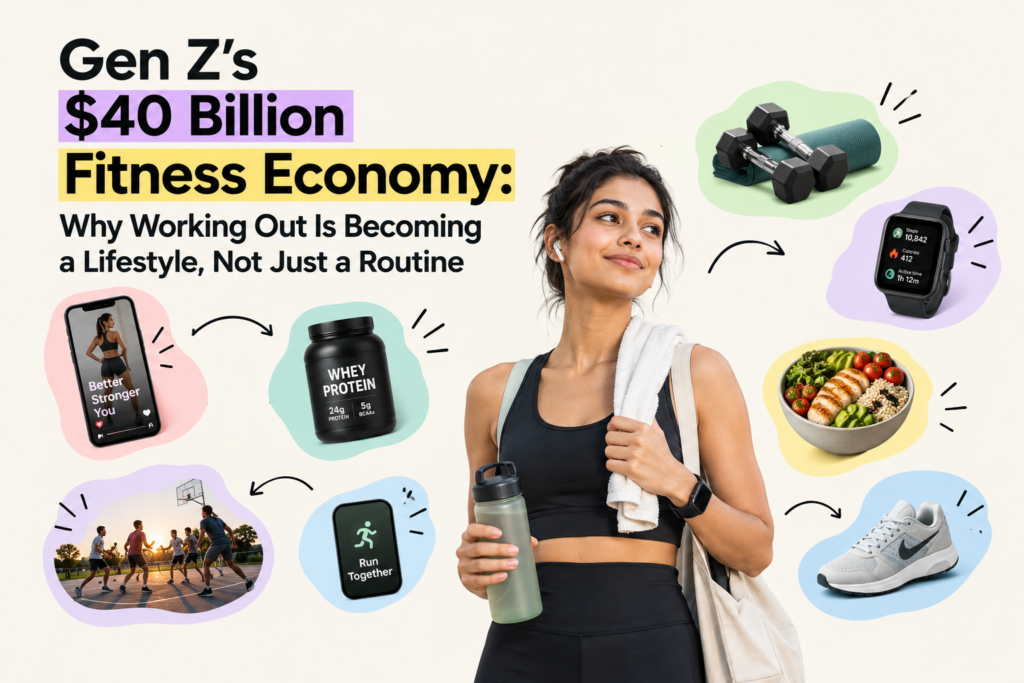
From gym memberships and athleisure to protein products, fitness apps and sports communities, young Indians are turning fitness into a much bigger consumption category.
For a growing number of young Indians, fitness does not end when the workout does.
It continues in the clothes they wear to the gym, the protein they consume afterwards, the smartwatch tracking their progress, the fitness creator they follow, the app recording their personal bests and the friends they meet for a game of badminton or a run on Sunday morning.
The workout may last an hour. The consumption ecosystem around it can extend throughout the day.
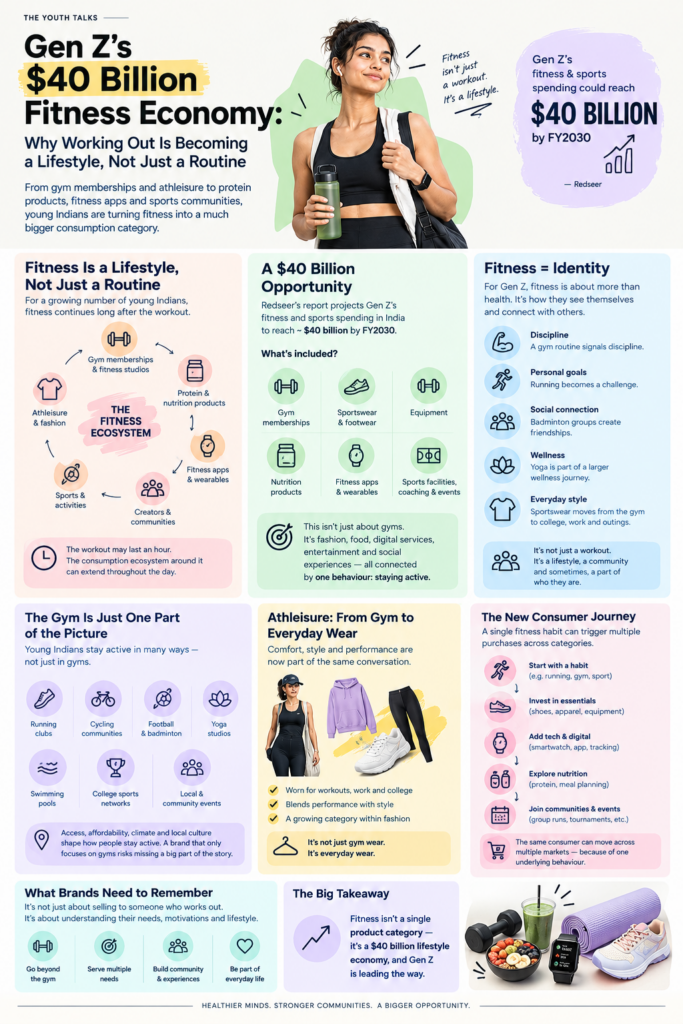
That distinction matters as India’s Gen Z comes into sharper focus as a consumer segment. According to Redseer’s report, The Indian Consumer at 2030: Redefining Aspirations, Choices, and Markets, Gen Z’s fitness and sports spending could reach approximately $40 billion by FY2030.
The projection points towards an opportunity that extends well beyond gyms and sporting goods. Fitness is increasingly connected to fashion, food, nutrition, digital services, entertainment and social experiences.
For brands, the question is no longer simply how to sell a product to someone who exercises. It is how to become relevant to a generation for whom fitness can be a routine, a personal goal, a social activity and, sometimes, a visible part of their identity.
Fitness is becoming a way to express identity
For decades, fitness marketing largely revolved around a familiar promise: get fitter, become healthier or improve your physical performance.
Those motivations remain important. But the consumer relationship with fitness can now extend into how young people see themselves and how they connect with others.
A gym routine can signal discipline. Running can become a personal challenge. A badminton group can provide a regular social circle. Yoga can be part of a broader wellness practice. Sportswear can move from the gym into college, the workplace and everyday outings.
These behaviours are not exclusive to Gen Z, nor does every young Indian approach exercise as a lifestyle statement. But the growing intersection of fitness with apparel, digital communities and social activities creates more opportunities for brands to participate in consumers’ lives.
The distinction is important: a consumer who buys a pair of running shoes once is one kind of customer. Someone who runs regularly, joins a running community, tracks performance and upgrades equipment over time may have a much wider set of needs.
The opportunity lies in understanding those needs without assuming that all fitness enthusiasts have the same motivations.
The $40 billion opportunity goes beyond gym memberships
Redseer’s projection of around $40 billion in Gen Z fitness and sports spending by FY2030 invites a broader question: what exactly makes up this economy?
It includes familiar categories such as gym memberships, sportswear, footwear and equipment. But the ecosystem also encompasses nutrition products, fitness applications, wearable devices, sports facilities, coaching and organised activities.
Consider how one fitness habit can trigger several purchases.
A young person who takes up running may begin with a basic pair of shoes. As the habit develops, they might invest in performance apparel, a smartwatch, a running app or a paid event. Someone who joins a gym could spend on training, clothing, protein products and meal planning. A student who starts playing a sport regularly may need equipment, court bookings and coaching.
None of these purchases is inevitable. Many people exercise with minimal spending, and some prefer free outdoor activities. Yet the examples illustrate why the commercial opportunity extends beyond any single product category.
The same consumer can participate in multiple markets because of one underlying behaviour.
For businesses, this means fitness should not automatically be treated as a narrow product vertical. It can be a point of connection between categories that have traditionally been marketed separately.
The gym is only one part of the fitness experience
Gyms remain a visible part of the fitness economy, but they are not the only places where young people exercise or participate in sport.
Running groups, cycling communities, local football teams, badminton courts, swimming pools, yoga studios and informal college sports networks all create different entry points.
This matters in India, where access, affordability, climate, infrastructure and local culture can shape how people stay active. A student living in a hostel may have different options from a young professional in a large apartment complex. Someone in a smaller city may rely on local sports facilities, while another consumer may have access to specialised studios and premium gyms.
A brand that assumes fitness always means a paid gym membership risks overlooking these differences.
The opportunity may lie in serving the activity itself: affordable equipment, accessible venues, beginner-friendly coaching, community events or products designed for people who are just getting started.
There is also a social dimension. For some young consumers, playing a sport or joining a group run makes exercise easier to sustain because it creates a commitment to other people. Fitness becomes something to do together, not simply a task to complete alone.
That opens the door for sports venues, event organisers, local communities and brands to build relationships around participation rather than only transactions.
Athleisure: from workout clothes to everyday clothing
One of the clearest overlaps between fitness and fashion is athleisure: clothing designed for physical activity that is also worn in everyday settings.
Redseer’s report highlights growth in gym wear and sports-related consumption. The wider opportunity is that sportswear can serve two purposes. It must function during exercise, but it can also fit into a consumer’s everyday wardrobe.
For young consumers balancing college, work, travel and social plans, clothing that moves across settings can offer practical value. Comfort, fit, price, durability and appearance may all influence the purchase.
This does not mean every athleisure purchase is driven by a desire to look athletic. Nor does it mean performance is irrelevant. The balance differs by consumer and product.
For brands, the strategic challenge is to understand which job the product is expected to perform. Is it built for serious training, casual wear, a specific sport or a combination of these? The answer should shape product design, pricing and communication.
The category also illustrates why fitness and fashion cannot always be analysed independently. A consumer may enter through an interest in exercise but continue buying because the product works well as everyday clothing.
Nutrition is becoming part of the conversation
Fitness spending also intersects with nutrition, particularly as consumers explore protein products and other offerings marketed around exercise, recovery and performance.
Redseer highlights protein-related products as part of the broader opportunity. The report also notes that listings for protein supplements on quick-commerce platforms grew by 230% between 2024 and 2025. That is a reported increase in listings, not proof that consumer purchases or total sales grew by the same percentage.
The distinction matters in a category where availability, marketing and consumer understanding can evolve at different speeds.
For brands, a larger range of products does not automatically translate into trust. Consumers may need clear information about ingredients, serving sizes, intended use, price and product quality. First-time buyers may also need help distinguishing between products that serve different purposes.
Young consumers should not be treated as a single group of expert nutrition shoppers. Some may be knowledgeable and highly selective; others may be exploring the category for the first time or relying on recommendations from friends and creators.
The opportunity is therefore not just to place more products in front of them. It is to make product information understandable and claims credible.
In a market shaped by wellness trends and online recommendations, transparency can be a meaningful competitive advantage.
Fitness apps and wearables turn progress into a product
Digital technology adds another layer to the fitness economy.
Fitness apps can help users record workouts, follow training plans, monitor progress and build routines. Wearables can provide information about movement, heart rate, sleep and other measures, depending on the device.
For some users, tracking makes progress tangible. A faster run, a longer walk or a more consistent exercise schedule can become a measurable achievement. Sharing milestones can also connect personal goals with social encouragement.
But not every user wants to pay for a subscription, and not everyone needs an advanced device. The challenge for digital fitness businesses is to identify which features provide enough ongoing value to justify payment.
A free app may be sufficient for someone who wants to count steps. A runner training for a long-distance event may be willing to pay for structured plans or detailed performance analysis. Someone else may prefer in-person coaching.
These are different customer needs, not merely different price points.
For brands building in this space, retention may depend on whether the service continues to help users achieve their goals after the novelty of downloading an app wears off. Personalisation, usability and credible guidance may matter more over time than the number of features offered at launch.
The community opportunity: making fitness social
Perhaps the most interesting part of the fitness economy is the potential to build communities around activities rather than products.
A running group can introduce newcomers to a sport. A college tournament can bring participants together around a shared interest. A local cycling event can connect people who might otherwise have little reason to interact.
For brands, these settings can offer a more meaningful form of engagement than a conventional advertisement. People can experience a product, meet others with similar interests and associate a brand with an activity they already value.
But community cannot simply be manufactured through a logo and a promotional event.
Young participants need a reason to return. That might be a welcoming environment, regular activities, opportunities to improve, access to facilities or the chance to meet people. A sponsorship that adds no value to the experience may attract attention once without building a lasting relationship.
Brands should therefore ask a different question: what does our presence make possible for the people participating?
A sportswear company might support beginner-friendly running sessions. A technology brand might help an amateur sports community track performance. A nutrition company might invest in accessible education rather than relying entirely on promotional sampling.
The strongest partnerships will depend on the activity and the audience. The principle is that a brand should contribute something useful to the community it wants to reach.
Not every Gen Z consumer is a premium fitness customer
The projected size of the market can make the opportunity appear straightforward: more interest in fitness should mean more spending.
Reality is more complicated.
Income, location, access to facilities, family priorities and competing expenses all influence how much a young person can spend. Someone may exercise regularly without buying supplements or premium sportswear. Another consumer may be interested in fitness but struggle to find affordable facilities nearby.
Redseer’s report points to both spending and participation trends, but a national market projection should not be read as evidence that every Gen Z consumer will spend heavily on fitness.
For brands, affordability and accessibility are therefore more than entry-level considerations. They can determine whether a product or service reaches beyond a relatively narrow audience.
That may mean offering entry-level equipment, flexible memberships, reasonably priced apparel, free introductory sessions or digital services with useful free features.
It also means avoiding the assumption that the most expensive or technologically advanced product is necessarily the most desirable. For a beginner, the product that makes starting easier may be more valuable than one designed for an advanced athlete.
What brands need to understand about the next fitness consumer
The emerging fitness economy presents opportunities across several sectors, but the same strategy will not work everywhere.
Sportswear companies need to understand the balance between performance, comfort, appearance and price. Nutrition brands need to earn trust through clear product information. Fitness apps need to offer continuing value rather than relying on initial curiosity. Sports venues and event organisers need to make participation accessible and enjoyable. Consumer brands looking to sponsor communities need to contribute something beyond visibility.
Across these categories, three questions deserve particular attention.
First, what motivates the consumer? Fitness can be about health, performance, appearance, stress management, friendship or competition. These motivations may overlap, but they are not interchangeable.
Second, what makes the habit sustainable? A one-time purchase is different from a recurring behaviour. Products and services that help people maintain a routine may have more opportunities to build lasting relationships.
Third, what role does the brand play in the experience? Is it helping someone start, improve, participate or connect with others? Or is it simply asking to be noticed?
These questions shift the focus from selling into a category to understanding the consumer journey within it.
The bigger picture
The projected $40 billion Gen Z fitness and sports economy is not simply a forecast about gym memberships or sports equipment. It points towards a wider ecosystem in which physical activity can connect apparel, nutrition, technology, services and social experiences.
The most important development may be the way these categories overlap. A young person can discover a sport through a creator, join a local community, buy affordable equipment, track progress through an app and eventually spend on coaching or specialised products. Another may find everything they need in a daily walk and a pair of comfortable shoes.
Both belong in the picture.
For brands, the opportunity is not to convince every young Indian to become a fitness enthusiast or a high-spending consumer. It is to understand the different ways fitness enters their lives—and to create products, services and experiences that genuinely help.
Because when fitness becomes a habit, a community or a source of identity, the relationship with the consumer can extend far beyond the moment of purchase.
The question for brands is no longer just what they can sell to young Indians who work out. It is what they can contribute to the lives those young Indians are trying to build.