
India’s young generation has grown up with instant digital payments. But as stablecoins, tokenised assets and blockchain-based financial services gain attention globally, the next evolution of money could reshape how young Indians receive international payments, access financial products and think about ownership. The opportunity is significant, but so are the questions around regulation, security and financial literacy.
A college student splits a restaurant bill with friends using UPI. A young professional pays rent through a banking app. A freelance designer receives money from a client in another Indian city, while a content creator waits for an international platform to process an overseas payment.
For India’s Gen Z, money increasingly moves through screens rather than wallets. Payments have become so convenient that scanning a QR code or entering a phone number can feel as ordinary as handing over cash once did.
The transformation has been remarkable. India’s digital payments ecosystem has expanded rapidly, with the Unified Payments Interface (UPI) becoming one of the most visible examples of how technology can change everyday financial behaviour.
But another conversation is emerging in the global financial technology industry. What happens when digital money moves beyond conventional payment applications? Could blockchain-based systems make international transfers easier? Could digital representations of assets change how people access investments? Could financial products become programmable, transferable and available in new ways?
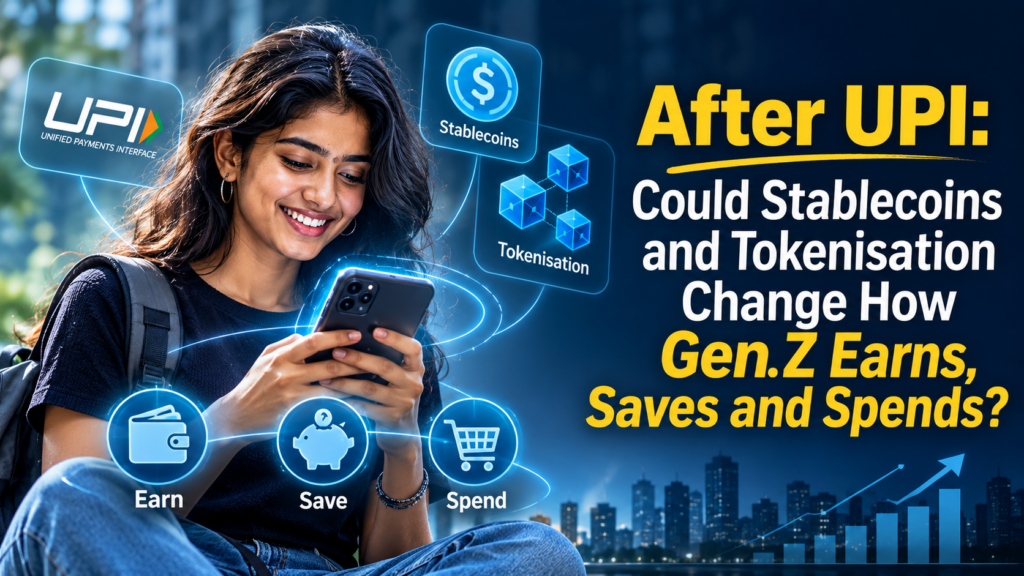
These questions are bringing stablecoins and tokenisation into discussions about the future of money.
For Gen Z, the implications could extend beyond investing in cryptocurrencies. They could eventually affect how young Indians earn from international clients, receive payments, access financial services, save and participate in the ownership of assets.
However, there is an important distinction between technological possibility and everyday financial reality. India already has a highly developed digital payments infrastructure, and the Reserve Bank of India has expressed significant concerns about privately issued stablecoins. Not every global innovation will necessarily become an appropriate or permitted financial product for Indian consumers.
The more interesting question, therefore, is not whether stablecoins will replace UPI. It is whether the next generation of financial technology could create new possibilities around how money and assets move.
Gen Z grew up with digital money
For young Indians, the transition from cash to digital payments has happened within a relatively short period.
A generation that once watched families withdraw cash from ATMs now routinely uses smartphones to pay for food, transport, shopping, subscriptions and everyday expenses.
The scale of this behavioural shift is reflected in government research. A February 2026 Ministry of Finance release, reporting findings from an independent study of 10,378 respondents across 15 states, found that UPI was the preferred transaction mode for 57% of surveyed users, compared with 38% for cash.
The study also found that 66% of users in the 18–25 age group adopted UPI, highlighting the strong preference for digital payments among younger consumers.
The RBI’s Payment System Report, published in May 2026, offers a wider picture of the infrastructure behind this transformation. India’s digital payment transaction volumes increased 33 times between 2016 and 2025, while transaction values nearly tripled.
For Gen Z, digital payments are no longer a new financial behaviour. They are part of everyday life.
But UPI’s success has also shaped expectations. Young consumers increasingly expect financial services to be quick, accessible and easy to use. Waiting several working days for a payment to arrive or navigating complicated banking procedures can feel unnecessarily inconvenient.
This expectation could influence how the next generation responds to emerging financial technologies.
Yet UPI has not made every financial service digital, instant or borderless. Receiving money from overseas, accessing certain international financial products and transferring value across financial systems can still involve intermediaries, compliance requirements and additional costs.
That is where stablecoins and tokenisation enter the discussion.
Stablecoins: Could international payments become easier?
Stablecoins are digital assets designed to maintain a relatively stable value by being linked to another asset, most commonly a currency such as the US dollar.
Unlike Bitcoin, whose market price can fluctuate substantially, a dollar-backed stablecoin aims to maintain a value close to one US dollar.
The most commonly discussed examples include USDT and USDC. Their value proposition is based on combining digital transferability with a relatively stable reference value.
For a young Indian freelancer working with an overseas client, the idea is easy to understand.
Imagine a designer in Bengaluru working with a company in the United States. The designer completes a project and needs to receive payment. Depending on the payment arrangement, the transfer may involve a bank, a payment provider, currency conversion and settlement procedures.
Blockchain-based transfers using stablecoins are often presented as a potential alternative. The sender transfers a digital asset through a blockchain network, and the recipient receives it in a compatible wallet.
The attraction is the possibility of faster settlement and fewer intermediaries.
The Reserve Bank of India’s December 2025 Financial Stability Report examined this proposition. It noted that conventional cross-border payments can involve multiple intermediaries, high transaction costs and multi-day settlement times. Stablecoins claim to offer faster and potentially cheaper transfers through blockchain networks.
However, the RBI also cautioned that many anticipated benefits remain untested or unrealised at scale. It noted that the dominant use of stablecoins continues to be crypto trading and liquidity within crypto markets. <Cite refs={[“turn933840view0”]}/>
This distinction is important.
Stablecoins may offer an interesting technological approach to moving value internationally, but they are not automatically cheaper or more convenient for every user. Exchange charges, blockchain fees, conversion costs, wallet compatibility, compliance checks and the risks of the receiving platform all matter.
For Indian freelancers, creators and remote professionals, the practical question is not simply whether a payment can travel across a blockchain. It is whether the entire process of receiving, converting, reporting and using that money can be done legally, securely and economically.
The global creator economy makes this conversation more relevant
Young Indians are increasingly exploring work that does not fit neatly into traditional employment structures.
Freelancers work with overseas clients. Designers and developers contribute to international projects. Creators earn through digital platforms. Consultants offer specialised services to businesses across different countries.
For these workers, international payments are not an abstract financial technology problem. They are part of how they earn a living.
A global financial system that makes cross-border payments more efficient could be useful to this generation.
Stablecoins are one possible technology being explored in this space. They could eventually support payment arrangements in which value moves between parties across borders without relying on the same sequence of conventional banking intermediaries.
But there are important limitations.
A dollar-backed stablecoin is not the same as holding dollars in an Indian bank account. Its value depends on the issuer’s ability to maintain the peg, the quality and accessibility of its reserves, the redemption arrangements and the reliability of the network and service providers involved.
There is also the question of converting the asset into Indian rupees and complying with applicable foreign-exchange, tax and reporting requirements.
For a young professional, a payment that arrives quickly but cannot be easily or lawfully converted into usable money is not necessarily a better payment solution.
The opportunity will depend on whether regulated financial infrastructure can make these technologies practical for ordinary users.
Tokenisation: Could Gen Z access ownership differently?
Stablecoins are primarily about digital representations of value linked to a reference asset. Tokenisation is a different concept.
It involves representing rights or interests in an asset through digital tokens, often using blockchain technology.
Depending on the structure, a token could represent a claim, ownership interest or entitlement associated with an underlying asset.
The concept is attracting attention because it could potentially make certain financial assets easier to issue, transfer, track and settle.
Consider an example.
A company wants to represent interests in a financial asset digitally. Instead of relying entirely on conventional records and processes, it explores a tokenised structure in which ownership records and transfers are represented through a digital system.
In theory, this could improve the efficiency of certain transactions and create new ways of managing assets.
For a young investor, tokenisation raises an interesting possibility: could some assets that are difficult or expensive to access through traditional structures eventually become available through new digital platforms?
The idea is attractive, but it requires careful explanation.
Tokenisation does not automatically make an asset affordable, liquid, safe or accessible to everyone. A digital token is only as valuable as the legal rights it represents and the underlying asset or arrangement supporting it.
If a token represents an interest in an asset, investors need to understand who owns the underlying asset, what rights the token holder receives, how transfers are recognised and what happens if the platform or issuer fails.
Digital representation should never be confused with guaranteed ownership or guaranteed returns.
For Gen Z, tokenisation could eventually become relevant to the way certain financial products are structured and distributed. But the quality of the legal framework, investor protection and market infrastructure will determine whether those possibilities translate into meaningful consumer benefits.
The RBI is exploring tokenisation too
The conversation around tokenisation is not limited to private cryptocurrency companies or international technology platforms.
India’s central bank has also been examining the potential of digital financial infrastructure.
The RBI’s 2025–26 Annual Report describes the development of a Unified Markets Interface (UMI), a multi-layer platform intended to facilitate the tokenisation of financial assets while using wholesale central bank digital currency for settlement efficiencies. It also notes that a pilot involving tokenisation of certificates of deposit was initiated on the platform. <Cite refs={[“turn641815search9”]}/>
This is an important distinction.
The development of tokenised financial infrastructure does not mean that every privately issued token or crypto asset has been endorsed by the RBI. It shows that the underlying technology can be explored within regulated financial systems.
The distinction between privately issued crypto assets and regulated digital financial infrastructure will be central to how India’s financial ecosystem evolves.
For young Indians, it means the future of digital finance may not necessarily be built around speculative cryptocurrencies. It could also involve technology being used by banks, financial institutions and regulated market participants to improve existing systems.
UPI, stablecoins and the Digital Rupee are not the same thing
One of the biggest challenges in discussions about the future of money is that different technologies are frequently grouped together.
UPI, stablecoins and India’s Digital Rupee all involve digital transactions, but they serve different purposes.
UPI is a payment system that allows users to transfer money between bank accounts. It does not create a new currency.
Stablecoins are privately issued digital assets designed to maintain a relatively stable value against another asset, usually a currency. Their stability depends on the issuer, reserves, redemption mechanisms and market confidence.
The Digital Rupee, or e₹, is India’s central bank digital currency. It is issued by the RBI and represents a digital form of the Indian rupee.
The RBI’s October 2026 FAQs clarify that the Digital Rupee is being piloted in retail and wholesale segments. It also explains that e₹ is a digital form of the rupee, whereas UPI is a means of payment. <Cite refs={[“turn933840view1”]}/>
The distinction matters because India does not necessarily need a privately issued digital currency to make domestic payments faster. UPI already provides an extensive digital payments infrastructure.
The Digital Rupee is being explored for additional use cases, including programmability and settlement. Stablecoins, meanwhile, raise a different set of questions around private issuance, cross-border movement, financial stability and monetary sovereignty.
For Gen Z, understanding these differences will become an important part of financial literacy.
Why India’s position on stablecoins is complicated
The global stablecoin industry is expanding, and its potential role in payments and digital financial infrastructure is receiving increasing attention.
But India’s position is more cautious.
The RBI’s December 2025 Financial Stability Report identifies several risks associated with stablecoins, including the possibility of undermining monetary sovereignty, creating liquidity vulnerabilities and affecting financial stability.
The central bank also notes that stablecoins can trade at values different from their intended peg, meaning that a digital asset designed to maintain a one-dollar value may not always be redeemable or tradable at precisely that value.
India’s concerns are particularly relevant because UPI and other domestic payment systems already provide fast, low-cost payment capabilities. The RBI has argued that the case for integrating privately issued stablecoins into India’s domestic financial system is not straightforward.
The regulatory environment also matters for individuals.
Virtual Digital Assets are subject to India’s tax framework, including the provisions governing income from their transfer and tax deducted at source on specified transactions. However, the existence of a tax framework should not be mistaken for government approval of every digital asset or its use as a payment instrument.
For a young Indian, this means that holding a stablecoin, receiving one as payment or using one to transfer value may involve legal, tax and compliance questions that should not be ignored.
The point is not that every stablecoin application is inherently unsafe. It is that technological convenience cannot replace regulatory clarity and consumer protection.
Could tokenisation change how young Indians save and invest?
The most interesting long-term possibility may lie in how financial products are structured.
Today, young investors access a range of products through banks, brokerage platforms, mutual fund applications and other financial services.
Tokenisation could eventually create new ways of representing and transferring interests in certain assets. It could also enable more automated processes around ownership records and settlement.
For Gen Z, this raises questions about access.
Could a young investor eventually access certain asset classes through digital platforms with lower operational barriers? Could financial products be designed with smaller participation amounts? Could digital ownership records make certain transactions easier to track?
These are possibilities being explored by the industry, not benefits that can be assumed.
Fractional access, for example, is not unique to blockchain. Traditional financial markets already offer products that allow investors to participate without purchasing an entire underlying asset.
Tokenisation may change how some of these products are issued, recorded or settled, but it does not eliminate the need to evaluate the asset itself.
A digitally represented investment can still be risky, illiquid or poorly structured.
For a generation that is increasingly comfortable with app-based financial services, the challenge will be to avoid assuming that an easy interface means a simple or safe investment.
What does this mean for young Indians who are building careers?
There is another side to this conversation that deserves attention.
Gen Z should not be viewed only as a consumer of emerging financial technologies. It could also be among the people building the products and infrastructure behind them.
Stablecoins and tokenisation require developers, security specialists, product managers, financial analysts, compliance professionals and entrepreneurs.
A young software engineer could work on payment infrastructure. A cybersecurity specialist could examine smart contract vulnerabilities. A product designer could help make complex financial applications easier to use. A startup founder could explore solutions for international payments or digital asset management.
This is where the financial technology conversation connects with the wider Web3 opportunity explored in the second article of this series.
At TOKEN2049 Singapore in October 2026, stablecoins were mentioned in 49.7% of the sessions analysed in the event report, while tokenisation and real-world assets appeared in 54.9%. AI and crypto featured in 60.1%.
These figures reflect the themes receiving attention among industry participants, not consumer adoption. But they demonstrate how the industry’s conversation is expanding beyond the price of individual cryptocurrencies towards financial infrastructure, institutional participation and new technology applications.
The event also brought together investors, founders, technology companies and developers from across the world, creating a platform for discussions about how these technologies could develop.
For young Indians interested in fintech and Web3, the opportunity may lie in understanding the problems these companies are trying to solve rather than simply following the latest digital asset trend.
The next financial revolution needs better financial literacy
There is a risk that emerging financial technologies will become another area where convenience develops faster than consumer understanding.
UPI has made payments remarkably simple. But even familiar digital payments require users to recognise fraud, protect their credentials and understand how transactions work.
Stablecoins and tokenised assets introduce additional layers of complexity.
Users need to understand the difference between a currency and a privately issued digital asset, how blockchain transactions work, what a wallet actually controls, what rights a token represents and what happens if an issuer or service provider fails.
They also need to understand that a stablecoin is not automatically risk-free simply because its price is designed to remain stable.
For colleges, universities and youth communities, this creates an opportunity to expand financial education beyond conventional topics such as savings accounts, mutual funds and stock market investing.
Students should be introduced to the basics of digital money, blockchain infrastructure, payment systems, digital ownership and the regulatory environment surrounding virtual assets.
But the objective should not be to encourage everyone to participate in crypto markets.
It should be to equip young people to understand emerging technologies, assess their risks and recognise the difference between a genuine financial innovation and a product being marketed through hype.
After UPI, the future of money may be more complex than we imagine
UPI changed how India pays. It made digital transactions accessible to millions of people and established a new expectation of speed and convenience.
The next phase of financial technology may not be about replacing that system. It could be about exploring new ways of moving value across borders, representing ownership, settling financial transactions and building services on digital infrastructure.
Stablecoins and tokenisation are part of that conversation, but their future in India will depend on regulatory decisions, technology, consumer protection and whether they solve problems that existing systems cannot address as effectively.
For Gen Z, the implications could be significant.
A young freelancer may benefit from better international payment infrastructure. A developer may build products around digital financial services. An entrepreneur may explore tokenisation. A young investor may encounter new ways of accessing financial products.
But none of these possibilities should be confused with guaranteed adoption or financial returns.
The generation that grew up scanning UPI QR codes may eventually encounter a much broader digital financial ecosystem. Its success will depend not only on how quickly technology evolves, but also on whether young people understand the systems they are being asked to trust.
The future of money may become increasingly digital. The more important question is whether the next generation will be prepared to use it wisely—and perhaps build it themselves.