
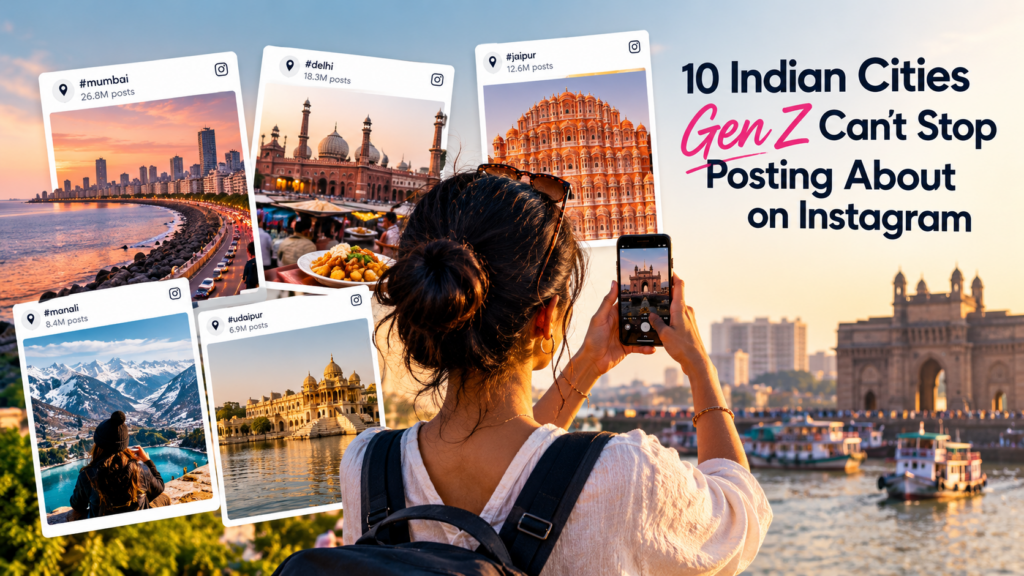
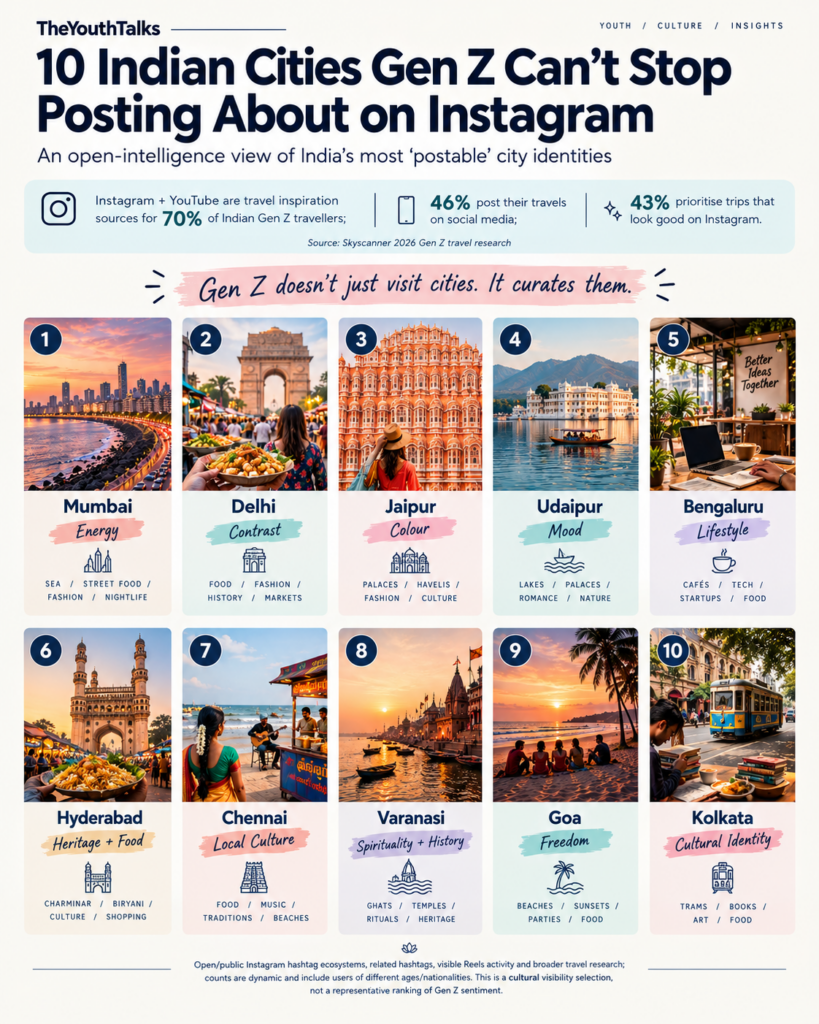
From Mumbai’s street energy to Jaipur’s visual drama, these are the Indian cities that have become powerful backdrops for a generation that doesn’t just travel to experience a place — it travels to tell a story about itself.
A city used to be remembered through photographs.
Gen Z is increasingly experiencing it through the camera.
The café is photographed before the coffee is finished. The outfit is captured before the evening begins. The food becomes a Reel. The sunset becomes a Story. A street corner becomes a location tag. And somewhere between the visit and the upload, the city itself becomes part of someone’s identity.
Instagram isn’t simply documenting Indian cities anymore. It is helping shape how young Indians discover, experience and talk about them.
The evidence is increasingly visible.
Skyscanner’s 2026 research says Instagram and YouTube are the two most popular sources of travel inspiration for Gen Z travellers in India, with 70% citing each. Forty-six percent say they post their travels on social media, while 43% prioritise trips that look good on Instagram.
Airbnb’s 2026 India Gen Z travel study, conducted with YouGov, adds another layer: 87% of Gen Z respondents say how they travel reflects who they are, while 95% want their trip to feel personal and unique rather than typical or pre-planned. Three in four say who they travel with matters more than where they go.
That changes the meaning of an “Instagrammable city”.
It isn’t simply a city with beautiful monuments.
It is a city with visual language.
A city needs places to photograph, but it also needs moods, food, fashion, people, neighbourhoods, experiences and stories that can be turned into content.
Using publicly observable Instagram hashtag activity, related hashtag ecosystems, visible Reels activity and broader travel research, here are 10 Indian cities that stand out in that visual conversation.
This is not a definitive ranking of Gen Z preference. Instagram’s public data does not reveal the age of every person posting under a city hashtag. Instead, this is an open-intelligence view of cities with strong and distinctive Instagram footprints — and what makes them so culturally “postable”.
1. Mumbai: The City That Never Runs Out of Content
Mumbai may have the strongest advantage of all: it doesn’t have a single visual identity.
It has many.
Marine Drive at sunset. Local trains. Bandra’s streets. Art Deco buildings. Bollywood. Street food. Fashion. Cafés. Sea-facing apartments. Monsoon photography. Nightlife. Cricket. Streetwear.
The city can look cinematic, chaotic, aspirational, gritty or glamorous depending on where you stand.
That breadth shows up in Instagram’s public hashtag ecosystem. The #mumbai hashtag alone is listed at more than 26.8 million posts, with related ecosystems including #mumbaikar, #mumbaidiaries, #mumbaifoodie, #mumbai_igers, #mymumbai, #mumbaifashion and #things2doinmumbai.
That is important.
Mumbai isn’t just being photographed. Mumbai is being interpreted.
One person posts a fashion look in Bandra. Another posts vada pav. Another posts a rainy local train. Someone else posts the skyline.
The city becomes a canvas onto which different versions of young India can project themselves.
Even the 2024 India Someday study of Instagrammable Indian destinations found Mumbai’s Gateway of India had the highest density of Instagram hashtags among the attractions it studied.
Mumbai doesn’t need to manufacture an aesthetic.
It already has several.
2. Delhi: Where Food, Fashion and History Collide
Delhi’s Instagram appeal comes from contradiction.
Old Delhi and New Delhi.
Mughal architecture and modern cafés.
Street food and fine dining.
Khan Market and Chandni Chowk.
India Gate and indie fashion.
The city provides an almost endless supply of contrasts — and contrast is excellent content.
Public hashtag intelligence currently puts #delhi at more than 18.3 million posts, while #newdelhi, #delhigram, #delhidiaries and #sodelhi each have substantial ecosystems of their own. Food, fashion, shopping and street culture dominate many of the related tags.
And Delhi’s visual appeal extends beyond the city hashtag itself.
The India Someday study found Jama Masjid in Old Delhi to be India’s second-most Instagrammed attraction by hashtag density, behind Mumbai’s Gateway of India.
Delhi therefore offers something particularly valuable to young creators:
content with context.
A Reel can be about food. It can also be about history.
A photograph can be fashion content. It can also be architecture.
Delhi doesn’t ask creators to choose between the contemporary and the traditional.
It puts both in the same frame.
3. Jaipur: The City That Looks Like It Was Designed for Reels
If Instagram rewarded visual consistency, Jaipur would be difficult to ignore.
Pink walls.
Palaces.
Havelis.
Jharokhas.
Jewellery.
Block prints.
Colourful markets.
Hawa Mahal.
Patrika Gate.
The Pink City has something many cities struggle to manufacture: an instantly recognisable visual identity.
The public #jaipur hashtag ecosystem currently contains more than 6.1 million posts, with #jaipurdiaries alone exceeding 667,000. Other related tags cover jewellery, photography, food, fashion, the Pink City and local creators.
And this isn’t merely accumulated historical content.
Current Reels activity shows Jaipur continuing to generate high-performing travel content. Public Reel-tracking data, for example, shows Jaipur travel videos attracting millions of views, including recent videos showcasing the city’s most photogenic locations.
The reason is simple:
Jaipur photographs exceptionally well from almost every angle.
But there is a deeper Gen Z insight here.
Jaipur allows the traveller to construct an aesthetic.
You can make your Jaipur look royal.
Or bohemian.
Or fashion-forward.
Or romantic.
Or traditional.
The city gives the creator the raw material. Instagram becomes the editing room.
4. Udaipur: India’s Moodboard City
If Jaipur is visual drama, Udaipur is visual mood.
Lakes.
Palaces.
Sunsets.
White architecture.
Heritage hotels.
Narrow streets.
Terraces overlooking water.
Udaipur almost naturally produces the kind of content that performs well on visual platforms.
The public #udaipur hashtag currently stands at approximately 2.48 million posts, with #udaipurblog and #udaipurdiaries each exceeding 350,000. Related hashtags extend into photography, fashion, food, weddings, City Palace and the city’s identity as the Lake City.
The Reel ecosystem is equally interesting. Public tracking of 2026 Udaipur content shows multiple creators generating Reels with millions of views.
Udaipur also demonstrates an important change in travel behaviour.
Young travellers aren’t necessarily looking for the city with the most attractions.
They are increasingly looking for the city with the strongest feeling.
Airbnb’s Gen Z research supports this broader shift: 95% of respondents wanted travel to feel personal and unique, while 87% said the way they travel reflects who they are.
Udaipur fits that mindset almost perfectly.
It is less “tick every tourist attraction” and more “build a mood”.
5. Bengaluru: The City of Lifestyle
Bengaluru doesn’t have Jaipur’s architecture or Udaipur’s lakes.
Its Instagram strength comes from something else:
lifestyle.
Cafés.
Startups.
Technology.
Music.
Food.
Fashion.
Pets.
Weekend culture.
Community.
Young professionals.
The city is increasingly photographed not as a tourist destination but as a way of living.
Public Instagram hashtag intelligence puts #bengaluru at roughly 1.69 million posts, with substantial related communities around #nammabengaluru, #bengalurudiaries, #bengaluruadda, food, photography and things to do in the city.
That makes Bengaluru especially interesting from a Gen Z perspective.
The city itself becomes content.
A café isn’t just a café.
It becomes a weekend destination.
A coworking space isn’t just a workplace.
It becomes part of an identity.
A concert isn’t simply entertainment.
It becomes a Reel.
Bengaluru demonstrates that an Instagrammable city doesn’t necessarily need spectacular monuments.
Sometimes it needs a spectacular lifestyle.
6. Hyderabad: Where Heritage Meets Food Culture
Hyderabad has another powerful Instagram formula:
heritage + food + contemporary culture.
Charminar.
Biryani.
Old City streets.
Pearls.
Palaces.
Cafés.
Fashion.
Wedding culture.
Modern Hyderabad.
The public #hyderabad hashtag currently contains more than 6.1 million posts, while #hyderabadi, #hyderabaddiaries, #hyderabadinsta, #hyderabadfashion and #hyderabadfoodie create large adjacent content communities.
What makes Hyderabad particularly interesting is the coexistence of multiple identities.
The traditional city hasn’t disappeared.
It has become content.
Food is content.
Architecture is content.
Fashion is content.
Even local identity is content.
This is increasingly important for young Indian audiences who don’t necessarily see “modern” and “traditional” as opposites.
A Gen Z creator can shoot a Reel around Charminar in the morning and spend the evening in a contemporary café.
The feed doesn’t need to make a choice.
Neither does the city.
7. Chennai: A City Finding Its Own Instagram Language
Chennai’s Instagram identity is less obvious to outsiders — and perhaps that’s exactly why it is interesting.
The city’s content ecosystem is built around food, fashion, music, cinema, local culture and everyday life.
The public #chennai hashtag currently has more than 8.1 million posts. Related communities include #chennaidiaries, #chennaifoodie, #chennaimemes, #chennaifashion, #nammachennai, #vadachennai and #walkwithchennai.
That tells us something important.
A city’s Instagram presence doesn’t have to be dominated by tourism.
It can be powered by locals documenting their own culture.
Chennai’s strength lies in that local voice.
The city isn’t necessarily saying, “Come and look at us.”
Its creators are saying, “This is how we live.”
And for Gen Z, that distinction matters.
Authenticity increasingly comes not from polished tourism campaigns but from people showing the city as they actually experience it.
8. Varanasi: Ancient India, Reframed for the Feed
Varanasi is one of India’s most visually distinctive cities.
The ghats.
The Ganga.
The boats.
The aarti.
The narrow lanes.
The colours.
The rituals.
The morning light.
The city has always been photographed.
Instagram simply gave those images a new distribution system.
Public hashtag intelligence puts #varanasi at approximately 1.19 million posts, with #varanasidiaries exceeding 115,000 and sizeable communities around #varanasighats, #ghatsofvaranasi, #varanasiphotography and #varanasifoodie.
Mainstream travel media continues to identify Varanasi among India’s most Instagrammable cities, with its ghats and Ganga Aarti repeatedly cited as major visual attractions.
But Varanasi represents something deeper.
Gen Z isn’t necessarily travelling only for novelty.
It is also rediscovering places with cultural depth — and presenting them through a contemporary visual language.
The ancient city becomes a Reel.
The spiritual experience becomes a Story.
The boat ride becomes a carousel.
Tradition doesn’t disappear on Instagram.
It gets reframed.
9. Goa: Not Just a Destination, But an Identity
Goa is slightly different from the other cities on this list.
Its Instagram ecosystem is destination-led rather than strictly city-led.
But its scale is impossible to ignore.
The public #goa hashtag currently contains more than 8 million posts, with enormous adjacent associations around travel, beaches, photography, sunsets and #goadiaries.
Goa has also mastered something particularly valuable in social culture:
it represents a lifestyle.
Beach.
Freedom.
Friends.
Music.
Food.
Sunsets.
Road trips.
Slow mornings.
Nightlife.
Even when someone isn’t physically in Goa, they can immediately understand what a “Goa mood” looks like.
That makes it incredibly powerful as social content.
The destination becomes shorthand for a version of yourself.
And that is perhaps the strongest form of Instagrammability there is.
10. Kolkata: The City Where Culture Becomes Content
Kolkata brings something different to the list: cultural texture.
Colonial architecture.
Durga Puja.
Books.
Coffee.
Football.
Street food.
Bengali fashion.
Art.
Music.
Old neighbourhoods.
New cafés.
The city has an enormous cultural vocabulary to draw from.
But more importantly, Kolkata’s appeal lies in its ability to turn ordinary life into visual storytelling.
A tram.
A College Street bookshop.
A café table.
A Puja pandal.
A plate of kathi rolls.
A football jersey.
A traditional sari.
A North Kolkata lane.
None of these needs to be an extraordinary tourist attraction.
They become extraordinary because of the story around them.
And that is increasingly how Gen Z uses Instagram.
The platform isn’t simply a catalogue of destinations.
It is a catalogue of identities.
The Bigger Story: Gen Z Doesn’t Just Visit Cities. It Curates Them.
The most interesting conclusion from this exercise isn’t which city has the biggest hashtag.
It is what the hashtag ecosystem tells us about young India’s relationship with place.
Mumbai is energy.
Delhi is contrast.
Jaipur is colour.
Udaipur is mood.
Bengaluru is lifestyle.
Hyderabad is heritage and food.
Chennai is local culture.
Varanasi is spirituality and history.
Goa is freedom.
Kolkata is cultural identity.
These cities are not competing for the same kind of attention.
And perhaps that is why they work.
Gen Z doesn’t necessarily want a destination that everyone else has already defined.
It wants to find its version of the destination.
That is consistent with the broader travel research.
Airbnb found that 95% of Indian Gen Z travellers want their trips to feel personal and unique, while 87% say travel reflects who they are.
Skyscanner found that 43% of Indian Gen Z travellers prioritise trips that look good on Instagram.
Put those findings together and a bigger cultural shift becomes visible.
Instagrammability is no longer simply about aesthetics. It is about self-expression.
A young traveller isn’t only asking:
“Is this city beautiful?”
They are increasingly asking:
“Can I see myself in this city?”
That is a very different question.
And it explains why a city like Mumbai can coexist with Udaipur, why Varanasi can sit alongside Bengaluru, and why Jaipur can remain relevant despite being one of India’s most photographed destinations for years.
Every generation can make the same city mean something different.
The camera doesn’t merely record the city.
It gives the traveller a way to author their version of it.
And perhaps that is the real Instagram City Index for Gen Z:
Not the places with the prettiest views.
Not even the places with the most posts.
But the places that give young Indians the most interesting ways to say:
“This is me.”
Methodology note: This article uses open/public intelligence available around September–October 2026, including publicly visible Instagram hashtag ecosystems and related hashtags, public Reels/creator activity, and published travel research. Instagram hashtag counts are dynamic, can include users of different ages and nationalities, and should not be interpreted as a direct measurement of Gen Z preference. The 10 cities are therefore presented as a cultural/Instagram visibility selection rather than a statistically representative ranking of Gen Z sentiment.