
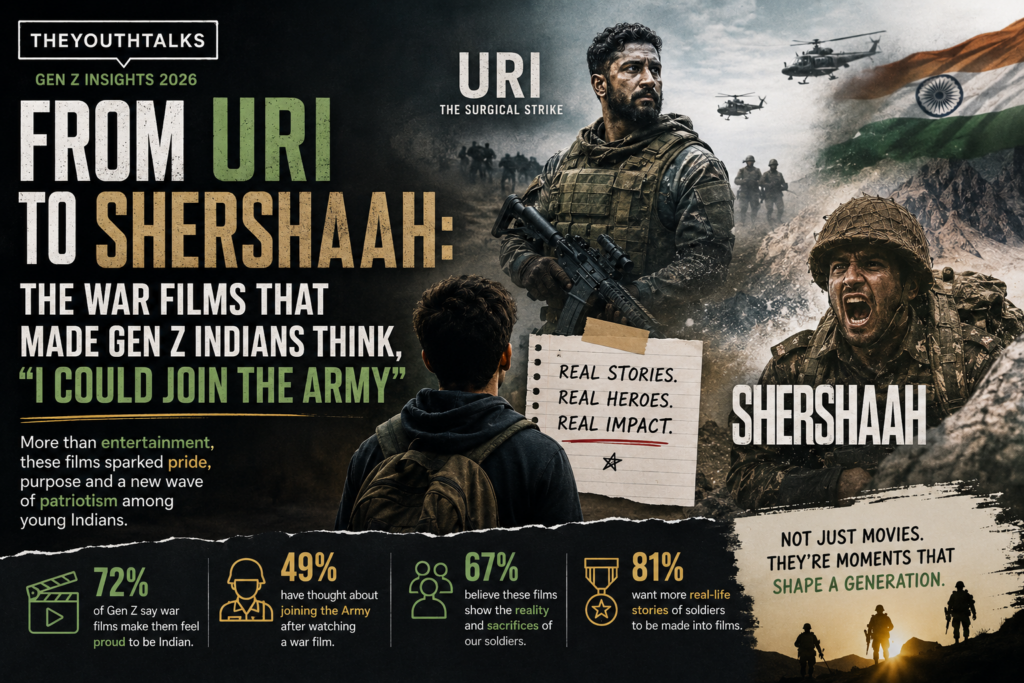
As Netflix’s new Kargil series Operation Safed Sagar lands just before Independence Day, we asked 100 young Indians which films made military service feel aspirational. Their answers reveal that today’s patriotism may be less about slogans — and more about stories.
Every August, India gets a little more patriotic.
The tricolour appears on cars and apartment balconies. Schoolchildren rehearse performances. Social media fills with old photographs, patriotic songs and familiar messages about sacrifice and service.
And, increasingly, young Indians turn to their screens.
This year, the timing feels particularly interesting. Netflix has just released Operation Safed Sagar: The Untold Story of the Kargil War, a new series centred on the Indian Air Force’s role in the 1999 Kargil conflict. The series, which premiered on August 7, follows the Golden Arrows squadron and its high-altitude missions during the war. Netflix describes it as a story based on true events and an untold chapter of the Kargil War.
It arrives at a moment when India’s relationship with military cinema is already unusually strong.
So we asked a simple question.
Which film first made you seriously consider joining the armed forces — even if you never actually did?
We asked 100 young Indians, primarily Gen Z students and early-career professionals.
The answers were revealing.
They also suggest that Bollywood may have influenced how an entire generation imagines the armed forces more than traditional recruitment messaging ever could.
The Films That Put the Uniform in Gen Z’s Imagination
Our respondents named a wide range of films, but a handful appeared repeatedly.
The list wasn’t simply a ranking of the biggest patriotic blockbusters. In fact, some of the most interesting responses came from films that were less about war itself and more about identity, purpose, courage and overcoming personal limitations.
Here are the ten titles that stood out.
1. Uri: The Surgical Strike
If there is one film that appears to have defined the modern Indian military movie for Gen Z, it is Uri.
Released in 2019, the Vicky Kaushal-starrer turned the 2016 surgical strikes into a high-energy military drama and became a major commercial success. Box Office India records its India net collection at more than ₹244 crore.
But its influence goes beyond box office numbers.
Respondents repeatedly mentioned the film’s depiction of preparation, intelligence and tactical planning. The army wasn’t presented merely as a collection of soldiers running into battle. It was shown as disciplined, technologically capable and strategically sophisticated.
And then there was the line.
“How’s the josh?”
For an entire generation, it became almost inseparable from the image of the contemporary Indian soldier.
2. Shershaah
If Uri made the military look powerful, Shershaah made the soldier feel personal.
The 2021 biographical film about Captain Vikram Batra introduced a younger generation to the personality behind the uniform. His ambition, humour, relationships and eventual sacrifice gave viewers something that large-scale war films sometimes struggle to create: emotional proximity.
For many young viewers, the armed forces stopped being an abstract institution.
There was suddenly a person to identify with.
And that matters.
Gen Z doesn’t necessarily respond to institutions simply because they are institutions. It responds to people, stories and identities.
3. LOC: Kargil
For respondents who grew up watching war films with their parents, LOC: Kargil remained surprisingly relevant.
Released in 2003, the film presented the Kargil War through a sprawling ensemble of characters and stories.
For some young respondents, it was less a film they discovered independently and more one that was introduced to them by family.
That distinction is important.
Military memory in India is often transmitted across generations through cinema. A parent who watched Border in the 1990s may have introduced it to a child who later watched Uri or Shershaah independently.
Cinema becomes a bridge between two very different generations.
4. Lakshya
Perhaps the most fascinating film on the list is Lakshya.
Because Lakshya isn’t really a war film for most of its runtime.
It is a film about a young man who doesn’t know what he wants to do with his life.
That makes it remarkably relevant to Gen Z.
Hrithik Roshan’s Karan starts out directionless, impulsive and seemingly uninterested in building a conventional career. The army eventually gives him discipline, responsibility and a sense of purpose.
Several respondents described this aspect as more influential than the battle sequences.
The message wasn’t simply join the army because it is patriotic.
It was closer to:
Join because you might become a different person there.
For a generation wrestling with questions about careers, identity and purpose, that is a powerful proposition.
5. Kesari
Kesari brought another dimension to the conversation: the idea of extraordinary courage in impossible circumstances.
The film dramatizes the Battle of Saragarhi, where a small contingent of Sikh soldiers faced a vastly larger attacking force.
For some respondents, particularly those from families or communities with strong military traditions, the story resonated because of its emphasis on regiment, brotherhood and collective identity.
The attraction wasn’t necessarily war itself.
It was belonging.
6. Gunjan Saxena: The Kargil Girl
If the traditional war film gave young men an image of military heroism, Gunjan Saxena offered something different to young women.
The film’s central conflict isn’t simply about combat.
It is about being told that you don’t belong.
Gunjan Saxena’s journey from aspiring pilot to a woman serving in the Indian Air Force gave young viewers a very different entry point into the armed forces.
The uniform here represented ambition and opportunity as much as sacrifice.
That shift matters.
The Indian military has been opening more roles and pathways for women, while the visibility of women in military aviation has also grown. In 2026, for example, Squadron Leader Bhawana Kanth made headlines after becoming the first woman to earn the Indian Air Force’s Fighter Combat Leader qualification — another reminder that the image of who can occupy a cockpit is changing.
Films don’t create these changes.
But they can make them imaginable.
7. Border
Every generation has its gateway film.
For many respondents, Border was it.
The 1997 film about the Battle of Longewala predates Gen Z by years, but its songs, characters and battle sequences survived through television reruns, family movie nights and YouTube clips.
Interestingly, very few respondents described it as a film they had discovered alone.
They inherited it.
That may be one of the reasons its cultural memory remains unusually strong.
8. Raazi
Raazi was an interesting outlier.
It isn’t a conventional Army recruitment film at all.
Instead, it focuses on intelligence, espionage and sacrifice through the story of Sehmat, played by Alia Bhatt.
Its appearance in our responses suggests that “serving the country” is becoming a broader concept for young Indians.
The aspiration isn’t necessarily to carry a rifle.
It could mean intelligence, aviation, technology, strategy or information.
The uniform is only one expression of national service.
9. Paltan
Paltan did not generate the same mainstream cultural impact as Uri or Shershaah, but it appeared repeatedly in responses from young people with stronger connections to military families or smaller-town India.
Its focus on the 1967 Nathu La and Cho La clashes offered something different: a lesser-known military story.
That may be an increasingly important direction for Indian military cinema.
The next generation doesn’t necessarily need another retelling of the same war.
It wants to discover the stories it hasn’t heard before.
10. Tejas
The appearance of Tejas is worth watching.
The 2023 film focuses on an Indian Air Force fighter pilot, putting aviation rather than ground combat at the centre of the story.
Its presence in a Gen Z list about military aspirations suggests that the idea of “joining the forces” may be becoming less synonymous with the Army alone.
Young Indians are seeing more pathways.
Army. Navy. Air Force. Intelligence. Aviation. Technology.
The military imagination is expanding.
And Then Came Operation Safed Sagar
This is where the timing of our survey becomes particularly interesting.
Operation Safed Sagar arrived on Netflix on August 7, immediately ahead of Independence Day. The series explores the Indian Air Force’s role during Kargil, focusing on the Golden Arrows squadron and the dangerous missions undertaken in the mountains.
It is, in a sense, a story about a part of the Kargil War that many younger Indians may know less about.
And that is precisely why it could matter.
The first generation that grew up with Border has already been introduced to one version of military heroism.
The generation that grew up with Uri saw another: technologically sophisticated, tactical and contemporary.
Shershaah made sacrifice intimate.
Gunjan Saxena expanded representation.
Operation Safed Sagar now puts the Air Force and high-altitude aerial warfare at the centre.
The story is changing.
What Our 100 Respondents Actually Told Us
The most interesting finding wasn’t which film came first.
It was why these films mattered.
Young Indians didn’t consistently say, “I watched this movie and wanted to become a soldier.”
Their responses were subtler.
They talked about discipline.
Purpose.
Courage.
Teamwork.
Leadership.
The feeling of doing something bigger than oneself.
That distinction is important.
The strongest military films may not be recruiting films in the conventional sense. They don’t need to tell a young viewer to fill out an application.
They simply make the possibility of service feel real.
And sometimes, that is enough to plant the first thought.
Bollywood May Be India’s Most Powerful Recruitment Poster
The Indian government introduced the Agnipath scheme in 2022 specifically to attract a younger, more contemporary and technologically attuned profile into the armed forces. Under the scheme, eligible young people can serve as Agniveers for four years, with up to 25% of each batch subsequently eligible for permanent enrolment, subject to organisational requirements and selection criteria.
That makes understanding young people’s perception of military service increasingly important.
Because recruitment doesn’t begin when someone fills out a form.
It may begin much earlier.
It begins when a 17-year-old sees a fighter pilot on screen and thinks, I could do that.
It begins when a college student watches Lakshya and starts wondering whether a disciplined life might suit them.
It begins when a young woman sees Gunjan Saxena in a cockpit and realises that the armed forces have a place for someone like her.
And sometimes it begins with a family watching Border together.
This Independence Day, Ask a Different Question
Patriotism is often measured through visible things — flags, slogans, songs and social media posts.
But perhaps there is another, quieter measure.
What kind of future does a young Indian imagine when they see someone serving the country?
Our small survey of 100 Gen Z Indians suggests that cinema remains an important part of that imagination.
The most powerful films aren’t necessarily the loudest ones.
They are the ones that give the uniform a human face.
That may be why Uri, Shershaah, Lakshya and Gunjan Saxena continue to resonate. They don’t simply show battles. They show people making choices.
And as Operation Safed Sagar introduces another chapter of India’s military history to a streaming-first generation, the conversation is likely to continue.
This Independence Day, perhaps the more interesting question isn’t which patriotic film do you love?
Ask a young Indian instead:
“Which film made you think you could serve the country?”
The answer may tell us much more about the next generation than any patriotic slogan ever could.