
From college hangouts and late-night conversations to parties and Instagram aesthetics, smoking may be about more than nicotine. Is a cigarette becoming a social accessory for young Indians?
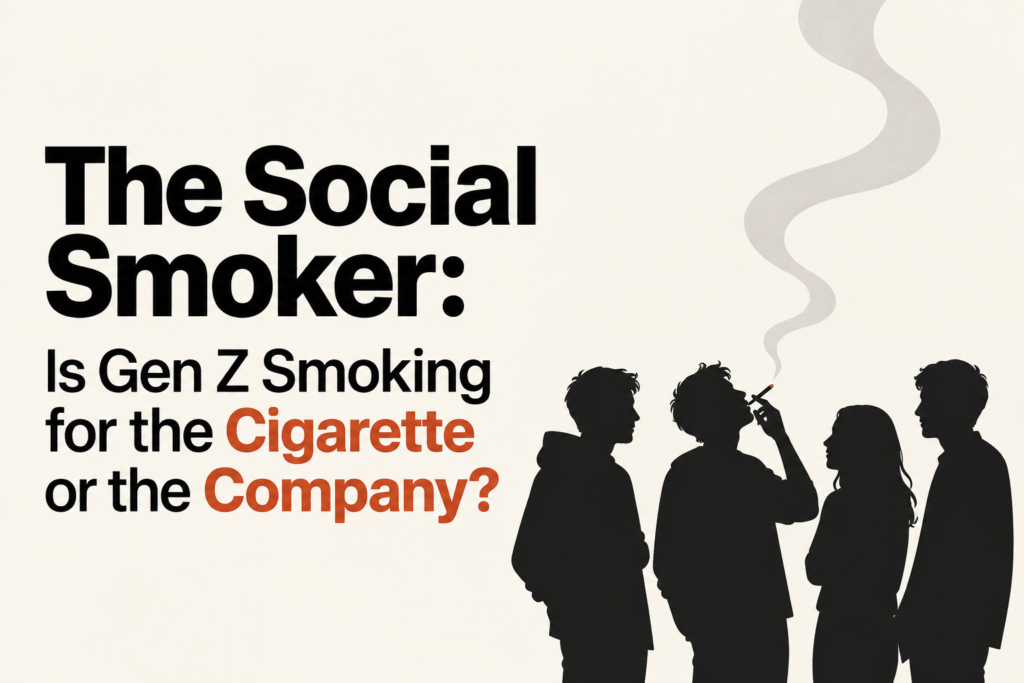
There is a familiar scene at many social gatherings. A group of young people steps outside a café, a party or a college hangout. Some are regular smokers. Others rarely touch a cigarette. Yet, when one person lights up, a few more join in. The conversation continues, friendships develop and, for some, the cigarette becomes part of the experience.
Ask a few of these occasional smokers whether they smoke, and you might get an interesting response: “I’m not really a smoker. I only smoke when I’m out with friends.”
This raises an interesting question about young people’s relationship with cigarettes. Is smoking still primarily an individual habit, or is it increasingly becoming a social activity?
The idea of a ‘social smoker’ is not new. But the distinction between someone who smokes regularly and someone who smokes only in certain social situations deserves a closer look, particularly as Gen Z navigates identity, friendships, nightlife and the pressure to fit in.
The rise of the occasional smoker
A 2014 study published in Nicotine & Tobacco Research, titled Prevalence and Correlates of Social Smoking in Young Adults, examined 1,811 American adults aged 18–25 who had smoked at least one cigarette in the preceding 30 days.
The findings revealed something interesting. Among the respondents, 46% identified themselves as social smokers, even though their reported behaviour did not necessarily fit the researchers’ behavioural definition. Another 27% both identified as social smokers and demonstrated social smoking patterns.
The distinction matters. Some young adults may smoke less frequently, smoke fewer cigarettes and associate smoking with specific social occasions rather than their everyday routines.
The study also found that people who both identified and behaved as social smokers reported a lower level of cigarette dependence than non-social smokers.
The larger takeaway is that not everyone who smokes necessarily sees themselves as a smoker. For some, smoking is tied to particular occasions, environments and social relationships.
Read the study: Prevalence and Correlates of Social Smoking in Young Adults
Is it about fitting in?
Think about the social settings in which young adults encounter cigarettes. College gatherings, music festivals, house parties, nightclubs and even informal breaks outside the workplace can create situations where smoking becomes a shared activity.
For someone who doesn’t smoke regularly, joining friends for a cigarette may feel less like adopting a habit and more like participating in a group experience.
There are several possible motivations behind this behaviour.
For some, it is about belonging. When friends step outside to smoke, joining them can mean being part of the conversation rather than missing out.
For others, it is about curiosity. They may want to experiment, understand what the experience feels like or avoid being the only person in a group who doesn’t participate.
And then there is the question of identity. Smoking has historically been associated with rebellion, independence and a certain idea of being grown-up. Films, music videos and popular culture have repeatedly used cigarettes to communicate these characteristics.
Whether young people consciously associate themselves with these images is another question. But the cultural symbolism of smoking has existed for decades.
The Instagram effect: When a habit becomes an aesthetic
There is another dimension worth examining: the visual representation of smoking.
A cigarette in a photograph, a late-night city backdrop, a dimly lit party or a candid picture with friends can sometimes become part of a carefully constructed lifestyle image.
Social media has made the presentation of identity an important part of how young people communicate with their peers. Fashion, music, travel, food and nightlife are all used to signal personality and belonging.
Could smoking also be entering this visual vocabulary?
It is an interesting hypothesis, but one that needs evidence. We should not assume that every photograph featuring a cigarette reflects a person’s smoking habits, or that young people are taking up smoking simply to look fashionable.
Nevertheless, it raises an important question: when an activity is repeatedly presented as an expression of confidence, rebellion or a particular lifestyle, does it influence how young audiences perceive that activity?
The distinction between consuming something and consuming its image is becoming increasingly relevant to youth culture.
What does Indian research tell us?
This conversation is not limited to Western campuses.
A study published in BMJ Open in June 2025, titled Beyond the Puff: Qualitative Insights into Smoking Behaviours and Societal Perceptions Among University Students in India, explored the experiences of 20 university students aged 19–30 at an institution in India.
The researchers identified several factors associated with smoking behaviour, including stress, cravings, mealtimes, cigarette availability and social influences.
The interviews also highlighted how differently students navigate smoking in different social environments. Some participants described smoking outside college while avoiding it around family members or older people. Others spoke about peer influence and the role of friends in introducing them to cigarettes.
The study is particularly interesting because it explores not just the act of smoking but also how students think about the way society perceives them.
Of course, 20 interviews at a single institution cannot establish how widespread these behaviours are among Indian students. But they offer a useful starting point for understanding the social and cultural factors behind smoking.
Read the research: BMJ Open – Beyond the Puff
The contradiction of being a non-smoker who smokes
Perhaps the most interesting aspect of social smoking is the way some occasional smokers define themselves.
Someone who smokes only at parties might not consider themselves a smoker. Someone who has a cigarette with friends once or twice a week may believe that their behaviour is fundamentally different from that of a regular smoker.
This distinction can create a false sense of control.
Occasional smoking is not risk-free. Even infrequent cigarette use exposes the body to harmful substances, and nicotine can lead to dependence. A habit that begins as something associated with social occasions can become more frequent over time.
The fact that someone doesn’t smoke every day does not make the behaviour harmless.
There is also a larger contradiction here. Young people are increasingly conscious of fitness, mental well-being, skincare, nutrition and healthier lifestyles. Yet, social settings can sometimes encourage behaviours that run counter to those priorities.
This does not mean Gen Z is becoming less health-conscious. It suggests that individual health choices and social behaviour do not always move in the same direction.
So, is social smoking becoming Gen Z’s new social currency?
It is too early to call social smoking a new Gen Z trend in India. There is evidence that social and occasional smoking exists among young adults, and Indian research has documented the influence of peers and social environments on student smoking behaviour.
What remains unclear is whether this behaviour is increasing, whether it is becoming more image-driven, and how much social media influences young people’s perceptions of smoking.
For brands, youth researchers, educators and public health organisations, these are important questions.
Understanding Gen Z requires looking beyond what young people consume and examining why they consume it, where they do it and what it communicates about their identity.
Perhaps the more revealing question isn’t simply whether Gen Z smokes.
It is whether some young people have started seeing smoking as something they do for the experience of being part of a group, rather than because they particularly want a cigarette.
And if that is happening, understanding the social appeal becomes just as important as understanding the habit itself.