






Political parties want young Indians to listen, participate and vote. But beyond campaign slogans, viral videos and promises of a better future, how can Gen Z decide who deserves its vote?
Every election comes with a familiar promise: the future belongs to the young.
Political speeches celebrate their ambition. Campaigns speak about jobs, education, entrepreneurship and national progress. Social media fills with clips designed to travel across timelines and WhatsApp groups. Young people appear in campaign imagery, at rallies, in online conversations and increasingly in the political narratives built around India’s future.

There is a reason for this attention.
Young Indians are entering the workforce, pursuing higher education, navigating an uncertain employment landscape and making decisions that will shape their economic and social lives for decades. Their concerns are not peripheral to the country’s future. They are central to it.

For political parties, this makes Gen Z an important audience to reach and understand.
But there is a difference between being spoken to and being represented.

A party can understand the language of young people without necessarily addressing their concerns. A campaign can be excellent at capturing attention without offering a convincing answer to the problems that matter. And a political promise can sound compelling on a smartphone screen while leaving important questions unanswered.
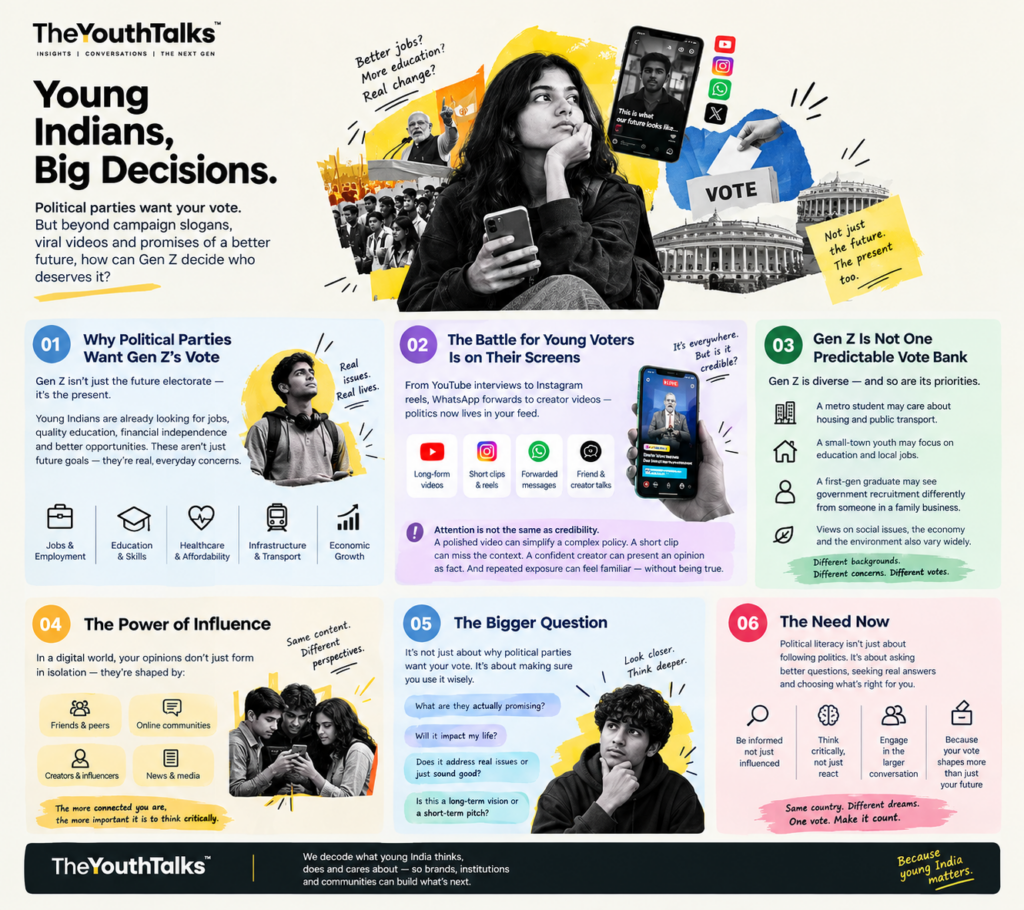
For Gen Z, therefore, the challenge is twofold: understand why political parties want its vote, and learn how to make that vote an informed decision.
Part One: Why Political Parties Want Gen Z’s Vote
1. Because young voters are not just the future electorate
The political importance of young people is often discussed in terms of what they will become. But young Indians are not waiting to become citizens with a stake in public policy. They already have one.
They are looking for employment, preparing for competitive examinations, attending universities, starting businesses, supporting families and trying to build financially independent lives.
Decisions about economic growth, public education, transport, digital infrastructure, taxation, healthcare and employment can influence these choices directly.
For a young graduate struggling to find a suitable job, employment policy is not an abstract election issue. For a student whose family is financing an expensive degree, the quality and affordability of education are immediate concerns. For a young entrepreneur, access to capital, reliable infrastructure and predictable regulation can determine whether an idea progresses beyond a business plan.
These experiences give young voters a direct interest in political outcomes.
Political parties have an incentive to understand these concerns because they affect how people evaluate governments and candidates. The question is whether that understanding leads to meaningful commitments or simply becomes another campaign theme.
2. Because the battle for young voters increasingly takes place on their screens
Political communication has changed alongside the media habits of young Indians.
A voter may encounter a political leader through a long-form interview on YouTube, a short campaign video on Instagram, a message forwarded on WhatsApp or a discussion among friends. The first encounter with a political issue may not happen through a newspaper, television debate or formal party meeting.
This creates new opportunities for political participation. Young people can discover issues, hear competing arguments, follow legislative developments and question public figures without waiting for traditional media to determine what receives attention.
But the same environment creates a problem: the ability to attract attention is not the same as the ability to establish credibility.
A polished video can simplify a complicated policy. A short clip can omit the context that changes its meaning. A confident creator can present an opinion as established fact. Repeated exposure to a claim can make it feel familiar without making it true.
Political parties and their supporters can use digital platforms to explain their positions, mobilise volunteers and engage with voters. Young people, meanwhile, need to recognise that digital fluency does not automatically translate into political literacy.
The important question is not whether politics belongs on social media. It already does. The question is whether young voters can look beyond the content and examine the claims being made.
3. Because Gen Z is not one predictable vote bank
There is a temptation to discuss Gen Z as though it has a single set of political preferences.
It does not.
A university student in a metropolitan city may prioritise housing costs and public transport. A young person in a smaller town may be more concerned about access to quality education and local employment. A first-generation graduate may see government recruitment differently from someone entering a family business. Young voters may also disagree sharply on social issues, economic policy, public services and the role of government.
Even people with similar backgrounds can arrive at different political conclusions.
This diversity makes young voters difficult to understand through stereotypes alone. It also makes them important for parties seeking to build support across communities and regions.
For Gen Z, the implication is equally significant: no political party can be assumed to represent an entire generation simply because its campaign features young faces or uses language that sounds relatable.
Representation must be evaluated through policies, candidates, actions and accountability—not aesthetics.
4. Because the issues of early adulthood are also political issues
Young people often experience politics through the lens of large national debates. Yet some of the most consequential political questions are closer to home.
Can a graduate find work that matches their education? Are public colleges adequately equipped? Is urban transport affordable and accessible? Can a young person start a business without unnecessary friction? Are public spaces safe? Can people access reliable information about government services?
These questions involve different institutions and levels of government. Some require national policy, others state-level action, and many depend on local administration.
They also reveal a gap that political campaigns can sometimes obscure: announcing a goal is not the same as delivering an outcome.
A promise to create employment, for instance, invites further questions. What kinds of jobs? Over what period? Through which programmes or investments? How will progress be measured? What evidence would show that the promise has been fulfilled?
Young voters do not need to become policy experts to ask these questions. They simply need to move beyond the headline.
5. Because participation can extend beyond election day
Political parties may seek more from young people than a vote. They may invite them to volunteer, attend events, participate in campus outreach, create campaign content or encourage others to support a particular position.
Political participation can be valuable. It can introduce young people to public issues, develop organisational skills and provide opportunities to contribute to causes they believe in.
But participation also deserves scrutiny.
Is a young person’s role limited to amplifying campaign messages, or are they being encouraged to understand the issues? Can they question the party’s position? Are they free to disagree? Does their involvement offer a meaningful way to contribute, or does it simply turn their social networks into another distribution channel?
Being politically active does not require unquestioning loyalty. In a democracy, engagement and independent judgment should be able to coexist.
The larger point is simple: political parties have reasons to reach young Indians. Young Indians, in turn, have every reason to evaluate what they are being offered.
Part Two: What Should Gen Z Keep in Mind Before Giving Its Vote?
Understanding political campaigns is only the beginning. The next step is learning how to make a decision amid competing claims, personal loyalties and an overwhelming volume of information.
1. First, make sure you can vote
Before debating candidates or comparing manifestos, complete the most basic step: make sure you are registered.
In India, eligible citizens can apply for inclusion in the electoral roll through the Election Commission of India’s voter services system.
A first-time voter’s registration checklist:
- Check your eligibility. You must be an Indian citizen, at least 18 on an applicable qualifying date, ordinarily resident in the relevant constituency and otherwise eligible under electoral law.
- Apply using Form 6. New electors can submit an application online through the Voters’ Services Portal. The prescribed application can also be pursued through the relevant election registration authorities.
- Keep the required information ready. Follow the latest official Form 6 instructions for age, residence, photographs and supporting documents. Do not assume that any particular identity document automatically satisfies every requirement.
- Track your application. Use the official voter services system to check the application status and follow up if needed.
- Verify your name on the electoral roll. Do not assume that submitting an application means registration is complete. Check your enrolment and polling details before election day.
India has provisions for multiple qualifying dates for voter registration, but the applicable electoral-roll revision and election schedule matter. Registration deadlines and procedures should therefore be checked through the Election Commission’s official resources rather than an old social media post or a generic online guide.
For official information, start with the Voters’ Services Portal and the Election Commission of India.
One important distinction: having an identity document is not, by itself, proof that your name is on the electoral roll. Check your enrolment separately and follow the current official instructions on acceptable identification at the polling station.
2. Understand which election you are voting in
Not every election chooses the same kind of representative or determines the same responsibilities.
In a Lok Sabha election, voters elect representatives to Parliament. In a State Assembly election, they elect representatives to the state legislature. Local-body elections concern institutions such as municipalities or panchayats, with their responsibilities shaped by the applicable state framework.
Why does this matter?
Because the authority to address an issue depends on the institution involved.
If your concern is a local road, municipal waste collection or neighbourhood infrastructure, you should understand which local authority is responsible. If your concern is state public transport or education policy, the relevant responsibilities may sit elsewhere. National employment trends, meanwhile, cannot be reduced to the actions of a single local representative.
A candidate should be evaluated partly on what the office they are contesting can actually influence.
Otherwise, voters risk judging people on promises they may have limited power to fulfil—or overlooking the responsibilities they do hold.
3. Read the manifesto, but do not stop there
Election manifestos can help voters understand a party’s stated priorities. They may outline plans relating to employment, education, welfare, economic development, public services and other issues.
Reading them is useful. Treating them as proof of future performance is not.
A promise is a commitment, not a completed outcome.
When a party makes a major promise, ask a few basic questions. Is the proposal specific? Does it explain how the goal might be achieved? Is there a credible timeline? What resources or institutional changes might be required? If the party has previously held power, what can its record tell you about implementation?
Past performance does not guarantee future results, and political circumstances can change. But examining a record is more informative than relying entirely on campaign language.
The same standard should apply across parties. A proposal should not become credible simply because it comes from the party you prefer, nor should it be dismissed solely because it comes from a party you dislike.
4. Look at the candidate as well as the party
Political choices are often framed as contests between parties and their leaders. Yet the individual candidate matters too.
A voter can examine publicly available candidate affidavits, relevant declarations, background information and credible reporting. The Election Commission’s candidate and election resources can help identify official information, while independent reporting may provide additional context.
These sources have limits. An affidavit is not a complete measure of someone’s ability to represent a constituency, and a headline about a candidate may not tell the whole story. Information should be read carefully, with attention to what has actually been established.
Consider the questions that matter to you: Does the candidate understand local concerns? Have they demonstrated the ability to work on public issues? Are their claims supported by evidence? Do they explain their positions clearly? Can their public record be examined?
No single checklist can determine the right choice for every voter. The point is to make the assessment more deliberate.
5. Treat viral political content as a starting point, not a verdict
Political information can travel quickly through social media and messaging groups. A video may appear to show a leader making a startling statement. A graphic may claim that a policy has transformed an entire sector. A forwarded message may accuse a candidate of wrongdoing.
Before sharing or believing it, pause.
Who originally published the content? Is the video complete, or has it been edited? Does the claim link to a primary document, an official announcement or verifiable data? Have credible, independent sources examined it? Is the headline stronger than the evidence underneath it?
A useful habit is to search for the original source rather than repeatedly reading posts that quote one another.
Official documents can establish what an institution announced or recorded. Independent journalism can provide context and scrutiny. Fact-checking organisations can investigate specific viral claims. Each has a role, and none should be treated as infallible without examining its evidence.
The goal is not to distrust everything. It is to give important claims the scrutiny they deserve.
6. Decide what matters to you before the campaign decides for you
Campaigns are designed to focus attention. They highlight certain issues, repeat particular messages and present a version of the choices before voters.
One way to preserve independent judgment is to identify your own priorities before becoming absorbed in the campaign.
What are the three issues that will most influence your future or your community? Employment? Education? Public safety? Healthcare? Economic opportunity? Environmental quality? The effectiveness of local services?
You do not need to have a fully developed position on every public issue. Nor should you expect one candidate or party to agree with you on everything.
But knowing what matters to you makes it easier to compare competing proposals. It also helps you distinguish between a message that is emotionally powerful and a policy that addresses the problem you care about.
Talk to people with different views. Read beyond sources that already agree with you. Be willing to revise an opinion when better evidence emerges.
Independent thinking does not mean thinking alone. It means retaining responsibility for your own conclusion.
7. Remember that NOTA is an option, not a magic reset button
India’s electronic voting process provides a None of the Above (NOTA) option in applicable elections. It allows a voter to indicate that they do not support any of the candidates on the ballot.
But voters should understand what it does and does not do. In general, a NOTA vote does not automatically cancel an election, invalidate the result or require a fresh election. Specific rules and arrangements should be checked for the election concerned.
The broader lesson is to understand the actual effect of a voting choice rather than rely on assumptions circulating online.
Whatever option you select, make the decision with an understanding of what it means.
The vote is yours. So is the responsibility to think.
For young Indians, the first vote can feel like a milestone. It may be the first time a person who has spent years discussing public affairs with family and friends formally participates in choosing a representative.
But the value of that vote does not depend on whether it is the first or the tenth. It lies in the opportunity to make a choice based on one’s own assessment.
Political parties will continue to compete for attention. They will make promises, build narratives, recruit supporters and try to persuade voters that their vision deserves a mandate. That is part of electoral democracy.
Young voters do not need to become cynical about politics to navigate it. They need to become more discerning.
Ask what a promise means in practice. Check who has the authority to deliver it. Look for evidence of performance. Question claims that arrive without context. Understand the candidate and the office. Register on time and verify your enrolment.
And resist the idea that being young automatically makes you either politically progressive, politically uninformed or loyal to any particular party. Gen Z is a generation of individuals with different experiences, ambitions and beliefs. Its political choices should reflect that diversity.
The real measure of a political campaign is not how effectively it speaks the language of young people. It is whether its claims, commitments and record withstand scrutiny.
And the real measure of an informed young voter is not knowing every political fact or having an opinion on every controversy. It is being willing to ask questions, examine evidence and make a decision without outsourcing that judgment to a party, an influencer, a family member or a viral post.
Political parties may want Gen Z’s vote. Gen Z should know what it wants from the people asking for it.