
From skincare and fashion to fitness and food, young Indian consumers are spending across categories while experimenting with competing products. For brands, the challenge is no longer just getting Gen Z to buy once. It is giving them a compelling reason to come back.
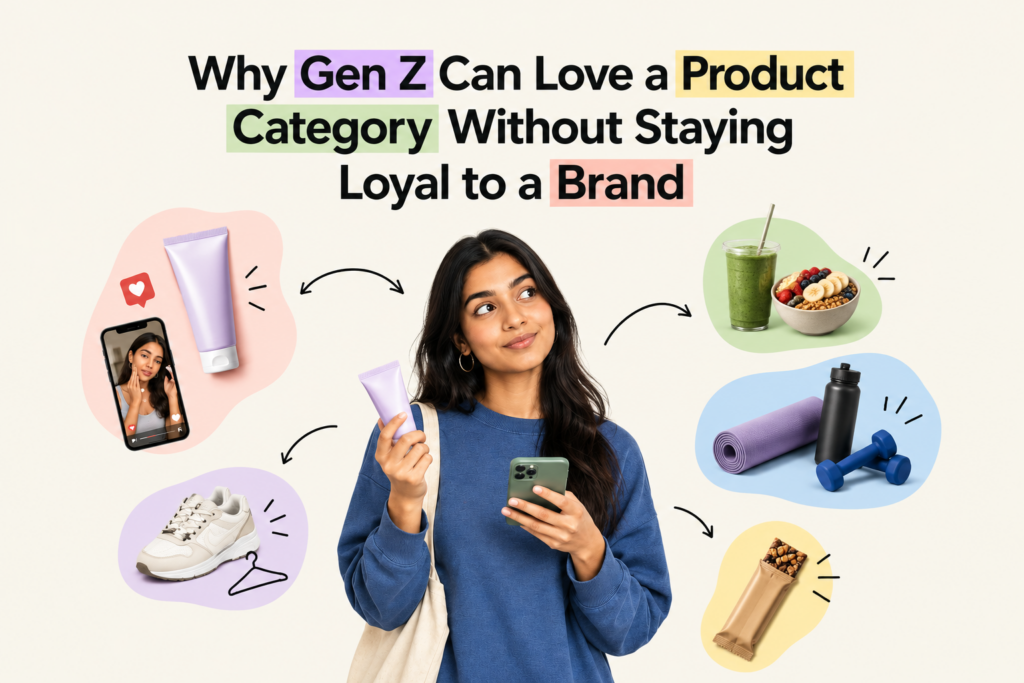
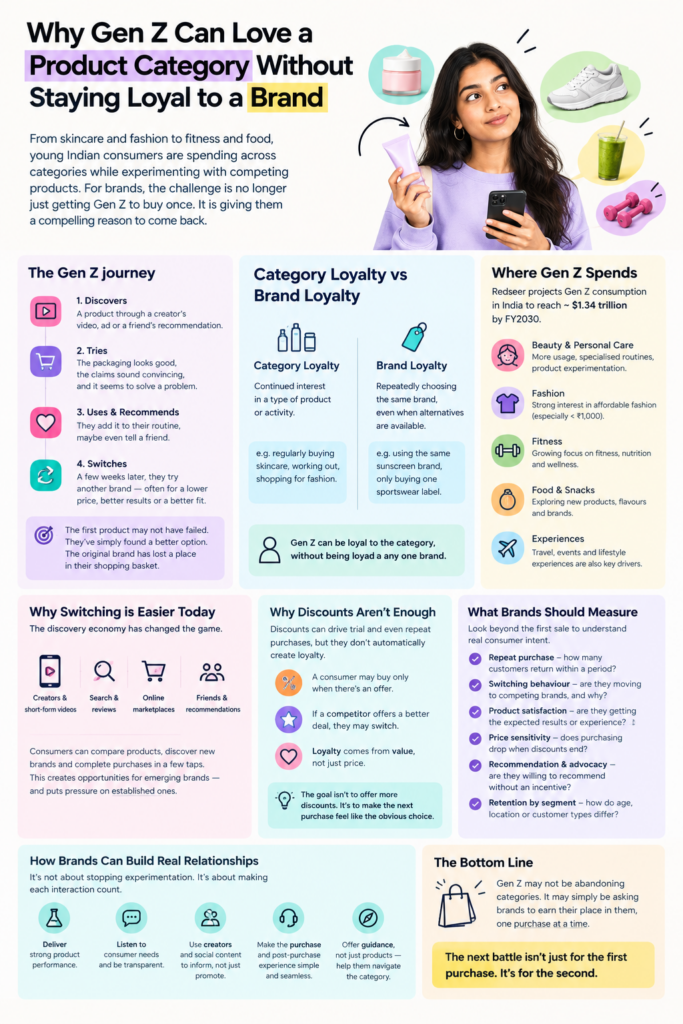
A young consumer discovers a skincare product through a creator’s video. The packaging looks appealing, the claims sound convincing, and the product appears to address a problem they have been trying to solve. They buy it, add it to their routine and perhaps recommend it to a friend.
A few weeks later, they switch to another brand.
The first product may not have failed. The consumer may simply have discovered an alternative that costs less, promises better results or appears more suited to their needs. The original brand has not necessarily lost a skincare customer. It has lost a place in that customer’s shopping basket.
This distinction matters for businesses trying to understand India’s Gen Z consumers.
Young Indians can be enthusiastic buyers of beauty products, sneakers, fitness equipment, snacks and other lifestyle categories without developing an equally strong attachment to the companies selling them. They may continue spending within a category even as their preferences between brands change.
For marketers, this creates an uncomfortable question: what does brand loyalty mean when consumers are willing to experiment, compare alternatives and change their minds?
The difference between category loyalty and brand loyalty
The two concepts are often treated as interchangeable, but they describe different behaviours.
Category loyalty is a consumer’s continued interest in a particular type of product or activity. Someone who regularly buys skincare products, exercises several times a week or frequently shops for fashion is demonstrating an ongoing preference for that category.
Brand loyalty is more specific. It describes a tendency to choose the same brand repeatedly, even when alternatives are available.
A consumer can display the first without demonstrating the second.
Consider someone who is committed to a skincare routine but alternates between sunscreen brands. Another consumer may love fitness but purchase sportswear from whichever company offers the right combination of design, price and performance. A third may regularly order protein snacks but have little preference for any single manufacturer.
In each case, the underlying need remains relatively stable while the brand supplying the solution can change.
This is not an exclusively Gen Z phenomenon. Consumers of every age compare products and respond to changing circumstances. What makes the behaviour especially relevant to young digital consumers is the ease with which they can discover alternatives, encounter new recommendations and evaluate competing claims.
The challenge for brands is to distinguish between a consumer who has lost interest in a category and one who remains interested but has found a different supplier.
The commercial implications are very different.
Redseer’s research points to a changing consumer
Redseer Strategy Consultants’ report, The Indian Consumer at 2030: Redefining Aspirations, Choices, and Markets, developed with Fireside Ventures, provides a useful starting point for understanding this shift.
The report projects that Gen Z consumption in India will reach approximately $1.34 trillion by FY2030. Its analysis of beauty and personal care describes growing product usage, more specialised routines and consumers experimenting with products suited to their particular needs.
The report also highlights the importance of affordable fashion, fitness, nutrition and experiences in the spending patterns of young Indians.
Taken together, these findings suggest that Gen Z’s consumer opportunity extends across categories rather than being concentrated in a handful of traditional status purchases.
But the report’s findings should not be interpreted as proof that every Gen Z consumer is disloyal. Nor does product experimentation automatically mean that brand loyalty is disappearing.
The more defensible interpretation is that brands are competing for a place in increasingly varied consumer routines, and that a strong category preference does not guarantee preference for any one company.
For marketers, this is a useful distinction. Growth in a category can create opportunities for several brands, but it can also intensify competition for repeat purchases.
Beauty: loyal to the problem, not necessarily the product
Beauty and personal care provide a particularly revealing example.
A consumer concerned about acne may explore cleansers, moisturisers, serums and sunscreen. As their understanding of skincare improves, they may become more particular about ingredients, texture, price, suitability and how products fit into their routines.
Their commitment to skincare may deepen even as their product choices become more experimental.
For a beauty brand, this creates two separate tasks: convincing the consumer to try the product and convincing them that it deserves a permanent place in their routine.
The first can be achieved through discovery, compelling packaging, creator recommendations or an attractive introductory price. The second requires a more sustained demonstration of value.
Does the product perform as expected? Is it comfortable to use? Is the price justified? Can the consumer find it easily when they need to replenish it?
If the answers are unsatisfactory, another brand may win the next purchase.
This is particularly important in categories where consumers can compare a wide range of alternatives and where individual preferences differ substantially.
A beauty company cannot assume that an effective social-media campaign will translate into lasting loyalty. The campaign may generate trial, but the product experience has to do the rest.
Fashion: when the next purchase is a fresh decision
Fashion presents a different version of the same challenge.
Young consumers may regularly purchase clothing, footwear and accessories without repeatedly choosing the same label. Their decisions can reflect changing aesthetics, affordability, occasion, availability and the desire to try something new.
A shopper might buy one brand’s sneakers, another company’s everyday clothing and a third label’s accessories. There may be no contradiction in these choices: each purchase serves a different purpose.
Redseer’s analysis highlights the importance of affordable fashion among Gen Z consumers, including the appeal of products priced below ₹1,000.
For brands, this makes the relationship between price and identity especially important. Young consumers may want products that help them express themselves without committing a large share of their disposable income to a single purchase.
An accessible price can encourage experimentation, but it can also make switching easier. If competing products appear similar, a discount or a new design may be enough to influence the next transaction.
The response cannot simply be to lower prices indefinitely. Brands still need a recognisable identity, credible quality and a reason for consumers to choose them when cheaper or newer alternatives appear.
The strongest proposition combines affordability with something distinctive that consumers value.
The discovery economy makes switching easier
Digital platforms have changed the conditions under which brands compete.
Consumers can encounter new products through creators, short-form videos, reviews, search results, online marketplaces and recommendations from friends. They can compare alternatives without visiting multiple stores, and many purchases can be completed in a few taps.
Discovery is no longer restricted to the brands a consumer already knows.
This creates opportunities for emerging companies. A smaller brand with a relevant product and a compelling proposition can reach consumers who might otherwise have continued buying familiar products.
But the same environment creates a challenge for established businesses. Previous purchases do not necessarily protect them from new competitors.
A consumer who discovers a better-priced alternative may try it. A creator may introduce a product that appears more relevant. A new formulation, design or flavour may make an existing choice seem less attractive.
However, it would be simplistic to conclude that social media has made all consumers fickle. Discovery and switching depend on the category, the cost of experimentation, the perceived risk of a disappointing purchase and the strength of existing preferences.
The important change is that consumers have more opportunities to reconsider their choices.
Brands must therefore compete not only to be discovered, but also to remain relevant after the first purchase.
Why discounts cannot build loyalty on their own
When repeat purchases become less predictable, discounts can appear to be an easy solution.
An introductory offer may encourage trial. A limited-time promotion may persuade a consumer to buy again. A loyalty programme may reward frequent purchases.
These mechanisms can be useful, but they do not necessarily create a meaningful preference for the brand itself.
A consumer who buys only when a product is discounted may be loyal to the offer rather than to the company. If a competitor introduces a better promotion, the purchase may move elsewhere.
For businesses, the distinction between incentivised repeat buying and genuine brand preference matters.
A stronger approach is to understand what makes the product worth returning to. For some categories, that may be consistent performance. For others, it may be design, convenience, service, availability or the trust associated with the brand.
Price remains part of the equation, particularly for young consumers managing limited budgets. But a sustainable strategy requires brands to offer more than a succession of discounts.
The aim should be to make the next purchase an easy and credible decision, rather than one that depends entirely on a temporary incentive.
What brands should measure instead
If brands want to understand whether they are building meaningful consumer relationships, they need to look beyond the initial sale.
Acquisition numbers reveal how many consumers have tried a product. They do not establish how many will return.
Repeat-purchase rates can provide a more useful signal, but even these need context. A consumer may repurchase a product because it is convenient, because alternatives are unavailable or because a discount makes it attractive. None of these reasons necessarily indicates a strong emotional attachment.
Brands should examine several measures together:
- Repeat purchase: How many customers return within a relevant period?
- Switching behaviour: Are customers moving to competing brands, and what reasons can the business identify?
- Product satisfaction: Are consumers getting the results or experience they expected?
- Price sensitivity: Does purchasing decline sharply when discounts end?
- Recommendation and advocacy: Are consumers willing to recommend the product without being prompted by an incentive?
- Retention by consumer segment: Do different age groups, locations or customer types behave differently?
The right measures will vary by category. A sunscreen brand, a sneaker company and a protein-snack business operate on different purchase cycles.
The principle is the same: a brand needs to understand not just whether consumers buy, but what brings them back.
Can brands turn experimentation into a relationship?
The answer is not to discourage consumers from trying alternatives. In many categories, experimentation is part of the buying journey.
Instead, brands need to make each interaction reinforce a credible reason to return.
That starts with product performance and a clear value proposition. It also involves listening to consumers, understanding the needs different products serve and making the purchasing experience straightforward.
Communication matters, too. Creator partnerships and social content can introduce products, explain how they work and help consumers evaluate whether they are appropriate for their needs. But the claims made through marketing must align with the actual experience.
Brands can also build relationships by helping consumers navigate a category rather than simply pushing another product. Useful guidance, responsive customer service and transparent information can create value beyond the transaction itself.
The objective is not to manufacture loyalty through constant engagement. It is to earn preference by consistently meeting expectations.
For some consumers, that may eventually translate into a strong attachment to a particular brand. For others, loyalty may remain conditional on price, performance or availability.
Businesses need to understand both groups rather than assume that every customer relationship will look the same.
The next battle is for the second purchase
India’s Gen Z consumers represent a substantial growth opportunity across beauty, fashion, fitness, food and other lifestyle categories. Redseer’s projections underline the scale of that opportunity, while its category analysis offers clues about the preferences shaping consumption.
But market growth does not automatically translate into durable brand growth.
A consumer can spend more on skincare without becoming more loyal to a skincare company. They can buy more fashion without committing to one label. They can embrace fitness while switching between products, services and providers.
For brands, the challenge is to recognise that category demand and brand preference are separate commercial questions.
The first purchase may be won through discovery, design, price or a compelling promise. The second purchase is an opportunity to demonstrate that the promise was worth believing.
In a marketplace where consumers have more ways to discover alternatives, that second decision deserves as much attention as the first.
Gen Z may not be abandoning categories. It may simply be asking brands to earn their place in them, one purchase at a time.