






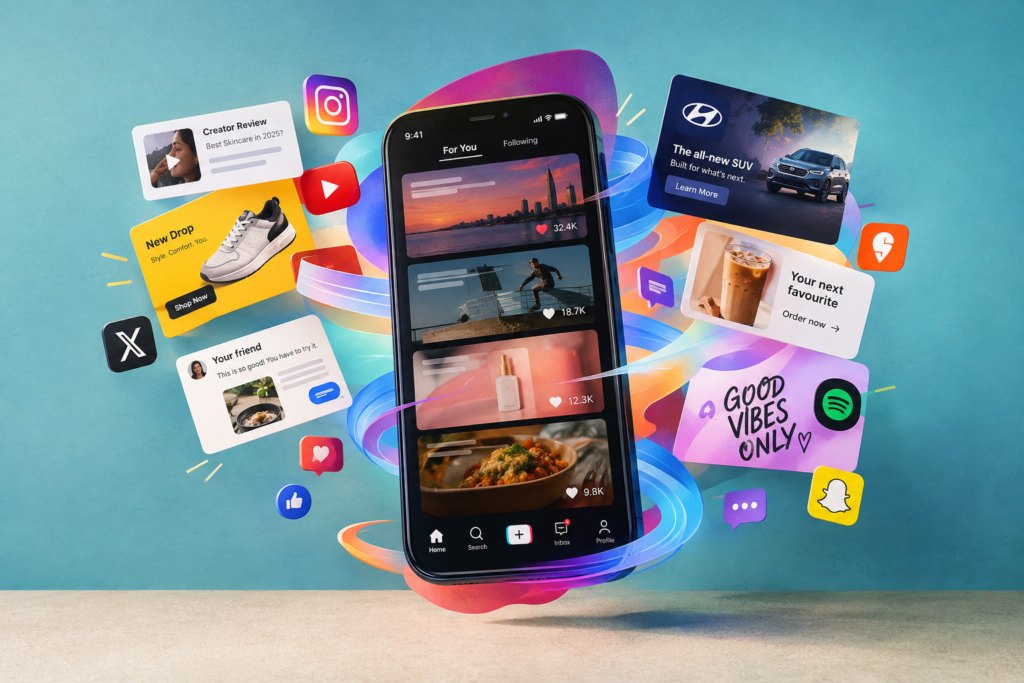
From social media feeds to creator-led recommendations, brands have more ways than ever to reach young consumers. But being seen is not the same as being remembered. In India’s crowded digital economy, the real battle is for attention that means something.
NEW DELHI: Imagine Aditi, a young Gen Z consumer in Delhi, opening Instagram during a break in her day. She moves between a friend’s story, a funny reel, a creator reviewing a new product and a brand advertisement. A few seconds later, she is watching something else.
The advertisement has been delivered. The platform may count an impression. But whether the brand has earned a place in Aditi’s memory is another question entirely.

For marketers, this is becoming an increasingly expensive problem. Young Indians are surrounded by content, recommendations, trends and commercial messages. Brands can buy visibility, collaborate with creators and flood digital platforms with videos. Yet none of these guarantees that a young consumer will stop, pay attention or care.
The challenge is not simply that Gen Z has a short attention span. It is that brands can no longer assume that reaching young people means earning their attention.

The numbers behind the attention problem
A 2025 study by Snapchat, WPP Media and Lumen Research offers a useful starting point. Its Attention Advantage report found that Gen Z in India paid approximately 34% less attention to social media advertisements than Millennials, and around 10% less attention to digital video advertisements.
The research drew on more than 3,000 Indian respondents and used technology to measure visual attention to advertising. It also found that measured attention was a stronger predictor of brand recall and favourability than conventional view-through rates.

The study was commissioned by Snap Inc. and WPP Media, so its findings should be read with that commercial context in mind. Nevertheless, it raises a question that extends beyond any single platform: how much advertising is actually being noticed by the people it is intended to reach?
Read the Attention Advantage study.
For years, marketers have relied on metrics such as reach, impressions, views and clicks to understand campaign performance. These remain useful, but they do not all measure the same thing.
A video view does not necessarily indicate sustained attention. A click does not automatically mean trust. And remembering an advertisement does not guarantee a purchase.
For brands targeting young consumers, the distinction between exposure and meaningful attention is becoming harder to ignore.
Gen Z isn’t disappearing. Its attention is going elsewhere.
It would be tempting to conclude that young consumers are simply losing the ability to concentrate. The more useful explanation may be that they have an abundance of choices and greater control over what they consume.
Google’s India consumer insights, published in June 2025, reported that 79% of surveyed Gen Z consumers used Google and/or YouTube daily. The research described young consumers as active searchers who use digital platforms to discover information, explore interests and evaluate options.
Source: Think with Google, How well does your brand know Gen Zs in India?
This matters because the same consumer who skips a conventional advertisement may spend several minutes watching a creator explain a smartphone, comparing skincare ingredients or researching a product before buying it.
The difference is not necessarily the ability to pay attention. It is the reason to pay attention.
A brand advertisement asks for time. A useful review offers information. A creator’s video may provide entertainment, familiarity or a sense of personal recommendation. A friend’s opinion can carry context that a polished campaign cannot reproduce.
Aditi’s hypothetical scroll captures the central problem facing marketers: the brand is competing not just against rival brands, but against everything else she might find more interesting or useful.
When creators become the route to attention
The growth of India’s creator economy illustrates how the competition is changing.
A May 2025 report by Boston Consulting Group estimated that India’s 2–2.5 million monetised content creators influenced $350–400 billion in consumer spending. The report projected that creator-influenced consumption could exceed $1 trillion by 2030.
These are estimates of spending influenced by creators, not a claim that every recommendation directly produces a purchase. Even so, the scale shows why brands increasingly view creators as more than distribution channels.
Source: BCG, From Content to Commerce: Mapping India’s Creator Economy.
Consider Hyundai India’s creator-led marketing activity on YouTube. In a campaign example shared by Google, gaming creators and livestreams helped promote a sporty SUV to younger audiences. Google reported 2.7 million livestream views and a 2.5-fold increase in event visitors.
The approach offered a lesson for marketers: rather than relying exclusively on conventional product advertising, a brand could enter a content environment where its intended audience was already engaged.
The broader principle is relevant across categories. A beauty brand can demonstrate how a product works. A smartphone company can let a creator test its camera. A food-delivery platform can participate in conversations about convenience, cravings and everyday spending.
The product becomes part of a story rather than an interruption to one.
But creator marketing is not a guaranteed solution. A large following does not automatically translate into credibility for every product. If a partnership feels forced, consumers may remember the creator while remaining indifferent to the brand.
The objective should not be to borrow somebody else’s popularity indefinitely. It should be to give consumers a reason to care about the product itself.
Why looking young isn’t enough
Another challenge for brands is the temptation to imitate youth culture instead of understanding it.
Adding internet slang to an advertisement, using a trending audio clip or collaborating with a popular influencer may create momentary visibility. But cultural relevance is not something that can be manufactured simply by inserting the latest trend into a campaign.
Young consumers are not one homogeneous audience. A college student in Delhi, an early-career professional in Bengaluru and a student in a smaller city may have different budgets, aspirations, languages and purchase priorities.
Even within the same city, the reasons for paying attention can differ. One consumer may want an honest product comparison; another may respond to humour, price or convenience.
This is where brands risk confusing a demographic label with a genuine understanding of their audience. Calling a campaign Gen Z-focused does not make it relevant to Gen Z.
A more useful question is whether the campaign addresses something its intended audience actually cares about.
That might mean demonstrating value instead of relying on aspirational imagery, explaining a product instead of merely making it look attractive, or acknowledging a consumer’s concerns rather than assuming that a celebrity endorsement will settle them.
The difference between a view and a relationship
The pressure to capture attention also exposes a weakness in how campaign success is sometimes evaluated.
A brand can generate millions of views without establishing whether consumers remember its name. A creator partnership can produce thousands of comments without demonstrating whether the audience trusts the recommendation. A viral campaign can attract widespread discussion without translating into sustained demand.
BCG’s creator-economy research identifies return-on-investment measurement, fake engagement and brand safety among the challenges facing the industry.
The implication is not that views and engagement are meaningless. It is that brands need to connect these measures to what they are ultimately trying to achieve.
Did the campaign improve brand recall? Did consumers consider the product? Did it change perceptions or influence a purchase? Did the brand earn enough trust to be considered again?
These questions become especially important when marketing budgets are spread across social platforms, video, influencers, events and other channels.
For marketers, the next advantage may come from understanding not just where attention occurs, but what that attention accomplishes.
What brands need to understand now
The answer is not to make every advertisement shorter, louder or more entertaining. Nor is it to abandon traditional advertising in favour of creators.
Different products, audiences and purchase decisions require different approaches. A quick, entertaining video might introduce a brand, while a detailed comparison or trusted recommendation could help a consumer make a considered purchase.
Brands need to understand the role they want to play in a young person’s life and create content that earns its place there.
For some, that means being useful. For others, it means being entertaining, culturally relevant or transparent about what a product offers. Often, it means doing less of what brands want to say and more of what consumers want to know.
The most important shift is conceptual: attention should not be treated as an automatic outcome of advertising expenditure.
Aditi may encounter hundreds of brand messages in a week. The brands that matter are not necessarily those she sees most often, but those that give her a reason to pause, remember or act.
And that is the uncomfortable reality confronting marketers. Young consumers have not stopped paying attention. They have become more selective about where they direct it.
In an economy overflowing with content, the real competitive advantage may belong to brands that stop asking how to get in front of Gen Z—and start asking why Gen Z should care when they do.