

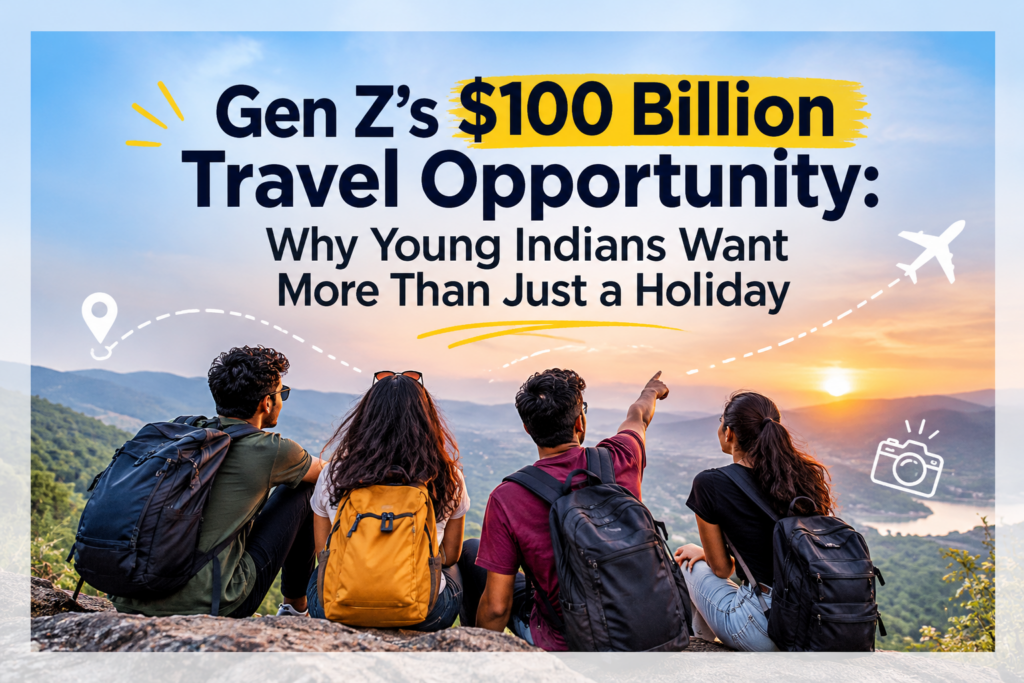
From hostels and offbeat stays to solo trips, hiking and Instagram-inspired itineraries, India’s young travellers are creating new opportunities for the travel economy.
For some young Indians, a holiday still means checking into a hotel, visiting the major attractions and returning home with photographs of the destination.
For others, the appeal lies in doing something different: taking a first solo trip, staying in a hostel with fellow travellers, hiking through the mountains, spending a few days in a small town or discovering a place that has not yet become a mainstream tourist destination.
The accommodation, the people met along the way and the stories brought home can become as important as the destination itself.
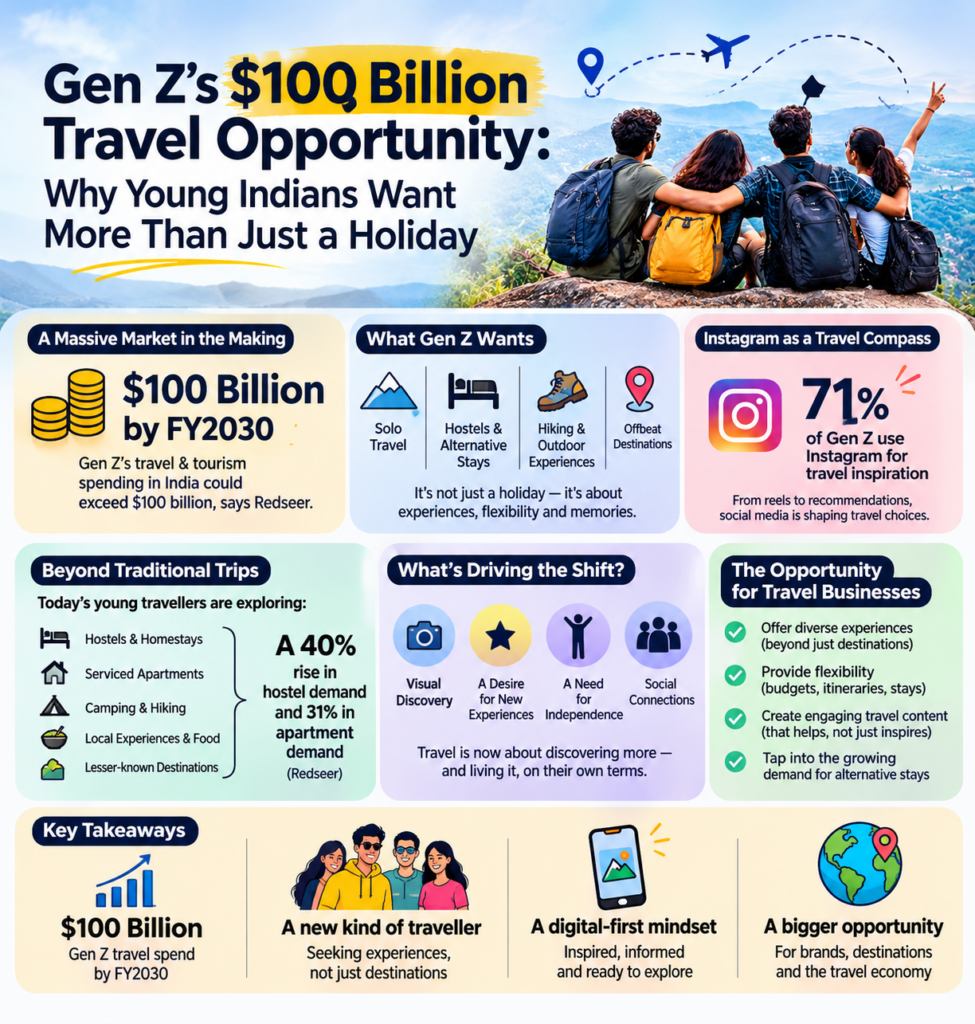
This shift in how travel is imagined and experienced is opening up opportunities across India’s tourism economy. According to Redseer’s report, The Indian Consumer at 2030: Redefining Aspirations, Choices, and Markets, Gen Z’s travel and tourism spending could exceed $100 billion by FY2030.
The projection is significant, but the more interesting question is what this generation may want from the money it spends.
Redseer highlights interest in solo travel, hostels, apartments, camping, hiking and offbeat stays. The report also cites Instagram as an important source of travel inspiration, alongside growth in demand for alternative accommodation.
Taken together, these signals suggest that the opportunity extends beyond selling tickets, hotel rooms and packaged holidays. Travel businesses may increasingly need to compete on the experiences they enable, the flexibility they offer and the memories travellers hope to create.
The destination is only part of the decision
Travel has always been about more than reaching a place. What may be changing is the range of experiences young consumers can discover, compare and consider before deciding where to go.
A destination can become attractive because of its landscape, food, local culture, outdoor activities or the possibility of meeting other travellers. A small café, a mountain trail or a homestay can become a reason to visit a place that was not previously on someone’s itinerary.
For some young people, travel also offers a chance to step outside familiar routines. A first trip without family, a journey with college friends or a weekend away from a demanding work schedule can represent a degree of independence.
That does not mean traditional sightseeing has lost its appeal. Nor does it mean Gen Z has one uniform travel personality. Many young Indians continue to prioritise family holidays, religious tourism, familiar destinations and carefully planned group trips.
The larger opportunity is that travel preferences are becoming more varied. Businesses that understand these different motivations may be better placed to serve travellers than those relying on a single definition of a good holiday.
Instagram is becoming part of travel discovery
For a generation accustomed to discovering restaurants, products, creators and events through digital platforms, travel inspiration increasingly begins before a booking website is opened.
Redseer reports that 71% of the Gen Z respondents in its cited measure use Instagram for travel inspiration. The figure should be understood in the context of the report’s methodology, rather than treated as a universal statistic for every young traveller in India.
Still, it points to the importance of visual discovery.
A short video of a mountain trail, a creator documenting a solo trip or a sequence of photographs from a lesser-known destination can introduce an audience to places it had not considered visiting. Content can also make particular experiences more tangible: what a hostel looks like, how a trek unfolds, what a local neighbourhood offers or how much a weekend might cost.
This creates a different challenge for travel brands. Being discoverable is no longer only about appearing when someone searches for a destination. It can also mean making an experience compelling enough for someone to imagine themselves taking part.
But inspiration and booking are not the same thing.
A destination may look extraordinary online and still be too expensive, difficult to reach or impractical for a student’s schedule. A traveller may save dozens of videos without booking any of the trips.
For travel businesses, the task is to connect visual appeal with useful information: realistic costs, transport options, safety considerations, accommodation details and activities that can actually be booked.
The strongest travel content does not merely make a place look desirable. It helps a potential visitor understand how to experience it.
The rise of hostels and alternative stays
A hotel is not the only way to experience a destination. Hostels, serviced apartments, homestays, camping facilities and other alternative accommodation options offer different combinations of price, privacy, flexibility and social interaction.
Redseer cites a 40% increase in hostel demand and a 31% increase in apartment demand in the measures referenced by the report. Before publication, these figures should be checked against the original charts to establish the precise period, baseline and definition of demand.
Even with that qualification, the categories illustrate why accommodation deserves attention as part of the wider travel story.
Hostels can appeal to travellers who want relatively affordable stays and opportunities to meet other people. Apartments may work for friends travelling together, longer visits or people who value access to a kitchen and more independent living arrangements. Camping and hiking experiences can appeal to travellers seeking time outdoors, while homestays may offer a closer connection to local life.
These options do not replace hotels for every traveller. Families, business travellers and visitors seeking particular services may continue to prefer conventional accommodation.
The opportunity lies in serving different travel needs rather than assuming every customer wants the same room, amenities or itinerary.
For operators, that means designing the experience around the traveller. A hostel needs more than low prices if guests also expect cleanliness, security and a welcoming atmosphere. An apartment needs reliable management and transparent listings. An offbeat stay needs to deliver the experience promised in its photographs.
As accommodation choices expand, trust becomes part of the product.
Solo travel and the appeal of independence
Solo travel has a particular appeal because it allows a person to make decisions without coordinating every choice with a group.
The traveller can choose the pace, change plans, spend longer in one place or follow an interest that others may not share. For some young adults, a solo trip can also be a way to build confidence and learn to navigate unfamiliar surroundings.
However, the idea of travelling alone should not be confused with wanting to be isolated. A solo traveller might stay in a hostel, join a group excursion or meet other people through a local activity. Independence and social connection can coexist.
Safety, affordability and practical access remain important considerations, especially for first-time travellers. Reliable transport, transparent accommodation information, emergency support and clear local guidance can influence whether a trip feels manageable.
Travel brands that want to serve solo travellers should therefore avoid treating independence as a marketing slogan. The real opportunity is to remove some of the uncertainty that can make a first trip difficult.
That might mean clear booking policies, verified accommodation details, accessible support or itineraries designed for people travelling alone. Businesses should also recognise that solo travel is not one market: a backpacker, a young professional taking a short break and someone travelling alone for the first time can have very different requirements.
Experiences can become the reason to travel
Camping, hiking, local food experiences, outdoor activities and cultural exploration all point towards a broader way of thinking about travel.
Instead of choosing a destination first and then deciding what to do there, a traveller may begin with an activity: a trek, a music event, a wildlife experience, a food trail or a weekend learning a new skill.
The destination then becomes the setting for the experience.
This creates opportunities for businesses that might not traditionally describe themselves as travel companies. Outdoor gear brands, event organisers, local guides, food businesses, activity platforms and regional tourism operators can all play a role in helping people plan a trip around an interest.
It can also create opportunities for destinations outside the most established tourist circuits. A place with distinctive local experiences, accessible transport and dependable accommodation may attract visitors looking for something different from the usual itinerary.
But the experience must be real, not simply photogenic. A beautiful view cannot compensate for poor safety standards, misleading information or an activity that fails to match its promotion.
For tourism businesses, authenticity and operational quality need to work together. A memorable experience is more likely to generate recommendations when the delivery matches the promise.
Affordability still shapes the journey
A projected travel market worth more than $100 billion can create the impression of a generation ready to spend freely on holidays. That would be an oversimplification.
Gen Z includes college students, first-job professionals, people living with their families and young adults with very different incomes and responsibilities. A student saving for a trip may have a very different budget from a professional who has been working for several years.
Even when the desire to travel is strong, transport, accommodation, meals and activity costs can determine whether a trip happens at all.
This makes affordability more nuanced than simply offering the cheapest possible package.
Some travellers may prioritise a low overall budget. Others may be willing to pay more for a unique experience while saving on accommodation. Friends travelling together may value apartments that allow them to split costs. A first-time solo traveller may pay extra for convenience, organised activities or greater reassurance.
Travel businesses need to understand what customers are trying to optimise: the total cost, the quality of the stay, the number of experiences, convenience or the freedom to make their own plans.
Flexible itineraries, transparent pricing and options at different price points can make travel easier to plan without assuming that every young customer wants a luxury experience or a bare-bones budget holiday.
The goal is not to make every trip inexpensive. It is to make the value clear.
Social media creates expectations as well as demand
The role of Instagram in travel discovery comes with a complication. When a destination becomes popular online, its appeal can be shaped by a narrow set of highly shareable images.
A traveller may see a quiet beach, an empty mountain viewpoint or a beautifully styled stay without seeing the crowds, travel time, weather conditions or practical costs involved.
That gap between expectation and reality can affect satisfaction. It can also put pressure on destinations when visitor numbers rise faster than local infrastructure can support them.
For travel brands, the response should not be to abandon visual storytelling. It should be to make it more useful and responsible.
Show the actual accommodation. Explain the journey. Be clear about seasonal conditions, local rules and activity requirements. Give travellers a realistic sense of the experience rather than presenting every destination as effortless and perfect.
Creators can contribute by sharing practical details alongside attractive images. Tourism businesses can work with local operators to ensure that increased attention benefits the people who live and work in the destination.
The objective should be to turn inspiration into a better trip, not merely another viral post.
What travel brands need to understand about Gen Z
The emerging opportunity is not simply to market more destinations to young Indians. It is to recognise the different jobs travel performs in their lives.
For one traveller, it may offer independence. For another, it may provide time with friends. Someone else may be motivated by outdoor adventure, local culture, food or the chance to disconnect from everyday routines.
That diversity has practical implications for travel businesses.
First, sell the experience clearly. Describe what visitors will do, who the experience suits, what it costs and what they should expect.
Second, make planning easier. Transparent pricing, dependable information and straightforward booking can bridge the gap between inspiration and action.
Third, design for different budgets and travel styles. Hostels, apartments, hotels, group trips and curated activities can serve different needs. They should not all be marketed as interchangeable.
Fourth, build trust beyond social media. Attractive content can create interest, but reliable service, safety and accurate descriptions determine whether the experience delivers.
Finally, think beyond the booking. Local recommendations, organised activities and opportunities to connect with other travellers can improve the overall trip and create reasons to return.
For brands, the most valuable relationship may begin before a traveller selects a destination and continue after they return home.
The bigger picture
Redseer’s projection of more than $100 billion in Gen Z travel and tourism spending by FY2030 points to a substantial opportunity for India’s travel economy. The report’s references to alternative accommodation, solo travel, outdoor activities and social-media discovery offer clues about the experiences that may shape part of that demand.
But the central story is not that every young Indian wants to travel farther, more frequently or more expensively.
It is that travel can serve different purposes: exploration, independence, friendship, learning and a break from routine. The companies that recognise these motivations may be better placed to create experiences people genuinely value.
For the travel industry, that means looking beyond the destination and even beyond the booking.
Because for a growing range of travellers, the most memorable part of a trip may not be the place they visited. It may be the experience they had there, the people they met and the person they discovered themselves to be along the way.