


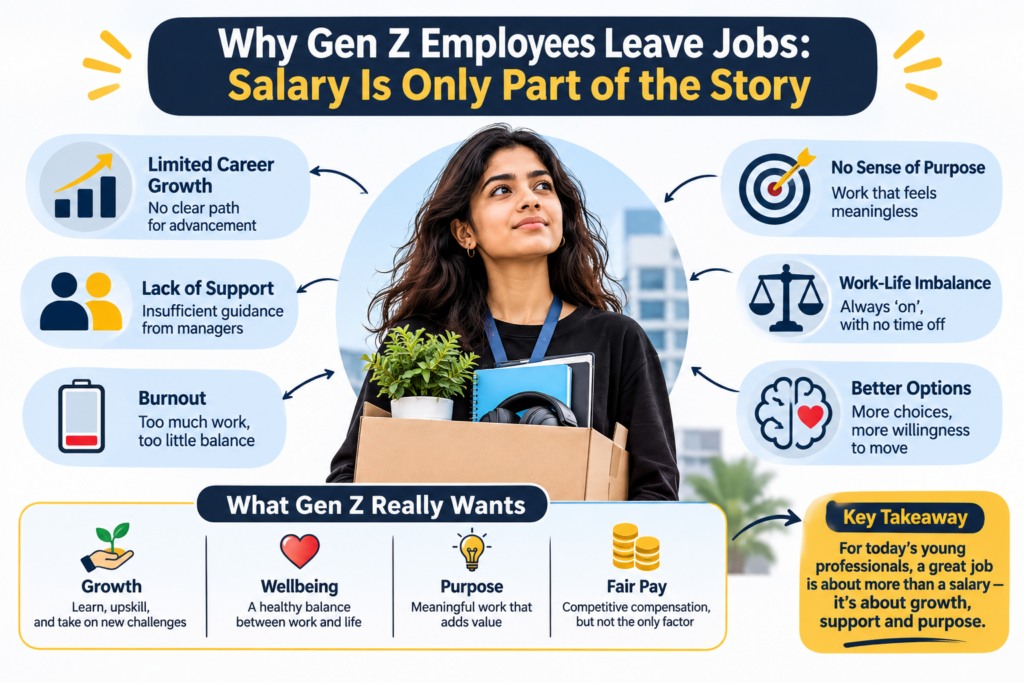
From limited career growth and weak managerial support to burnout and a lack of purpose, young employees are reassessing what makes a job worth staying for.
For years, employee retention has been discussed through a familiar lens: pay people better, offer attractive benefits and give them a reason to stay. Compensation still matters, particularly in a country where financial security remains a major concern for young professionals. But the relationship between employees and employers is becoming more complicated.
A salary increase may persuade someone to accept a job. It may even convince them to stay for another year. But it cannot always compensate for a role in which they are not learning, a manager who offers little guidance, a workplace that leaves them exhausted or a career path that seems to be going nowhere.
For India’s Gen Z workforce, the decision to leave a job is increasingly worth examining beyond the familiar assumption that younger employees are simply less loyal.
The more useful question for employers is not just why young people are leaving, but what they are experiencing before they decide to go.
The salary question is real, but incomplete
It would be misleading to suggest that compensation has become less important. Young professionals are entering the workforce at a time when financial independence, rising living costs and uncertainty about future employment all influence career decisions.
Deloitte’s 2025 Gen Z and Millennial Survey, which included 505 Gen Z respondents and 304 millennials in India, found that 55% of Indian Gen Z respondents were living paycheck to paycheck. Unemployment was the biggest societal concern identified by Indian Gen Z respondents in the survey, cited by 29%.
These findings offer an important counterpoint to the idea that young employees are motivated only by flexibility or personal fulfilment. Financial security remains a fundamental part of their relationship with work.
However, the reasons employees leave can extend beyond the size of their monthly salary. Deloitte’s 2024 global survey found that, among Gen Z respondents globally who had left their previous organisation, insufficient pay was the most frequently cited reason. Other reasons included a lack of career advancement, burnout, concerns about mental health, an unsatisfactory work-life balance and a lack of learning opportunities.
The lesson is not that salary does not matter. It is that compensation is only one part of the employment experience.
When a job stops offering growth
One of the most significant reasons a young professional may begin reconsidering a job is the feeling that their career has stopped moving.
For someone in the early years of a career, a job is not merely a source of monthly income. It is also an opportunity to acquire skills, build professional confidence, understand an industry and become more valuable in the employment market.
A role that initially offers excitement can become frustrating when the work becomes repetitive, responsibilities do not expand and there is little clarity about what comes next.
Deloitte’s 2025 India survey provides a useful perspective. As many as 94% of Gen Z respondents in India said on-the-job learning and practical experience were helpful tools for career growth. Another 91% identified mentorship and guidance from experienced colleagues as helpful.
These are not small expectations. They suggest that young employees see the workplace as an important environment for developing their capabilities.
When learning becomes an occasional training session rather than part of everyday work, the gap between expectation and experience can become difficult to ignore.
The manager may matter more than the company handbook
A company can have a well-designed employee engagement policy, learning programmes and a carefully worded culture statement. But much of an employee’s everyday experience is shaped by one person: their immediate manager.
For a young employee, a manager can be a source of direction, feedback and confidence. They can also become a reason to disengage when expectations are unclear, mistakes are treated harshly or guidance is difficult to access.
The 2025 Deloitte India survey points to a gap worth examining. While 62% of Gen Z respondents believed managers should provide guidance and support to team members, only 44% said this reflected their actual experience. Similarly, 50% believed managers should teach and mentor employees, while 43% said they experienced this in practice.
The gap is not necessarily evidence of poor managers across organisations. It does, however, highlight a mismatch between the support young employees value and what they report receiving.
This becomes especially important during the first few years of employment. A new employee may not always know how to navigate an unfamiliar task, communicate with senior colleagues or recover from a mistake. They need feedback that helps them improve, not simply a performance review several months later.
For employers, this raises a practical question: are managers being trained to lead younger teams, or are they expected to figure it out themselves?
Burnout is not always visible on the resignation letter
Another factor in the retention conversation is the growing importance of workplace well-being.
Long working hours, constant availability, unpredictable workloads and limited control over how work gets done can gradually affect an employee’s relationship with their job. The individual may continue meeting deadlines and attending meetings, even as motivation and energy decline.
Deloitte’s 2025 India findings show that 33% of Gen Z respondents reported feeling stressed or anxious all or most of the time. Among those who identified as stressed or anxious, 36% said their job contributed significantly to those feelings.
The survey also identified long working hours as a major source of workplace stress for Indian Gen Z respondents. Among those who said their job contributed significantly to their stress, 52% identified long working hours as a key factor.
This matters because burnout does not always lead to an immediate resignation. It can first appear as reduced enthusiasm, disengagement, declining participation or a growing desire to look for another opportunity.
An employee may not leave after one difficult week. But when an intense workload becomes the normal operating model, the attraction of another workplace can become stronger.
The question for employers is whether they are identifying the conditions that create stress, rather than treating well-being as a separate activity involving occasional wellness sessions.
Purpose and workplace culture are part of the decision
The idea that employees should find meaning in their work is sometimes dismissed as a luxury, particularly when financial security remains a priority. But purpose does not necessarily mean that every employee expects their job to change the world.
It can be as straightforward as believing in the product being built, feeling that one’s work makes a contribution, being treated fairly or working in an organisation whose actions are consistent with its stated values.
Deloitte’s 2025 survey found that 47% of Gen Z respondents in India had left a job because it lacked purpose. The same survey found that 60% had rejected a potential employer because of personal ethics or beliefs.
These findings suggest that values are not always an abstract consideration reserved for company websites or recruitment presentations. They can influence actual employment decisions.
For an organisation, this creates a challenge. A strong employer brand may attract applicants, but the experience after joining must support the promises made during recruitment. A company that talks about collaboration but rewards internal competition, or promotes employee well-being while normalising excessive workloads, risks creating a credibility gap.
Young employees may be willing to accept demanding work. What becomes harder to accept is a workplace where the stated culture and everyday experience do not match.
Is job-hopping really a sign of disloyalty?
Frequent job changes are often interpreted as evidence that younger employees lack patience or commitment. But that interpretation may overlook how careers are changing.
A professional entering the workforce today is likely to evaluate opportunities through several considerations: compensation, skills, future employability, work environment, flexibility and the possibility of career progression.
Changing jobs can sometimes be a deliberate decision to gain experience, move into a growing industry or secure a role with better long-term prospects. It can also be a response to an unsatisfactory first employment experience.
This does not mean every resignation is justified or that employers should be expected to meet every individual preference. Organisations need continuity, institutional knowledge and employees who are willing to work through challenges.
But retention should not be confused with simply keeping people on the payroll. An employee who stays without learning, feeling valued or seeing a future in the organisation may be present without being meaningfully engaged.
The more useful measure is whether the organisation gives capable people reasons to build their careers there.
What employers need to rethink
The findings point towards a broader retention agenda, one that goes beyond annual salary revisions and employee engagement events.
First, organisations need to make career progression more visible. Employees should understand what skills, responsibilities and outcomes can help them move to the next stage of their careers.
Second, managers need to become more effective mentors. Regular feedback, accessible guidance and opportunities to take on meaningful responsibilities can make a substantial difference to the early-career experience.
Third, workloads and expectations need to be realistic. Flexibility is not simply about where an employee works; it is also about whether they have reasonable control over how they organise their work and personal lives.
Finally, employers need to build credibility between what they promise and what employees experience. Culture is not defined by recruitment campaigns or statements of values. It is shaped by everyday decisions, leadership behaviour and the way people are treated.
The real retention test
Gen Z employees are not necessarily looking for a perfect workplace. They are looking for a workplace in which effort leads somewhere.
They want to earn, but they also want to learn. They want opportunities, but they need guidance to make the most of them. They can accept demanding responsibilities, but not necessarily an environment in which exhaustion becomes a measure of commitment.
Salary will continue to influence whether an employee accepts an offer or considers another one. But the decision to stay is shaped by a much wider experience.
For employers, the retention question may therefore need to change. Instead of asking why young employees are so quick to leave, it may be more useful to ask whether the organisation is giving them enough reasons to stay.
Because retaining Gen Z is not simply about preventing the next resignation. It is about building a workplace in which the next generation can see a future.