

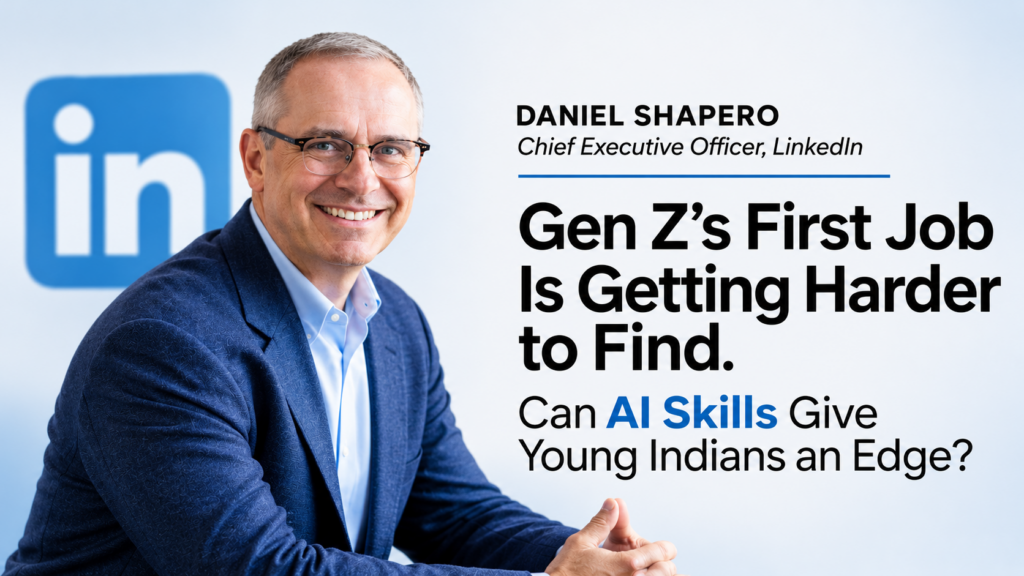
LinkedIn CEO Daniel Shapero describes the job market as “frozen”, acknowledging the growing difficulties facing young professionals entering the workforce. But as employers increasingly look for people who can work with artificial intelligence, could Gen Z’s familiarity with AI become an unexpected career advantage? For India’s students and fresh graduates, the opportunity may be real — but simply knowing how to use ChatGPT may not be enough.
For millions of young people preparing to enter the workforce, getting the first job is becoming an increasingly difficult proposition. Competition is intense, employers are cautious about hiring, and the traditional route from college graduation to an entry-level position is no longer as straightforward as it once seemed.
Now, artificial intelligence is adding another dimension to the challenge.
AI tools can automate tasks that were traditionally assigned to junior employees, from basic research and data processing to content creation and administrative work. At the same time, companies are looking for people who can use these technologies to improve productivity, rethink workflows and solve business problems.
This creates an interesting contradiction for Gen Z. The same technology that could make some entry-level roles more vulnerable might also give younger candidates an advantage when competing for the jobs that remain.
That is the argument put forward by LinkedIn CEO Daniel Shapero, who believes that employers’ perception of younger professionals as being more comfortable with emerging technology could work in their favour.
In an interview with Fortune, published on November 23, 2026, Shapero acknowledged the difficulties facing people at the beginning of their careers.
“It is a frozen job market, and that does make it tougher for people that are earlier in their career for sure,” he told Fortune.
But he also pointed to a potential advantage for younger jobseekers as businesses try to incorporate AI into their operations.
“There is a belief that people that are earlier, maybe they’re more attuned to the latest tech, and they understand how to use AI in their job,” Shapero said.
He added that companies are looking to hire people who can help them “transform how the company operates”.
It is an important observation at a time when the definition of being job-ready is changing. For India’s Gen Z, the question is no longer simply whether they have the right degree or technical qualification. It is increasingly whether they can demonstrate how they will contribute in a workplace where AI is becoming part of everyday business.
The job market is frozen. But AI is creating new expectations
Shapero’s comments reflect a broader shift taking place in the global employment market.
LinkedIn’s October 27, 2026, data release, LinkedIn data shows where opportunity is emerging as work changes, found that the share of job postings requiring AI literacy skills had increased by approximately 65% over the previous 12 months.
The platform also reported that members who listed AI literacy skills on their profiles were 78% more likely to get hired and 11% more likely to receive a promotion than members who did not.
These figures should be interpreted carefully. They show an association between AI skills and employment outcomes, not proof that adding an AI skill to a profile automatically improves someone’s chances of getting hired. Candidates with AI skills may also possess other qualifications and experience that employers value.
Nevertheless, the direction is significant.
AI literacy is moving beyond specialist technology roles. LinkedIn’s data indicates that employers are increasingly seeking these capabilities in professions such as marketing, design, project management, administration and writing.
In other words, a company does not need to be an AI company to expect its employees to understand AI.
A marketing graduate may be expected to use AI for consumer research and campaign development. A finance professional may need to work with AI-assisted data analysis. A designer may be expected to incorporate generative tools into creative workflows. Even an administrative or project management role may involve using AI to organise information, prepare reports and improve efficiency.
For fresh graduates, this means that AI literacy could increasingly become a complementary skill across disciplines rather than a separate career specialisation.
India could be an important part of the opportunity
The Indian employment market offers an especially interesting perspective.
According to LinkedIn’s October 2026 data, entry-level hiring for AI Engineers in India grew by 55% year-on-year. The corresponding growth in the United States was 68%.
LinkedIn also estimated that AI had helped create approximately two million new jobs, with AI Engineer ranking among the fastest-growing occupations across several major economies.
These numbers are encouraging, but they need context. The growth in AI Engineer hiring does not mean that there are enough AI-related vacancies to absorb all the graduates entering India’s workforce. Nor does it suggest that every young person needs to become an AI engineer.
The larger opportunity may lie in the application of AI across existing industries.
India has a large pool of graduates entering careers in business, commerce, engineering, communications, design, finance, marketing and management. As companies adopt AI, they will increasingly need professionals who understand both their respective disciplines and the capabilities of these new tools.
Consider a young marketing graduate who can use AI to analyse customer feedback, identify emerging consumer preferences, prepare campaign ideas and evaluate competing brands. Their advantage is not simply that they know how to generate text or images. It is that they can use technology to approach a business problem more efficiently.
Similarly, an engineering graduate who can use AI-assisted coding tools but also understands software architecture, testing and product requirements brings a different level of value from someone who simply knows how to generate code.
The distinction is important: AI tools may make certain tasks easier, but employers still need people who understand what the task is trying to achieve.
Are Gen Z really AI natives?
The term ‘AI native’ is increasingly used to describe younger people who have grown up with digital technology and are comfortable experimenting with new platforms.
But being digitally native does not automatically mean being AI proficient.
A student who uses ChatGPT to summarise lecture notes, prepare assignments or generate presentation ideas may be familiar with AI. That does not necessarily mean they know how to use it responsibly in a professional environment.
There is a difference between asking an AI tool to write a marketing plan and understanding the consumer, business objective, target audience and market context behind that plan.
There is also a difference between generating code and knowing whether the code is secure, efficient and fit for purpose.
Employers are unlikely to be impressed by a candidate simply listing several AI tools on their CV. They will want to know what the candidate can actually do with them.
This is where Gen Z has an opportunity to turn familiarity into a genuine professional advantage.
Instead of presenting themselves as people who know how to use AI, young candidates should be able to demonstrate how they have used it to solve problems, improve processes or produce better outcomes.
The advantage will belong less to those who use the most tools and more to those who understand when, why and how to use them.
The new employability test: Can you demonstrate what you can do?
For a long time, the first job application was largely built around academic qualifications, internships, grades and a CV listing skills.
Those things still matter. But as AI makes it easier to produce certain kinds of work, employers may increasingly look for evidence of how candidates think, make decisions and apply their knowledge.
A fresh graduate interested in marketing, for instance, could create a small portfolio demonstrating how they used AI to research a category, analyse customer reviews, identify a consumer insight and develop a campaign proposal.
A finance student could demonstrate how they used AI-assisted tools to organise a dataset, identify trends and prepare an analysis, while explaining how they checked the accuracy of the output.
An aspiring software developer could showcase a working application, explain the role AI played in building it and demonstrate that they understand the underlying code.
These examples are not substitutes for professional experience. But they can give employers something more tangible than a list of tools on a résumé.
The same principle applies to students from non-technical backgrounds. AI is not exclusively an engineering opportunity. Understanding how to apply it to a particular profession may become one of the most useful differentiators for early-career talent.
There is, however, another skill that cannot be overlooked: judgement.
AI systems can generate incorrect information, reproduce biases and produce convincing answers that are not necessarily accurate. A professional who can question the output, verify information, protect confidential data and take responsibility for the final work is likely to be more valuable than someone who accepts every AI-generated answer at face value.
The networking paradox: Digitally connected, professionally disconnected
Shapero’s advice to young jobseekers extends beyond technology.
In the same Fortune interview, he argued that applying for jobs is no longer enough and that building professional relationships is becoming an increasingly important part of the hiring process.
He advised young people to connect with professionals at companies they would like to work for, seek career advice and build relationships that could lead to further introductions.
He compared the process to raising money for a startup. Founders would not simply email a long list of investors and wait for someone to respond. They would try to meet people, build relationships and seek introductions.
The same approach, he suggested, can help jobseekers.
This is particularly relevant to Gen Z, a generation that spends much of its time connected through digital platforms but may not always feel confident initiating professional conversations.
LinkedIn’s September 2, 2026, research, based on a Censuswide survey of more than 18,000 working professionals across 12 markets including India, found that 72% of Gen Z professionals felt disconnected from people who could help advance their careers.
The reasons were revealing. Some 37% worried about bothering others, an equal proportion feared being judged, and 34% were concerned about sounding inauthentic.
Nearly two-thirds said nobody had clearly shown them how to build professional relationships. At the same time, 83% of Millennial and Gen X professionals surveyed said they would be willing to help someone at the beginning of their career, even if they did not know them personally.
The findings point to an interesting gap between the availability of professional networks and young people’s confidence in using them.
For students and fresh graduates, networking does not have to mean sending generic messages asking for jobs. It can begin with following professionals in an industry, asking thoughtful questions, attending industry events, participating in communities and learning from people already doing the work they aspire to do.
AI may help a candidate become more productive. But a conversation with someone who understands an organisation can help them discover opportunities that never make it to a job portal.
Five ways Gen Z can turn AI familiarity into a career advantage
For young Indians preparing to enter the workforce, the opportunity is to move from simply experimenting with AI to demonstrating professional capability.
1. Move beyond prompting.
Learn to use AI to complete actual tasks. Understand how it can support research, analysis, coding, design, communication and problem-solving rather than treating it as a shortcut for generating answers.
2. Build a portfolio of work.
Create projects that demonstrate how you have applied AI to real or simulated business problems. A practical example of your work can make your skills easier for an employer to evaluate.
3. Combine AI with domain knowledge.
An AI-skilled marketing graduate still needs to understand consumers and brands. A finance professional needs to understand numbers and risk. A designer needs to understand visual communication. AI becomes more valuable when combined with expertise in a particular field.
4. Learn to question AI output.
Develop the ability to verify facts, identify errors, recognise bias and protect sensitive information. Critical thinking and accountability remain essential even when technology does much of the execution.
5. Build relationships, not just profiles.
Use professional platforms to learn from people in your chosen industry. Reach out with specific questions, participate in professional communities and develop genuine connections. Do not make your job search entirely dependent on online applications.
The first job may be harder to find. The definition of being job-ready is changing.
There is a danger in interpreting the AI opportunity as a guarantee that Gen Z will have an easier time finding employment.
The entry-level job market remains challenging. AI could also reduce the need for certain routine tasks that traditionally gave fresh graduates their first professional experience. Companies may expect fewer people to accomplish more, using technology to improve productivity.
This raises a difficult question for employers as well: if AI takes over some of the work through which young professionals traditionally gained experience, how will the next generation develop the judgement, problem-solving abilities and practical knowledge needed to progress?
For India’s colleges and universities, the challenge is equally important. Preparing students for the workplace will require more than adding an AI module to the curriculum. Young people need opportunities to apply technology to real-world problems, work in teams, communicate ideas and understand how businesses operate.
For employers, the opportunity is to look beyond conventional definitions of entry-level talent and recognise candidates who bring curiosity, adaptability and the ability to learn new technologies.
And for Gen Z, perhaps the most important shift is in how they approach their own careers.
Being comfortable with technology may help open a door. But the ability to think critically, understand a business problem, communicate clearly, demonstrate practical skills and build professional relationships is what may help them walk through it.
Daniel Shapero’s observation is therefore less a promise of an AI-powered employment advantage and more an invitation to rethink what young candidates bring to the workplace.
The job market may be frozen. But the expectations of employers are changing.
For India’s Gen Z, the opportunity is not simply to be the generation that grew up with AI. It is to become the generation that knows what to do with it.