
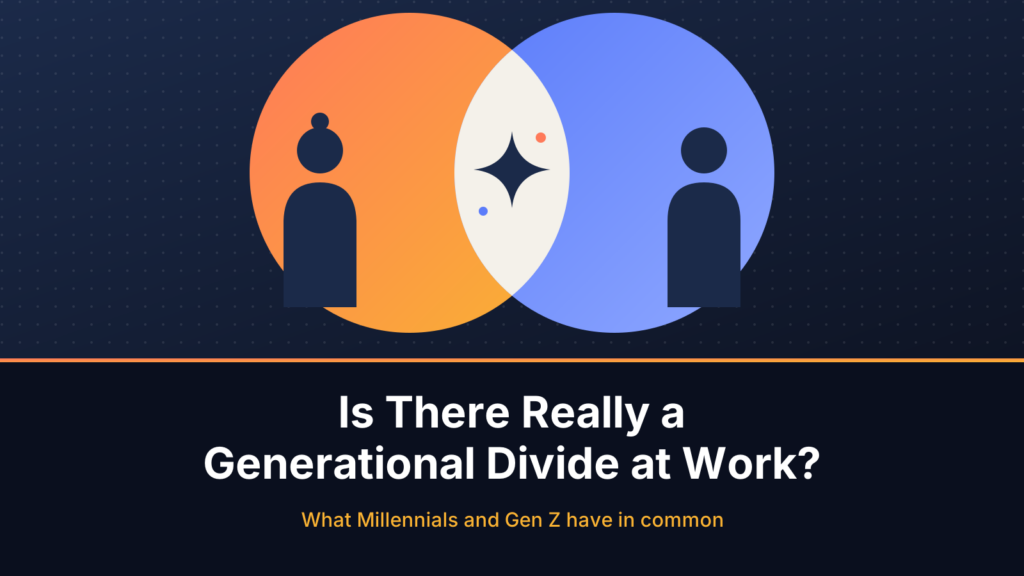
Often portrayed as two generations with very different expectations, Millennials and Gen Z may have more in common at work than employers realise. From career growth and financial security to purpose, well-being and the adoption of AI, their priorities are increasingly converging.
A familiar workplace conversation plays out in many organisations. Millennials are described as ambitious professionals who grew up with the internet, adapted to corporate structures and worked their way towards leadership positions. Gen Z, meanwhile, is often characterised as a generation that wants flexibility, faster growth, greater purpose and a different relationship with work.
The contrast makes for an easy narrative. It also risks overlooking something important: the two generations may not be as different as the stereotypes suggest.
Both entered the workforce during periods of significant economic and technological change. Millennials experienced the expansion of the internet, smartphones and the digital economy during their formative working years. Gen Z entered a workplace already shaped by digital platforms, remote collaboration and, increasingly, artificial intelligence.
Their career stages may differ, but many of their expectations are remarkably similar. They want financial stability, opportunities to develop skills, supportive managers, meaningful work and a life outside their jobs.
The latest Deloitte Global Gen Z and Millennial Survey 2026, including responses from 506 Gen Z and 300 millennial professionals in India, offers an opportunity to examine this overlap more closely.
Rather than asking which generation is changing the workplace, perhaps employers should ask whether they are responding to the priorities that both generations increasingly share.
The pursuit of purpose is not exclusive to Gen Z
One of the most common assumptions about younger employees is that Gen Z places a greater emphasis on purpose, values and social impact, while older professionals are more likely to prioritise compensation and career advancement.
The evidence suggests that this distinction may be overstated.
According to Deloitte’s 2026 India survey, 99% of Gen Z respondents and 98% of millennials said having a sense of purpose was important for job satisfaction.
The difference is marginal.
Both generations also appear willing to make employment decisions based on their beliefs. The survey found that 48% of Gen Z and 41% of millennial respondents in India had rejected a potential employer because of personal ethics or beliefs.
These findings suggest that purpose is not simply a Gen Z workplace demand. It is an expectation shared across both generations.
The idea of purpose, however, does not have to mean that employees expect every organisation to solve a major social problem. It can involve believing in the work being done, understanding how one’s contribution matters, being treated fairly and seeing consistency between an organisation’s stated values and its actions.
For employers, the implication is significant. Building a credible workplace culture is not about appealing to one age group. It is about creating an environment in which people across career stages can see value in what they do.
Both generations want financial security
The image of Gen Z as a generation driven primarily by flexibility and experiences can sometimes obscure the economic realities shaping its career choices.
Financial independence remains an important consideration for young professionals. But this is hardly unique to them.
Deloitte’s 2026 India survey found that 54% of Gen Z respondents and 44% of millennials had delayed major life decisions because of their financial situation.
Housing affordability also influenced career decisions for more than 60% of respondents across both generations.
The figures highlight a shared concern: employment is not just about professional identity or personal fulfilment. It is also about being able to afford a home, plan for the future, support family responsibilities and make major life decisions with some confidence.
There are differences in the degree of financial pressure. In the same survey, 20% of Gen Z respondents and 13% of millennials said they struggled to pay their living expenses each month.
But the broader point remains that financial security is a common priority.
This also challenges the assumption that younger employees are unwilling to commit to organisations. When economic pressures influence decisions about housing, family and future plans, stability becomes an important part of the employment proposition.
Career growth matters, but the definition is changing
Another area where the two generations converge is professional development.
The traditional idea of career progression often follows a familiar sequence: join an organisation, gain experience, receive promotions and gradually move into leadership.
That pathway still matters, but it is no longer the only way employees measure progress.
Deloitte’s 2025 India survey found that 94% of Gen Z respondents considered on-the-job learning and practical experience helpful for career growth. The figure among millennials was even higher, at 97%.
The same survey found that 91% of Gen Z and 94% of millennial respondents considered mentorship and guidance from experienced colleagues helpful.
The difference is small, and the underlying message is clear: both generations value learning that helps them become better at their work.
This is particularly relevant as industries undergo technological change. A marketing professional may need to understand data analytics and AI-assisted content tools. An engineer may need to develop new capabilities as software development practices evolve. A finance professional may need to become comfortable working with automation and advanced analytical systems.
For employees at different career stages, the learning requirement may be different, but the need to keep developing is shared.
Organisations that treat learning and development as a Gen Z-specific expectation may therefore be missing a much wider workforce priority.
AI is becoming a common workplace language
Perhaps one of the clearest examples of generational convergence is the adoption of artificial intelligence.
There is a tendency to associate Gen Z with technology adoption and assume that millennials may be slower to adapt. But the latest Deloitte India findings suggest that both generations are integrating AI into their everyday work.
The 2026 survey found that 93% of Gen Z respondents and 95% of millennials in India were using AI in their day-to-day work.
The difference is just two percentage points.
Both groups also reported positive effects from AI on their professional and personal lives. More than 90% of respondents across the two cohorts said AI had a positive impact.
The applications may differ slightly. Gen Z respondents most commonly reported using GenAI for design, content creation and data analysis, while millennials most frequently cited data analysis, content creation and project management.
But the larger development is that AI is becoming a shared workplace capability rather than the defining technology of one generation.
This has implications for organisations. Instead of treating digital transformation as a process in which younger employees teach older colleagues, companies could encourage cross-generational learning.
Millennials may bring experience in managing projects, clients, teams and business processes. Gen Z employees may bring exposure to newer platforms, tools and digital behaviours. Both can learn from each other.
The opportunity is to combine these strengths rather than turn technology adoption into a generational competition.
Leadership is not necessarily the ultimate career goal
Another assumption is that millennials are more interested in traditional career advancement, while Gen Z is less interested in management responsibilities.
The 2026 Deloitte findings complicate this narrative.
In India, 96% of Gen Z respondents and 93% of millennials expressed interest in senior leadership roles. Interest in supervisory or management positions was also high, at 89% and 87%, respectively.
However, only 9% of Gen Z and 8% of millennials identified senior leadership as their primary career goal.
This distinction matters.
Employees may be interested in leadership without wanting to pursue it at any cost. The responsibility, workload and personal trade-offs associated with senior roles can influence whether they see management as the right next step.
For many professionals, becoming a specialist, gaining expertise or achieving financial independence may be just as important as managing a large team.
This is a useful reminder for organisations that often equate ambition with promotions. Career development needs to accommodate different paths, including specialist, technical, managerial and entrepreneurial trajectories.
The workplace relationship matters to both
The idea that Gen Z wants a fundamentally different workplace experience from millennials also deserves closer examination.
Flexibility, supportive colleagues, work-life balance and a sense of belonging are often presented as newer expectations associated with younger employees.
Yet these are not necessarily new needs. What may have changed is how openly employees communicate them and how much importance they place on organisations delivering them.
Deloitte’s 2026 India findings indicate that workplace relationships remain important across both generations. Around 79–80% of respondents considered colleagues to be friends.
The survey also found that employees with workplace friendships were more likely to say they intended to stay longer and reported higher levels of happiness.
This is an important finding because it places human connection at the centre of workplace experience.
A supportive team, approachable manager and sense of belonging can matter whether someone is in their first job or has spent more than a decade in the workforce.
The difference may lie in how employees expect organisations to create these experiences. Gen Z may be more vocal about flexibility and feedback, while millennials may be balancing those expectations with leadership responsibilities, family commitments and longer-term financial planning.
But the underlying need for a healthy working environment is shared.
Where the differences still matter
Recognising common ground does not mean pretending that generational differences do not exist.
Gen Z and millennials are at different stages of their professional and personal lives. A recent graduate may be trying to understand workplace expectations, build confidence and acquire basic professional skills. A millennial with a decade of experience may be managing teams, supporting a family or considering a move into senior leadership.
Their immediate priorities, financial responsibilities and expectations from employers can therefore differ.
There may also be differences in how they communicate, approach technology, seek feedback and define professional identity.
But these differences should not automatically be interpreted as evidence of incompatible workplace values.
A young employee asking for frequent feedback is not necessarily unwilling to take responsibility. A millennial seeking greater flexibility is not necessarily less ambitious. Someone who does not want a management role may still be highly committed to their profession.
The risk for employers is that generational labels become shortcuts for understanding people. Once that happens, organisations may start designing policies around assumptions rather than actual employee needs.
The opportunity for employers: Build workplaces for people, not generations
The findings point towards a more useful way of thinking about workforce management.
Instead of designing separate workplace cultures for Gen Z and millennials, organisations could focus on the conditions that help employees across age groups perform and progress.
These include transparent career pathways, access to continuous learning, supportive managers, fair compensation, meaningful responsibilities and sustainable workloads.
Managers should also be encouraged to understand employees as individuals rather than assume that age determines what motivates them.
A young professional may value financial stability more than flexibility. An experienced employee may want to learn new AI tools or move into a different function. Both may want opportunities to grow without sacrificing their personal lives.
Organisations also need to create opportunities for reverse mentoring and cross-generational collaboration. Younger employees can share knowledge of emerging tools and digital behaviours, while experienced colleagues can offer institutional knowledge, industry understanding and professional guidance.
This is not about one generation correcting the other. It is about recognising that different experiences can strengthen the same organisation.
Perhaps the generational divide is smaller than the workplace conversation suggests
For years, employers have been encouraged to understand Gen Z as a new kind of employee with a different set of expectations. Some of that change is real. The way people communicate, learn, use technology and approach careers continues to evolve.
But the latest evidence from India suggests that many of the priorities associated with Gen Z are also shared by millennials.
Both want financial security. Both value purpose. Both are using AI. Both want opportunities to learn and progress. Both place importance on workplace relationships and well-being.
The differences are more likely to emerge from career stage, personal circumstances and individual expectations than from generation alone.
For employers, this should be an encouraging development. It means they do not necessarily need to reinvent the workplace for every new generation entering it.
They need to build organisations that recognise changing expectations, support people at different stages of their careers and create opportunities for employees to grow together.
Perhaps the real workplace divide is not between Gen Z and millennials. It is between organisations that understand what their people need and those that continue to manage employees through generational stereotypes.