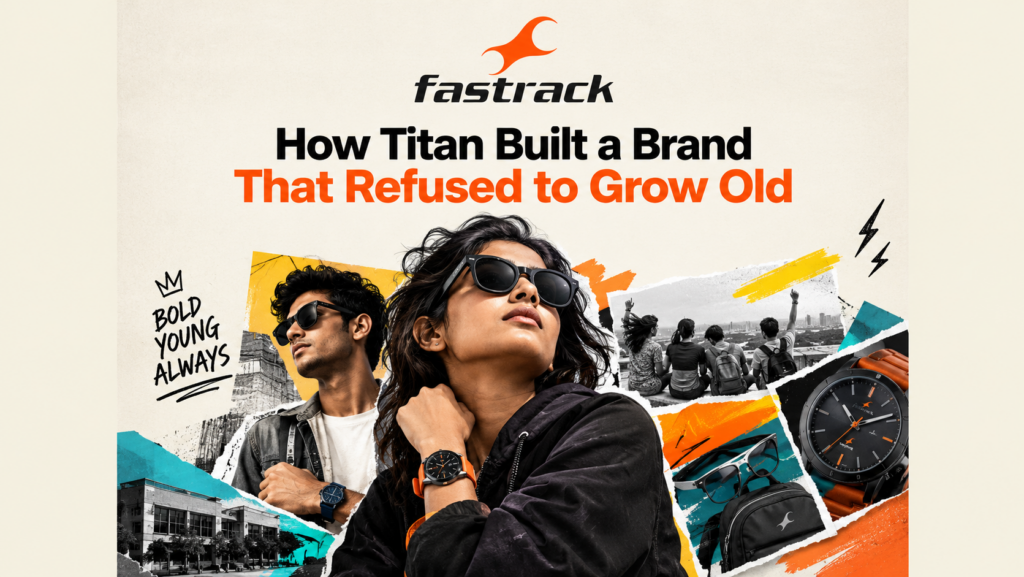
Born inside one of India’s most established consumer companies, Fastrack has spent more than two decades doing something surprisingly difficult: staying culturally relevant to each new generation without losing the attitude that made the brand different in the first place.
There is something almost contradictory about Fastrack.
Its parent company, Titan, is one of India’s most established consumer brands. Titan represents watches, craftsmanship, trust, precision and, for many Indian families, the moment when a watch becomes a meaningful gift.
Fastrack was something else.
It was louder.
Younger.
More irreverent.
More fashion-conscious.
And, importantly, it was never particularly interested in behaving like the brand that created it.
That may be one of the most interesting things about Fastrack’s story.
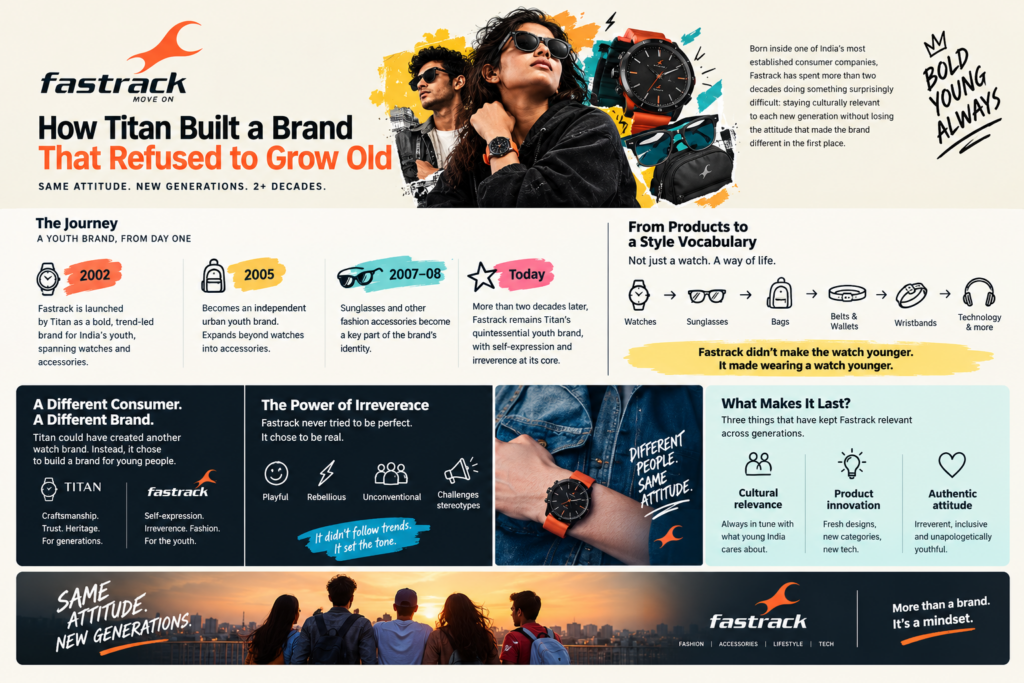
In 2002, Titan formally launched Fastrack as a bold, trend-led brand for India’s youth, spanning watches and accessories. Titan’s own heritage archive describes the launch as an attempt to create a distinct proposition for a younger consumer.
More than two decades later, Fastrack remains positioned by Titan as its quintessential youth brand, with self-expression and irreverence at its core.
The products have changed.
The technology has changed.
The consumer has changed.
But the attitude has remained remarkably consistent.
And that is what makes Fastrack worth studying.
The watch stopped being just a watch
For generations, the fundamental question a watch answered was simple:
What time is it?
But fashion changed that equation.
Once mobile phones made checking the time almost effortless, the traditional functional reason for wearing a watch became less important for many consumers.
The watch had to become something else.
An accessory.
A piece of style.
A signal of personality.
A part of an outfit.
Fastrack understood that transition early.
It did not necessarily need to convince a young person that they needed another way to tell time.
It needed to convince them that they wanted something on their wrist that looked and felt like them.
That distinction became central to the brand.
Titan’s current description of Fastrack talks about trendy, eye-catching designs aimed at bold and fashion-forward consumers, while placing self-expression at the heart of the brand.
In other words:
Fastrack did not make the watch younger. It made wearing a watch younger.
A youth brand inside a legacy company
There is an even bigger lesson hidden in Fastrack’s origins.
Titan did not need another watch brand.
It needed a different relationship with a different consumer.
That is an important distinction.
A corporate portfolio can contain multiple brands competing in the same broad category while playing completely different cultural roles.
Titan could own the world of traditional watchmaking while Fastrack occupied the world of youth fashion.
That separation allowed the two brands to coexist without having to speak in the same voice.
And Fastrack’s independence became part of its appeal.
Titan’s own historical material records that Fastrack became an independent urban youth brand in 2005. The brand subsequently expanded into accessories, while its portfolio increasingly moved beyond watches.
The strategy was clear:
Don’t simply sell a younger watch.
Build a brand for young people.
That sounds simple today.
In the early 2000s, it was considerably more distinctive.
From wristwear to a style vocabulary
Fastrack’s evolution beyond watches is perhaps the clearest evidence that the brand was never really about watches alone.
Titan expanded Fastrack into sunglasses, and later into bags, belts, wallets and wristbands. By 2007–08, Titan’s annual report was already describing Fastrack as a youth brand expanding into other categories, with sunglasses becoming a significant part of its proposition.
This matters because it changed the fundamental question.
If Fastrack understood how young consumers wanted to express themselves on their wrists, perhaps it could help them express themselves elsewhere too.
Eyewear.
Bags.
Accessories.
Eventually, technology.
The brand was moving from product to style vocabulary.
That is a very different kind of expansion.
A watch company asks:
What else can we put on the wrist?
A lifestyle brand asks:
What else can we help our consumer express?
Fastrack increasingly belonged to the second category.
Irreverence became an asset
Another reason Fastrack survived multiple generations is that it did not try to make youthfulness synonymous with perfection.
The brand’s personality has consistently leaned towards the unconventional, playful and slightly rebellious.
Titan describes Fastrack today as a brand that pushes boundaries, challenges societal stereotypes and encourages open-mindedness.
That attitude has appeared repeatedly in its communication.
Fastrack’s campaigns have often taken a deliberately unconventional route rather than relying purely on traditional fashion imagery. Its eyewear communication, for instance, used humour and the idea of sunglasses being “necessary, not accessory” to make a functional point through the brand’s characteristic quirkiness.
That is an important piece of brand architecture.
Humour is not simply decoration.
It becomes recognition.
A consumer may forget the technical specifications of a watch.
They may not forget how a brand made them feel.
And then the consumer changed again
The most difficult thing about building a youth brand is that youth keeps moving.
The 18-year-old consumer of 2002 is not the 18-year-old consumer of 2026.
Their entertainment is different.
Their technology is different.
Their cultural references are different.
Their relationship with fashion is different.
Even the meaning of “cool” has changed.
So a youth brand has two choices.
It can keep changing until it becomes unrecognisable.
Or it can keep its core attitude while changing the way that attitude is expressed.
Fastrack appears to have chosen the second route.
The brand’s underlying proposition — individuality, boldness, self-expression — remains recognisable.
But the canvas keeps changing.
That may be the secret.
Fastrack has not tried to preserve a particular version of youth. It has tried to preserve an attitude towards youth.
From analog cool to fashion-tech
The next major shift came when the watch itself changed.
Smartwatches created a completely different category.
Now the device on your wrist could track activity, display notifications, monitor health metrics, interact with your phone and become part of your digital life.
Fastrack entered smart wearables with Fastrack Smart, whose journey began in 2017. Titan describes the sub-brand as an intersection of fashion, technology, innovation, style and affordability.
But this created a branding challenge.
Smartwatches were increasingly becoming technology products.
Fastrack had spent years establishing itself as a fashion brand.
How could it make technology feel like Fastrack?
The answer was not to abandon the brand’s identity.
It was to bring that identity into technology.
The “Follow Yourself” campaign for Fastrack Smart, launched with Ranveer Singh, positioned the product around individuality and the idea of young consumers following their own path.
The proposition was therefore consistent.
The object had changed.
The attitude had not.
Now, even the watch is learning
The latest chapter takes that evolution one step further.
In 2026, Fastrack introduced MYND, an AI-powered smartwatch designed for what Titan calls India’s AI-savvy generation.
The product combines AI-enabled personalisation and contextual reminders with health and fitness features and customisable watch faces. Titan positions the product not simply as a functional wearable, but as another form of personal expression.
That is a fascinating endpoint for a brand that started with fashion watches.
First, the watch told you the time.
Then it became part of your outfit.
Then it became a smart device.
Now it can use AI to become more personalised to the person wearing it.
The category has changed almost completely.
But the underlying Fastrack proposition can still be recognised:
Make technology feel like an extension of the individual.
The brand has also learned to keep moving with culture
Fastrack’s recent product and campaign choices suggest that the brand continues to look for cultural spaces where younger consumers are spending attention.
Its recent portfolio has included collections and collaborations connected to music, motorsport and contemporary youth interests. Titan’s FY26 earnings presentation, for example, highlights Fastrack’s WILD collection and an Overdrive collaboration with Red Bull Moto Jam, alongside a broader push into youth-led watch segments.
This is important because cultural relevance rarely comes from one permanent campaign.
It comes from repeatedly finding the places where the consumer’s attention is moving.
Music today.
Motorsport tomorrow.
AI after that.
The product changes.
The conversation changes.
The brand needs to keep listening.
The hardest problem for any youth brand
And this is where the Fastrack story becomes more interesting than a simple success story.
Because there is an uncomfortable question hiding underneath it:
Can a brand remain young without trying too hard to look young?
That is one of the hardest problems in marketing.
A brand can use slang.
It can hire young celebrities.
It can create memes.
It can launch on Instagram.
It can collaborate with musicians.
None of those things automatically make a brand culturally young.
Youthfulness is not a visual identity.
It is a relationship with change.
Fastrack’s advantage is that its core identity was never simply “being young.”
It was being unapologetically yourself.
That distinction gives the brand room to evolve.
A 2005 Fastrack consumer could express that through a chunky watch.
A 2015 consumer could do it through sunglasses.
A 2023 consumer could do it through a smartwatch.
A 2026 consumer can do it through an AI-powered wearable.
The expression changes.
The underlying desire remains.
The bigger lesson
There is a tendency to think that legacy companies have to create completely separate businesses to remain relevant to younger consumers.
Fastrack offers another possibility.
Sometimes the answer is not to make the parent brand younger.
It is to create a new brand that is allowed to be young in its own way.
Titan did not need to become Fastrack.
It needed Fastrack to become Fastrack.
That separation gave the brand permission to be irreverent, fashion-led, experimental and culturally responsive while still benefiting from the capabilities of a much larger organisation.
And perhaps that is why Fastrack has remained relevant for more than two decades.
Not because it discovered the secret to eternal youth.
But because it understood something more useful:
Youth is not an age. It is an attitude towards change.
The consumer who buys a Fastrack watch today is not the same consumer who bought one twenty years ago.
The culture is not the same.
The technology is not the same.
The meaning of fashion is not the same.
And yet the brand can still feel familiar.
That may be Fastrack’s greatest achievement.
It did not refuse to grow old by pretending that time had stopped.
It refused to grow old by changing with the people who were living in it.
And perhaps that is the real lesson for every brand trying to remain relevant to the next generation:
Don’t try to stay young. Stay willing to change.
Because generations move on.
Brands that move with them have a chance to stay in the conversation.