
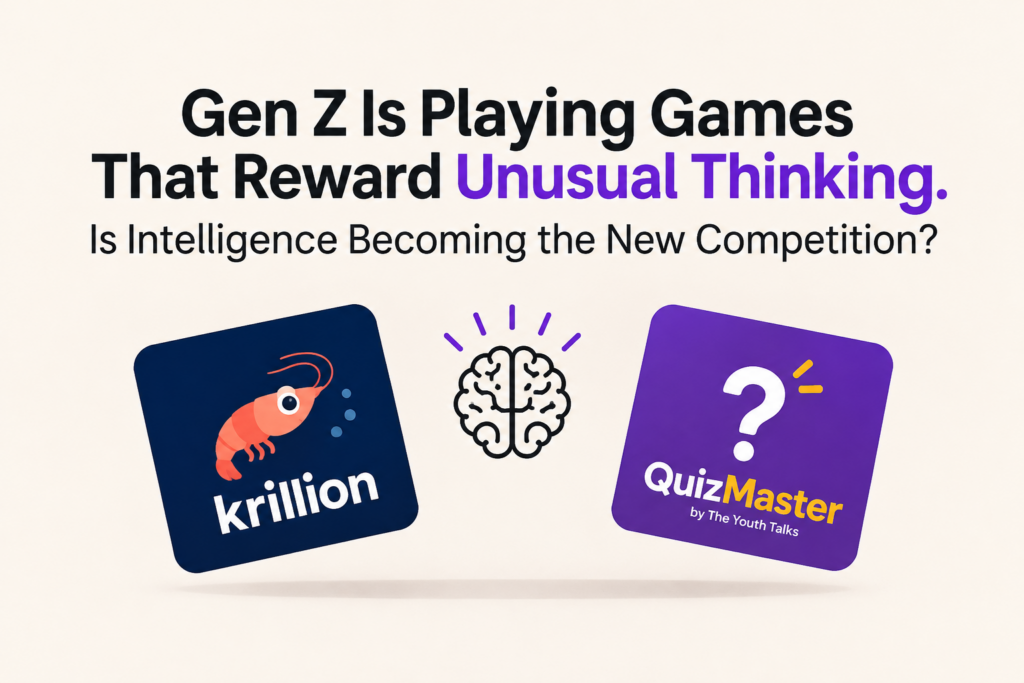
From viral word games such as Krillion to competitive quizzing platforms, a new generation of digital games is putting a premium on curiosity, originality and knowledge. Is the next big gaming trend less about winning and more about demonstrating how you think?
For years, casual games have competed for young people’s attention through familiar mechanics: beat the clock, solve the puzzle, cross the next level or score higher than your friends. But a new breed of online games is experimenting with a slightly different proposition. Instead of simply asking players to get the right answer, they reward them for coming up with an answer that very few other people would think of.
One game attracting attention around this idea is Krillion, a browser-based trivia game that has begun circulating across online youth communities. Its premise is deceptively simple. Players are presented with seven questions every day and have 25 seconds to answer each one. But there is a twist: the game isn’t merely looking for correct answers. It wants the rarest correct answers.
Asked to name an object with a lens, for instance, a player typing ‘camera’ might receive a relatively modest score. Someone thinking of an ‘endoscope’ could earn considerably more. Both answers are correct, but one demonstrates a less obvious association.
The objective is to think beyond the first answer that comes to mind.
The game’s scoring system rewards uncommon responses, with higher scores allowing players to take their virtual krill deeper into the ocean. Its daily format, time pressure and competitive scoring give it the familiar mechanics of a casual trivia game, while its emphasis on unusual answers introduces a different dimension.
The appeal is worth examining, particularly at a time when young audiences are surrounded by an almost limitless supply of digital entertainment. Could games that challenge people to think differently offer a compelling alternative to the familiar cycle of scrolling, watching and consuming?
Beyond Getting the Answer Right
The most interesting aspect of Krillion is not necessarily its trivia format. It is the way it changes the definition of a good answer.
Traditional trivia games reward knowledge. You either know the capital of a country, remember the name of an actor or recognise a historical event, or you don’t. Word games such as Wordle reward pattern recognition, vocabulary and the ability to solve a problem within a limited number of attempts.
Krillion introduces another variable: the popularity of an answer.
Knowing that an animal eats fish is useful, but naming an animal that does so regularly and is unlikely to be the first choice of most players is potentially more rewarding.
This turns the game into an exercise in association, recall and lateral thinking. Players must consider what they know, search their memory for less obvious possibilities and make a decision before the clock runs out.
There is an interesting distinction here between being knowledgeable and being original. A player may know dozens of possible answers, but the challenge is to identify the one that is both correct and uncommon.
In an environment where information is increasingly accessible through search engines and AI-powered tools, the ability to make unexpected connections is an interesting proposition for game designers.
Of course, a trivia game cannot measure intelligence in any comprehensive sense. A high score may reflect niche knowledge, familiarity with a subject or simply a lucky association. But the format does reward a particular kind of thinking: the ability to move beyond obvious answers.
And that may be precisely what makes it engaging.
The Psychology of Thinking Differently
There is a psychological dimension to this form of competition that deserves attention.
Most competitive games establish a visible hierarchy. Someone finishes first, achieves the highest score or completes a challenge faster than everyone else. The reward is usually linked to performance against a common benchmark.
Games such as Krillion introduce a more individualised measure of achievement. The player is not simply trying to know more than someone else. They are trying to demonstrate that they can think of something others might overlook.
That distinction can be rewarding.
Finding an unusual answer creates a small moment of personal discovery. It is the satisfaction of remembering something obscure, making an unexpected connection or approaching a familiar question from a different direction.
It also introduces an element of surprise. A player might be confident about an answer, only to discover that thousands of others have thought of exactly the same thing. Another seemingly obscure response could produce a much higher score.
This unpredictability can encourage experimentation.
There is also a social dimension. Sharing an unusual answer with friends becomes a way of demonstrating knowledge, humour or individuality. The conversation is no longer limited to who scored the highest. It can revolve around who came up with the most unexpected response.
For younger audiences navigating social environments where personal expression and identity are important, this kind of recognition could have its own appeal.
However, it would be premature to conclude that Gen Z is abandoning conventional gaming in favour of intellectual challenges. The more interesting possibility is that young players are open to multiple forms of entertainment, including games that offer a different kind of mental engagement.
The Daily Engagement Loop: Seven Questions, One Habit
Krillion also demonstrates how relatively simple game mechanics can encourage repeat participation.
Its daily format is central to the experience. Everyone receives the same seven prompts, and the questions change after 24 hours. Players have a limited window to participate before the next challenge arrives.
This creates a familiar engagement mechanism: anticipation.
The format has similarities to daily puzzles and word games that have successfully built routines around a single daily challenge. Rather than offering an endless supply of levels, they give players a reason to return at a particular time.
The 25-second response window adds urgency. Players cannot spend several minutes researching every possible answer. They must rely on memory, instinct and quick associations.
There is also a potential social feedback loop. If friends are discussing their scores or sharing an unusually high-scoring answer, others may feel encouraged to participate before the day’s questions disappear.
This is where FOMO, or the fear of missing out, enters the picture.
The combination of limited availability, shared prompts and score comparisons can make a relatively small game feel like a collective daily event.
For digital product designers, there is a useful lesson here. Engagement does not always require an infinite content feed, elaborate rewards or increasingly complicated features. Sometimes, a clearly defined daily experience can be enough to encourage repeat visits.
The challenge, of course, is sustaining that interest after the novelty wears off.
India’s Own Experiment: Can Knowledge Become a Social Game?
The emergence of games such as Krillion also raises an interesting opportunity in India, where digital entertainment platforms are increasingly exploring ways to make participation more engaging.
One such experiment is QuizMaster, a new quizzing platform launched by The Youth Talks, designed around the interests and knowledge of Gen Z.
Rather than limiting itself to conventional general knowledge, QuizMaster covers subjects ranging from technology, money and finance to sports, brands, fashion, social media, health, wellness and entertainment. Its proposition is straightforward: users take short quizzes, earn points for correct answers, collect achievement badges and compete for a place on a weekly leaderboard.
Each quiz features 10 questions, with faster correct answers earning additional points. The leaderboard resets every Monday, with the top three participants recognised at the end of the week.
The idea is to make knowledge-based participation feel less like an examination and more like a social competition.
There is an interesting distinction between this model and Krillion. While Krillion rewards players for coming up with uncommon answers, QuizMaster rewards knowledge, accuracy and speed. Both, however, build their experience around active participation rather than passive content consumption.
For The Youth Talks, the larger ambition is to explore whether quizzing can become a recurring digital habit among young Indians, supported by familiar interests, competitive recognition and community participation.
Its emerging Quizmaster programme, which allows selected community creators to develop quizzes for the platform, could also introduce a participatory dimension, bringing colleges, subject enthusiasts and youth communities into the content creation process.
There is also scope to extend the experience beyond individual participation. College-level leaderboards, inter-campus quiz competitions and themed challenges could potentially turn a simple online quiz into a wider youth engagement activity.
Whether this model can build sustained engagement will depend on the quality and frequency of new quizzes, the strength of its community and the platform’s ability to give users a reason to return.
But the underlying proposition is worth exploring: in an entertainment environment dominated by short videos and endless scrolling, could a generation of young people also be persuaded to compete over what they know?
An Opportunity for the Gaming Industry
For gaming companies, the larger opportunity may lie in the design philosophy behind games such as Krillion and emerging quizzing platforms.
Casual gaming has become a competitive market. Developers are constantly looking for ways to attract users, encourage repeat engagement and build communities around relatively simple experiences.
Yet not every successful game needs sophisticated graphics, extensive storylines or large development teams.
Krillion’s reported origins are interesting in this context. According to Fast Company, its creator operates under the pseudonym ‘kp’ and describes himself as a 23-year-old American computer science graduate. The game is reportedly run by a one-person team.
Its emergence illustrates how independent developers can experiment with simple ideas and reach audiences through the internet without necessarily having the resources of established gaming studios.
There are several possibilities for developers exploring this space.
First, games can be built around niche knowledge communities. Music, cinema, sports, technology and regional culture could each support their own trivia ecosystems.
Second, multiplayer formats could turn individual challenges into social competitions, allowing friends, classrooms and college communities to compete against one another.
Third, daily and weekly challenges could create recurring engagement without requiring users to spend long periods inside an application.
Finally, AI-assisted evaluation could potentially expand the range of questions that games can accommodate. Krillion’s own FAQ describes a combination of automated familiarity databases, language-model assistance and manual review for determining answer rarity.
That said, this approach also presents challenges. Unusual answers must still be factually correct, scoring must be consistent, and players need to trust that the system is not arbitrarily rewarding or penalising responses.
A game built around originality cannot afford to lose credibility over its scoring.
For brands, this is also an interesting opportunity. Sponsored knowledge challenges, financial literacy quizzes, technology competitions and brand-led campus challenges could provide a more participatory alternative to conventional digital advertising.
The key will be ensuring that commercial partnerships enhance the experience rather than turn every interaction into a promotional exercise.
Are Young People Looking for More Intellectually Engaging Entertainment?
Perhaps the most interesting question raised by Krillion is not whether it will become the next Wordle, but what its appeal might tell us about the changing nature of digital entertainment.
Young people are often described as consumers of short-form videos, memes and highly personalised content. But this is only one part of their digital behaviour. They also participate in competitive gaming, online communities, quizzes, collaborative challenges and activities that reward knowledge and skill.
The popularity of a particular game does not establish a generational shift. Nor does an appetite for short-form entertainment necessarily mean young audiences have lost interest in more demanding activities.
The two can coexist.
What games such as Krillion demonstrate is that simplicity and intellectual engagement need not be mutually exclusive. A game can be easy to understand, quick to play and still require players to think creatively.
There is also something particularly interesting about the idea of rewarding an answer that others have not considered. In a digital environment where trends, opinions and even content formats are frequently replicated, originality becomes a form of distinction.
For gaming companies, the opportunity may be to build experiences that reward curiosity rather than just time spent playing.
For marketers, it offers another reminder that young audiences do not necessarily engage only with passive entertainment. Participation, competition and the satisfaction of demonstrating individual knowledge can be powerful engagement drivers.
And for Gen Z, the appeal might be simpler.
Sometimes, getting the right answer is not enough. The real satisfaction comes from coming up with an answer nobody else thought of.
Perhaps the next interesting competition in casual gaming will not be about who knows the most, but who can think of something different.