
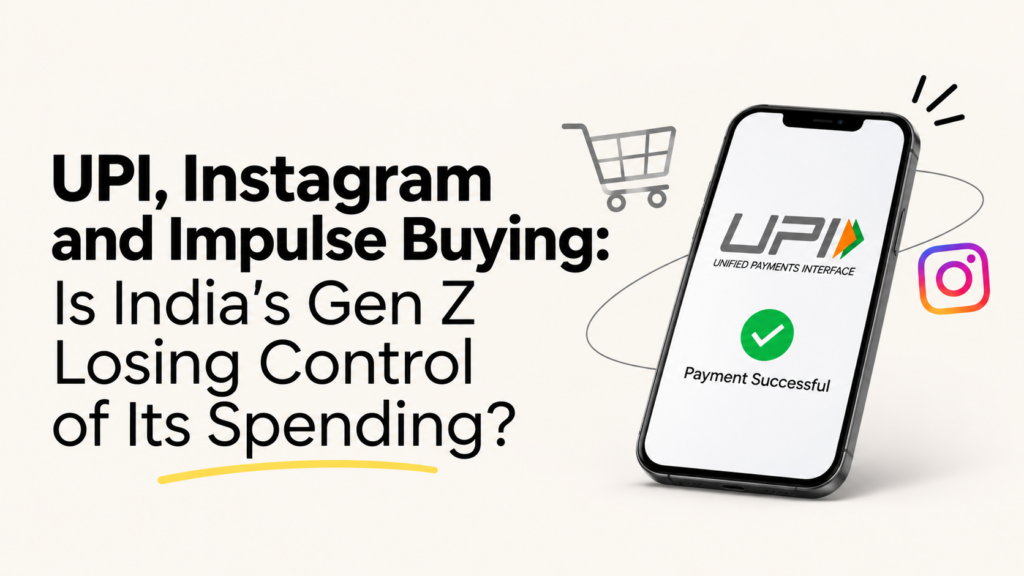
From creator recommendations and flash sales to one-tap UPI payments, India’s young consumers are navigating a shopping environment built around instant gratification. But as digital payments become effortless, are young Indians finding it harder to keep track of where their money goes?
Imagine a college student scrolling through Instagram late in the evening. A creator is reviewing a new skincare product. A few reels later, the same product appears in an advertisement, followed by a limited-period discount on an e-commerce platform.
The product costs ₹799. It seems affordable. The student opens the shopping app, adds it to the cart, selects UPI and completes the payment.
The entire process takes a couple of minutes.
A few days later, another purchase follows. Perhaps it is a pair of sneakers, a food delivery order, a subscription or an accessory that has been trending among friends.
None of these purchases appears particularly expensive on its own. But when several such transactions happen throughout the month, the cumulative spending can become significant.
This is increasingly relevant to India’s Gen Z, a generation that has grown up with smartphones, social media, digital marketplaces and instant payment systems.
For young Indians, the journey from discovering a product to purchasing it has become remarkably short. Social media platforms influence what they notice, creators shape what they consider desirable, shopping platforms provide immediate access, and UPI makes completing the transaction almost effortless.
The question is whether this convenience is changing the way young consumers think about money.
Are they spending more impulsively, or are they simply participating in a more digitally connected consumption economy?
Several recent research findings offer interesting insights into this evolving relationship between India’s Gen Z, digital commerce and personal finance.
1. Instagram is becoming more than a place to discover trends
For a long time, social media was primarily associated with entertainment, friendships and self-expression. That relationship has changed considerably.
Platforms such as Instagram have increasingly become discovery channels for products, brands and lifestyle choices.
A young consumer might discover a skincare routine through a creator, learn about a new clothing brand through a fashion reel, see a gadget recommendation in a technology video or encounter a restaurant through a food influencer.
Unlike traditional advertising, these recommendations often appear within entertainment content. The distinction between watching something for enjoyment and discovering something to buy can become blurred.
The Flipkart Glam Up Annual Beauty Trends Report, published in June 2025 in collaboration with NielsenIQ, offers an interesting indication of this behaviour.
According to the report:
70% of Gen Z beauty consumers discover new beauty brands on Instagram, compared with approximately 50% of other consumers.
72% of Gen Z search on creator pages while purchasing beauty products, compared with 49% of millennials.
30% of shopping decisions are influenced by creators, according to the report’s findings.
A creator does not necessarily have to tell someone to purchase a product. Demonstrating how it works, showing its results or including it in a daily routine can create interest and influence consideration.
For Gen Z, the creator economy has effectively become another product-discovery ecosystem.
However, it would be inaccurate to assume that every discovery leads to an immediate purchase. The same Flipkart report notes that Gen Z consumers also rely on recommendations and research before buying, particularly for beauty products.
That makes the behaviour more interesting: young consumers can be highly informed shoppers while still being exposed to frequent purchase triggers.
2. UPI has made spending incredibly convenient. But has it also changed how money feels?
India’s digital payments revolution has transformed everyday transactions.
Whether it is splitting a restaurant bill, purchasing coffee, paying for groceries, ordering food or shopping online, UPI has made transferring money significantly easier.
For younger consumers, who are comfortable navigating digital platforms, this has become a natural part of everyday life.
The Flipkart-NielsenIQ report found that 90% of Gen Z digital transactors use UPI for payments, compared with approximately 60% of other shoppers.
Its September 2025 Bulletin study, Impact of UPI on Cash Demand – Evidence from National and Subnational Levels, found that UPI processed 18,586 crore transactions during FY2024–25, compared with 1,252 crore in FY2019–20.
The average UPI transaction value also declined from ₹1,703 in FY2019–20 to ₹1,404 in FY2024–25. The RBI noted that a large proportion of person-to-merchant transactions were below ₹500.
A ₹60 coffee, ₹150 lunch, ₹99 subscription or ₹250 auto ride can all be paid for digitally.
The convenience is undeniable. But there is a behavioural question worth examining.
When people hand over physical cash, they can see the money leaving their wallets. Digital payments replace that physical exchange with a screen notification or transaction confirmation.
This raises the possibility that the psychological experience of spending may change when the payment process becomes less tangible.
It does not mean that UPI automatically encourages overspending. The RBI’s research examines payment adoption and cash demand, not whether digital payments cause impulse purchases.
However, the increasing frequency of small digital transactions makes it worth asking whether young consumers are paying sufficient attention to their cumulative spending.
3. The small-purchase problem: When ₹200 does not feel like much
One of the more interesting aspects of digital consumption is that spending does not always happen through large, planned purchases.
It can happen through a series of smaller decisions.
A food delivery order after college. A quick-commerce purchase because something is needed immediately. A new phone accessory, a discounted T-shirt, a paid gaming upgrade or an additional streaming subscription.
Each transaction may appear manageable.
But consider a hypothetical monthly spending pattern:
| Everyday purchase | Monthly spending |
|---|---|
| Additional food delivery orders | ₹1,200 |
| Coffee and snacks | ₹900 |
| Unplanned fashion purchases | ₹1,000 |
| Digital subscriptions | ₹500 |
| Small online purchases | ₹800 |
| Total | ₹4,400 |
Illustrative example, not survey findings or an estimate of average Gen Z spending.
₹4,400 may not seem particularly significant when spread across a month. But for a student managing a limited allowance or a young professional earning their first salary, it can represent a meaningful amount.
The challenge is not necessarily excessive spending on one occasion. It may be the accumulation of spending decisions that are individually easy to justify.
The RBI’s observation that a large share of UPI merchant transactions fall below ₹500 gives this aspect of the story additional relevance.
The bigger question for young consumers may therefore be less about how much they spend on a single purchase and more about how frequently they make purchases without consciously reviewing their overall financial position.
4. Are creators and social media influencing what Gen Z wants to buy?
The influence of social media on purchasing decisions extends beyond product discovery.
It can also shape what consumers consider desirable.
Fashion trends, skincare routines, gadgets, fitness products, travel experiences and even food preferences are increasingly visible through digital content.
A product that was previously unfamiliar can quickly become part of a wider online conversation.
There is also a social dimension to consumption.
Young consumers may want to experiment with products, participate in trends, recreate something they have seen online or simply try something their friends are discussing.
The 2025 Gen Z Playbook, an index commissioned by Snapchat and The Economic Times in partnership with Kantar, offers an interesting counterpoint.
It found that:
80% of Gen Z respondents placed greater trust in relatable influencer stories than celebrity endorsements.
85% were more likely to buy from brands with which they felt a personal connection.
84% researched both online and offline to find the best deals.
In fact, the emphasis on research and deal hunting indicates that many young consumers are making considered choices.
But there is an important distinction between being informed about a product and being financially disciplined about purchasing it.
A consumer may compare five brands, read reviews, watch creator demonstrations and wait for a discount before buying something that was never part of their original budget.
The purchase can be well researched and still be impulsive in terms of financial planning.
This is where the relationship between social media and spending becomes particularly interesting.
5. The financial reality: Gen Z wants independence, but money remains a concern
There is another side to this story that deserves attention.
It would be unfair to portray India’s Gen Z as a generation that simply prefers spending over saving.
In fact, research suggests that financial security is an important concern for young Indians.
The 2025 Deloitte Global Gen Z and Millennial Survey found that 55% of Indian Gen Z respondents reported living paycheck to paycheck. The survey also identified unemployment as the biggest concern for Indian Gen Z, followed by education, skills and training.
These findings highlight a contradiction.
Young Indians are increasingly exposed to products, experiences and lifestyle choices through digital platforms. At the same time, many are navigating financial constraints, uncertain career prospects and the pressure of becoming financially independent.
The result is an environment in which consumption and financial security can sometimes compete with each other.
For a college student, an unplanned purchase may mean having less money for the rest of the month. For someone in their first job, frequent discretionary spending may affect how much they can save.
The issue is not that young people should avoid spending on things they enjoy. It is whether they have enough visibility into their finances to make those decisions consciously.
Interestingly, the EY study How Financial Services Can Evolve to Stay Relevant for Gen Z found that 48% of surveyed Gen Z respondents maintained multiple bank accounts, suggesting that many are already taking steps to organise their finances.
It also found that 68% used UPI for its ease and cashback benefits, while 46% chose credit cards for rewards and discounts.
6. The EMI and Buy Now, Pay Later temptation
Another dimension of digital consumption is the growing availability of flexible payment options.
From credit cards and no-cost EMIs to Buy Now, Pay Later services, consumers have multiple ways to divide or defer payments.
For a young person making their first independent purchases, this can make products appear more accessible.
A smartphone priced at ₹30,000 may seem expensive when viewed as a single payment. But an instalment of ₹2,500 a month can feel considerably more manageable.
The problem is that the monthly instalment does not represent the complete financial commitment.
When multiple purchases are made through instalment plans, the cumulative monthly obligation can become difficult to manage.
There is also a psychological distinction between being able to afford an instalment and being able to comfortably afford the product.
A purchase that fits within a monthly payment schedule may still be unsuitable for someone’s overall financial situation.
This is particularly relevant for young consumers who are beginning to manage credit independently.
The objective should not be to discourage responsible credit usage. Credit can be useful when understood and managed properly. However, deferred payments should not be mistaken for additional income or free money.
For Gen Z, understanding the total cost of a purchase, the repayment schedule, interest charges and potential penalties is becoming an important part of financial literacy.
7. The psychology of the ‘pause before you pay’
If the digital environment makes purchasing easier, one way to regain control may be to introduce a little friction into the decision-making process.
This is the idea behind the ‘pause before you pay’ rule.
Instead of immediately purchasing something that catches their attention, consumers give themselves a fixed waiting period before completing the transaction.
For smaller discretionary purchases, this could mean waiting 24 hours. For more expensive purchases, the waiting period could be longer.
The purpose is not to stop people from buying things they genuinely want. It is to distinguish between a purchase driven by immediate excitement and one that makes sense after some consideration.
A few simple questions can help:
Do I actually need this, or did I discover it while scrolling?
Was this purchase part of my original budget?
Can I comfortably pay for it without affecting my savings or essential expenses?
Do I already own something that serves the same purpose?
Will I still want this product after 24 or 48 hours?
There are also practical steps that can help.
Leave products in the cart: Instead of checking out immediately, save the product and revisit it the following day.
Review UPI transactions: Look at the cumulative amount spent rather than evaluating every transaction individually.
Audit subscriptions: Check recurring payments and cancel services that are no longer being used.
Set discretionary spending limits: Allocate a monthly amount for entertainment, shopping and eating out.
Be careful with instalments: Consider the full purchase price and existing financial commitments before choosing EMI or deferred payment options.
The waiting period can be especially useful when a purchase is triggered by a limited-period offer, a creator recommendation or the fear of missing out on a trend.
A discount is only a saving when the product was something you actually intended to purchase.
8. Is Gen Z really losing control, or is the spending environment changing?
Perhaps the most important question is whether the problem lies with the consumer or the environment in which the consumer makes decisions.
Consider how the modern digital purchase journey works.
A social media platform introduces a product. A creator demonstrates its benefits. An advertisement reinforces the message. An e-commerce platform offers a discount. A payment application completes the transaction.
Each part of this journey is designed to reduce friction between discovery and purchase.
For businesses, this is an effective commerce ecosystem. For consumers, it offers convenience, choice and access to products that may not have been easily available earlier.
But it also means that opportunities to spend are constantly present.
The distinction between entertainment, advertising, product discovery and shopping is becoming less obvious.
It is therefore worth asking whether financial discipline needs to evolve alongside digital consumption.
The answer is unlikely to be abandoning UPI, avoiding Instagram or refusing to participate in online shopping. These platforms have become integral to everyday life.
Instead, young consumers may need to become more conscious of how digital environments influence their financial decisions.
There is also a responsibility for financial institutions, payment platforms and commerce businesses to make spending more transparent and help consumers understand their financial commitments.
Importantly, the available research does not establish that UPI causes impulse buying or that India’s Gen Z is collectively overspending. It establishes the scale of digital payment adoption, the influence of digital product discovery and the financial pressures facing young consumers. The behavioural connection deserves further investigation.
The takeaway: Convenience should not come at the cost of financial awareness
India’s Gen Z is entering adulthood at a time when spending has never been easier.
A product can be discovered on Instagram, researched through creator reviews, compared across shopping platforms and purchased through UPI without leaving the phone.
This is a remarkable transformation in consumer behaviour.
But the ease of completing a transaction does not necessarily mean that the purchase is financially sensible.
The challenge for young consumers is to develop a relationship with money that is as digitally sophisticated as the platforms they use every day.
The next time a product appears on their Instagram feed, perhaps the most useful response is not to immediately ask where to buy it.
It might simply be to wait 24 hours.
Because in an economy built around instant gratification, the ability to pause could become an important financial skill.