
As degrees become more common and employers increasingly look for practical skills, Indian students are beginning to question whether their college education is preparing them for the world beyond examinations. From internships and industry exposure to AI, campus communities and career networks, the expectations from higher education are changing.
For generations of Indian students, the formula for a successful college experience was relatively straightforward: secure admission to a good institution, attend classes, score well in examinations, earn a degree and find a job. College was largely viewed as the bridge between academic education and professional life.
For today’s Gen Z, however, that equation is becoming more complicated.
A degree remains important, but students are navigating a world in which employers increasingly expect practical experience, digital fluency, communication skills and the ability to adapt to changing workplace requirements. At the same time, artificial intelligence is transforming how people learn, work and acquire new skills. Professional opportunities are no longer limited to campus placements, while online communities, independent projects, internships and competitions are creating alternative routes to professional development.
The result is a changing relationship between students and their colleges. Young people are not necessarily questioning the value of higher education. They are increasingly questioning whether the experience they receive is sufficient for the opportunities and challenges waiting outside the campus.
The question is no longer simply whether a student will graduate with good marks. It is whether they will graduate with the confidence, capabilities, relationships and experience to make those marks count.
The degree still matters, but is it enough?
India’s higher education system has expanded significantly, bringing more young people into colleges and universities. Yet the transition from education to employment remains a considerable challenge.
The State of Working India 2026 report by Azim Premji University, titled ‘Youth in the Labour Market: Pathways from Learning to Earning’, highlights this contradiction. While access to higher education has become more widespread, the growth in the number of graduates has not been matched by commensurate growth in graduate employment. The report also notes that financial barriers continue to restrict access to professional education, particularly in fields such as engineering and medicine.
This raises an important question about the value students receive from their education.
Mercer’s India’s Graduate Skill Index 2025 provides another indication of the challenge. Based on an assessment of more than one million students across over 2,700 campuses, the report found that 42.6% of Indian graduates applying for jobs were assessed as overall employable. The figure was marginally lower than the 44.3% recorded in 2023.
The report also highlights the growing importance of critical thinking, communication and learning agility alongside technical capabilities.
These findings do not suggest that college degrees have lost their relevance. Rather, they point towards a widening gap between academic qualifications and the capabilities employers expect from new graduates.
For students, this means that academic performance alone may not provide the professional advantage it once appeared to promise. They increasingly need to demonstrate what they can do with the knowledge acquired in classrooms.
Practical experience is becoming part of the college experience
One of the most important expectations from higher education is the opportunity to apply classroom learning to real-world situations.
Students studying computer science may understand programming concepts but still need experience building applications, collaborating on projects and solving practical problems. Management students may understand business frameworks but benefit from working on live marketing campaigns, analysing consumer behaviour or participating in business simulations.
The same applies across disciplines. Engineering students need exposure to actual engineering challenges, while students of media, design and communication benefit from working on real briefs, producing content and interacting with industry professionals.
Internships, hackathons, research assignments, live projects and industry collaborations can help bridge this gap.
However, access to such experiences is not uniform.
A report on industry readiness in Indian higher education, covered by The Indian Express in January 2026, highlighted that internships were integrated across all programmes in only 9.4% of institutions and within select programmes in another 17.4%. Overall, internship integration stood at 26.8%. The report also indicated that 37.8% of institutions had no internship integration, while only 9.68% used live industry projects.
The findings point to a structural challenge: students are increasingly expected to graduate with practical experience, but not every institution has built the systems necessary to provide it.
For Gen Z, the ability to participate in a hackathon, work on a company-sponsored project, undertake an internship or contribute to a research initiative can therefore become an important differentiator.
These experiences also help students discover what interests them before they make longer-term career decisions. A student who participates in a product development challenge may discover an interest in entrepreneurship, while another who works on a marketing project may realise that their strengths lie in consumer research rather than conventional management roles.
College should provide the space to experiment with these possibilities.
AI is changing what students expect from education
Perhaps the biggest development reshaping the college experience is artificial intelligence.
Students today can use AI tools to understand difficult concepts, generate ideas, write and debug code, prepare presentations, summarise research and explore subjects outside their academic curriculum.
The Stanford Institute for Human-Centered AI’s AI Index Report 2026, drawing on the Chegg Global Student Survey, reported that 84% of Indian university students had used generative AI to support their studies in 2025, compared with 44% in 2023.
This is a substantial shift in just two years.
For students, AI offers a way to supplement classroom learning. Someone struggling with a programming concept can seek an explanation at their own pace. A student preparing for an examination can use AI to generate practice questions, while another can explore an unfamiliar subject without depending entirely on classroom instruction.
But widespread access to AI also changes what students should expect from their institutions.
Universities cannot simply introduce AI tools and consider themselves future-ready. They need to help students understand how to use these technologies responsibly, evaluate the accuracy of their outputs, question assumptions and apply human judgement.
EY-Parthenon and FICCI’s 2025 report, Future-Ready Campuses: Unlocking the Power of AI in Higher Education, found that more than 56% of Indian higher education institutions had implemented AI-related policies. Around 60% permitted students to use AI tools, including generative AI applications in tutoring.
The report also identified institutional applications such as AI-generated learning materials, tutoring systems and adaptive learning platforms.
Yet the bigger opportunity lies beyond the adoption of technology. Colleges need to prepare students to work alongside AI rather than simply use it to complete assignments.
The ability to ask better questions, evaluate information, solve unfamiliar problems and combine technical tools with domain knowledge will become increasingly important.
For Gen Z, a future-ready college should therefore offer more than access to technology. It should create an environment where students can experiment with it, challenge it and understand its limitations.
Campus communities can teach lessons that classrooms cannot
Academic knowledge is only one part of professional development. Much of what students learn about working with people, managing responsibilities and making decisions happens outside the classroom.
Student clubs, college festivals, entrepreneurship cells, technical societies, cultural organisations and campus communities offer opportunities to develop these capabilities.
Organising a college festival involves budgeting, sponsorship discussions, marketing, logistics and coordination. Running a technical community requires planning events, bringing speakers on board and engaging participants. Participating in a debate society can help students develop communication skills and the confidence to defend an argument.
These experiences may not always translate into formal academic credits, but they can build capabilities that employers value.
There is also a social dimension to the campus experience. College is often where young people interact with individuals from different regions, economic backgrounds, cultures and academic disciplines.
These relationships can expand perspectives and create friendships, professional connections and collaborations that continue long after graduation.
However, participation should not be confused with achievement. Simply joining multiple clubs or collecting certificates does not guarantee personal development. What matters is the responsibility students take, the problems they solve and what they learn through the experience.
For institutions, the challenge is to ensure that campus communities are not treated as peripheral activities but as meaningful components of student development.
The value of college is also in the people students meet
Professional networks are often discussed as an advantage of attending prestigious institutions. But meaningful connections should not be restricted to students studying at the country’s most recognised universities.
Professors, alumni, industry professionals, fellow students and entrepreneurs can all become important sources of guidance and opportunity.
The difficulty is that many students do not know how to build these relationships.
A professor who is approachable and actively engaged with students can help them identify research opportunities or explore career paths. Alumni interactions can provide a more realistic understanding of industries than a conventional career presentation. Industry talks, mentorship programmes and networking events can help students understand what employers look for.
Peer networks are equally important. Students working together on a hackathon, research assignment or entrepreneurial project often develop relationships based on shared interests and capabilities.
For students from smaller cities and institutions with limited industry access, these connections can be particularly valuable.
Colleges can play a meaningful role by developing structured mentorship programmes, alumni engagement initiatives, industry chapters and collaborative projects that connect students with professionals.
A university’s value should not be measured only by the companies visiting its placement cell. Its ability to create meaningful connections between students and the wider professional ecosystem also deserves attention.
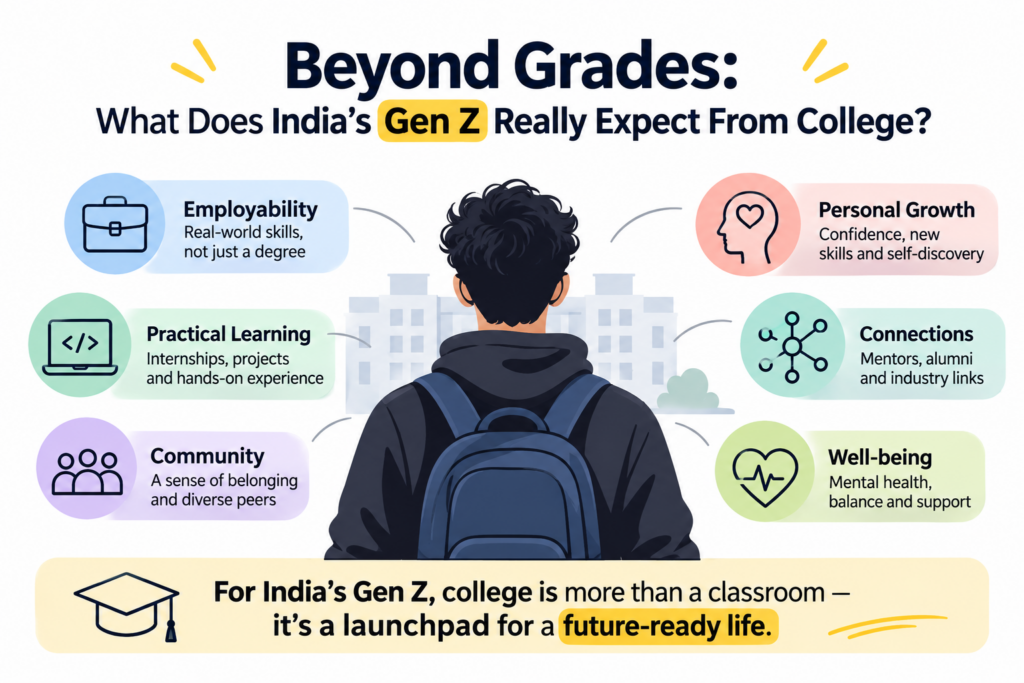
The college experience cannot be reduced to employability
While career preparation is an important expectation, college should not become an extended recruitment programme.
The years spent in higher education are also an opportunity for students to develop independence, discover their interests and build an understanding of the world around them.
Living away from home, managing finances, balancing academic responsibilities, resolving disagreements and making decisions independently can be important learning experiences.
Students also need environments where they feel safe, included and supported.
The QS I-GAUGE One Campus, Many Smiles: The Voices Behind Well-being in Indian Higher Education report, published in December 2025, draws on insights from more than 5.4 lakh stakeholders. It examines institutional well-being through dimensions including safety, emotional support, recognition, inclusion, growth and future-readiness.
This is a useful reminder that a good college experience cannot be evaluated solely through examination results and placement statistics.
A student may graduate with a strong academic record but still feel disconnected from their institution. Another may have an excellent placement offer but have had limited opportunities to explore interests outside their chosen discipline.
The quality of higher education should account for both professional preparation and the broader development of young people.
The challenge for colleges is to create an environment where academic ambition, personal well-being and meaningful campus participation can coexist.
Is the responsibility shifting from colleges to students?
There is an emerging contradiction in the way higher education is experienced.
Students are increasingly encouraged to pursue internships, learn additional skills, build portfolios, participate in competitions, develop professional networks and stay updated with technology.
Much of this is valuable. However, it also raises a question about institutional responsibility.
If students must independently find industry projects, pay for additional certifications, learn new technologies outside the curriculum and build professional networks without meaningful institutional support, what exactly is the college experience providing?
The answer will differ across institutions.
Some universities have built strong industry partnerships, entrepreneurship ecosystems, research facilities and active student communities. Others continue to operate with limited practical exposure and relatively traditional teaching models.
The difference matters because access to opportunities is not simply a question of individual motivation. It is also influenced by institutional resources, location, family finances and the networks available to students.
A student at a well-connected university may have access to corporate mentors, funded research projects and multiple internships. Another student studying in a smaller city may need to search independently for similar opportunities.
Higher education cannot eliminate every inequality, but institutions can do more to ensure that access to meaningful experiences is not determined entirely by where a student studies.
What should the next generation of colleges offer?
The changing expectations of Gen Z do not mean that traditional academic education has become irrelevant. Strong subject knowledge, disciplined learning and academic foundations remain essential.
What is changing is the expectation that these foundations should translate into something tangible.
The college of the future will need to combine academic teaching with experiential learning, industry engagement, technology access, mentorship and opportunities for personal growth.
Students should be able to work on real-world problems before graduation, interact with professionals beyond occasional guest lectures, participate in interdisciplinary projects and develop portfolios that demonstrate their capabilities.
They should also have access to career guidance that extends beyond placement preparation, alongside supportive campus environments that encourage curiosity, experimentation and inclusion.
For students, the responsibility is to engage actively with the opportunities available to them rather than treating college as a series of examinations to be cleared.
For institutions, however, the responsibility is equally significant. They must create opportunities that allow students to discover their strengths, test their knowledge and build capabilities beyond the syllabus.
The bigger question: What does a college degree actually prepare you for?
India’s Gen Z is entering higher education at a time when the relationship between learning and employment is changing rapidly. Technology is altering professional requirements, employers are looking for a wider combination of skills, and students have more ways to access knowledge than previous generations.
In this environment, the value of a college education will increasingly depend on what happens between admission and graduation.
The degree remains the formal outcome. But the experience surrounding it can determine whether a student leaves with practical capabilities, meaningful relationships, confidence and a clearer understanding of their future.
Perhaps the more important question for India’s universities is not whether students are getting good grades, but whether they are getting enough opportunities to discover what they can do with what they have learned.
Because the most valuable part of college may not be what students remember from their examinations. It may be the projects they built, the people they met, the challenges they solved and the possibilities they discovered along the way.