
Short-form video has become one of India’s most powerful product discovery channels, but new research suggests that family recommendations, smaller creators, online reviews and personal research still play a decisive role in what young consumers eventually buy. For marketers, the challenge is shifting from winning attention to earning trust.
The Instagram discovery paradox
Imagine a college student in Jaipur scrolling through Instagram. A creator demonstrates a new skincare product. The video is engaging, the packaging looks attractive, and thousands of people have commented on it. The student saves the Reel, shares it with a friend and perhaps visits the brand’s profile.
But does that mean a purchase is imminent?
Not necessarily.
Before spending money, the student might search for the product on Google, watch a YouTube review, read customer feedback on an e-commerce platform or ask a friend who has already used it. The Reel may have introduced the brand, but the final decision could depend on several conversations and evaluations that happen outside Instagram.
This distinction is becoming increasingly important for brands trying to understand India’s Gen Z consumers.
Social media has transformed how young Indians discover products. Short-form video, creator recommendations and algorithm-driven feeds have become powerful channels for introducing brands to consumers who might never have encountered them through traditional advertising.
Yet discovery and trust are not the same thing. And the growing body of research around young Indian consumers suggests that brands need to understand the difference.
Instagram has become the new product discovery window
The scale of Instagram’s influence is difficult to ignore.
In June 2026, Meta published findings from studies commissioned from IPSOS, covering more than 4,000 respondents across 23 cities, including metros, Tier II and III cities and rural India.
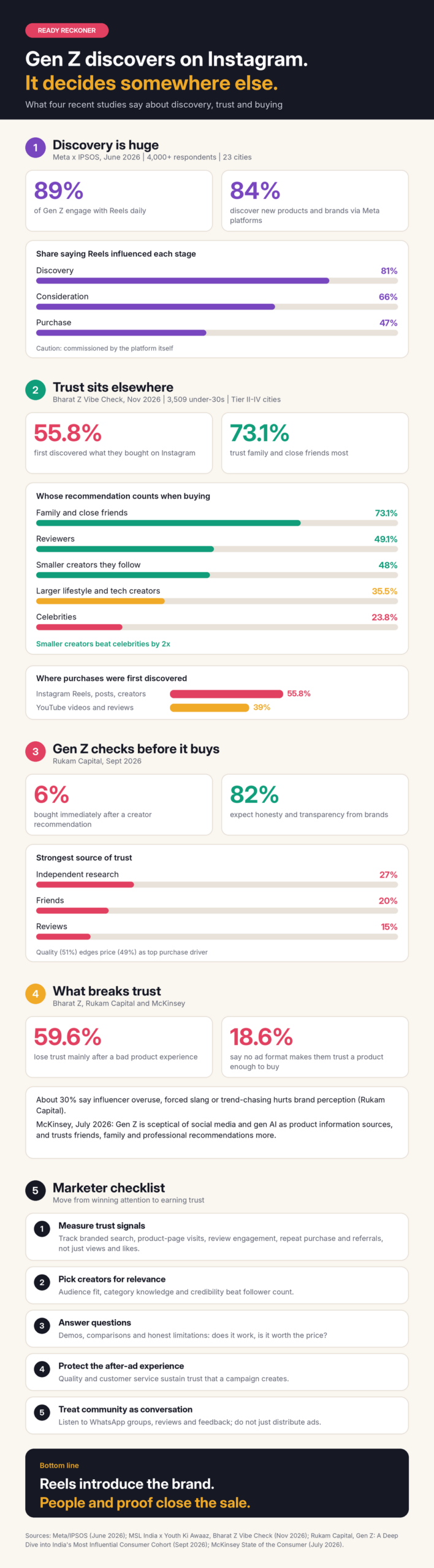
Among the findings, 89% of Gen Z respondents said they engaged with Reels daily. Furthermore, 84% of Gen Z consumers said they discovered new products and brands through Meta’s platforms.
The research also found that Reels influenced different stages of the consumer journey, including product discovery, consideration and purchase decisions. Meta reported figures of 81%, 66% and 47% respectively for these stages.
These findings point towards an important shift in how brands reach younger consumers. Advertising is no longer restricted to a dedicated commercial break or a sponsored placement. It increasingly appears within the entertainment, conversations and creator content that young people consume throughout the day.
Beauty, fashion, lifestyle, fitness, comedy, sports and travel are among the categories generating substantial engagement on Reels.
For brands, this creates an opportunity to introduce products in contexts where consumers are already spending their time.
A fashion label can demonstrate how an outfit looks in everyday situations. A skincare company can collaborate with a creator to explain a routine. A travel company can use short videos to showcase destinations that young people may not have considered previously.
The product is no longer necessarily introduced through an advertisement that interrupts entertainment. It becomes part of the entertainment itself.
However, these findings should be understood in context. The Meta study was commissioned by the platform itself and measures engagement and influence within its ecosystem. It should not be interpreted as an independent measurement of every Indian consumer’s behaviour or as proof that all product discovery results in a purchase.
Nevertheless, the direction of the shift is significant.
Bharat Z reveals a more interesting consumer story
While Meta’s research establishes the scale of short-form video consumption, a more recent study offers an interesting perspective on what happens after discovery.
The November 2026 edition of Bharat Z Vibe Check: What Young Indians in Tier II, III and IV Cities Binge, Buy and Believe, released by MSL India in collaboration with Youth Ki Awaaz, surveyed 3,509 respondents under the age of 30 through YKA’s WhatsApp-native polling platform, Yoot.
The findings reveal a fascinating distinction between where young consumers discover products and whom they trust before making a purchase.
According to the report:
- 55.8% identified Instagram Reels, posts or creators as their first source of discovering products they eventually purchased.
- 39% cited YouTube videos and reviews.
- 73.1% said they trusted family and close friends most when considering something new.
- 49.1% identified reviewers as a source of trust.
- 48% said they considered recommendations from smaller creators they followed when making buying decisions.
The study also found that 54.8% trusted Reels and short-video advertising when considering a purchase, while 18.6% said no advertising format made them trust a product enough to buy it.
The distinction is important.
Instagram is increasingly where the discovery journey begins. But when the decision involves spending money, young consumers continue to seek reassurance from people and sources they consider credible.
This is not necessarily a rejection of influencer marketing. Rather, it suggests that influencer visibility alone may not be sufficient to establish purchase confidence.
A creator can introduce a product, demonstrate its features and generate interest. But the consumer still wants to know whether the product actually works, whether it offers value for money and whether other people have had a satisfactory experience.
For marketers, this is perhaps the most important finding emerging from the latest research.
The creator economy is changing, but credibility matters more than reach
Influencer marketing has grown into a significant part of brand communication strategies.
For several years, the industry largely measured influence through follower counts, impressions, engagement rates and celebrity associations. The assumption was relatively straightforward: a creator with a larger audience could potentially deliver greater visibility for a brand.
But Gen Z’s evolving behaviour is challenging this approach.
The Bharat Z study found that 48% of respondents considered smaller creators they followed when making buying decisions. The corresponding figures were 35.5% for larger lifestyle and technology creators and 23.8% for celebrities.
These findings suggest that smaller creators deserve a more serious place in brand marketing strategies.
A creator with 20,000 followers who consistently discusses fitness, personal finance, technology or fashion may have a more relevant relationship with their audience than a celebrity reaching millions of people across unrelated interests.
The distinction is not simply about audience size. It is about context.
A young consumer researching a laptop may find a detailed explanation from a technology creator more useful than a celebrity endorsement. Someone exploring skincare may prefer an honest product comparison from a creator who regularly discusses ingredients and routines.
Smaller creators can also bring brands closer to specific communities, interests and regional audiences.
This is particularly relevant for India, where language, cultural preferences, purchasing power and local aspirations vary considerably across markets.
A creator in Indore, Jaipur, Lucknow or Coimbatore may understand the everyday concerns of their audience in ways that a national celebrity campaign cannot easily replicate.
However, smaller does not automatically mean more credible. Repeated sponsored recommendations, undisclosed commercial relationships and exaggerated product claims can weaken trust regardless of follower count.
The opportunity for brands is to build longer-term relationships with creators whose interests genuinely align with their products, rather than treating every collaboration as a one-time media placement.
The trust equation goes beyond social media
One of the more revealing aspects of the Bharat Z research is the continued importance of personal relationships.
Despite the growing role of digital platforms, 73.1% of respondents said they trusted family and close friends most when considering something new.
This challenges the idea that Gen Z is entirely influenced by digital culture.
Young consumers may spend a significant amount of time online, but their purchase decisions continue to be shaped by offline relationships.
Consider a student discovering a new smartphone through an Instagram Reel. The video may create interest, but the student might subsequently ask friends about battery life, compare specifications on YouTube and visit a retail store before deciding.
Similarly, a young consumer discovering a clothing brand through a creator may still look for customer photographs, check return policies and ask friends whether the brand is reliable.
The process is increasingly interconnected.
A consumer can discover something online, evaluate it through independent research, discuss it in a WhatsApp group and finally purchase it through an e-commerce application or physical store.
McKinsey’s July 2026 analysis of its State of the Consumer Survey reinforces this distinction. Its research found that social media had become an important source of discovery and purchasing for Gen Z, but younger consumers remained relatively sceptical of social media and generative AI as sources of product information.
Friends and family, professional recommendations and other offline sources ranked higher on trust than algorithm-driven channels.
The implication for brands is clear: being present where consumers discover products is only one part of the equation. They also need to provide enough credible information for consumers to feel comfortable making a decision.
Gen Z is becoming more demanding about what brands promise
The changing relationship between discovery and trust also reflects a broader shift in consumer expectations.
A September 2026 study by Rukam Capital, titled Gen Z: A Deep Dive into India’s Most Influential Consumer Cohort, found that 82% of respondents expected honesty and transparency from brands.
Quality was identified as the most important purchase driver by 51%, followed by price at 49%.
The study also found that independent research was the strongest source of trust, cited by 27% of respondents. Friends followed at 20%, while reviews accounted for 15%.
Interestingly, only 6% said they made an immediate purchase following a creator recommendation. Most preferred to undertake further research or check reviews.
The research also highlighted the risks of excessive influencer marketing. Around 30% of respondents identified influencer overuse, forced slang or excessive trend-chasing as behaviours that could negatively affect brand perception.
This is an important consideration for marketers attempting to communicate with Gen Z.
Young consumers are not necessarily opposed to advertising or brand collaborations. They are increasingly exposed to them, and that exposure can make them more aware of the commercial motivations behind the content they consume.
A creator recommending five unrelated products in the same week may struggle to maintain credibility. A brand attempting to use every trending phrase or meme may appear disconnected from the audience it wants to reach.
Authenticity, therefore, cannot simply be a creative direction written into an influencer brief. It has to be reflected in the product, the claims being made and the overall consumer experience.
Why smaller cities deserve greater attention
The conversation around Instagram-led discovery also has implications beyond India’s metropolitan markets.
The Bharat Z research specifically focuses on consumers in Tier II, III and IV cities, an audience that is increasingly important to brands looking beyond traditional urban markets.
The study found that 58% of respondents selected food delivery and eating out among their leading self-spending categories. Travel followed at 44.1%, while fashion and beauty accounted for 33.5%.
These categories provide useful context for understanding how young consumers in smaller cities are spending their money and what kinds of brands may attract their attention.
The digital discovery journey is also not limited to Instagram.
YouTube was identified by 39% of respondents as a source of discovering products they eventually purchased, suggesting that longer-form reviews and demonstrations continue to play a role alongside short-form content.
For brands, this creates an opportunity to build communication strategies around different consumer needs.
Reels can introduce a product. YouTube can explain it in greater detail. Regional creators can provide cultural relevance. Customer reviews can establish credibility. WhatsApp communities and conversations can help people exchange recommendations.
The objective should not be to replicate the same campaign across every platform. It should be to understand what role each platform plays in the consumer’s decision-making process.
This is particularly important when brands are targeting audiences with different purchasing power, regional preferences and access to products.
A campaign that generates millions of impressions in metropolitan markets may not necessarily deliver the same results in smaller cities.
Understanding the audience is more important than simply expanding the media budget.
From views and engagement to actual trust: What marketers need to rethink
For marketing managers, the findings point towards a need to reconsider how influencer and social media campaigns are planned and evaluated.
The first change should be in how success is measured.
Views, reach, likes and shares remain useful indicators of content performance. However, they do not independently establish whether consumers trust a brand or intend to purchase its products.
Marketing teams should increasingly examine indicators such as branded search activity, product-page visits, review engagement, consideration, repeat purchases and customer recommendations.
The second change should be in creator selection.
Instead of evaluating creators primarily by follower count, brands should examine audience relevance, category knowledge, consistency, credibility and the relationship a creator has built with their community.
A smaller creator with a highly relevant audience may be more useful than a celebrity with a much larger but less targeted following.
Third, brands need to invest in content that answers questions rather than simply generating excitement.
Consumers want to understand how a product works, what makes it different, whether it is worth its price and what limitations it may have.
Demonstrations, comparisons, product explanations and genuine customer experiences can help address these questions.
Fourth, brands need to pay greater attention to what happens after the advertisement.
Poor product quality, misleading claims and disappointing customer service can quickly undo the trust created through an effective campaign.
The Bharat Z study found that bad product experiences were the leading reason for losing trust, cited by 59.6% of respondents. Greenwashing and poor customer service were also significant concerns.
This is a reminder that brand trust is not created by communication alone. It is sustained by what consumers actually experience.
Finally, marketers should stop treating community as an extension of their advertising distribution strategy.
Communities can provide something that paid campaigns cannot easily manufacture: ongoing conversations, feedback, recommendations and relationships.
For brands seeking to build long-term relevance among young consumers, listening to these conversations may be as important as producing the next viral video.
The next competitive advantage may be trust, not attention
India’s Gen Z is spending an increasing amount of time discovering products through digital platforms. Instagram Reels has become an important part of this journey, and creators are playing a growing role in introducing brands, shaping preferences and influencing consumer conversations.
But the research also challenges a simplistic interpretation of the influencer economy.
The fact that a young consumer watches a Reel does not mean they trust the recommendation. Discovering a product does not automatically translate into considering it. And considering a product does not guarantee a purchase.
The consumer journey is more complicated, involving multiple platforms, personal relationships, independent research and actual product experiences.
For brands, the opportunity is not to abandon influencer marketing or reduce their presence on Instagram. It is to recognise that visibility and credibility are two different outcomes requiring different strategies.
The brands that succeed with Gen Z may not necessarily be those that appear most frequently on its social media feeds.
They may be the ones whose products stand up to scrutiny, whose creators have genuine credibility, whose claims are transparent and whose customers are willing to recommend them to others.
Instagram can introduce a brand to millions of young consumers. But earning a place in their consideration set, and eventually in their shopping basket, requires something more enduring.
In an economy increasingly driven by digital discovery, trust may become the most valuable conversion metric brands cannot afford to overlook.