
As social media gives cigarettes a new cultural identity and vaping continues to attract young consumers globally, India faces a different but equally important question: are young people becoming confused about what is actually healthier?
A cigarette has spent decades fighting an image problem. It is associated with cancer warnings, addiction, second-hand smoke and increasingly restrictive public spaces. For an entire generation, the message has been straightforward: smoking is bad for you.
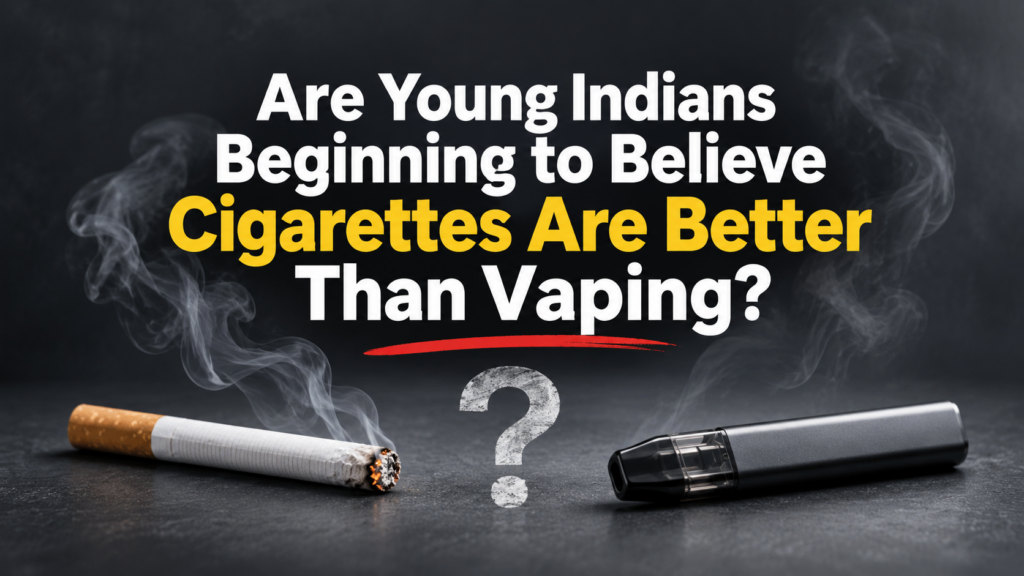
But a curious conversation has begun emerging in parts of the internet, particularly in the United States. Some young people are questioning whether traditional cigarettes might actually be a better alternative to vaping.
The argument is not necessarily that smoking is healthy. Rather, it is that cigarettes are supposedly more natural, easier to control and less chemically complicated than electronic cigarettes. In some online discussions, tobacco is even being described as a “plant-based alternative” to vaping.
It is a striking example of how consumer perceptions can change when health information becomes mixed with social-media narratives, personal anecdotes and lifestyle trends.
A November 2026 report by the New York Post highlighted this emerging conversation, documenting young people who claimed they felt better after moving away from vaping and returning to cigarettes. Some described cigarettes as more social and less convenient to consume continuously, while others questioned the ingredients in vaping products.
Medical experts, however, have strongly challenged the suggestion that cigarettes are healthier.
For India, this development raises an important question. While there is no established evidence that Indian Gen Z is following the same pattern, the country has its own complicated relationship with tobacco, nicotine, social media and youth culture. And the growing availability of health-related claims online makes the distinction between perception and scientific evidence increasingly important.
The return of the ‘natural’ argument
The most interesting aspect of the emerging American conversation is the language being used to defend cigarettes.
Words such as natural, organic and plant-based have acquired considerable cultural currency among younger consumers. From food and skincare to personal wellness, products that appear closer to nature often enjoy a perception advantage over products associated with synthetic ingredients or industrial processing.
Tobacco, after all, is a plant. This seemingly simple observation is being used in some online conversations to suggest that cigarettes are somehow more straightforward than vaping devices containing liquids, flavourings and other ingredients.
But this is a fundamental misunderstanding of how health risks work.
The fact that tobacco is plant-derived does not make inhaling its smoke safe. Burning tobacco produces thousands of chemicals, including substances that are toxic and carcinogenic. Combustion is central to the harm caused by conventional cigarettes.
Vaping, meanwhile, is not harmless. Most e-cigarettes contain nicotine, which is highly addictive, and their aerosols can contain harmful substances. Their long-term health effects are still being studied.
The US Food and Drug Administration makes an important distinction: combustible tobacco products, including cigarettes, are generally the most harmful category of tobacco products. Non-combustible alternatives such as e-cigarettes generally carry lower health risks, although they are not risk-free.
This distinction matters because a discussion about relative harm should never become an endorsement of either product, particularly among young people who do not already use nicotine.
The bigger problem is that social media rarely presents such complicated distinctions with the same clarity as public-health research.
India’s vaping conversation is already complicated
India’s experience is different from that of the United States.
In September 2019, the government brought into force the Prohibition of Electronic Cigarettes Act, which prohibits the production, manufacture, import, export, transport, sale, distribution, storage and advertising of electronic cigarettes.
The legislation covers electronic nicotine delivery systems and other specified electronic devices, including products that heat substances to produce an aerosol for inhalation.
Yet a legal prohibition does not automatically eliminate awareness, curiosity or access.
A particularly relevant research paper, published in 2024 in Substance Abuse: Research and Treatment, examined the digital marketing of e-cigarettes in India.
The researchers surveyed 370 young people aged 18–24 as part of a study conducted in 2022. They also examined social-media influencers and online stores promoting or selling e-cigarettes.
The findings offer an important insight into the digital environment surrounding young consumers.
Among the participants, 66.6% reported awareness of e-cigarettes through social media. Instagram emerged as a particularly important platform, with 46% identifying it as a source through which they had encountered information about e-cigarettes.
The researchers also identified 189 Instagram influencers promoting e-cigarettes. Their content presented the products in positive ways, highlighting attributes such as flavours, lifestyle appeal, enjoyment and perceived cost-effectiveness.
The study identified 83 online stores selling e-cigarettes, including 49 Indian and 34 international stores.
Perhaps most concerning, 93.2% of the young respondents were unaware of the 2019 legislation prohibiting e-cigarettes in India.
These findings need to be interpreted carefully. The research was conducted in 2022, and its sample of 370 young people should not be treated as a nationally representative estimate of Indian Gen Z. Nor does it establish that young Indians are switching from vaping to cigarettes.
However, it demonstrates something important: even in a country where e-cigarettes are prohibited, social media can remain an important channel through which young people encounter the category.
That makes the digital conversation around tobacco and nicotine worth watching.
Why Gen Z may be vulnerable to conflicting health narratives
Gen Z has grown up with access to more health information than any previous generation. But access to information does not necessarily translate into the ability to distinguish credible medical evidence from misleading claims.
Social platforms have changed how health information is discovered and consumed.
A young person researching nicotine might encounter a government health warning, a medical professional explaining addiction, a lifestyle creator discussing vaping, and a personal account claiming that cigarettes improved their wellbeing.
All four may appear in the same social-media environment.
The difficulty is that personal experiences often feel more convincing than abstract statistics.
When someone says that they stopped vaping and experienced better sleep, improved breathing or reduced anxiety, the claim can feel relatable. It may also receive engagement because it challenges an established belief.
But an individual’s experience cannot establish that cigarettes are healthier. Changes in symptoms may have several explanations, and self-reported improvements do not cancel out the established long-term risks of smoking.
This is particularly relevant to nicotine consumption because addiction is not simply a question of which product someone chooses.
Nicotine can reinforce repeated consumption. The speed and frequency with which a product can be used, its nicotine concentration, its accessibility and the habits surrounding consumption can all influence patterns of dependence.
Some American users interviewed in the recent media coverage have argued that cigarettes offer a more defined beginning and end to consumption, unlike discreet vaping devices that can be used repeatedly throughout the day.
This is an interesting behavioural observation, but it does not establish that cigarettes are a safer or healthier way to consume nicotine.
The distinction between feeling more in control and actually reducing health risks is an important one.
India has a tobacco problem that goes beyond vaping
There is another reason why this conversation deserves attention in India.
The country’s tobacco challenge is much larger than the relatively new debate around vaping.
According to the Government of India’s Global Adult Tobacco Survey (GATS-2), conducted in 2016–17, 28.6% of adults aged 15 and above used tobacco in some form. This included 10.7% who smoked tobacco and 21.4% who used smokeless tobacco. These categories overlap because some people use both.
The survey also recorded a decline in tobacco consumption compared with the first round conducted in 2009–10.
Among people aged 15–24, tobacco use declined from 18.4% to 12.4% between the two survey rounds.
The Global Youth Tobacco Survey (GYTS-4), conducted in 2019, also found that 8.5% of school-going children aged 13–15 were current users of some form of tobacco, down from 14.6% in 2009.
These are encouraging indicators, but they are not recent measurements of current Gen Z behaviour. India’s next challenge is to understand how the tobacco and nicotine landscape is evolving among today’s young adults.
It is also important to recognise that India’s tobacco consumption patterns differ from those in Western markets. Smokeless tobacco, khaini, gutkha and bidis are part of a much wider public-health conversation.
Consequently, an American trend involving young adults moving from disposable vapes to conventional cigarettes cannot simply be transplanted into the Indian context.
The more relevant question is whether social-media narratives are changing how Indian youth perceive the risks associated with different nicotine products.
The marketing lesson: perception can travel faster than regulation
For marketers, this development offers a broader lesson about how consumer perceptions are constructed.
Products do not exist only through their ingredients, specifications or regulatory classifications. They also acquire meaning through culture, identity, communities and the language people use to describe them.
The wellness industry has demonstrated the commercial strength of words such as natural, clean, organic and chemical-free. Consumers increasingly associate these descriptions with products they perceive as healthier or more trustworthy.
But the same vocabulary can also be misused.
Calling a product plant-based does not establish that it is safe. Describing something as chemical-free is scientifically meaningless. And presenting a personal experience as medical evidence can create a misleading impression of product safety.
This is particularly relevant to brands operating in categories such as food, beauty, personal care, fitness and wellness.
Young consumers are not simply responding to advertising messages. They are interpreting products through creators, peer conversations, online communities and their own experiences.
The challenge for marketers is that the same communication ecosystem that creates brand trust can also spread misinformation.
The tobacco conversation illustrates how quickly a familiar product can acquire a different cultural narrative. A cigarette that was once associated primarily with health warnings may be presented in an online conversation as an expression of authenticity, rebellion, nostalgia or simplicity.
That does not mean such a repositioning has become mainstream among Indian young people. There is insufficient evidence to make that claim. But it is a reminder that consumer perceptions should not be assumed to remain fixed.
For platforms, regulators and public-health organisations, the challenge is equally significant. Digital misinformation is not always delivered as an obvious false claim. Sometimes it arrives as a personal story, a lifestyle recommendation or an apparently harmless comparison.
What should Indian brands and platforms be watching?
There are three developments worth monitoring.
First, the language of wellness. The growing preference for natural and plant-derived products creates an opportunity for marketers, but also a responsibility to ensure that such claims are substantiated. A natural origin is not proof of safety.
Second, the influence of creators. The 2024 Indian research demonstrates that young people encounter e-cigarette-related content through social media, including influencer accounts. Monitoring how nicotine products are discussed online is therefore an important part of understanding youth behaviour.
Third, the gap between awareness and knowledge. The finding that 93.2% of respondents in the study were unaware of India’s e-cigarette prohibition suggests that policy communication may not be reaching young audiences effectively. Public-health messaging must compete in the same digital environments where young people discover products and lifestyle trends.
For brands, this is not an invitation to enter the tobacco or vaping conversation commercially. It is a reminder that credibility, transparency and responsible communication matter, particularly when the subject is young consumers and health.
The question India should be asking
The American conversation about Gen Z returning to cigarettes may be an emerging cultural trend, a collection of individual experiences or simply a social-media narrative receiving disproportionate attention.
It would be premature to conclude that it represents a widespread behavioural shift.
India, however, has enough evidence to recognise that social media plays a significant role in how young people encounter nicotine-related products and information.
The 2024 research on digital e-cigarette marketing makes that point particularly clearly.
What remains unanswered is whether Indian young adults are beginning to make similar comparisons between cigarettes and vaping, whether they consider natural products inherently safer, and how much their perceptions are shaped by creators and online communities.
These are questions that deserve further research.
For Gen Z, the challenge is not simply choosing between a cigarette and a vape. It is understanding that a product’s cultural image, its ingredients and its actual health risks are three very different things.
And in an era when a viral claim can reach millions before a medical correction catches up, that distinction has never mattered more.