
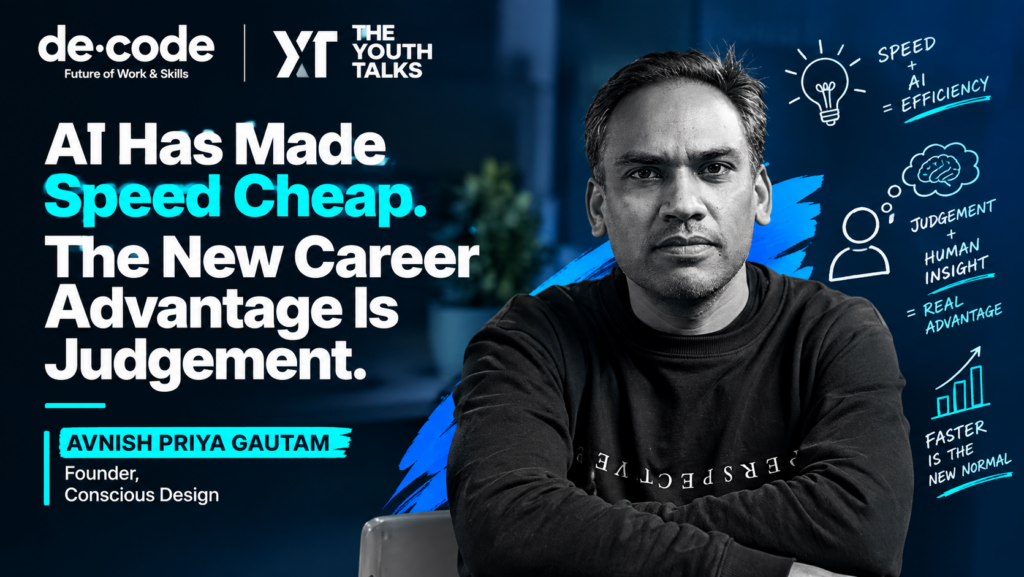
At a recent AI Jobs Project session, designer and builder Avnish Priya Gautam challenged students to rethink what makes people valuable in an AI-first workplace. When everyone can create faster, he argued, the real differentiator may be knowing what is worth creating in the first place.
For decades, one of the biggest advantages a professional could develop was the ability to execute.
Learn a skill. Become good at it. Work faster. Produce more.
Artificial intelligence is changing that equation.
Today, an AI tool can help an engineer write code, a designer create interfaces, a marketer develop campaigns and a founder prototype an idea — often in minutes.
The result is a world where the ability to create is becoming increasingly accessible.
But if everyone can create faster, what actually makes one person more valuable than another?
For Avnish Priya Gautam, a designer and builder with two decades of experience, the answer lies in a deceptively simple idea:
Speed is free. Judgement isn’t.
That was the central theme of his conversation with students at a recent AI Jobs Project session.
When everyone gets faster, speed stops being the advantage
Avnish began with a personal story from his time as a design head at a healthcare company.
His team had been given a large body of information — months of consumer research, user research, customer-service data and in-app feedback. The assignment was to extract meaningful insights and translate them into implementable design directions.
Under normal circumstances, he says, such work could take two or three weeks.
The deadline this time was four days.
His first reaction was that there had to be a mistake.
There wasn’t.
What he realised was that the organisation had entered a new reality where expectations around speed had changed. AI and new tools had made it possible to compress work that once took weeks into days — and organisations were beginning to assume that faster turnaround was simply the new normal.
That observation has an important implication for young professionals.
Being fast may no longer be a competitive advantage when everybody has access to the same acceleration.
If AI can help everyone produce more quickly, then speed becomes the baseline.
The harder question becomes: what should you produce?
AI can build it. But should you build it?
This is where Avnish’s argument moves from productivity to design thinking.
He believes AI has dramatically lowered the barrier between an idea and its execution.
A student can imagine a product and potentially have a working prototype by the end of the day. An engineer can use AI to generate code. A designer can create polished visual work. A founder can experiment with multiple ideas without assembling a large team first.
The ability to make something is no longer necessarily the bottleneck.
Judgement is.
Is the idea meaningful?
Does anyone actually need it?
Does it create value?
Does it solve a real problem?
And perhaps most importantly: is this the best use of the time and resources available?
That distinction is becoming particularly important for students entering the workforce.
The traditional question was often:
“Can you do this?”
The AI-era question may increasingly become:
“Why are you doing this?”
The nine hours AI gives you are not automatically nine productive hours
Avnish offers an interesting way of thinking about AI-driven productivity.
Suppose a task that once took ten hours can now be completed in one hour with AI.
You have gained nine hours.
The obvious response is to use those nine hours to produce nine more things.
But that isn’t necessarily the best outcome.
You could instead use the time to think more deeply about the problem, explore alternatives, understand the user, test the idea or decide whether the original task was even worth doing.
In other words, AI gives you more time. What you do with that time becomes a question of judgement.
This is particularly relevant for young professionals who may otherwise fall into the trap of measuring their value purely through output.
More output is not necessarily more value.
Sometimes, the most valuable decision is deciding what not to build.
The boundaries between engineer, designer and builder are disappearing
Avnish also challenges another assumption that has shaped professional careers: that people should remain within clearly defined roles.
He argues that AI is blurring those boundaries.
Engineers can increasingly design.
Designers can increasingly ship code.
Product managers can prototype.
Founders can build.
People who once needed to depend on specialists for every stage of creation can now use AI to participate directly in multiple parts of the process.
For students, this could mean that saying “I only know how to code” may become a weaker proposition.
Technical depth will still matter, but the ability to understand the larger problem and collaborate across disciplines could become equally important.
Avnish makes the point bluntly: if someone’s work can be reduced to a predictable, repeatable Standard Operating Procedure, it becomes increasingly vulnerable to automation.
The implication isn’t that every SOP-driven job disappears overnight.
It is that repeatable execution is becoming easier to automate, making uniquely human judgement more important.
When CEOs can build with AI, expectations change too
One of Avnish’s most revealing examples comes from his experience working on AI features for a large electronics company.
His team’s responsibility was to develop features that could create new value and revenue around existing products.
But something unexpected happened.
Senior leaders themselves began using AI to create ideas and prototypes.
Suddenly, the leadership team could experiment with concepts in minutes.
That changed the conversation with the design and product teams.
Instead of simply asking when something could be delivered, leaders could look at an AI-generated concept and ask why the professional team’s output didn’t look as impressive or move as quickly.
Avnish’s team increasingly found itself defending not its ability to execute, but the judgement behind what it had chosen to build.
The shift is profound.
AI isn’t just changing the tools employees use.
It is changing what employers can reasonably expect employees to accomplish.
The new bottleneck may be “taste”
Avnish describes this new bottleneck using an interesting word: taste.
Not taste in the narrow aesthetic sense, but the ability to recognise whether something is meaningful, useful, appropriate and valuable.
AI can give you ten possible answers.
It can produce ten designs.
It can generate ten product ideas.
It can write ten versions of the same piece of code.
But which one should you choose?
That requires context.
It requires understanding people.
It requires knowing the constraints.
And ultimately, it requires judgement.
For students, this may be one of the most important skills to start developing now.
Don’t simply ask AI to create.
Look at what it creates. Critique it. Question it. Improve it. Understand why one solution is better than another.
That is how taste develops.
So what does this mean for the next generation of professionals?
Avnish doesn’t offer students the comforting promise that AI won’t affect their careers.
Quite the opposite.
He acknowledges that nobody can say with certainty which jobs AI will eventually transform or eliminate. The outcome will depend partly on how the technology evolves — and partly on how people prepare themselves.
His own position is equally clear: everyone is a student in this new environment, including experienced professionals.
That may ultimately be the most important message from his session.
The AI era isn’t simply about learning another tool.
It is about moving up the value chain.
From executing → thinking.
From building → deciding what to build.
From speed → judgement.
And from asking “Can I make this?” to asking the far more important question:
“Should this exist?”
Because when AI makes creation faster and more accessible to everyone, the scarce skill may no longer be the ability to build. It may be the judgement to know what deserves to be built.