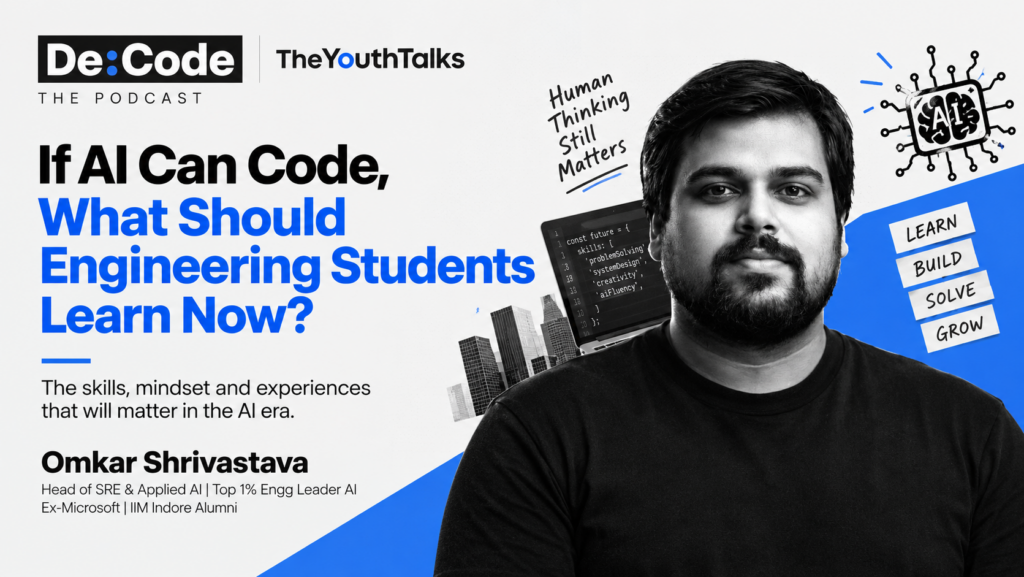
As AI takes over more of the work traditionally associated with software engineering, Omkar Shrivastava, Head of SRE & Applied AI at Levi’s and former Microsoft engineering leader, believes the advantage will increasingly belong to those who can solve problems—not simply write code.
For years, engineering students were told that the formula for a successful technology career was relatively straightforward: build strong technical fundamentals, learn to code, get a good degree and find a job.
That formula is now being disrupted.
AI can already help engineers write code, debug problems, generate documentation and accelerate development. For a student entering the industry today, the question is no longer simply “Can you code?”
It is becoming:
“Can you figure out what needs to be built in the first place?”
That was one of the central themes in TheYouthTalks’ De:Code conversation with Omkar Shrivastava, Head of SRE & Applied AI at Levi’s, former Microsoft engineering leader and an IIM Indore alumnus. With more than 15 years of experience across engineering, data, SRE and AI, Shrivastava’s own career journey—from a Tier-3 college to some of the world’s largest technology companies—offers an interesting perspective on how the engineering career is changing.
Your college can open the door. It doesn’t decide how far you go.
Shrivastava is candid about the advantages students at premier institutions have.
IITs and other leading colleges offer better placement opportunities, stronger alumni networks and an environment that can expose students to industry-level problems much earlier. For students at Tier-2 and Tier-3 institutions, those opportunities often have to be found independently.
But there is another side to the equation.
Shrivastava believes the willingness to learn, solve real-world problems and continuously update one’s skills can eventually matter more than where a student started.
His own first job came through an off-campus route. After a difficult period that included preparing for the civil services examination and waiting for an Infosys joining date, he chose not to sit idle. He moved to Bengaluru, joined a startup and gained experience before eventually beginning his Infosys journey.
For students, there is an important lesson here: a delayed opportunity doesn’t have to mean wasted time.
AI is giving students a head start
Shrivastava describes AI in an interesting way: as an accelerator.
If engineering was once a race in which a student started at zero, AI can effectively move that starting point several hundred metres forward. But the advantage depends on how effectively the student uses the technology.
That could be particularly significant for students who don’t have access to the same institutional ecosystem as students at premier colleges.
The internet has already democratised access to knowledge. AI is taking that one step further by making it possible for students to learn, experiment and build with assistance that previously required much more experience.
But there is a catch.
Everyone gets access to the same tools.
If everyone is using the same GPT models, copilots and AI development tools, simply knowing how to use them will eventually become less of a differentiator.
Coding may become less important than thinking
This is where Shrivastava sees the biggest change.
AI can generate increasingly sophisticated code, potentially allowing a relatively inexperienced engineer to produce work that would previously have required significantly more experience.
But writing individual pieces of code isn’t the same as understanding an entire system.
When multiple technologies, applications, databases and services have to work together, context becomes critical. Shrivastava believes experienced engineers will continue to have an advantage in system design and complex problem-solving because understanding the larger architecture requires more than simply generating code.
That points towards a different skill hierarchy for young engineers.
Coding remains important. But problem-solving may become more important.
So what will companies look for?
Shrivastava expects analytical ability, depth of thinking and fresh ideas to become increasingly valuable.
He has also noticed people from non-technical backgrounds participating in technology and AI discussions and performing surprisingly well—not necessarily because they can code better, but because they approach problems differently.
For students, this is perhaps the most encouraging part of the conversation.
You don’t necessarily need to know everything.
You need to be able to learn, question, analyse and solve.
And you need to keep doing it.
Shrivastava describes technology careers as a continuous process of “unlearn and learn”. A BTech degree, in his view, isn’t the finishing line. Once students enter the workplace, the problems they encounter can be very different from what they studied in college.
Don’t compete with AI. Learn to use it.
Shrivastava compares today’s AI transition with the arrival of calculators.
When technology automated repetitive accounting work, people who refused to learn the new tools became vulnerable. Those who learned to use them gained an advantage. He sees AI in much the same way: another technology that can increase productivity and allow people to create more value.
For today’s engineering student, therefore, the message isn’t to become afraid of AI.
It is to become better because of it.
Learn to code. Learn AI. Build projects. Understand systems. Solve problems outside textbooks. Experiment. Ask better questions. Develop the ability to work with ambiguity.
Because if AI eventually makes coding accessible to almost everyone, the most valuable engineer may not be the one who can write the most code.
It may be the one who can look at a difficult problem and know what to build, why to build it and how to make it work in the real world.
And for students, that could be the biggest career shift AI brings—not the end of engineering, but the beginning of a very different definition of what it means to be an engineer.