

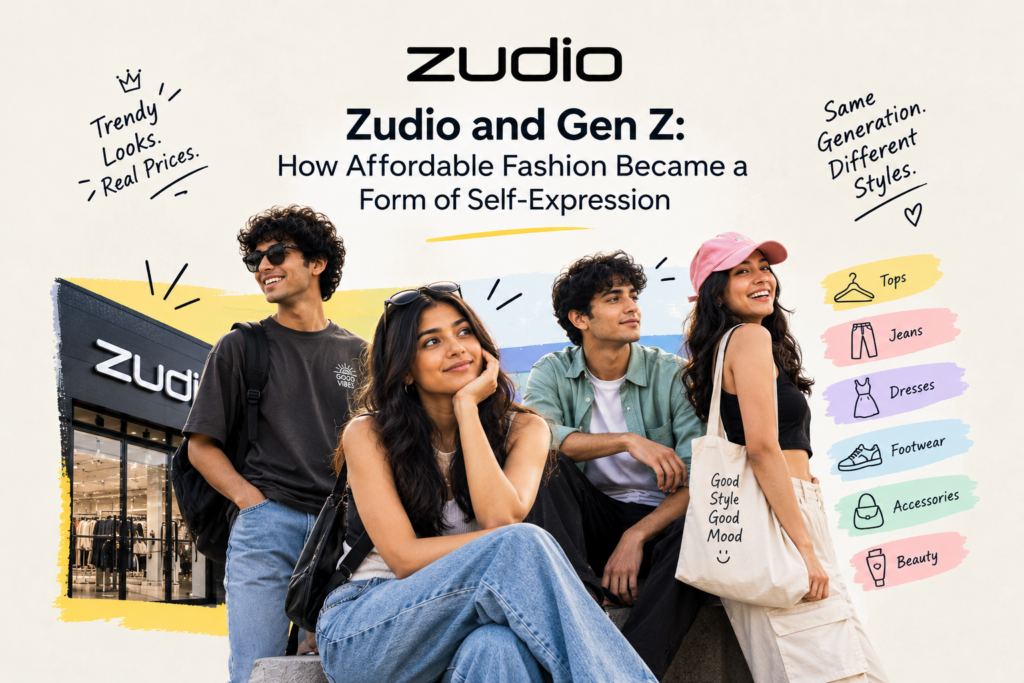
From college wardrobes to everyday street style, Zudio’s rise reflects a generation’s desire to experiment with fashion without spending a fortune.
Walk into a Zudio store and the appeal is not particularly difficult to understand. There are T-shirts, jeans, dresses, footwear, accessories and beauty products, with new styles offering shoppers plenty to browse. The prices make trying something different feel more achievable than it might at a premium fashion retailer.
For a college student, that could mean buying a new outfit for a party. For a young professional, it might mean refreshing a work wardrobe without committing a large part of a monthly salary. For someone simply curious about a new trend, it creates an opportunity to experiment without making an expensive purchase.
This is where Zudio’s story becomes more interesting than low prices alone.
For many young consumers, fashion is not simply about buying clothes. It is about trying out identities, expressing personal taste and adapting to changing trends. The challenge is that experimentation can become expensive when every new look requires a significant investment.
Zudio has built its proposition around making contemporary fashion accessible to a broad range of consumers. Owned by Trent Limited, part of the Tata Group, the brand has grown into one of India’s most visible value-fashion retailers.
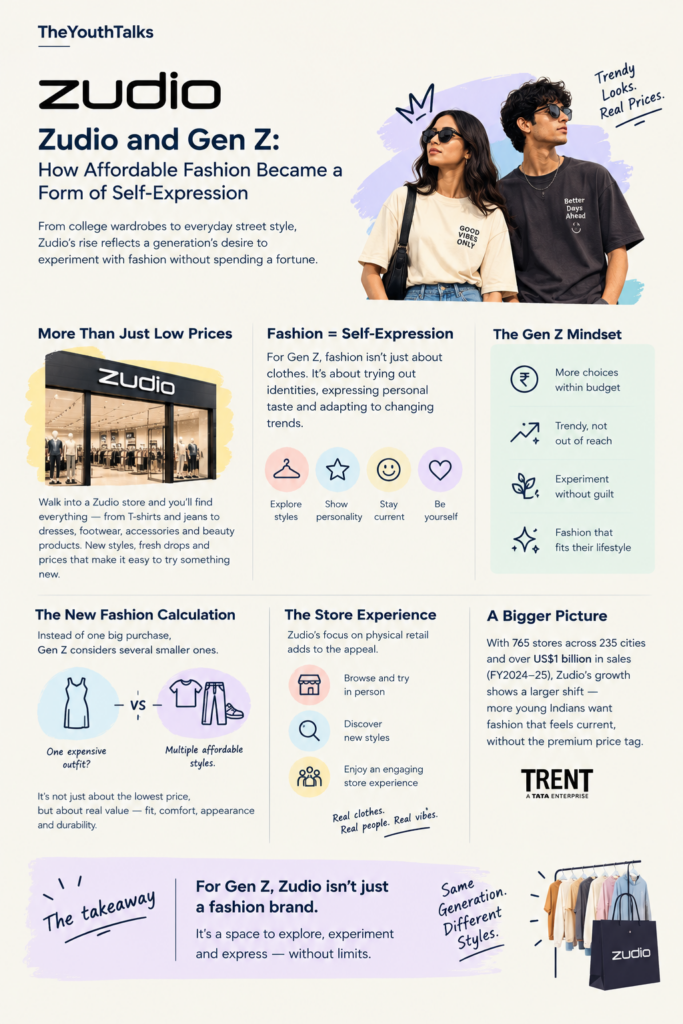
Trent reported that Zudio crossed US$1 billion in sales in FY2024–25, with 765 stores across 235 cities as of March 2025. Its expansion offers a useful lens through which to examine a bigger consumer shift: the growing appeal of fashion that feels current without requiring premium spending.
For Gen Z, the significance may lie not in any one T-shirt or pair of jeans, but in the freedom to make more choices about how they present themselves.
Fashion is a form of self-expression
Young consumers encounter fashion trends through a variety of channels: friends, creators, celebrities, films, music, college campuses and social platforms. They can see different aesthetics, compare styles and discover looks that they may want to try for themselves.
But seeing a trend and participating in it are two different things.
Price can determine whether an appealing style remains something to admire from a distance or becomes something a shopper can actually wear. Affordable fashion lowers that barrier, making it easier to experiment with silhouettes, colours, prints and accessories.
A consumer might try oversized clothing one month and a more fitted style the next. Someone else may prefer minimal basics, while another gravitates towards statement pieces. Not every purchase represents a carefully considered expression of identity; sometimes a shopper simply likes the way something looks.
The important point is that fashion choices can be fluid. Young consumers do not necessarily want to commit to one aesthetic, brand or style for years.
Affordable options can make that fluidity easier to accommodate.
This is one reason Zudio’s appeal can resonate with younger shoppers. Its value proposition allows consumers to participate in everyday fashion without every purchase having to be a major financial decision.
That does not establish that Gen Z is the brand’s only or even its largest customer segment. Zudio serves a much broader market. But its success offers a window into the preferences of younger, trend-conscious consumers who want choice alongside affordability.
The new fashion calculation: how much can I experiment for?
For years, fashion brands have often tried to persuade consumers to pay more through labels, design, perceived quality or an aspirational lifestyle. Those propositions continue to work for many customers.
Zudio’s model approaches the question differently. It makes the price itself a central part of the proposition, while attempting to keep the merchandise contemporary and the store experience engaging.
For a young shopper managing a limited budget, this changes the calculation.
Instead of asking whether a single expensive purchase is worth the money, the shopper can consider several smaller purchases. A new top, a pair of everyday trousers or an accessory may offer a way to refresh an existing wardrobe without replacing everything.
There is a distinction here between buying cheaply and buying with a clear sense of value. Low prices may attract the first visit, but shoppers still need to feel that the product is worth what they paid.
Fit, comfort, appearance and durability matter. A garment that looks appealing on a rack but does not work in everyday life may not encourage a return visit.
Zudio’s long-term challenge, like that of any value-fashion retailer, is to ensure that its affordability is supported by a sufficiently compelling product proposition.
The consumer is not simply looking for the lowest possible price. The consumer wants a price that makes sense for the product.
The store is part of the attraction
One of the more unusual aspects of Zudio’s strategy is its emphasis on physical retail.
In an era when many fashion brands have invested heavily in e-commerce, apps and digital customer acquisition, Trent’s annual report describes Zudio as deliberately avoiding online retail because of the economics of the segment. The company instead emphasises store accessibility, frequently refreshed merchandise and expansion into new markets.
That decision shapes the shopping experience.
A physical store allows customers to browse products, assess colours and fabrics, check fit and compare options immediately. Shoppers can discover an item they were not specifically looking for and decide whether it is worth adding to their basket.
The experience is different from searching for a particular product online. It is more exploratory, and that can suit a retailer whose proposition depends partly on giving customers new things to discover on successive visits.
Store locations matter, too. By expanding across cities and neighbourhoods, Zudio can make its offering accessible to shoppers who may not regularly visit premium shopping destinations.
Trent reported that Zudio entered 67 cities during FY2024–25 and increased its presence in another 56 cities, including Tier II and Tier III markets.
That expansion matters because fashion aspirations are not limited to India’s largest metropolitan areas. Young people in smaller cities also encounter global and national trends, develop personal styles and seek products that help them express themselves.
The opportunity is to bring an accessible retail format closer to those consumers.
Why the business model matters as much as the price tag
Zudio’s growth is not simply a story of putting inexpensive clothes on shelves. Its business model is designed around controlling costs while keeping merchandise fresh.
Trent’s annual report highlights predominantly domestic sourcing, in-house merchandise curation and shorter lead times as elements of the model. The company also describes avoiding heavy price discounting and marketing expenditure, instead building visibility through the expansion of its store network.
These operational choices are important because value fashion is a demanding business. Consumers expect affordable prices, but trends can change quickly. Retailers must decide what to stock, how much inventory to hold, when to refresh collections and how to avoid being left with merchandise that no longer attracts shoppers.
A brand cannot rely indefinitely on low prices if its products stop feeling relevant.
Zudio’s approach attempts to connect affordability with responsiveness: maintain accessible prices while bringing refreshed merchandise into stores.
For shoppers, the result is a reason to browse again. For the retailer, the challenge is to make that freshness work without undermining cost discipline or product quality.
The model is not easily reduced to a single tactic. Pricing, sourcing, inventory management, store expansion and merchandise selection need to work together.
That is an important lesson for other brands seeking to attract value-conscious younger consumers. Simply lowering prices does not automatically recreate Zudio’s proposition.
Social media creates the aspiration. Retail makes it accessible.
Young consumers do not discover fashion through stores alone. Social media, creators, entertainment and peer groups can introduce new looks and make particular styles more visible.
But the relationship between online inspiration and offline buying is more complicated than assuming that a viral trend immediately translates into sales.
A shopper may see an outfit online and look for something similar at a price they can afford. Another may use social platforms to explore different aesthetics before deciding what suits them. Some will follow trends closely; others will adapt ideas to their own preferences.
Zudio’s role in this environment is not necessarily to originate every trend. It is to offer accessible merchandise that allows shoppers to participate in the broader fashion conversation.
That distinction matters. A retailer does not need to persuade every customer to adopt a completely new style. It can succeed by giving customers affordable ways to update the styles they already enjoy.
For brands, this also highlights why visibility and conversion are different things. A trend can attract attention, but the product must still be available, appealing and priced appropriately for the shopper who wants to act on that interest.
Affordable fashion does not mean every young consumer shops the same way
It would be a mistake to interpret Zudio’s success as evidence that Gen Z cares only about price.
Young consumers are not a uniform market. Some prioritise affordability above almost everything else. Others are willing to spend more on footwear, branded products, quality basics or specific styles. Many mix price points, buying inexpensive everyday items while saving for a purchase they consider more important.
The same person may shop differently depending on the occasion, their budget and how frequently they expect to use a product.
That is why the more useful lesson from Zudio is not that every brand should become cheaper. It is that brands need to understand the value equation for the consumers they serve.
What does the customer expect at a particular price? Which products are worth spending more on? Where does affordability enable experimentation, and where might quality or longevity take priority?
These questions are more revealing than assuming that an entire generation follows one purchasing pattern.
Zudio’s appeal lies in a specific combination of price, accessible locations, changing merchandise and a relatively straightforward shopping proposition. Other brands will need to identify their own combination rather than imitate only the price point.
The sustainability question cannot be ignored
The growth of affordable, trend-led fashion also raises a legitimate question: what happens when lower prices make it easier to buy more clothes?
More accessible fashion can allow people to participate in trends that might otherwise be out of reach. But the wider fast-fashion model can also encourage frequent purchasing, short product lifecycles and greater textile waste.
It would be unfair to assume that every Zudio purchase is disposable or that all customers buy clothing simply because it is inexpensive. Equally, a discussion of the brand’s success should not ignore the environmental questions associated with high-volume fashion consumption.
The challenge for the industry is to make affordability compatible with better product longevity and more responsible consumption.
For shoppers, that might mean choosing items they expect to wear repeatedly, taking care of their clothes and combining new purchases with existing wardrobes. For retailers, it raises questions about material choices, durability, inventory and what happens to products after use.
Affordable fashion and responsible consumption are not necessarily incompatible, but achieving both requires more than an attractive price tag.
What other brands can learn from Zudio
Zudio’s rise offers several lessons for brands seeking to understand younger Indian consumers.
First, affordability can expand participation. It allows more consumers to explore fashion trends without making every purchase a major financial commitment.
Second, value must be visible. The combination of price, merchandise, convenience and shopping experience matters more than price alone.
Third, physical accessibility remains powerful. Digital discovery is important, but a well-located store can still be central to how shoppers encounter and evaluate products.
Fourth, freshness requires operational discipline. Keeping merchandise relevant involves decisions about sourcing, inventory and timing, not simply adding new styles.
Finally, brands should not confuse a generation with a single audience. Gen Z includes consumers with different incomes, tastes, priorities and shopping habits. Understanding those differences is essential to building a lasting proposition.
These lessons extend beyond apparel. They apply wherever consumers want products that help them participate in a lifestyle without paying more than they believe the experience is worth.
The bigger picture
Zudio’s success is part of a larger change in Indian retail: contemporary fashion is becoming more accessible across a wider range of markets and consumers.
For younger shoppers, the attraction is not necessarily about owning a particular label. It can be about having more choices, trying a different look or finding clothes that fit their lives and budgets.
That is why the brand’s story deserves attention beyond its store count or sales performance. It illustrates how affordability can become an enabler of self-expression, rather than merely a response to limited spending power.
The next challenge for Zudio is to sustain that proposition as it grows: keep prices compelling, merchandise relevant and the shopping experience worthwhile in an increasingly competitive value-fashion market.
For other brands, the lesson is equally clear. Young consumers do not automatically reject premium fashion, nor do they automatically embrace inexpensive fashion. They make trade-offs based on what matters to them.
Sometimes that is a label. Sometimes it is quality. Sometimes it is the freedom to try something new without spending too much.
Zudio’s biggest lesson may be that when fashion becomes more affordable, the opportunity is not just to sell more clothes. It is to give more people the freedom to experiment with who they want to be.