
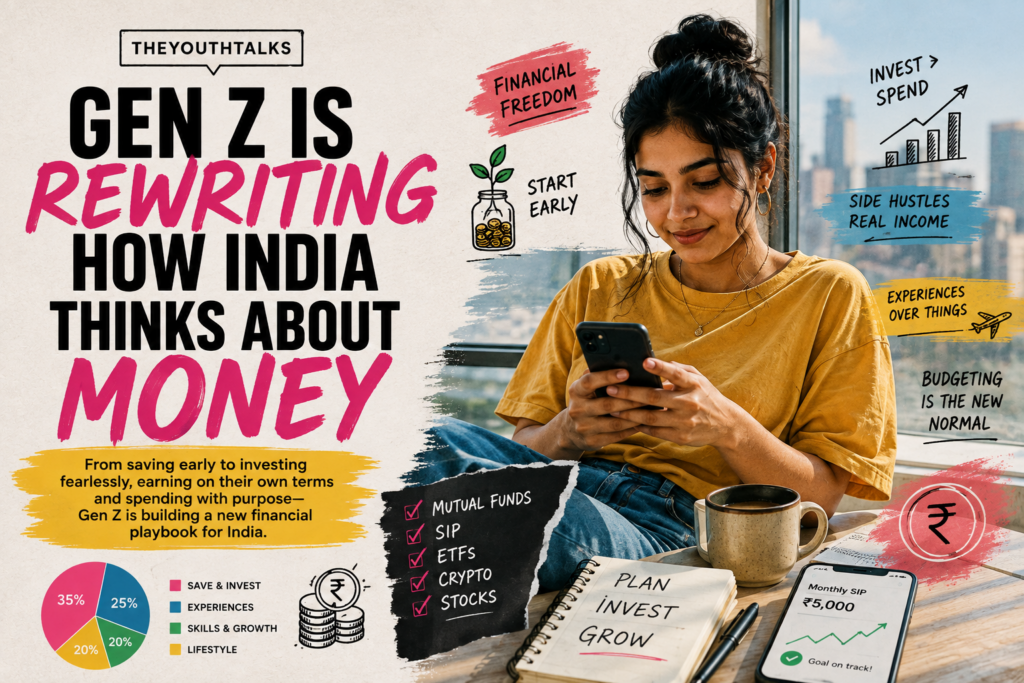
From SIPs and stocks to financial independence, India’s youngest generation is moving beyond FDs and traditional ideas of wealth. The bigger story is not what they invest in, but what they believe money should do for them.
For generations of Indians, financial security had a familiar shape.
Save your salary.
Buy some gold.
Open a fixed deposit.
Build your provident fund.
Eventually, buy a house.
The formula was simple: work hard, save consistently and avoid unnecessary risk.
For many families, these weren’t just financial choices. They were almost cultural instructions passed from one generation to another.
Then came Gen Z.
India’s youngest working generation is entering adulthood with a very different financial environment. Their money lives on smartphones. Their investment choices are influenced by apps, creators, podcasts, social media and digital communities. They can track markets in real time, start a SIP with relatively small amounts and explore stocks without ever visiting a bank or meeting a traditional broker.
But the bigger change isn’t technological.
It is psychological.
The question for a young Indian today is increasingly not just:
“How much should I save?”
It is:
“How can I make my money work for me?”
That shift could reshape India’s relationship with wealth over the next decade.
From Saving Money to Building Wealth
The traditional Indian approach to money was heavily influenced by security.
An FD felt safe.
Gold felt tangible.
A house represented stability.
Savings provided a cushion against uncertainty.
For Gen Z, those ideas haven’t disappeared. But they are being joined by a new definition of financial security.
Security can mean having investments.
It can mean liquidity.
It can mean multiple income streams.
It can mean being financially independent earlier in life.
And increasingly, it can mean having enough financial flexibility to make choices without being completely dependent on a monthly salary.
That last point is particularly important.
For a young professional, wealth may not simply mean owning a larger house or a more expensive car. It may mean being able to change jobs without panic, take a career break, travel, start a business or move to another city without feeling financially trapped.
In that sense, investing becomes more than a financial activity.
It becomes a tool for freedom.
The Smartphone Has Become the New Investment Desk
Perhaps the biggest force behind this change is not the stock market itself.
It is the smartphone.
Investing once came with considerable friction.
There were forms to fill. Brokers to contact. Documents to understand. Financial terminology that could make even a curious beginner hesitate.
Today, much of that complexity has been compressed into an app.
A smartphone has effectively become a personal financial interface.
A young professional can open an investment account, explore mutual funds, set up an SIP, monitor a portfolio and learn about a financial product without leaving the room.
And reducing friction changes behaviour.
When something feels complicated, people postpone it.
When something becomes accessible, they experiment.
Gen Z is particularly comfortable with this model because apps already manage much of their everyday lives.
They order food through apps.
They book travel through apps.
They learn through apps.
They communicate through apps.
So why should investing be different?
The distance between earning money and investing money has become remarkably small.
And that means investing can begin much earlier.
It no longer necessarily has to wait for marriage, home ownership, a senior job title or a six-figure monthly salary.
It can begin with the first serious paycheque.
The Rise of the Small Investor
One of the most significant trends in India’s investment ecosystem is the growing participation of younger investors.
More than 56% of newly opened SIP accounts are reportedly held by investors under 30, while the average age of Indian stock-market investors has fallen from around 36 to 33.
The numbers matter.
But the behaviour behind them matters even more.
A generation is beginning to invest earlier.
And it isn’t necessarily waiting for large sums of money to accumulate first.
Young investors are increasingly comfortable starting with manageable amounts and building the habit over time. Some research places typical monthly investments among younger investors in the ₹10,000–₹15,000 range, although the amount varies significantly depending on income and circumstances.
The principle is more important than the number:
Start early. Start small. Keep going.
That philosophy fits naturally with SIPs.
Why SIPs Fit the Gen Z Mindset
SIPs have a psychological advantage that makes them particularly compatible with younger investors.
They turn investing into a habit.
Instead of asking someone to make one large financial decision, they encourage a smaller decision repeatedly.
For someone earning their first salary, investing ₹2,000, ₹5,000 or ₹10,000 a month can feel much more achievable than waiting until they have accumulated a large lump sum.
Once automated, the process also requires less active decision-making.
That matters because good financial behaviour is often less about making one brilliant decision and more about making reasonably good decisions consistently.
Gen Z may not know everything about markets.
But they have something previous generations did not have at the same scale:
instant access to the tools required to participate.
And that accessibility is changing who gets to think of themselves as an investor.
Gen Z Is Becoming More Comfortable With Equity
The growing interest in stocks and equity mutual funds is another important part of the story.
Recent portfolio data indicates that direct stocks and equity mutual funds account for a substantial portion of retail investment portfolios, with one cited distribution putting the figure at around 47%.
It would be tempting to interpret this simply as evidence that young Indians are becoming more aggressive.
That would be too simplistic.
A better interpretation is that equities have become much more familiar.
Stocks are no longer discussed exclusively by brokers and financial professionals.
They are part of everyday digital culture.
An IPO becomes social-media content.
A company’s quarterly results become a talking point.
A market rally appears across news feeds.
A young investor can follow an entire financial story unfold on their phone.
Markets have moved closer to popular culture.
And that proximity can have two very different consequences.
It can create confidence.
But it can also create overconfidence.
That distinction will become increasingly important as more young Indians enter the market.
The Finfluencer Has Changed Financial Education
Previous generations often learned about money from parents, relatives, newspapers, bank managers or financial advisors.
Gen Z may encounter financial education somewhere very different.
Instagram.
YouTube.
Podcasts.
Short-form videos.
Online communities.
The rise of the finfluencer has fundamentally changed how financial information travels.
A complicated financial concept can now be explained in 60 seconds.
An investor can watch a video about compounding while travelling to work.
A creator can explain mutual funds using everyday examples.
A podcast can turn an intimidating subject into a conversation.
This democratises financial education.
But it also creates a serious problem.
Who is checking the person giving the advice?
Not every creator is qualified.
Not every financial opinion is suitable for every investor.
And not every attractive investment story comes with an honest discussion of risk.
Some research suggests that more than 60% of investors under 25 have been influenced by financial content on social media.
That is an extraordinary level of influence.
It means financial brands are no longer competing only with banks and brokerages for attention.
They are competing with creators.
And for Gen Z, trust may increasingly be built through authenticity, explanation and community rather than institutional authority alone.
More Information Doesn’t Necessarily Mean Better Decisions
This is perhaps the contradiction at the heart of Gen Z’s financial revolution.
Young Indians have access to more financial information than ever before.
But access to information isn’t the same as financial literacy.
Someone can open a demat account without understanding volatility.
Someone can start an SIP without understanding the fund they’re investing in.
Someone can follow a stock tip without understanding the downside.
And someone who experiences strong returns during a bull market may develop a sense of confidence that hasn’t yet been tested by a serious correction.
In other words:
Gen Z may be more financially engaged without necessarily being financially mature.
That distinction matters.
The next phase of India’s investment revolution cannot simply be about encouraging more young people to invest.
It must also be about teaching them how to think.
How to assess risk.
How to diversify.
How to distinguish education from advice.
How to understand time horizons.
And perhaps most importantly, how to resist the temptation to confuse a good investment decision with a lucky outcome.
Tier-2 India Is Entering the Investment Conversation
There is another dimension that makes this transformation particularly significant for India.
Digital investment platforms are expanding participation beyond the biggest metropolitan centres.
Data from major investment platforms has indicated that a significant majority of their investors come from Tier-2 and Tier-3 cities, with younger users representing a substantial share of the overall customer base.
That points towards something bigger than a change in investment preferences.
It points towards financial democratisation.
A young person in a smaller Indian city can increasingly access many of the same digital investment tools available to someone in Mumbai, Delhi or Bengaluru.
Geography matters less.
This is part of a much larger transformation.
Digital platforms have already changed access to education, employment, entertainment, commerce and entrepreneurship.
Now they are changing access to financial markets.
And that could bring millions of new investors into India’s financial ecosystem.
What Does Gen Z Actually Want Money For?
This may be the most important question of all.
Because investment behaviour doesn’t exist in isolation.
It reflects aspirations.
For previous generations, wealth was often represented by visible assets.
A house.
A car.
Gold.
Savings.
For Gen Z, the definition may be more fluid.
Financial success could mean being able to travel.
Taking a career break.
Starting a business.
Working remotely.
Moving to another city.
Supporting parents.
Pursuing a passion.
Or simply having enough money invested to know that one bad month will not derail their entire life.
That changes the emotional meaning of investing.
It isn’t necessarily about becoming rich.
It is about becoming less financially trapped.
An SIP can therefore represent something bigger than a mutual-fund contribution.
For a young investor, it can be a small monthly act of independence.
Is the House Still the Ultimate Financial Goal?
For decades, buying a home has been one of India’s strongest symbols of financial success.
Gen Z isn’t necessarily abandoning that ambition.
But it may be questioning the timing.
A young professional might prefer renting for longer because it offers mobility.
They may want to change cities.
Switch careers.
Travel.
Build a business.
Or simply keep more of their wealth liquid.
A large mortgage can provide stability, but it can also reduce flexibility.
For a generation that has grown up watching careers, workplaces and even cities change rapidly, flexibility itself can feel valuable.
That doesn’t mean Gen Z doesn’t want property.
It means the traditional sequence—
education → job → marriage → house → children
—is no longer the only financial roadmap.
There are now many versions of adulthood.
And consequently, many versions of wealth.
Gen Z May Be Redefining Financial Success
Perhaps the biggest shift is philosophical.
Previous generations often asked:
“How much should I save?”
Gen Z is increasingly asking:
“How can I grow what I have?”
That is a fundamentally different starting point.
It moves the conversation from preservation to participation.
From savings to wealth creation.
From waiting to starting.
And from financial security as a destination to financial independence as an ongoing process.
Money becomes less about what you own and more about what choices your money allows you to make.
That is a powerful idea.
And it may influence everything from banking products to credit, insurance, wealth management and financial content over the next decade.
What This Means for Banks, Fintechs and Brands
India’s financial industry has a massive generational opportunity in front of it.
But Gen Z may not respond to traditional financial messaging.
“Secure your future” can sound distant.
“Plan for retirement” can feel irrelevant at 23.
“Build long-term wealth” may be correct, but abstract.
The opportunity is to make financial outcomes tangible.
Build your first ₹10 lakh.
Create an emergency fund.
Invest for your next decade.
Build financial freedom before you need it.
The language changes.
And so does the relationship.
Financial brands can become educators rather than simply product sellers.
Content can become part of the product experience.
Communities can become part of customer acquisition.
Creators can become part of financial education.
And trust can become the most important differentiator.
Because the young investor isn’t simply asking:
“Where should I put my money?”
They are also asking:
“Who should I trust with my financial future?”
The Future of Money Is Getting Younger
India’s investment landscape is changing.
The investor is getting younger.
The platforms are getting simpler.
Financial information is becoming more accessible.
And the definition of wealth is becoming more personal.
For Gen Z, financial independence may not mean owning everything.
It may mean having enough freedom to choose what comes next.
That is perhaps the most important shift of all.
The previous generation often measured wealth through accumulation.
The next generation may measure it through optionality.
The ability to say no.
The ability to take a risk.
The ability to change direction.
The ability to walk away from a bad job.
The ability to pursue an idea.
The ability to live life on your own terms.
And perhaps that is what Gen Z is really investing in.
Not just stocks.
Not just mutual funds.
Not just SIPs.
Freedom.
India’s next generation of wealth creators isn’t waiting for adulthood to begin.
They have already started investing in the life they want.