
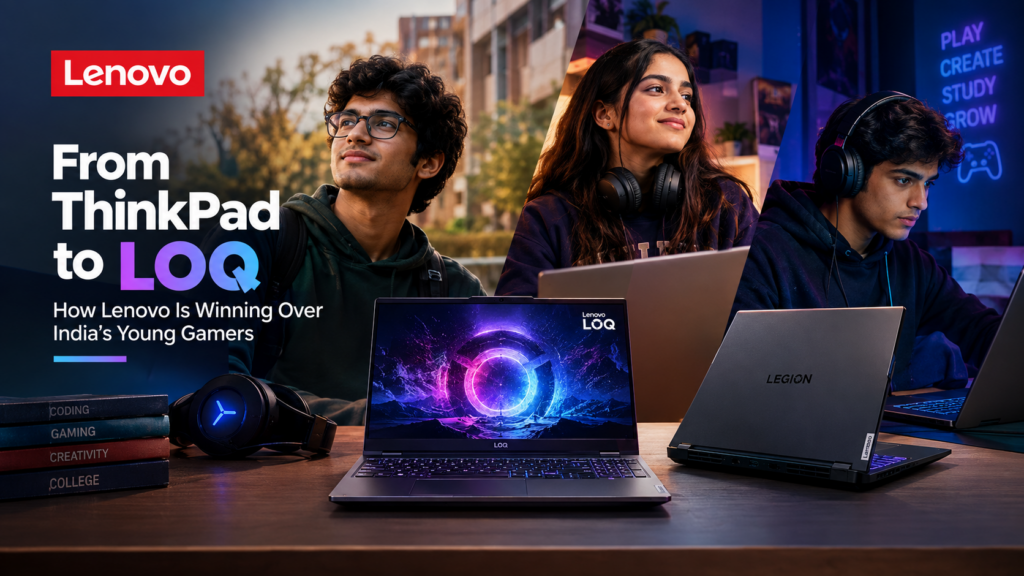
For years, Lenovo meant ThinkPad, college laptops and dependable everyday computing. Gaming belonged to brands such as ROG, Predator and MSI. But among India’s young gamers, Lenovo is increasingly becoming part of the conversation — and LOQ and Legion may have a lot to do with it.
There was a time when the phrase gaming laptop immediately brought a handful of names to mind.
ASUS ROG. Acer Predator. MSI.
Lenovo, meanwhile, occupied a very different space in the Indian consumer’s mind.
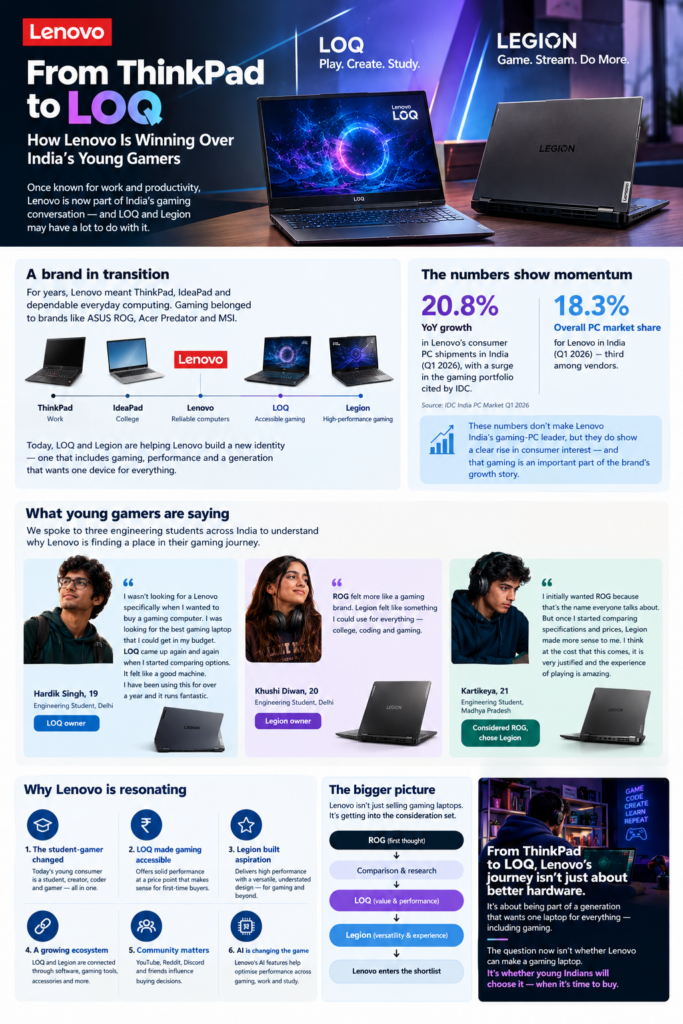
ThinkPad meant work. IdeaPad meant college. Lenovo meant a reliable computer that could get things done.
Gaming was something else.
That distinction is becoming harder to make.
Walk into the laptop-buying journey of a young Indian gamer today and Lenovo’s gaming portfolio is increasingly difficult to ignore. At one end is LOQ, positioned as an accessible entry point into PC gaming. At the other is Legion, Lenovo’s more premium gaming line.
And perhaps more importantly, Lenovo is increasingly selling these machines not simply as gaming computers, but as computers for young people whose lives happen to include gaming.
That may sound like a subtle difference.
It isn’t.
The young gamer isn’t only a gamer anymore
The traditional idea of a gaming laptop was relatively straightforward: powerful hardware, high refresh-rate display, dedicated graphics and enough performance to run demanding games.
But the Indian student buying a gaming laptop today may also be a computer science student, content creator, programmer, designer, freelancer or aspiring entrepreneur.
The laptop has to survive college before it gets to the gaming session.
Lenovo appears to understand this shift.
Its current LOQ positioning explicitly talks about gaming alongside studying, working, creating and streaming. Its student offering also brings LOQ and Legion into a broader “student gamer” proposition, alongside machines positioned for coding, content creation and other university work.
Legion similarly sits at the intersection of gaming and other demanding use cases, with Lenovo positioning newer Legion machines around gaming, streaming and STEM work.
For a generation that increasingly expects one device to do everything, that matters.
And the experiences of young gamers themselves offer an interesting glimpse into how the decision is actually being made.
LOQ came up again and again
Hardik Singh, an engineering student in Delhi and a Lenovo LOQ owner, says Lenovo wasn’t even the starting point when he began looking for a gaming laptop.
He was looking for something much more basic: the best machine he could get for his money.
“I wasn’t looking for a Lenovo specifically when I wanted to buy a gaming computer. I was looking for the best gaming laptop that I could get in my budget. LOQ came up again and again when I started comparing options. It felt like a good machine. I have been using this for over a year and it runs fantastic.”
That is an important distinction.
Hardik did not begin with a strong Lenovo preference. He arrived at Lenovo through the comparison process.
And that may be precisely where LOQ has found its opening.
Lenovo positions LOQ as a gateway into PC gaming, with an emphasis on performance without making the first step into gaming prohibitively expensive. Its current India proposition also explicitly combines gaming with school, work, coding and content creation.
For a student working within a finite budget, the question isn’t necessarily:
“Which is the coolest gaming brand?”
It can be:
“What gives me the most computer for my money?”
That is a very different battleground.
From gaming machine to everyday machine
For Khushi Diwan, an engineering student in Delhi and a Legion owner, the distinction between gaming and everything else was even more important.
“ROG felt more like a gaming brand. Legion felt like something I could use for everything — college, coding and gaming.”
That single observation captures an important shift in the category.
A gaming laptop doesn’t necessarily have to announce that gaming is the only thing it was built for.
For a student, the same machine might spend the morning running code, the afternoon handling a college presentation and the evening running a demanding game.
Lenovo’s current product positioning reflects exactly this overlap. The company describes Legion devices as machines for gaming, streaming and STEM work, while its LOQ portfolio talks about moving between games, study and creation.
This creates an interesting space for Lenovo.
It doesn’t have to persuade every young consumer that gaming is their identity.
It can instead argue that gaming can be part of their identity without being the whole identity.
And then there is ROG
Kartikeya, an engineering student from Madhya Pradesh, provides perhaps the clearest example of Lenovo entering a consideration set that historically belonged to dedicated gaming brands.
His first choice was ROG.
“I initially wanted ROG because that’s the name everyone talks about. But once I started comparing specifications and prices, Legion made more sense to me. I think at the cost that this comes, it is very justified and the experience of playing is amazing.”
There is something revealing about that journey.
ROG was the initial association.
Legion entered during evaluation.
The decision then became about specifications, price and actual gaming experience.
Which leads to a potentially important distinction:
Lenovo may not always be winning the first thought. It may be winning the comparison.
And in a category where consumers increasingly research specifications, compare configurations and watch hours of reviews before making a purchase, getting into that comparison set can be enormously important.
The three young gamers we spoke to arrived at Lenovo through different routes.
Hardik came through value and comparison.
Khushi came through versatility.
Kartikeya came through a direct comparison with ROG.
None of them described Lenovo as the brand they had always dreamed of owning.
And that may actually make their experiences more interesting.
Lenovo’s gaming business is growing inside a larger PC story
There are signs that Lenovo’s consumer PC business in India is gaining momentum.
According to IDC, Lenovo held 18.3% of India’s overall PC market in Q1 2026, ranking third among vendors. More notably for this story, its consumer shipments grew 20.8% year-on-year, with IDC citing a surge in Lenovo’s gaming portfolio alongside a 58% increase in e-commerce shipments.
The numbers, however, need to be read carefully.
They do not establish Lenovo as India’s gaming-PC market leader.
They do suggest that gaming is becoming an increasingly relevant part of Lenovo’s consumer PC strategy.
And Lenovo is not treating LOQ as just another product line.
The company describes LOQ as a starting point for gamers, while the broader ecosystem connects LOQ and Legion through software, gaming tools and devices. Its current products also incorporate features designed around switching between gaming and other workloads.
That creates a potentially powerful consumer journey:
LOQ → first gaming laptop → gaming ecosystem → Legion
The customer doesn’t necessarily have to leave Lenovo as their needs and budget grow.
The real battle may be for the consideration set
This is where Lenovo’s transformation becomes particularly interesting.
The gaming-laptop market isn’t simply a contest between specifications.
Every major player has powerful machines.
ASUS has ROG.
Acer has Predator.
MSI has its enthusiast-focused gaming portfolio.
HP has OMEN.
Lenovo has Legion and LOQ.
The hardware differences matter, but young consumers also build mental shortcuts around brands.
Which brand feels like a gaming brand?
Which one feels aspirational?
Which one feels worth the money?
Which one can handle college?
Which one would you be comfortable carrying into a classroom?
Which one would your friends recommend?
And increasingly:
Which one would you actually shortlist?
Lenovo’s opportunity may lie in that last question.
The company doesn’t necessarily need to replace ROG as the first name someone thinks of when they hear “gaming laptop.”
It needs to make sure Lenovo is one of the names that appears when that person opens ten browser tabs and starts comparing what to buy.
The experiences of Hardik, Khushi and Kartikeya suggest that this is already happening for at least some young buyers.
From ThinkPad to LOQ
There is an irony to Lenovo’s gaming journey.
The company’s greatest strength may once have been its association with serious work.
ThinkPad built a reputation around productivity, reliability and professional computing.
Now, a younger generation is asking a different question:
Can the same machine handle everything I want to do?
Study.
Code.
Create.
Work.
Game.
Stream.
And perhaps that is why Lenovo’s gaming proposition feels different from simply putting a powerful GPU inside a laptop.
LOQ is trying to make gaming more accessible.
Legion is trying to make high-performance gaming aspirational without making the machine irrelevant outside gaming.
And the broader Lenovo ecosystem is increasingly connecting those experiences.
For young Indian gamers, the brand journey may therefore be less about moving from Lenovo to gaming — and more about discovering that Lenovo can belong in gaming in the first place.
That is a significant shift from the world in which Lenovo meant ThinkPad and gaming meant ROG.
The bigger question now is not whether Lenovo can build a gaming laptop.
It clearly can.
The more interesting question is whether, over time, Lenovo itself becomes one of the first answers a new generation gives when asked what a gaming computer should be.
For now, the evidence suggests something more modest — but perhaps more consequential.
Lenovo is getting into the conversation.
And increasingly, young gamers are listening.