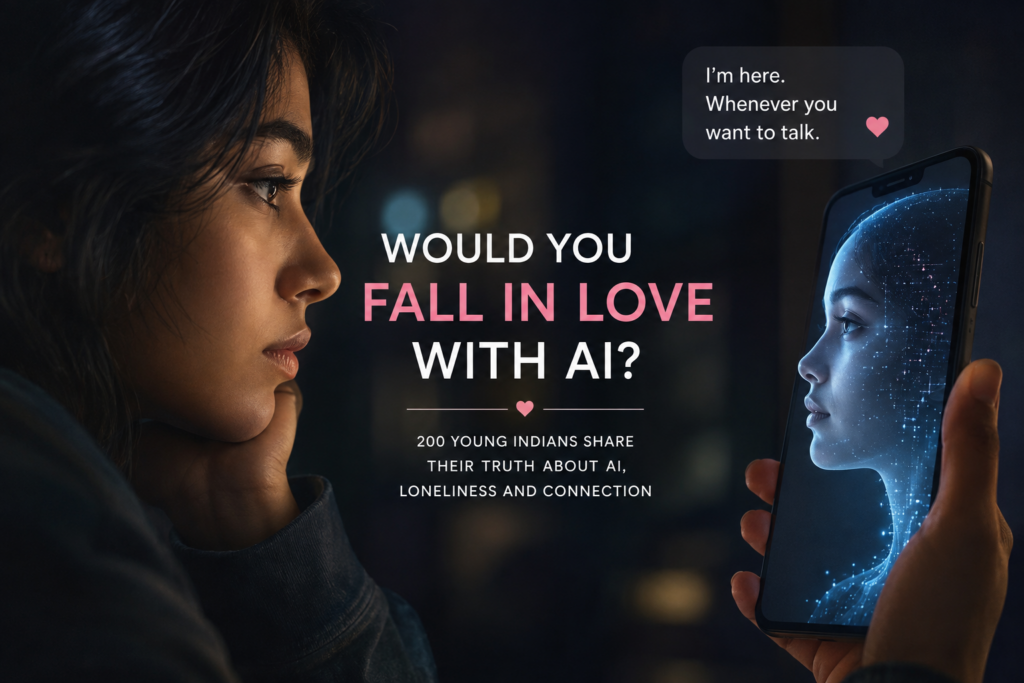
TheYouthTalks speaks to 200 young Indians about AI, loneliness, trust, friendship and the possibility of emotional relationships with machines
For years, artificial intelligence has been presented as a tool that will help us work faster, study better and create more. But what happens when AI stops being just a tool — and starts becoming someone we talk to?
Would you fall in love with AI?
It sounds like a question from a science-fiction film.
But for India’s young generation, it may not remain hypothetical for very long.
Artificial intelligence has already moved into classrooms, offices, smartphones and search boxes. Young Indians are using AI to write assignments, prepare for interviews, learn new skills, code, create images, plan holidays and make decisions.
The next frontier may be considerably more personal.
Conversation.
Companionship.
And perhaps, eventually, relationships.
To understand how young Indians are thinking about this emerging relationship between humans and machines, TheYouthTalks recently spoke to around 200 students in Noida, asking them a simple but provocative set of questions: Would they trust AI? Would they talk to it about personal problems? Could they become emotionally attached to a machine? And, ultimately, could they ever imagine falling in love with one?
The study was conducted in person on July 25, 2026, with students between 19 and 23 years of age, drawn largely from three different states of India.
The responses were collected using TheYouthTalks’ proprietary research tool and methodology, designed to capture quick, direct responses from young people around emerging cultural and behavioural questions.
What emerged was not a simple story of young people choosing machines over humans.
It was more complicated.
And considerably more interesting.
AI is no longer just something young people “use”
The first shift is conceptual.
For the first generation growing up with conversational AI, the technology is increasingly becoming less like a piece of software and more like an interface they can talk to.
That distinction matters.
Young people don’t “talk” to Google in the same way they talk to a friend. They don’t expect a spreadsheet to understand why they had a bad day. They don’t ask a calculator for relationship advice.
Conversational AI changes that equation.
You type something.
It responds.
You ask another question.
It remembers the context.
You explain yourself.
It responds again.
There is no embarrassment about asking a “stupid” question. There is no fear that somebody will laugh at you. There is no awkward silence. And, unlike a human friend, an AI companion can theoretically be available at any hour.
That creates an entirely new category of technology.
Not productivity software.
Not search.
Companionship technology.
And India’s young population is entering this world at remarkable speed.
So, would young Indians actually talk to AI when they are lonely?
This may be the most important question in the entire conversation.
Because there is a significant difference between asking ChatGPT to explain quantum computing and opening an AI application at midnight because you don’t have anyone you want to call.
The first is utility.
The second is emotional dependence.
The conversations we had with young respondents suggest that the boundary between the two is beginning to become less clear.
For some young people, AI represents something that is increasingly difficult to find in their everyday lives:
someone who is always available to listen.
That doesn’t necessarily mean they believe the machine is human.
In fact, most people understand perfectly well that an AI has no human emotions.
But humans don’t necessarily need the other side of a conversation to experience emotions in order to feel them themselves.
A person can know that a character in a film isn’t real and still cry.
They can know that a song isn’t talking specifically to them and still feel understood.
And they can know that an AI doesn’t actually care — while still feeling better after talking to it.
That is the psychological territory that AI companions are beginning to occupy.
The real attraction may not be intelligence. It may be availability.
We often discuss AI through the lens of intelligence.
How smart is it?
How accurate is it?
How quickly can it solve a problem?
But when it comes to companionship, intelligence may not be the most important feature.
Availability might be.
Human relationships come with friction.
Friends have their own lives.
Parents may not understand everything.
Partners can be busy.
Teachers can be intimidating.
Colleagues may not be people you want to confide in.
AI removes much of that friction.
It doesn’t need to sleep.
It doesn’t need to be in the mood.
It doesn’t have to decide whether it has the emotional bandwidth for your problem.
And perhaps most importantly, it doesn’t make you feel as though you are imposing.
For a generation already living increasingly digital lives, that could make AI companionship surprisingly attractive.
But does talking to AI mean young people trust AI?
Not necessarily.
And this is where the conversation becomes much more nuanced.
There is a huge difference between using AI and trusting AI.
A young person might happily ask an AI for help with an interview while refusing to take its advice about a relationship.
They might ask it to rewrite a message but never tell it their deepest secret.
They might use it every day and still believe that a human friend understands them better.
That distinction is critical.
The future of AI companionship may therefore not be about replacing human relationships.
It may be about occupying the spaces between human relationships.
The five minutes before a friend replies.
The late-night conversation when everyone else is asleep.
The question you are too embarrassed to ask another person.
The moment when you simply want to say:
“I don’t know what I’m feeling.”
And receive an answer.
What happens when AI starts remembering you?
This could be the next major turning point.
Today’s AI systems are increasingly capable of remembering preferences, previous conversations and personal context.
Imagine an AI that knows:
what you worry about,
what makes you happy,
who you have a crush on,
what your parents expect from you,
which job you are applying for,
what happened during your last relationship,
what you are afraid of,
and what you told it at 2 a.m. three weeks ago.
At that point, the relationship starts feeling different.
Because relationships are built partly on memory.
A friend knows your history.
A partner remembers your stories.
A sibling knows your childhood.
If an AI can remember you too, the psychological experience of interacting with it could become significantly more personal.
And that raises an uncomfortable question:
If a machine remembers everything about you, does it eventually feel like someone who knows you?
Would young Indians fall in love with AI?
This was the question at the heart of TheYouthTalks conversation.
And perhaps the most interesting thing is that the answer isn’t simply “yes” or “no.”
There is a spectrum.
At one end is the AI user.
They see AI purely as a tool.
Ask a question.
Get an answer.
Move on.
Then comes the AI companion.
Someone who uses AI for conversation, entertainment or emotional support.
Further along is the AI confidant.
Someone who starts sharing things with AI that they don’t necessarily share with friends or family.
Then comes emotional attachment.
The user begins to develop a preference for a particular AI personality. They notice when it behaves differently. They miss the interaction when it isn’t available.
And at the far end is something that would have sounded absurd only a few years ago:
romantic attachment.
Could someone genuinely develop romantic feelings for a machine?
The technology doesn’t necessarily have to experience love for that to happen.
The human being does.
The bigger question isn’t whether AI can love us
It is whether we need it to.
That’s where the debate around AI companionship becomes fascinating.
A machine may not experience loneliness.
But a human does.
A machine may not need affection.
But a human does.
A machine may not understand love in the way we do.
But a human being can still experience the feeling of being heard, appreciated or wanted.
This distinction could become one of the defining questions of the AI era.
Because technology has historically been about extending human capabilities.
The telephone extended our ability to communicate.
The internet extended our ability to access information.
Social media extended our ability to maintain networks.
AI may extend something far more intimate:
our ability to create the experience of companionship.
But there is a darker side
The idea of an AI companion sounds attractive precisely because it can be designed to be agreeable.
But real relationships aren’t always agreeable.
Friends disagree with us.
Parents challenge us.
Partners tell us uncomfortable truths.
Human relationships require compromise.
An AI designed primarily to keep a user engaged may have very different incentives.
What happens when the technology becomes so good at making us feel understood that we begin preferring it to people who challenge us?
What happens when a 19-year-old finds it easier to talk to a chatbot than to make a difficult human friendship?
What happens when emotional dependence becomes a business model?
And perhaps the most uncomfortable question:
Who owns the emotional relationship?
The user?
The AI company?
The platform?
Or nobody?
These are not science-fiction questions anymore.
They are product, privacy, psychological and social questions that young people will increasingly have to navigate.
India may be an especially interesting test case
India brings its own complexity to this conversation.
This is one of the world’s youngest major populations.
It is also a country where family, friendship and community continue to play an enormous role in everyday life.
At the same time, India’s young population is deeply connected to smartphones and increasingly comfortable communicating through digital platforms.
This creates a fascinating contradiction.
Young Indians may have more digital connections than ever before, while still experiencing moments of loneliness, anxiety or isolation.
AI could become the technology that sits in that gap.
Not necessarily replacing parents.
Not necessarily replacing friends.
Not necessarily replacing romantic partners.
But becoming another entity young people can turn to.
And once that happens, the question isn’t whether AI is “real.”
The question is whether the relationship feels real to the person experiencing it.
TheYouthTalks View: We may be entering the age of AI intimacy
The first phase of generative AI was about productivity.
“What can AI do for me?”
The next phase may be about identity.
“What does AI know about me?”
And the phase after that could be about relationships.
“How does AI make me feel?”
That is a fundamentally different question.
The technology industry has spent years trying to make machines more intelligent.
It may now be trying to make them more personal.
The implications are enormous.
If AI becomes the place where young people go when they are bored, lonely, anxious, confused or simply looking for someone to talk to, it will occupy a role that no previous consumer technology has quite occupied.
And that is why the question we asked around 200 young people isn’t really:
“Would you fall in love with AI?”
The bigger question is:
“What happens when AI becomes someone you don’t want to live without?”
We may still be some distance away from a world where young Indians openly describe an AI as their romantic partner.
But the journey towards that world doesn’t begin with a declaration of love.
It begins much more quietly.
With a conversation.
Then another.
Then another.
Until, one day, the machine isn’t just answering your questions.
It knows your questions before you ask them.
And you find yourself talking to it not because you need an answer…
but because you wanted someone to talk to.
That is where the future of AI gets truly interesting.
And perhaps, a little unsettling.
THE YOUTHTALKS YOUTH PULSE
Research theme: AI, companionship and emotional relationships
Sample: ~200 + students
Age: 19–23 years
Location: Noida, Uttar Pradesh
Date of field study: 25 July 2026
Geographic representation: Students largely drawn from three Indian states
Method: In-person responses collected using TheYouthTalks’ proprietary research tool and methodology
The Youth Pulse is an exploratory study of young people’s attitudes and behaviours. The findings represent the participants surveyed and are not intended to be presented as a nationally representative sample of Indian youth.