
For a generation that is increasingly willing to move cities for education and opportunity, finding a place to live is no longer simply a real-estate decision. It is becoming a question of convenience, community, safety and even career.
For generations of Indian families, moving to another city came with a familiar checklist.
Find a flat. Find a landlord. Arrange the furniture. Find domestic help. Figure out food. Pay the electricity bill. And, perhaps most importantly, convince your parents that you will be safe.
For a young Indian moving out at 18, 20 or 25, the opportunity may have been exciting. The logistics rarely were.
But that equation is beginning to change.
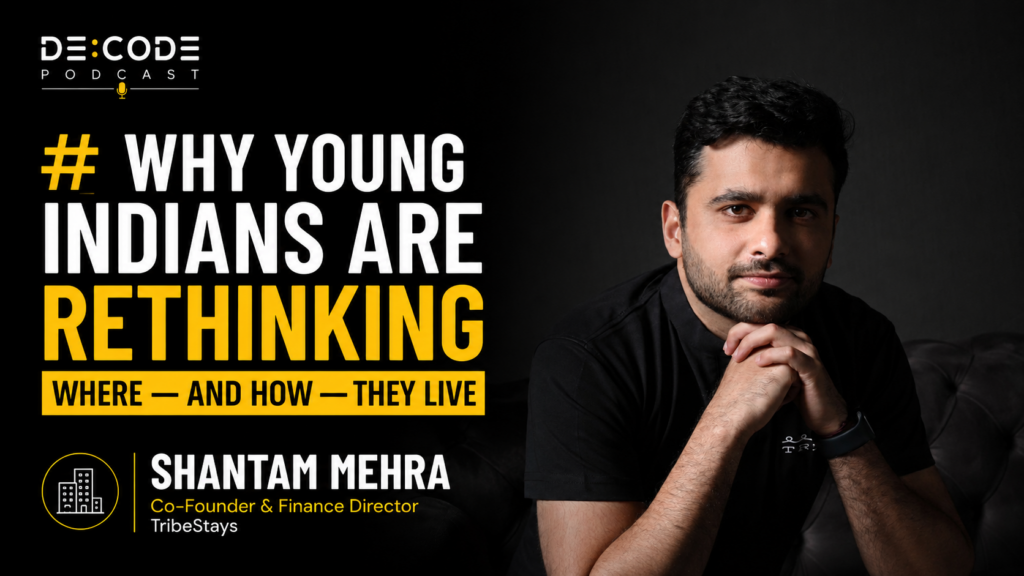
In a recent conversation with Shantam Mehra, Co-founder of TribeStays, we explored a simple but increasingly important question: What does the way young Indians choose where to live tell us about the way they want to live and work?
And the answer may have less to do with real estate — and much more to do with lifestyle.
The end of the “just find a flat” approach?
Shantam makes an interesting distinction between traditional PG accommodation, conventional apartments and what Tribe Stays calls premium managed living.
The proposition is relatively simple: instead of asking a young person who has just moved cities to suddenly become responsible for an entire household, take care of the infrastructure around them.
Depending on the accommodation, that could mean a furnished room or apartment, meals, housekeeping, laundry, Wi-Fi, gym facilities and other services — with residents able to manage several aspects of their stay digitally.
The difference, therefore, isn’t simply the room.
It is the removal of friction.
For a 20-year-old arriving in a new city, the ability to move into a professionally managed space without having to immediately navigate brokers, furniture, domestic help, utility bills and everyday household management can make the decision to move significantly easier.
And that matters because mobility itself is becoming increasingly important.
When a home becomes a career enabler
One of the most interesting ideas to emerge from the conversation was that accommodation may increasingly become part of the career decision.
A young professional choosing between a job in their hometown and a better opportunity in another city isn’t just comparing salaries.
They are comparing the cost and complexity of building a life somewhere else.
If accommodation can reduce that friction, the decision potentially becomes easier.
Shantam believes managed living can eventually become part of a larger ecosystem connecting employment, housing and mobility.
And that raises an interesting question for employers:
Could accommodation eventually become part of the employee value proposition?
Imagine two companies offering similar salaries. One simply offers the job. The other helps a new employee relocate, provides access to managed accommodation and gives them a ready-made community in a new city.
For a young employee arriving alone, that difference could be meaningful.
The workplace may end at the office door. But the employee experience does not necessarily end there.
The premium is not just about luxury
Perhaps one of the more revealing parts of the conversation was Shantam’s observation that young Indians — and particularly families from smaller cities — are increasingly willing to pay for a better living experience.
Tribe Stays operates at a premium compared with conventional PG accommodation. Yet Shantam says a significant part of its occupancy has come from Tier 2 and Tier 3 cities.
That is important.
Because the demand isn’t necessarily about luxury for luxury’s sake.
For many families, particularly those sending their children to another city for higher education, the premium can represent something else: safety, predictability and peace of mind.
The young person gets independence.
The parent gets a safety net.
And the business attempts to sit somewhere in between.
Independence without isolation
There is another paradox at the heart of modern living.
Young Indians are more connected digitally than any previous generation, yet loneliness remains a growing part of the conversation around young people’s lives.
That is where Shantam sees community becoming important.
Tribe’s model isn’t simply about putting several people under one roof. Residents can have their own private spaces while accessing a wider community through shared amenities, activities, clubs and events.
Football. Cricket. Cycling. Travel. Social events.
The philosophy is essentially: give people their personal space, but make community available when they want it.
That distinction is important.
Young people may not necessarily want to live with everyone.
But they may want the option of not living alone.
Safety, especially for young women
The conversation also touched on one of the most complicated realities of young Indians moving cities: safety.
For parents of young women, the decision to send a daughter to another city can involve an additional layer of concern.
Shantam describes additional security measures in Tribe’s student accommodation, including separate floors and security arrangements, as well as technology-enabled emergency support.
But perhaps the larger point is this:
Safety should not become a reason for young women to have fewer opportunities.
If better-managed accommodation can provide an additional safety net, it can potentially make mobility more accessible to young women — and make parents more comfortable with the idea of their daughters building lives away from home.
And then there is technology
For Tribe, technology isn’t simply being used to make a booking.
The company’s longer-term ambition is to make the living experience increasingly serviceable through technology — from booking meals and transport to accessing concierge services, community activities, rooms and other amenities.
But one of the more interesting ideas Shantam discusses is the possibility of technology helping residents build economic and professional communities within the same living ecosystem.
A photographer could find a client.
A web designer could find a startup founder.
A creator could access a studio.
A resident interested in podcasting could potentially access the infrastructure to create one.
In that sense, managed living starts becoming more than accommodation.
It becomes an ecosystem around a person’s life.
From moving cities to choosing how we live
Perhaps the biggest idea from the conversation is that managed living may eventually stop being viewed simply as a solution for people who have moved cities.
Shantam believes the next evolution could be people choosing professionally managed living within the same city.
Not because they cannot afford an apartment.
But because they increasingly value convenience.
Why pay separately for a home, housekeeping, food, gym, laundry, maintenance and a dozen other services — and spend time managing all of them — if a single ecosystem can take care of much of it?
That could represent a significant shift in the way urban India thinks about housing.
The traditional model says:
I rent a home, and I manage my life around it.
The emerging model could say:
I choose a living environment that manages more of my life, so I can spend more time living it.
The bigger question
India is becoming increasingly mobile.
Young people are moving for colleges, jobs and opportunities. Companies are hiring across cities. New business districts and infrastructure are being built outside traditional urban centres. And technology is making it easier to work, travel and live differently.
The question, therefore, may no longer be simply:
“Where will you live?”
It could increasingly become:
“What kind of life do you want your living environment to enable?”
That is the space Tribe Stays is attempting to occupy.
And if Shantam’s prediction is right, the next big change may not be people moving from one city to another.
It may be Indians beginning to rethink what home itself is supposed to mean.
Watch the full conversation
In our conversation with Shantam Mehra, Co-founder of Tribe Stays, we go deeper into the changing expectations of young Indians, premium co-living, safety, technology, loneliness, the future of employee benefits and why managed living could become a much bigger part of India’s urban ecosystem.
Watch the full conversation below:
TheYouthTalks | Conversations shaping the way young India thinks, works and lives.