How Instagram is becoming India’s new storefront — and giving small businesses a radically cheaper way to build brands
There was a time when starting a serious business on the internet meant starting with a website.
You bought a domain. You hired someone to build a site. You photographed your products. You installed an e-commerce system. You figured out payments, analytics, SEO and digital advertising. Then came the harder question: how would anyone actually find you?
For the next generation of entrepreneurs, that sequence is beginning to look strangely old-fashioned.
A young jewellery designer in Jaipur, a home baker in Bengaluru, a thrift seller in Delhi, a ceramic artist in Mumbai or a fashion entrepreneur in Kolkata can now start somewhere very different: Instagram.
The Instagram profile becomes the shop window. Reels become advertising. Comments become reviews. Creators become distribution. Direct messages become the sales desk. WhatsApp becomes customer service. And the audience — rather than a website’s monthly visitors — becomes the business’s most valuable asset.
The website isn’t literally dead.
But the website-first model of building a small consumer business may be.
And India is becoming one of the world’s most interesting laboratories for what comes next.
481 million reasons to pay attention
Start with scale.
According to data derived from Meta’s advertising tools, Instagram had an estimated 481 million people in India’s advertising audience in late 2025. That represented approximately 46.8% of India’s internet user base.
More importantly, Instagram’s potential advertising reach in India increased by 89.5 million people, or 22.9%, between October 2024 and October 2025.
That is not a small incremental shift. It means the addressable audience that marketers can reach on Instagram grew by almost 90 million people in a single year.
The numbers need one important qualification: Meta’s advertising reach figures are not the same thing as monthly or daily active users. They are planning estimates for advertising audiences, and Meta has changed how some of these figures are calculated over time.
But even with that caveat, the scale is difficult to ignore.
Instagram is no longer simply an app where young people post photographs.
It is becoming one of India’s largest attention infrastructures.
And that matters enormously to commerce.
India is moving from search-led commerce to scroll-led discovery
For years, online shopping was fundamentally a search activity.
You knew what you wanted.
You searched Google.
You went to Amazon, Flipkart or a brand website.
You compared products.
You bought.
Social commerce changes the starting point.
You don’t necessarily know what you want.
You see it.
A creator is wearing it.
Someone you follow is talking about it.
A Reel appears in your feed.
You discover a brand you didn’t know existed.
You visit its profile.
You look through its posts.
You read comments.
You check customer reviews.
You send a DM.
You click WhatsApp.
You buy.
The shopping journey starts before the consumer has decided to shop.
That may be Instagram’s biggest commercial advantage.
A February 2026 study from Meta and the Retailers Association of India found that 77% of retail brand and product discovery happens on social media, with Meta’s platforms accounting for 96% of that social discovery in the study. The research also found that 97% of consumers watched short-form video daily.
Another Meta-commissioned study published in 2025 found that almost 8 in 10 Indian shoppers discover products through social media, with 96% of that social discovery occurring on Meta platforms.
The important shift isn’t merely that people are buying through social media.
It is that social media is increasingly deciding what they want to buy in the first place.
Reels is becoming a product-discovery engine
This is where Instagram’s evolution becomes even more interesting.
Meta’s latest India research, conducted with Ipsos, found that 89% of Gen Z respondents engage with Reels daily. The figure was 85% among women and 88% among NCCS A audiences.
Overall, 97% of respondents said they watched video on Meta platforms at least once a day. The urban-rural divide was remarkably narrow: daily video engagement was reported at 98% in urban areas and 94% in rural areas.
That is an extraordinary implication for marketers.
Instagram is not simply reaching India’s metropolitan youth.
It is increasingly participating in a pan-India video economy.
And then comes the commerce data.
Meta says Reels delivers 81% stronger product discovery and 47% greater influence on purchase decisions, compared with other surveyed short-form video platforms and TV respectively. The company also says Reels generates roughly 60% higher creator engagement than other short-form video platforms in its research.
If television once created awareness and e-commerce platforms converted intent, Reels is increasingly sitting somewhere in the middle:
Entertainment → Discovery → Interest → Consideration → Purchase
That is an enormously powerful position.
The small business opportunity is even bigger
But the most interesting consequence of Instagram’s rise may not be its impact on Nike, Coca-Cola or Samsung.
It could be what it does for the smallest businesses.
India has more than 60 million small businesses, according to Meta, and the company says 92% of businesses using Meta platforms in India are MSMEs.
Think about what this means.
For a small entrepreneur, building a traditional e-commerce operation can be expensive and complicated.
There is the website.
Then the catalogue.
Then product photography.
Then SEO.
Then performance marketing.
Then analytics.
Then customer acquisition.
Then retention.
Then CRM.
And after doing all of that, there is still the fundamental problem:
Where do the customers come from?
Instagram attacks the problem from the other direction.
The audience already exists.
The entrepreneur’s job is to create something worth discovering.
That changes the economics of starting a business.
A small brand can begin with a phone, a product, a personality and a few good videos.
It doesn’t have to wait until it can afford to look like a large company.
It can build the audience first.
And that is profoundly democratising.
The Instagram-native entrepreneur
This is perhaps the most interesting new business archetype emerging from the platform.
Call them the Instagram-native entrepreneur.
They don’t necessarily think:
“I need to build a website and then find customers.”
They think:
“I need to build a community and then give that community something to buy.”
Their business architecture looks very different.
Reel = advertising
Profile = storefront
Posts = catalogue
Comments = social proof
Creators = distribution
DM = sales desk
WhatsApp = customer relationship
UPI = payment
Customer repost = referral
And suddenly, the distinction between marketing and commerce starts disappearing.
That may be Instagram’s most important innovation.
The advertisement can also be the product demonstration.
The product demonstration can also be entertainment.
The entertainment can also create discovery.
And the discovery can lead directly to a sale.
The website still matters — but its job is changing
This is where the “website is dead” argument needs some nuance.
Websites aren’t going away.
For larger businesses, they remain essential for transactions, SEO, first-party data, customer accounts, enterprise credibility, detailed catalogues and many other functions.
But the website may no longer be the front door of a consumer brand.
For many young businesses, Instagram may be the front door.
The website becomes the place the customer visits later, once trust and interest already exist.
That is a significant reversal.
For the first generation of digital entrepreneurs, the formula was:
Website → traffic → audience → customers
For the Instagram-native entrepreneur, it can be:
Content → audience → community → customers → website
The difference is subtle but economically important.
The business isn’t starting by buying attention.
It is trying to earn attention first.
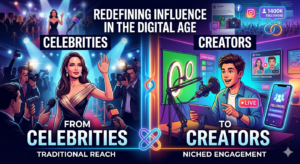
And this is where creators change everything
Instagram has also turned distribution into something that small businesses can borrow.
A young jewellery company doesn’t need a national television campaign.
It may need 20 creators who genuinely like the product.
A fashion brand doesn’t necessarily need a celebrity endorsement.
It might need a hundred people whose followers trust their taste.
This is why the creator economy and social commerce are becoming inseparable.
Meta’s India research has found that creators, short-form video and messaging are reshaping product discovery and purchase behaviour. Its retail research also points to the growing role of micro- and nano-creators in trust and consideration.
The result is a fascinating redistribution of marketing power.
The traditional advertising model said:
Big brand → Big budget → Big media → Big audience
The social-commerce model increasingly allows:
Small brand → Strong content → Relevant creator → Niche audience → Community → Commerce
The second model doesn’t eliminate the first.
But it gives the small player a fighting chance.
Instagram is beginning to look less like social media and more like media
There is another reason this matters.
Instagram is increasingly competing for the role traditionally occupied by media companies.
People don’t only go there to follow friends.
They go there for:
News.
Entertainment.
Fashion.
Sports.
Beauty.
Food.
Travel.
Reviews.
Creators.
Shopping inspiration.
Culture.
Meta itself says Instagram had reached 3 billion monthly active users globally by September 2025, while Reels were being reshared more than 4.5 billion times every day across Meta platforms.
In India, the significance of Instagram’s 481-million-person advertising audience is therefore not merely a social-media statistic.
It is a media statistic.
A platform that can reach hundreds of millions of people, influence what they discover, host creators, distribute entertainment, carry advertising and increasingly influence purchase decisions is no longer easily categorised as “social.”
It is becoming a media-and-commerce ecosystem.
And India may be the perfect market for this model
India has several characteristics that make the Instagram-native business particularly powerful.
A massive small-business economy.
A young population.
Extremely high mobile usage.
Affordable data.
UPI.
WhatsApp.
Creators.
Short-form video.
Regional-language content.
And a rapidly expanding digital consumer base beyond the largest metros.
Instagram’s recent expansion of Reels translation into Bengali, Tamil, Telugu, Kannada and Marathi is another indication of how important India’s linguistic diversity has become to the platform’s growth strategy.
This matters because the next great Instagram business may not come from Mumbai, Delhi or Bengaluru.
It could come from a Tier 2 city.
A home chef.
A local fashion label.
A regional beauty entrepreneur.
A ceramic artist.
A thrift seller.
A small-town jewellery maker.
The platform can potentially take a product that was once limited to a neighbourhood and put it in front of a national audience.
That is not just social media growth.
That is market access.
The new question for marketers
For the advertising industry, this creates a much bigger question.
For decades, brands separated their marketing funnel into distinct stages:
Awareness.
Consideration.
Conversion.
Instagram is increasingly blurring those boundaries.
A person watches a Reel.
Discovers a product.
Sees a creator using it.
Reads comments.
Visits the brand.
Sends a message.
And buys.
The entire journey can happen around one platform ecosystem.
So perhaps the next question isn’t:
“How much should brands spend on Instagram?”
It is:
“What happens when the advertisement becomes the storefront?”
That is a much bigger question.
The next generation may build audiences before they build websites
For India’s entrepreneurs, the implications are enormous.
The internet’s first generation taught businesses to build websites.
The second generation taught them to buy digital advertising.
The next generation may learn to build audiences.
And that changes who gets to participate.
You no longer necessarily need a huge marketing budget to be discovered.
You need something people want to discover.
You need a product.
You need a point of view.
You need content.
You need consistency.
And you need a community willing to tell other people about you.
The website will survive.
E-commerce platforms will survive.
Marketplaces will survive.
But the idea that every serious digital business needs to begin with a website may already belong to another era.
The storefront of the future may not be a URL.
It may be a profile.
And in India, that storefront is increasingly looking like Instagram.
THE WEBSITE IS DEAD.
LONG LIVE INSTAGRAM.