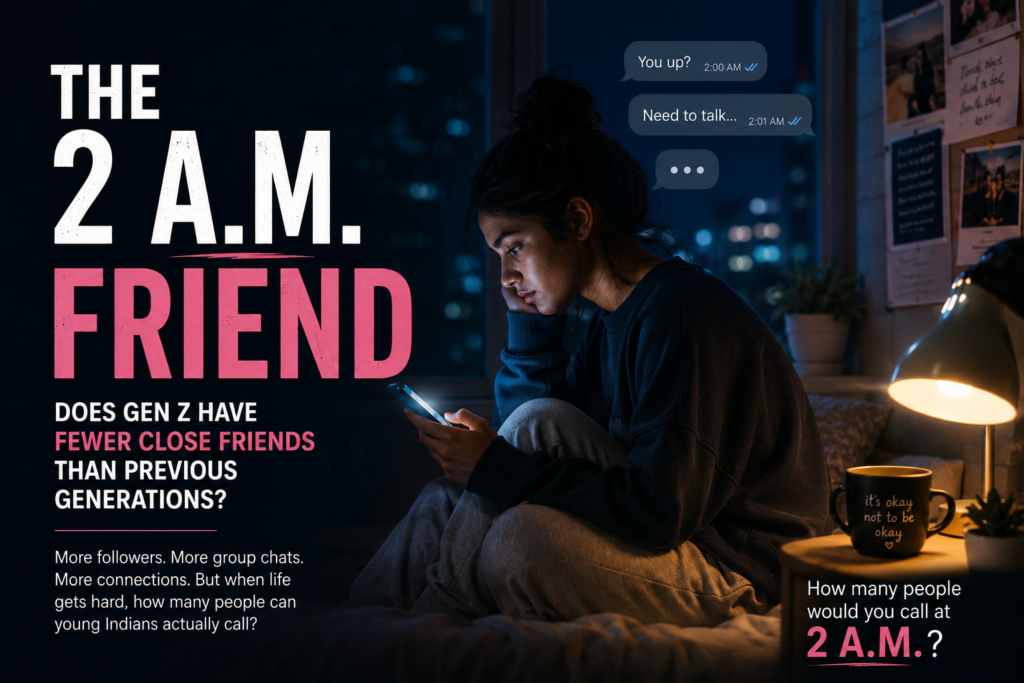
Young Indians have more ways to connect than any generation before them. But when life gets difficult, how many people can they actually call? The answer may reveal something bigger about the changing nature of friendship.
You probably have more friends than your parents did at your age.
Your phone certainly thinks you do.
There are Instagram followers, WhatsApp groups, college friends, school friends, gaming friends, work friends, people you met on a trip, people you haven’t spoken to in two years but still follow, and perhaps a few hundred names sitting quietly in your contacts.
You are, technically, connected to a lot of people.
But here’s a different question.
If something went seriously wrong tonight, how many people would you call?
Not text.
Not post a story hoping someone notices.
Not send a meme.
Actually call.
At 2 a.m.
Maybe the answer is three.
Perhaps two.
Maybe just one.
For some young people, it may be nobody.
And that distinction — between the number of people we are connected to and the number of people we feel genuinely close to — could be one of the defining social questions of the Gen Z era.
The question, then, isn’t necessarily whether young Indians have fewer friends than previous generations.
It is whether friendship itself is changing.
We have never had more ways to stay connected
The paradox is hard to miss.
Technology has made maintaining friendships extraordinarily easy.
A friend can move from Delhi to Bengaluru and still remain a daily presence in your life. A college group can continue on WhatsApp long after graduation. Someone you met while travelling can become a regular part of your Instagram feed. Gaming communities can turn strangers into friends without the two people ever living in the same city.
Young people don’t have to be physically together to interact.
And that isn’t necessarily a bad thing.
Research from the Pew Research Center illustrates just how positively many teenagers view the social side of technology. In a 2024 survey of U.S. teenagers, 74% said social media made them feel more connected to what was happening in their friends’ lives, while 52% said social media made them feel as though they had people who could support them during difficult times.
The latest Pew research, published in 2026, similarly finds that teenagers commonly use platforms such as Instagram, Snapchat and TikTok to keep in touch with friends and family and connect with people who share their interests.
So the familiar argument that “social media has destroyed friendship” is too simplistic.
For many young people, social media is friendship infrastructure.
It keeps people in touch.
It creates communities.
It helps friendships survive distance.
It can even help people find others who share interests they may struggle to find offline.
But there is another side to the story.
Being able to see what your friends are doing isn’t necessarily the same as feeling that you can rely on them.
The 2 A.M. test
Perhaps the simplest way to understand modern friendship is to forget followers, likes and group chats for a moment.
Ask:
Who would you call at 2 a.m.?
The World Happiness Report 2025 offers some striking evidence that this question matters.
Using Gallup World Poll data covering more than 661,000 observations across 168 countries between 2006 and 2023, researchers found that 19% of young adults globally reported having no one they could count on for social support in 2023.
That’s up 39% compared with 2006.
The researchers also found that each year, roughly 0.1% more young adults reported having nobody they could count on — which translates into around 1.7 million additional young people globally each year reporting that they have no reliable source of social support.
That is not the same as saying young people have no friends.
It is a much more subtle problem.
They may know people. They may interact with people. They may even have large social networks. But some are increasingly unsure about who they can actually depend on.
That is the difference between connection and support.
And it may be the most important distinction in the entire friendship conversation.
The surprising Indian story
Here’s where the story becomes particularly interesting for India.
It would be easy to assume that India is simply following a global trajectory towards greater loneliness and social disconnection.
But the latest World Happiness Report data doesn’t quite support that conclusion.
India was actually one of the countries that buck the broader global trend.
In its analysis of 22 countries and regions, the World Happiness Report found that the quality of social connection among young adults declined in many places between 2006 and 2023. But India, Mexico and Egypt showed significant increases in the quality of social connection among young adults during that period.
That is an important finding.
It means we should be careful about importing a Western narrative of a universal “lonely Gen Z” into India.
India has a very different social architecture.
Families are often geographically closer.
Young adults may continue living with parents much longer.
College and workplace communities can be dense.
Neighbourhoods, extended families and community networks remain important.
And yet, India’s young people are also living through extraordinary social change.
They are moving cities for education and employment.
They are spending more time online.
They are building friendships across digital communities.
They are forming relationships outside traditional social structures.
They are also becoming increasingly comfortable with solitude and independence.
So perhaps India isn’t experiencing a straightforward friendship recession.
Perhaps it is experiencing a friendship transition.
From the “best friend” to the friendship portfolio
Think about the way friendship worked for many previous generations.
There was often a relatively clear hierarchy.
Your school friends.
Your neighbourhood friends.
Your college friends.
And somewhere inside that group:
your best friend.
Today, Gen Z friendship can be much more fragmented.
One person might be the friend you call when you are emotionally overwhelmed.
Another might be the person you discuss career decisions with.
Someone else might be your gaming partner.
Another might be the person you travel with.
There could be a school friend you haven’t seen in months but still consider family.
And then there are online friends who may know an astonishing amount about your personality without ever having met you.
Friendship has become less like a single circle and more like a portfolio.
Different people occupy different emotional spaces.
This isn’t necessarily evidence that relationships have become shallower.
It could simply mean they have become more specialised.
But specialisation can have a downside
The problem comes when every relationship fulfils only one narrow function.
You have someone to joke with.
Someone to party with.
Someone to study with.
Someone to collaborate with.
Someone to game with.
Someone to exchange reels with.
But who knows when you’re struggling?
Who knows what you’re afraid of?
Who knows what happened in your relationship?
Who can tell from your voice that something is wrong?
Who can sit silently beside you without needing entertainment?
These are different kinds of intimacy.
And they are harder to manufacture digitally.
The World Health Organization’s 2025 Commission on Social Connection makes precisely this distinction. It defines social connection not simply by the number of relationships someone has, but by their structure, function and quality— including whether relationships provide meaningful support and whether interactions are positive or strained.
That is why counting friends may be the wrong metric.
The better question is:
What do those friendships actually do for you?
The friendship gender gap may matter too
There is another layer that deserves attention, particularly when we talk about young men.
Research from Pew’s 2025 study of U.S. teenagers found that 89% of teens with at least one close friend said they had a friend they could turn to for emotional support.
But there was a gender difference.
Among girls, 95% said they had a close friend they could turn to for emotional support.
Among boys, the number was 85%.
The difference is only ten percentage points, but it points towards a broader cultural issue.
Boys may have friends.
They may spend enormous amounts of time together.
They may play sport, game, travel, joke and hang out together.
But that doesn’t necessarily mean they have relationships in which vulnerability feels easy.
A friendship can be extremely active and still emotionally quiet.
That matters in India too, where young men are often socialised to be self-reliant and emotionally restrained.
The stereotypical male friendship may be built around doing things together rather than talking about how you feel.
There is nothing inherently wrong with that.
But when a crisis arrives, the difference becomes significant.
Social media isn’t killing friendship. It is changing it.
This is perhaps where the conversation needs more nuance.
The evidence doesn’t support a simple “social media bad, real friendship good” conclusion.
In fact, Pew’s recent research shows that teenagers are more likely to say social media helps their friendships than harms them: 30% said social media helps their friendships, compared with 7% who said it hurts them.
At the same time, there are warning signs.
The percentage of teens saying social media makes them feel they have people who can support them through tough times fell from 67% in 2022 to 52% in 2024.
So technology can simultaneously make friendship easier and emotional connection harder.
That sounds contradictory.
It isn’t.
You can be updated on someone’s life without being close to them.
You can respond to someone’s Story without asking how they’re actually doing.
You can send someone a birthday message without having spoken to them in six months.
You can be surrounded by notifications and still feel socially undernourished.
Connection is not the same thing as intimacy.
India has another advantage: physical proximity
There is a reason the Indian story may ultimately look different.
The World Happiness Report’s data suggests that India’s young adults have bucked the global decline in the quality of social connection.
One possible explanation is the country’s unusually dense social fabric.
Indian young adults may complain about parents being intrusive, relatives asking too many questions or never getting enough privacy.
But those same structures can provide something that increasingly independent young adults elsewhere may struggle to find:
a ready-made social network.
You may have parents.
Grandparents.
Cousins.
Siblings.
Neighbours.
School friends.
College friends.
Family friends.
Work colleagues.
Even when individual relationships aren’t particularly close, the network itself can create a sense that there are people around.
That is a valuable form of social capital.
And it may partly explain why India’s trajectory doesn’t neatly match the most pessimistic Western narratives about Gen Z loneliness.
But adulthood changes the rules
There is a catch.
College is perhaps the last stage of life when friendship happens almost automatically.
You see the same people every day.
You share classes.
You eat together.
You complain about professors.
You prepare for exams.
You go out after class.
You attend events.
You don’t have to schedule friendship.
Then adulthood arrives.
People move.
Jobs become demanding.
Relationships take priority.
Some friends get married.
Others go abroad.
Someone moves to Bengaluru.
Someone else to Mumbai.
Another takes a job in Dubai.
The WhatsApp group survives.
The friendship may not.
This is why young adulthood is such a critical period for social connection.
The World Happiness Report notes that early friendships formed during university can have lasting effects on wellbeing. In one longitudinal study discussed in the report, each additional friendship formed during the early weeks of college was associated with a 17% greater likelihood of moving towards an improving wellbeing trajectory, while losing a friendship increased the likelihood of a worsening trajectory by 19%.
Friendship isn’t just a pleasant side effect of growing up.
It can shape how people experience growing up.
So, do young Indians have fewer close friends?
We don’t actually know.
And that may be the most honest answer.
There isn’t enough nationally representative Indian evidence to confidently declare that Gen Z has fewer close friends than previous generations.
But there is enough evidence to ask a much more compelling question.
Young people globally are reporting changes in the quality and reliability of their social connections. The World Health Organization estimates that roughly one in six people worldwide experiences loneliness, with young people among the groups reporting the highest rates; around 21% of young people report loneliness.
At the same time, young people can have extensive social networks.
And in India, the available cross-national evidence suggests that young adults’ social connection may actually have strengthened over the period studied.
So perhaps the story isn’t:
“Gen Z has fewer friends.”
It may be:
“Gen Z is redefining what a friend is.”
The 2 A.M. Friend is still different
There is something almost old-fashioned about the idea of the 2 a.m. friend.
It isn’t about followers.
It isn’t about likes.
It isn’t about maintaining a 300-day Snapchat streak.
It isn’t even necessarily about seeing each other every week.
It is about knowing that when life becomes difficult, someone will answer.
That kind of friendship takes time.
It requires repetition.
Shared experiences.
Vulnerability.
Forgiveness.
Reliability.
And occasionally, uncomfortable conversations.
It cannot be fully automated.
It cannot be measured by follower counts.
And it certainly cannot be replaced by a blue tick.
TheYouthTalks Take: Maybe we don’t need more friends. Maybe we need deeper ones.
The internet has given Gen Z something previous generations didn’t have: the ability to maintain hundreds of weak ties with almost no effort.
That’s a remarkable social advantage.
A person in Delhi can remain close to someone in Kochi, Toronto or Singapore.
A niche interest that once had five people in an entire college can now connect thousands of people online.
A teenager who feels like an outsider in their physical environment can find an entire community somewhere else.
These are extraordinary possibilities.
But the abundance of connections creates a new challenge.
Which ones deserve our time?
Perhaps the next generation of friendship isn’t about collecting more people.
It is about becoming better at recognising the few relationships worth investing in.
The friend who notices you’ve gone quiet.
The one who remembers the interview you were nervous about.
The person who doesn’t just like your holiday photograph but calls when you’re having a terrible day.
The friend you can sit with without performing.
The person you can disagree with and still trust.
And, yes, the person who picks up at 2 a.m.
Because perhaps that is the real measure of friendship.
Not:
How many people know you?
But:
How many people would notice if you weren’t okay?
Gen Z may not have fewer friends.
It may simply be the first generation forced to confront the difference between being socially connected and actually being socially close.
And that difference could define the future of friendship in India.